Exporting to Domestic Sales: The Chinese-style Outbound Journey of an AI Short Film

marsbitPubblicato 2026-05-14Pubblicato ultima volta 2026-05-14

Introduzione

From Export to Domestic Boom: The Chinese-Style Overseas Journey of an AI Short Film The story begins with PJ Ace, a prominent Hollywood AI filmmaker, launching a public search on X for the creator of a stunning AI-generated short film titled "Zombie Scavenger." The film, featuring a robot cowboy in a post-apocalyptic wasteland, impressed Ace with its quality, which he estimated would have cost $500,000 and six months pre-AI. The trail led back to China. The creator, Mx-Shell, is a self-described amateur from China with a photography and music background. Using ByteDance's AI video tool, Seedance 2.0, he independently produced the short in about ten days for a minimal cost. Ironically, while the film went viral overseas after Ace's endorsement, it initially gained little traction on Chinese platforms like Bilibili. This sparked a "cross-server" search. Ace posted in English on X, while Mx-Shell, who doesn't speak English, posted his QQ email in Chinese comment sections. With netizens' help, they connected. Ace extended an invitation, asking if Mx-Shell was interested in becoming a Hollywood director. The article highlights this as a case of "talent export" or "brilliance going overseas." A creator in China, using domestic AI tools and computing power, captured global attention first. This "export-to-domestic-sales" path succeeded due to China's competitive, low-cost AI video tool market and its vast pool of untapped creative talent. Mx-Shell's success underscores that AI...

Author: David, Shenchao TechFlow

Hollywood is searching the internet for a Chinese person. But the person being sought didn't even leave a usable contact method.

On the evening of May 10th, PJ Ace, the founder of the Los Angeles-based AI film studio Genre.ai, reposted an AI short film called "Zombie Sweeper" on X. PJ Ace is probably one of the most influential figures in the AI video circle, with his own content garnering over 300 million views across platforms.

His evaluation of this film was extremely high, calling it "one of the best short films I've seen in recent years."

The premise of the short film is roughly this: a robot cowboy rides an ostrich through a post-apocalyptic wasteland, battles zombies, and has a love affair with a plastic mannequin. Besides having a sufficiently cyberpunk and fantastical theme, the visuals and music also possess a blockbuster quality.

(Viewers who haven't seen it can click here to get a feel for it.)

Within a few hours of PJ's post going live, its views had already reached 5 million.
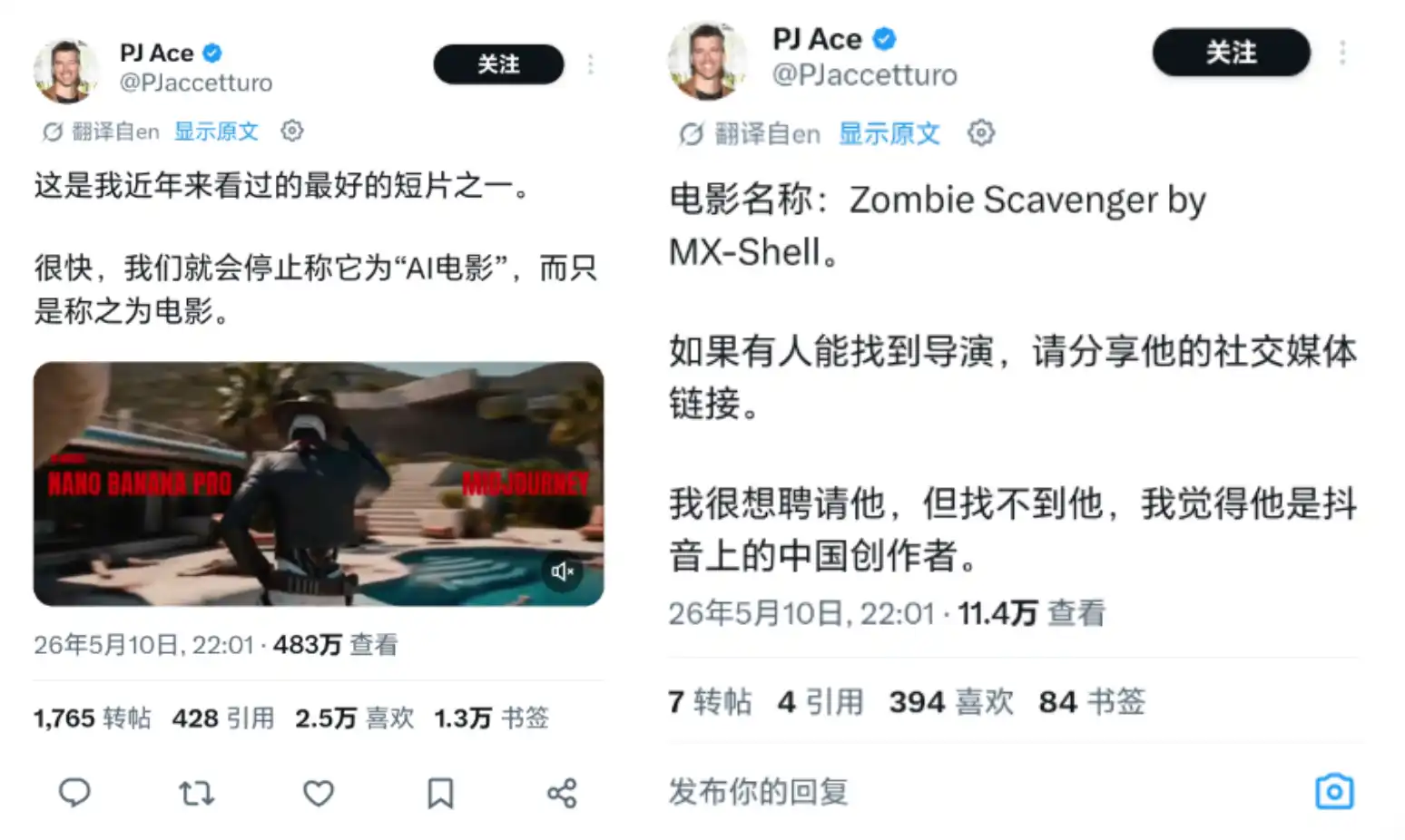
He then followed up with a search post: "I really want to hire the director of this film, but I can't find him. I think he's a Chinese creator on Douyin."

A person holding Hollywood content production resources is posting a lost-and-found notice on Twitter to find a Chinese person? The author finds this scenario even more surreal than the short film itself...

His reasoning was that before AI, something of this quality would have cost at least $500,000 and 6 months, yet this creator achieved this level with just his own efforts. So, the comments quickly turned into a search party. Some searched for the author ID 'MX-Shell', others traced clues back to Bilibili.

A large-scale cross-platform search, stretching from Hollywood to Bilibili's comment section, had just begun.

However, on the same day PJ Ace was anxiously posting missing person notices on Twitter, this short film hadn't caused much of a stir on Bilibili and Douyin, lying quietly in the information feed.

A short film made by a Chinese person using Chinese AI tools had to first circle around to the other side of the Pacific, become popular there, and then be seen by its own people. The process of this large-scale cross-platform search making its way back to China itself became an "export to domestic sales" phenomenon.

Letting the Hobby Be Seen

The person PJ Ace is looking for has labeled himself on Bilibili with five characters: Amateur Enthusiast.

The author, Mx-Shell, claims in the comments to be from Yunnan, graduated from a technical secondary school, never attended university, and never worked for any film company. The description on his Bilibili profile, 'Non-professional amateur enthusiast', seems sincerely humble rather than mere self-deprecation.

Reportedly, "Zombie Sweeper" was made by him using ByteDance's AI video tool Seedance 2.0. One person, no team, no investment, independently completed from conception to final cut, even the background music was self-produced.

The production cycle was about 10 days, with the token cost equivalent to roughly 3,000 RMB.

And then came the part the author finds most fascinating in the whole incident.

PJ Ace's search post was seen by millions on X, but Mx-Shell himself couldn't see it at all, unaware that a Hollywood director across the Pacific was looking for him.

When the news eventually made its way back to China, the comments under the video exploded, but Mx-Shell himself neither understood English nor had channels to connect with overseas media. He even posted his QQ email, asking netizens to help forward it to the other side.


Hollywood was looking for him in English on Twitter, and he was looking for Hollywood in the Bilibili comment section with a QQ email. This cross-platform conversation had a happy ending thanks to the matchmaking efforts of netizens.

Currently, PJ has already emailed him. In the letter, PJ Ace said he runs a film studio in Los Angeles, the short film got over 4 million views the day it was shared, and then asked: Are you interested in becoming a Hollywood director?

An amateur enthusiast received an olive branch extended by Hollywood. This is perhaps another wonderful and serendipitous instance of talent discovery in the AI era.

Talent Going Outbound, Export to Domestic Sales

Let's talk about why this film was quiet on Bilibili at first but exploded when posted on X.

On Bilibili, a short film labeled 'Contains AI-generated content' has to compete for the same information feed with professional animations from million-follower UP owners, gameplay streams, and popular fan-made content. Mx-Shell had only a few thousand followers at the time, no recommendation spots—a grain of sand falling into a desert.

X is a completely different world. The overseas AI creator community has developed its own ecosystem over the past two years, with key opinion leaders, consensus on evaluation, and mature dissemination networks.

PJ Ace is a core node in this ecosystem. When he saw "Zombie Sweeper," he saw the work itself; AI was just the tool. The fan base spread it through relay, igniting the content within hours.

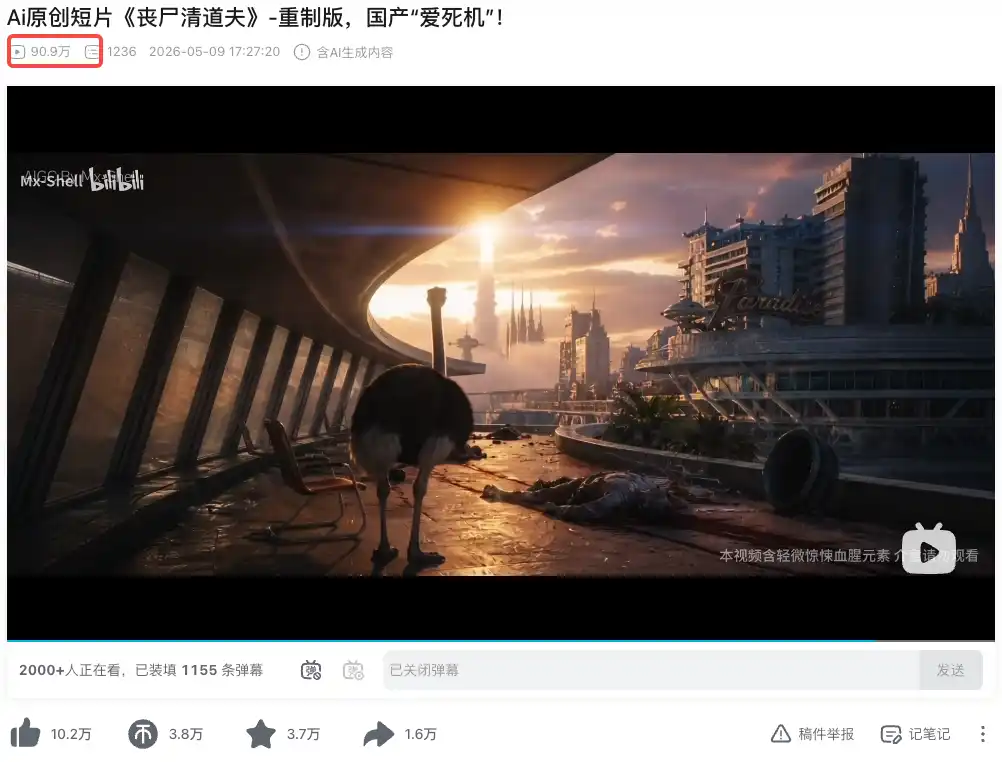
The subsequent data backflow also illustrates this point. Domestic viewers recognized its merit as well, with Bilibili garnering over 900,000 views and 100,000 likes. Content has never been the primary problem in the AI era; the problem is whether it gets delivered to the right audience.
This reminds the author of a similar phenomenon: Token outbound.

Chinese large language models sell computing power to the world via APIs. The electricity never leaves China's power grid, but value is delivered cross-border via tokens. Mx-Shell's story is the creative version of the same logic. Talent and aesthetics never left his computer, but the work, through a short film, also completed cross-border delivery. Seedance is ByteDance's, the computing power is from Chinese data centers, the creator is from Yunnan, and the first large-scale audience was across the Pacific.

If token outbound is electricity outbound, then "Zombie Sweeper" is talent outbound.

Why is this path being paved starting from China? Probably because China simultaneously possesses two things. The world's most fiercely competitive AI video tool market, where ByteDance, Alibaba, and Kuaishou are stepping on each other's toes, driving generation costs to the floor. The Seedance 2.0 used by Mx-Shell has relatively low spending costs.

And a large number of creative people who previously had no outlet—people with aesthetic sense and ideas, lacking only a handy tool.

The former gave the latter a key. Once the door was pushed open, the global market was on the other side.

AI is a Good Shovel, But You Have to Dig Yourself

The story isn't over yet.

After Mx-Shell connected with PJ Ace, he posted a lengthy article responding to the public attention. Thirteen points, each one substantial. The author thinks this text itself is worth a careful read.

He said the style of "Zombie Sweeper" is called Atom Punk, a form of retro-futurism. The creative inspiration came from Pixar's "WALL-E" and was made according to the standards of the popular Netflix series "Love, Death & Robots."

One of the creative intents was to let overseas audiences see the current level of domestic AI production.

Shot control relies on prompts, which were basically crafted by hand. Post-production was done by one person. Even the background music was original. Looking at these details together, you realize Mx-Shell is definitely not just someone who "got lucky with AI tools."

He has visual aesthetics, being a photographer by background. He has auditory aesthetics, being an independent musician. He has a sense for narrative, setting his own bar according to Love, Death & Robots standards.

AI tools gave him productivity, but the aesthetics and judgment are his own.

So, the author feels the saying "AI lets everyone make movies" is only half right. AI has indeed lowered the production barrier to the floor, but computing power can be bought; aesthetics cannot.

Anyone can use Seedance 2.0, so why was it specifically Mx-Shell who created something that made Hollywood post a search notice? The tools are equal, but the people using them are vastly different.

This leads to another interesting angle.

The investment ByteDance has put into Seedance 2.0 is unknown to the outside world, but so far, the best advertisement for this tool might have been made by a technical secondary school graduate from Yunnan.

ByteDance's marketing department couldn't have planned such a story because the story's persuasive power lies precisely in it being spontaneous, grassroots, and unexpected.

The strongest proof for a platform product is always users creating things that exceed the platform's expectations. Taobao's early benchmark stories were rural women earning millions selling local specialties; YouTube's benchmark was teenagers in bedrooms making shows better than TV. Seedance 2.0's benchmark story is more creators like Mx-Shell.

According to DataEye data, the overseas AI short drama and webtoon market size is expected to reach $650 million in 2026, a sixfold year-on-year increase. Currently, two paths are running in this market:

One is the industrial route. Domestic teams mass-produce AI short dramas—zombies, werewolves, rags-to-riches stories—packaged into genre shells familiar to Western audiences, monetized through TikTok ad buys. Reports indicate multiple works have already achieved tens of millions of views. This path competes on capital, team, and production capacity, somewhat like the short video factories of the past.

The other is the path Mx-Shell took. One person, one computer, no ad buys, no scale. The content itself is the driving force for dissemination. A few thousand RMB in token cost, less than two weeks in cycle, exchanged not for platform revenue share, but for Hollywood actively reaching out.

Both paths can succeed, but the author finds the second path more noteworthy.

Because the barrier to the first path is money. If you have money, you can do it; it doesn't have much to do with the individual creator. The barrier to the second path is the person—the aesthetics, the judgment of content. These things AI cannot give you, and money cannot buy them.

He won't be the last to walk this path.

China has a large number of creators with aesthetic sense, ideas, and a desire to express. Previously, what stood in their way was equipment, funds, teams, education. Now, these barriers are being dismantled one by one by AI tools. The only remaining question is: how to be seen?

Mx-Shell's answer was a QQ email and a group of enthusiastic netizens. The next person might have a different method.

But before a truly developed domestic ecosystem for AI creation grows, this detour of export to domestic sales will probably have to be taken a while longer.


Domande pertinenti

QWho is looking for the Chinese creator of the AI short film 'Zombie Scavenger', and why is it significant?

APJ Ace, the founder of the Hollywood AI film studio Genre.ai, is searching for the creator because he believes the short film is one of the best he's seen in recent years. This is significant as it represents a top Hollywood professional actively seeking out and offering opportunities to an unknown, self-taught creator from China, highlighting how AI is democratizing creative recognition.

QWhat key details about the creator Mx-Shell and the film's production are mentioned in the article?

AThe creator, Mx-Shell, is a self-described amateur from Yunnan with a technical secondary school education and no formal film training or industry experience. He produced 'Zombie Scavenger' independently in about 10 days using ByteDance's AI tool Seedance 2.0, with a cost of approximately 3000 RMB (in tokens). He handled the concept, visuals, and even composed the original soundtrack himself.

QAccording to the article, what are the two different paths emerging for Chinese AI short film creators targeting the overseas market?

AThe two paths are: 1) An industrialized route, where domestic teams mass-produce AI short dramas (e.g., zombie, werewolf, revenge stories) tailored for Western audiences, relying on TikTok advertising for monetization. 2) An individual creator path, exemplified by Mx-Shell, where a single person uses AI tools to create high-quality, original content that gains traction through its own artistic merit, leading to opportunities like the one from Hollywood.

QWhy did the short film initially gain massive attention on X (Twitter) but not on Bilibili?

AOn Bilibili, the film was buried in a vast information stream competing with content from established creators. On X, it was discovered and shared by PJ Ace, a key influencer within the established overseas AI creator community. His endorsement triggered a network effect, rapidly amplifying the film's visibility to millions, demonstrating the power of niche, connected communities versus broad, saturated platforms.

QWhat does the article suggest is the 'real barrier' for creators in the AI era, and what role does AI play?

AThe article suggests that the real, lasting barrier is not access to tools or capital (which AI has dramatically lowered), but the creator's inherent aesthetic sense, judgment, and narrative ability—qualities that AI cannot provide. AI acts as a powerful 'shovel' that removes production hurdles, but the 'treasure'—the valuable, standout content—must be unearthed by the creator's own vision and taste.

Letture associate

After Three Consecutive Quarters of Decline, Can the Crypto Market Find a Window for Stabilization in Q3?

The cryptocurrency market has just concluded its worst-performing quarter since 2022, with total capitalization dropping 12.6% to $2.1 trillion. All core metrics indicate capital is leaving the sector, not just rotating within it. Bitcoin fell 14.2% and Ethereum dropped 25.4% in Q2, breaking their previous correlation with US tech stocks. A key driver is the reversal in US spot Bitcoin ETF flows, which saw a net outflow of approximately $4.67 billion in Q2, including a record monthly outflow near $4.5 billion in June. While recent data suggests long-term holders are accumulating again, sustained ETF outflows mean continued selling pressure. Market focus is now singularly on the Federal Reserve. The upcoming July FOMC meeting is seen as the most critical event for Q3. A dovish signal could support Bitcoin reclaiming a $68,000-$84,000 range, while a hawkish stance might establish a new trading band around $50,000-$56,000. Additionally, regulatory uncertainty persists, with the progress of the crucial *CLARITY Act* stalling in the Senate, reducing its perceived 2026 passage probability to 40-45%. Despite the broad downturn, a few sectors showed growth. Prediction markets saw nominal volume surge 48.7% year-over-year to $113.8 billion, and tokenized collectibles transaction volume rose 143% quarterly to $1.4 billion. The Real-World Asset (RWA) tokenization sector also continued steady growth, now representing ~$28.1 billion in on-chain value. The market's foundation for an extreme crash appears limited, with Bitcoin price hovering near its 200-week moving average. However, the trading paradigm has shifted from narrative-driven speculation to decisions based on price action, policy developments, and interest rate expectations, making a broad sentiment-driven rally unlikely in the near term.

marsbit16 h fa

After Three Consecutive Quarters of Decline, Can the Crypto Market Find a Window for Stabilization in Q3?

marsbit16 h fa

BIT Trading Moment: BTC Still Suppressed by Weekly 200 EMA, Rejection May Restart Decline; Storage and Semiconductors that Surged Last Night Begin Falling in Evening Trading

**Crypto & Stock Market Wrap: Bitcoin Tests Resistance, Stocks Retreat After AI Surge** Bitcoin consolidates around $66,000, facing key resistance near $68,000—an area seen as a major psychological and technical hurdle where previous rallies have failed. Analysts note the cryptocurrency is caught between its 200-week moving average (~$63,333) and 200-week EMA (~$68,328). A clear break above $68k is needed to signal a stronger bullish trend, while a rejection could lead to a retest of $63k support. Market sentiment remains cautious, with low futures open interest pointing to a low-liquidity rebound rather than a full bull market. Bitcoin spot ETFs saw another $203 million inflow. US stock futures pointed lower after a strong Tuesday session led by a massive rebound in semiconductors and memory stocks. The rally was fueled by renewed optimism about AI-driven hardware demand, with Micron, SanDisk, and SK Hynix surging. However, those gains reversed in pre-market trading. Super Micro Computer (SMCI) soared over 20% after hours on strong guidance and a record backlog. Other standouts included Rocket Lab and nuclear energy plays Oklo and X-Energy. Rising oil prices (Brent above $91) and climbing Treasury yields (10-year near 4.64%), however, are reigniting inflation concerns and acting as a headwind for equities. In Asia, markets were mixed. South Korea's KOSPI pared early gains to close slightly higher as semiconductor stocks like SK Hynix gave back initial surges. Japan's Nikkei edged lower as the yen hit a fresh 38-year low against the dollar, raising fears of potential market intervention. Key events to watch include the Samsung Galaxy launch, AMD's AI event, and a slew of major tech earnings from Alphabet, Tesla, and IBM after the close on Wednesday, followed by the ECB meeting and Intel's earnings on Thursday.

marsbit16 h fa

BIT Trading Moment: BTC Still Suppressed by Weekly 200 EMA, Rejection May Restart Decline; Storage and Semiconductors that Surged Last Night Begin Falling in Evening Trading

marsbit16 h fa

Former CFTC Chairman, Circle President Tarbert: Preaching Long-Termism While Cashing Out $30 Million Himself

Former CFTC Chairman and Circle President Heath Tarbert has consistently advocated for a long-term vision in public, urging patience from investors as Circle’s stock price has fallen significantly from its peak. However, it has been revealed that since Circle’s IPO, Tarbert has continuously sold his CRCL shares through pre-arranged trading plans, cashing out approximately $30 million, without making any public market purchases. This contrast between his public messaging and personal actions has drawn criticism. Tarbert joined Circle in July 2023 as Chief Legal Officer, leveraging his regulatory experience to help guide the company through its IPO and expansion. Despite promoting stablecoins as long-term infrastructure, he established a 10b5-1 trading plan just before Circle went public, leading to substantial stock sales over the following year. In March 2026, he initiated another plan to sell more shares. His career trajectory highlights a pattern of moving between high-level regulatory roles and influential positions in the financial sector. After resigning as CFTC Chairman in early 2021, he joined Citadel Securities as Chief Legal Officer just 27 days later, during a period of intense regulatory scrutiny for the firm. He later joined Circle, aiding its efforts to navigate regulatory challenges for its public listing. While Tarbert's expertise in policy and compliance is valuable to companies like Circle, his actions—advocating long-term confidence while personally divesting—raise questions about the alignment between his public statements and his private financial decisions, leaving investors who followed his advice to bear the market risks.

marsbit17 h fa

Former CFTC Chairman, Circle President Tarbert: Preaching Long-Termism While Cashing Out $30 Million Himself

marsbit17 h fa

Gate Research Institute: The 'Wall Street-ization' Wave of Crypto Financial Products – Competition or Integration?

The article titled "Gate Research Institute: Are Crypto Financial Products Sparking a 'Wall Street' Wave—Competition or Convergence?" explores the evolving relationship between the crypto ecosystem and traditional finance (TradFi). The piece begins by reflecting on Bitcoin's original 2009 vision of decentralization, disintermediation, and moving away from banks. It then contrasts this with the 2024 landscape, where key crypto assets like Bitcoin are increasingly held through Wall Street products like ETFs issued by giants like BlackRock. The article questions whether this signifies that TradFi is systematically taking over the rights to issue, price, custody, and distribute crypto financial assets. The core argument is that this is not a zero-sum takeover but rather a bidirectional convergence where each side addresses the other's weaknesses. Crypto offers 24/7 global markets, programmable settlement, and open access but lacks compliant channels, institutional-grade custody, deep fiat liquidity, and mainstream distribution. TradFi possesses these but is constrained by legacy systems, limited operating hours, and slow settlement. Two primary convergence paths are highlighted: * **Path A (CEX to TradFi):** Exemplified by Gate, which has progressed from offering tokenized stocks and CFDs to providing direct, real stock trading (US, Hong Kong, South Korea) within its platform, using USDT. * **Path B (TradFi to Crypto):** Exemplified by Robinhood, which has integrated crypto trading, acquired exchanges like Bitstamp, and is moving traditional assets like stocks onto the blockchain via tokenization and its own Layer 2. Both paths are ultimately competing to become the next-generation, unified financial account—a "super account" where users can seamlessly trade cryptocurrencies, stocks, ETFs, RWA (Real World Assets), and tokenized treasury products in one interface. The growth of RWA and tokenized treasuries (e.g., BlackRock's BUIDL) is presented as the asset-layer fusion, providing stable, yield-bearing assets on-chain and acting as a bridge between the two worlds. In conclusion, the "Wall Street-ization" of crypto is framed as a mutual transformation. Decentralized ideals persist in the protocol layer, while at the application layer, a more efficient, global, and accessible unified capital market is emerging from this convergence. The future competition lies not between crypto exchanges and stockbrokers, but between platforms vying to offer the most comprehensive asset coverage, liquidity, and user experience within a single account.

marsbit17 h fa

Gate Research Institute: The 'Wall Street-ization' Wave of Crypto Financial Products – Competition or Integration?

marsbit17 h fa

Trading

Spot
活动图片




