Expert Reveals How To Get An Advantage In XRP For Better Gains

bitcoinistPubblicato 2026-02-02Pubblicato ultima volta 2026-02-02

Introduzione

Expert Jake Claver reveals that understanding the underlying structural shift in banking—where Ripple's technology is being adopted to move trillions in frozen assets—provides a key advantage for XRP gains. Despite current bearish pressure near $1.58, analysts like Bird indicate the bear phase is ending, with macro indicators and institutional optimism suggesting a potential stabilization at $1.60 and a larger recovery toward $3.

XRP’s price action in recent days has been characterized by sustained downside pressure. At the time of writing, XRP is dangerously close to losing $1.5, after falling from higher levels in early January and failing to hold $1.6 as support.

This poor price action coincides with discussions inside the XRP community. One of those discussions is a comment from crypto expert Jake Claver, who outlined why understanding what is happening beneath the surface could offer a meaningful advantage in XRP.

Most Are Still Missing The Bigger Picture

In a recent statement, Jake Claver noted that much of the traditional financial world is still unaware of the structural shift that’s quietly taking place among banks and financial institutions. According to him, Ripple’s technology should not be viewed as just another blockchain project. Instead, Ripple’s technology is an infrastructure that is being positioned to unlock trillions of dollars in assets that are currently frozen or operationally constrained.

His view is that this disconnect between perception and reality is exactly where early advantage tends to form, especially before price fully reflects long-term utility. Claver went further by pointing directly to the adoption of XRP and XRPL by major banks and financial institutions. Systems are already being implemented around the XRP Ledger, which will eventually support the movement of real-world value at scale.

The change will be massive when those assets begin flowing through these rails. This goes back to the prevailing sentiment among XRP enthusiasts that real-world adoption will send the cryptocurrency’s price trading above double and triple digits. As noted by Claver, everything will change permanently when these assets start flowing, and those who understand this now have an advantage for better gains.

XRP’s Bear Phase Is Nearing Its End

XRP is currently trading at $1.58, having recently reached an intraday low of $1.54. The outlook is now looking bearish. However, in a recent post on X, Bird, a DropCoin developer and prominent XRP community figure, noted that the XRP bear market is approaching its final stages. According to him, the next pump is close and will finally send the XRP price up and right.

Bird pointed to a cluster of macro and sentiment indicators that he believes offer an advantage to those paying attention early. He highlighted the Russell 2000 pushing into all-time-high territory, Bitcoin dominance showing signs of topping out, and precious metals like gold and silver losing upside momentum.
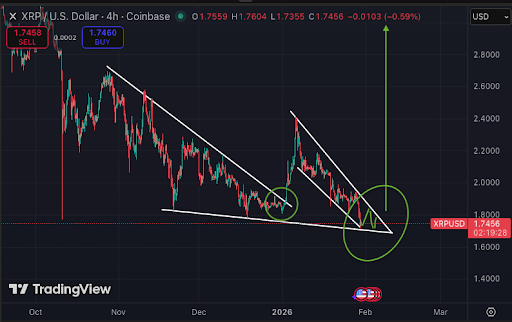
XRP Price Chart. Source: @Bird_XRPL on X

On the sentiment side, he also referenced optimism from Ripple leadership (Chris Larsen and David Schwartz) on social media. These subtle shifts are lining up beneath the surface to create conditions where XRP could stabilize around $1.60 before attempting a larger recovery move. If that rotation materializes as expected, then a broader rally could eventually carry XRP back above the $3 level once momentum fully flips.

Price begins another recovery trend | Source: XRPUSDT on Tradingview.com

Letture associate

Behind Musk and Huang Jen-hsun's 'AI Factories', an Unseen Battle for Freshwater Has Begun

Behind the "AI factories" of Elon Musk and Jensen Huang lies a hidden battle for a critical resource: fresh water. As AI models like ChatGPT and Claude process billions of prompts daily, they consume vast amounts of water for cooling. By 2030, global AI infrastructure is projected to use 9.3 trillion liters annually—enough to meet the basic needs of 1.3 billion people. This "water grab" stems from the massive heat generated by high-powered GPUs. Over 70% of data centers use evaporative cooling systems, where water absorbs heat and evaporates into the atmosphere, depleting local groundwater. Training models like GPT-4 can consume over 600 million liters of water. Tech giants like Google and Microsoft report skyrocketing water usage, sparking conflicts with local communities over resources. A flashpoint occurred in Memphis, Tennessee, where Musk's xAI built the Colossus supercomputer. It draws nearly 3.8 million liters of drinking water daily from local aquifers, leading to public outrage and legal action. In response, xAI is building an $80 million water recycling plant to use treated wastewater instead. Facing pressure, companies like Microsoft promote "waterless" closed-loop cooling systems. However, these systems increase electricity consumption by 20-30%, shifting the water burden to power plants, which require immense cooling water themselves—a case of indirect water footprint transfer. For China's AI industry, this crisis offers a strategic warning and opportunity. Instead of replicating the West's resource-intensive model, China can leverage its "East Data, West Computing" policy to locate data centers in cooler, water-rich regions like Guizhou. Furthermore, developing lightweight edge computing for smart homes and embodied AI robots can drastically reduce the need for constant cloud queries, cutting both water and energy consumption at the source. The freshwater war underscores a fundamental question: Will AI be a tool for human advancement or a silicon-based monster competing for our planet's last drops of clean water? The answer is becoming clearer as the water vapor rises.

marsbit36 min fa

Behind Musk and Huang Jen-hsun's 'AI Factories', an Unseen Battle for Freshwater Has Begun

marsbit36 min fa

AGI is Just One Step Away

The article discusses Anthropic's release of the Fable 5 model, a heavily restricted version of its powerful Mythos model. Initially unveiled in April, Mythos reportedly identified over 10,000 high-risk vulnerabilities for 50 enterprise clients, causing significant concern. Due to its dangerous capabilities in areas like autonomous cyber-attacks and biochemical weapons design guidance (classified as CB-1 level), the unaltered Mythos 5 remains limited to about 200 vetted entities like government agencies. Fable 5, released with a safety classifier, demonstrates extraordinary performance, leading benchmarks in coding (SWE-Bench Pro), software engineering, and research. It exhibits true "long-horizon agency," autonomously planning and executing complex, multi-step tasks like migrating 50 million lines of code in a day, moving beyond simple question-answering. The article positions Fable 5 at OpenAI's Level 3 ("Agent") and progressing toward Level 4 ("Innovator"), suggesting AGI (Artificial General Intelligence) is within reach, potentially 18-24 months away. To mitigate risks, Anthropic implemented a two-layer safety "cage": a silent routing system that redirects dangerous queries to a weaker model, and a mandatory 30-day data retention policy for all Mythos traffic to detect patterns of malicious use. Despite its high cost ($10/$50 per million input/output tokens), the model targets the enterprise market, where its unparalleled productivity and defensive capabilities against AI-powered cyber threats justify the premium. This signals a market maturation where top-tier AI becomes a strategic, high-value tool for businesses, potentially widening the gap with consumer-focused models and accelerating the rise of "one-person companies" while disrupting labor markets.

marsbit48 min fa

AGI is Just One Step Away

marsbit48 min fa

AI Investors' 2026 Anxiety: When Models Devour Everything, What Moat Is Left for Startups?

In 2026, a wave of investor anxiety questions the defensibility of AI startups as models improve, fearing that most companies are just "thin wrappers" destined to be absorbed by foundation models or chipmakers. The author argues against this despair, positing that true moats lie not in benchmark performance but in areas models cannot easily reach. The logic of despair is that if models excel at all measurable tasks, only compute and cutting-edge model weights hold lasting value. However, the essay contends that the most valuable work is inherently "untrainable." Benchmarks measure what can be measured and thus optimized for, but real-world correctness often resides in private, complex systems. Examples include legacy codebases, intricate legal transactions, or hospital workflows. This kind of correctness is proprietary, costly to establish, and cannot be validated quickly—it requires time and trust within an organization. As models commodify visible, measurable tasks from both above (labs absorbing scaffolding) and below (saturation by cheaper models), value shifts to "untrainable ground." This encompasses work where correctness is a private truth, locked behind integration barriers, licenses, liability frameworks, and entrenched user habits. Trust and adoption are slow, human-centric processes that smarter models cannot accelerate. Successful companies defend their position by embedding deeply into client operations, owning the definition of "good" within a specific domain (e.g., Harvey in law, OpenEvidence in medicine), and pricing on outcomes rather than tokens. While labs compete fiercely, they are incentivized to keep the application layer vibrant. The future belongs not to those competing on generic benchmarks but to those navigating unscoreable terrain, doing the "unsexy work" of translation between models and messy human realities. The most cited benchmark scores are thus maps of territory about to become worthless, signaling who will lose the right to define what counts as good.

marsbit2 h fa

AI Investors' 2026 Anxiety: When Models Devour Everything, What Moat Is Left for Startups?

marsbit2 h fa

Trading

Spot
Futures

Articoli Popolari

Cosa è XRP 2.0

XRP 2.0: Una Nuova Frontiera nel Paesaggio delle Criptovalute Introduzione a XRP 2.0 Nel mondo in continua evoluzione delle criptovalute, nuovi progetti emergono continuamente, cercando attenzione e adozione. Una tale iniziativa promettente è XRP 2.0, un nuovo progetto di criptovaluta progettato per sfruttare avanzate tecnologie blockchain e metodologie di crittografia robuste. Anche se il nome richiama alla mente l'XRP di Ripple, è fondamentale notare che XRP 2.0 opera in modo indipendente, concentrandosi sul miglioramento della sicurezza delle transazioni, della privacy e della scalabilità. Mentre il panorama finanziario digitale abbraccia sempre di più soluzioni decentralizzate, XRP 2.0 mira a contribuire in modo significativo al web3 e all'espansione generale dei progetti crypto. Cos'è XRP 2.0? Alla sua base, XRP 2.0 è un progetto di criptovaluta che mira a creare un ecosistema di valuta digitale sicuro e decentralizzato. La sua tecnologia fondamentale integra principi di blockchain sofisticati con tecniche di crittografia all'avanguardia. L'obiettivo principale di XRP 2.0 è quello di affermarsi come una piattaforma affidabile ed efficiente in grado di consentire un'esecuzione rapida delle transazioni, dando priorità a migliori protezioni della privacy per i suoi utenti. Il progetto è promosso come una soluzione a molte limitazioni affrontate dalle criptovalute esistenti, proponendo un sistema in grado di gestire un volume maggiore di transazioni con migliorata velocità e privacy. Questa versatilità pone XRP 2.0 come un significativo competitor in un mercato affollato di varie valute digitali. Chi è il Creatore di XRP 2.0? L'identità del creatore dietro XRP 2.0 è stata segnalata come 'Wilbur'. Tuttavia, i dettagli completi riguardanti Wilbur o l'entità associata rimangono sfuggenti. L'anonimato di molti creatori di criptovalute non è un fenomeno raro nel settore, spesso progettato per mantenere un certo grado di privacy e sicurezza. Chi sono gli Investitori di XRP 2.0? Al momento, informazioni specifiche relative alle fondazioni o organizzazioni di investimento a supporto di XRP 2.0 non sono disponibili pubblicamente. Nel settore delle criptovalute, il supporto di investitori rinomati può influenzare significativamente la credibilità e il successo di un progetto, tuttavia la trasparenza riguardo ai sostenitori finanziari di XRP 2.0 non è stata stabilita. Come Funziona XRP 2.0? XRP 2.0 si distingue per l'impiego di una combinazione di tecnologia blockchain e algoritmi di crittografia avanzati che garantiscono transazioni sicure e decentralizzate. La sua struttura innovativa include caratteristiche uniche progettate per promuovere il coinvolgimento degli utenti e ampliare le funzionalità oltre le transazioni convenzionali delle criptovalute. Tra queste caratteristiche, XRP 2.0 incorpora capacità alimentate da intelligenza artificiale, come funzionalità di testo in immagini e testo in voce. Queste aggiunte sono progettate per migliorare l'esperienza interattiva per gli utenti, promuovendo una maggiore applicabilità in vari settori. Unendo progressi tecnologici con design incentrati sugli utenti, XRP 2.0 mira a catturare l'attenzione di una vasta gamma di individui e aziende che cercano di integrare soluzioni di criptovaluta nei loro framework operativi. Cronologia di XRP 2.0 Comprendere XRP 2.0 richiede di esaminare i traguardi che hanno definito il suo percorso fino ad ora: 23 luglio 2023: XRP 2.0 viene introdotto come un nuovo progetto di criptovaluta, mirante a rivoluzionare le capacità di transazione sicura e decentralizzata nel dominio blockchain. 8 settembre 2023: Si verifica il lancio di un altro progetto, XRP20, marcando l'emergere di un token ERC-20 sulla blockchain di Ethereum che resta non correlato a XRP 2.0. 13 novembre 2023: Il ledger XRP subisce un significativo aggiornamento con il rilascio della versione 2.0.0 del software server rippled. È essenziale notare che questo sviluppo è scollegato dal progetto di criptovaluta XRP 2.0. Punti Chiave su XRP 2.0 Per distillare l'essenza di XRP 2.0, emergono diversi fattori critici: Caratteristiche Uniche: L'inclusione di funzionalità come il testo in immagini e testo in voce alimentato da intelligenza artificiale diversifica ulteriormente le potenziali applicazioni di XRP 2.0. Tecnologia Blockchain: Il framework utilizza meccanismi blockchain avanzati e protocolli di crittografia, garantendo un ambiente sicuro e decentralizzato per le transazioni. Scalabilità e Privacy: XRP 2.0 dà priorità a migliori protezioni della privacy nei processi di transazione e alla scalabilità necessaria per accogliere una base di utenti in crescita. Nessuna Affiliazione con Ripple: È importante notare che, nonostante il suo nome, XRP 2.0 non ha alcuna fedeltà o collaborazione con l'XRP di Ripple, distinguendo il proprio framework operativo e obiettivi all'interno dell'ecosistema delle criptovalute. Conclusione XRP 2.0 rappresenta un'ambiziosa venture nell'ambito delle criptovalute, mirante a offrire una combinazione di sicurezza, privacy ed efficienza nelle transazioni digitali. Integrando tecnologie sofisticate e caratteristiche user-friendly, il progetto si propone di ampliare gli orizzonti di ciò che le criptovalute possono realizzare nell'economia digitale odierna. Sebbene l'anonimato del suo creatore e la mancanza di investitori dichiarati possano sollevare domande per alcuni, il focus di XRP 2.0 su funzionalità avanzate e decentralizzazione ne amplifica l'appeal in un mercato crypto sempre più affollato. Man mano che il panorama delle criptovalute continua a evolversi, XRP 2.0 potrebbe emergere come un attore decisivo nell'espansione di soluzioni blockchain sicure e scalabili.

166 Totale visualizzazioniPubblicato il 2024.04.05Aggiornato il 2024.12.03

Cosa è XRP 2.0

Come comprare XRP

Benvenuto in HTX.com! Abbiamo reso l'acquisto di XRP (XRP) semplice e conveniente. Segui la nostra guida passo passo per intraprendere il tuo viaggio nel mondo delle criptovalute.Step 1: Crea il tuo Account HTXUsa la tua email o numero di telefono per registrarti il tuo account gratuito su HTX. Vivi un'esperienza facile e sblocca tutte le funzionalità,Crea il mio accountStep 2: Vai in Acquista crypto e seleziona il tuo metodo di pagamentoCarta di credito/debito: utilizza la tua Visa o Mastercard per acquistare immediatamente XRPXRP.Bilancio: Usa i fondi dal bilancio del tuo account HTX per fare trading senza problemi.Terze parti: abbiamo aggiunto metodi di pagamento molto utilizzati come Google Pay e Apple Pay per maggiore comodità.P2P: Fai trading direttamente con altri utenti HTX.Over-the-Counter (OTC): Offriamo servizi su misura e tassi di cambio competitivi per i trader.Step 3: Conserva XRP (XRP)Dopo aver acquistato XRP (XRP), conserva nel tuo account HTX. In alternativa, puoi inviare tramite trasferimento blockchain o scambiare per altre criptovalute.Step 4: Scambia XRP (XRP)Scambia facilmente XRP (XRP) nel mercato spot di HTX. Accedi al tuo account, seleziona la tua coppia di trading, esegui le tue operazioni e monitora in tempo reale. Offriamo un'esperienza user-friendly sia per chi ha appena iniziato che per i trader più esperti.

1.5k Totale visualizzazioniPubblicato il 2024.12.10Aggiornato il 2026.06.02

Come comprare XRP

Discussioni

Benvenuto nella Community HTX. Qui puoi rimanere informato sugli ultimi sviluppi della piattaforma e accedere ad approfondimenti esperti sul mercato. Le opinioni degli utenti sul prezzo di XRP XRP sono presentate come di seguito.

活动图片