Ex-Ripple Director Shares 4 Crypto And Blockchain Predictions For 2026

bitcoinistPubblicato 2025-12-24Pubblicato ultima volta 2025-12-24

Introduzione

Former Ripple director and current Evernorth CEO Asheesh Birla predicts that by 2026, institutional adoption will move beyond speculation and become embedded in everyday financial infrastructure. His four key forecasts include: 1) Corporate treasuries will become programmable through DeFi and AI, reducing manual processes and middlemen. 2) Local stablecoins will proliferate and challenge the traditional $9.6 trillion FX market via on-chain exchanges. 3) Stablecoins will achieve mainstream use in corporate and bank settlements for real-time liquidity analytics and faster transactions, potentially growing from $300 billion to $100 trillion in market cap. 4) NFTs will rebrand as digital access tokens for membership, combining ticketing, loyalty, and collectibles. Birla emphasizes a shift toward practical, institutional use cases for blockchain and crypto.

Asheesh Birla, a former Ripple board member who now runs Evernorth, an XRP-focused digital asset treasury, is out with a tidy set of 2026 predictions that basically boil down to one thing: institutions finally stop circling and start using this stuff in production.

In a short video shared to social media, Birla frames next year as the moment crypto infrastructure slips into the background and starts doing the boring work it always promised to do.

“My theme this year is really around how institutions, financial and corporate institutions, are going to start adopting blockchain technology at scale,” he said. “It’s going to be part of everyday financial infrastructure in 2026. It’s going to quietly power how money moves.”

4 Crypto Predictions For 2026 By Ex-Ripple Exec Birla

Prediction No. 1 is corporate treasury operations getting “programmable,” in his words, as DeFi tooling collides with AI-driven automation. The pitch is straightforward: back offices are still messy, manual, and full of middlemen. If you can turn parts of treasury management into code — and then let AI help run the workflows — you compress cost, time, and operational friction.

“It’s just a more efficient way to manage their operations, which today are manual and have a lot of middlemen,” the ex-Ripple director said. “Using DeFi and AI, I think you’re going to see a lot of those efficiency gains start to come to fruition and you’re going to see fewer middlemen and a better experience for moving money and managing your global operations in 2026.”

His second call is a twist on the stablecoin trade: not just more dollar coins, but “local stablecoins” proliferating across regions, then meeting on-chain in FX venues.

“You’re going to see these challenge the 9.6 trillion dollar FX market,” he said, arguing that on-chain DEX liquidity becomes the base layer for a new kind of spot FX market that competes with legacy rails.

Prediction No. 3 is stablecoins going fully mainstream inside corporate and bank plumbing — less as a crypto product, more as settlement tech. Birla claims the upside is obvious to finance teams: “real-time analytics into your liquidity positions around the world,” faster movement, cleaner reconciliation.

He also throws out the big-number trajectory that’s become common in these forecasts, saying stablecoins could grow “from 300 billion to 100 trillion dollars in market cap” based on “industry projections.”

And then there’s the NFT comeback, which he’s careful to describe as a rebrand and a reframing, not a rerun of 2021. Forget JPEG roulette, he says. Think access.

“They’re going to be about membership access,” the ex-Ripple director said in his prediction no. 4. “So it’s going to allow you to combine ticketing, loyalty, and digital collectibles into one digital access token.”

The subtext here matters: Birla’s now building Evernorth around XRP exposure and institutional participation, with the firm positioning itself as a purpose-built XRP treasury.

So his “bigger story” is also a bit of a sales thesis, crypto moving beyond speculation by embedding into how money moves, how treasuries run, and how brands manage customer relationships.

At press time, XRP traded at $1.8577.
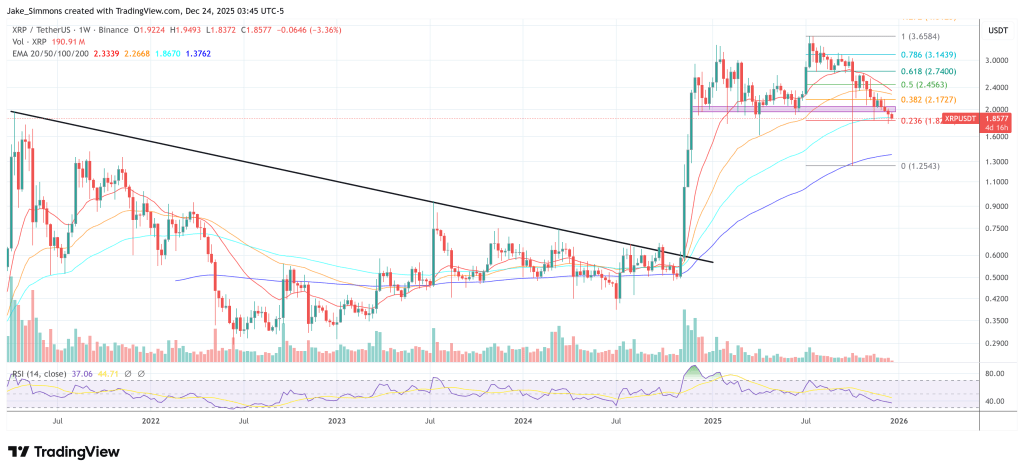
XRP falls below key support, 1-week chart | Source: XRPUSDT on TradingView.com

Domande pertinenti

QWhat is the main theme of Asheesh Birla's 2026 predictions for blockchain and crypto?

AThe main theme is how financial and corporate institutions will start adopting blockchain technology at scale, making it part of everyday financial infrastructure that quietly powers how money moves.

QAccording to Birla, what will be the primary use case for NFTs in 2026, moving beyond the 2021 speculation?

ANFTs will be rebranded and reframed to focus on membership access, combining ticketing, loyalty programs, and digital collectibles into one digital access token.

QHow does Birla predict stablecoins will evolve in the crypto market by 2026?

ABirla predicts stablecoins will go fully mainstream as settlement technology within corporate and bank systems, potentially growing from a $300 billion to a $100 trillion market cap, and will include the proliferation of 'local stablecoins' that challenge the traditional FX market.

QWhat specific efficiency gains does Birla foresee from combining DeFi tooling with AI-driven automation in corporate treasury operations?

AHe foresees that turning parts of treasury management into code and using AI to run workflows will compress cost, time, and operational friction by reducing manual processes and middlemen, leading to a more efficient way to manage global operations and move money.

QWhat role does Birla's company, Evernorth, play in the context of these predictions?

AEvernorth is a digital asset treasury focused on XRP, positioning itself to facilitate institutional participation and exposure to XRP as crypto moves beyond speculation and embeds into money movement, treasury management, and customer relationship management.

Letture associate

From South Korea to the United States: Blue-Collar Jobs Are Becoming Increasingly Popular, Thanks to AI

AI is reshaping the labor market's value proposition. The traditional four-year college degree is losing its appeal as a guaranteed career path, while skilled blue-collar trades like electricians, welders, and plumbers are experiencing historic demand and wage premiums. This shift is driven by dual pressures: AI's displacement of certain white-collar roles and a booming need for physical infrastructure and data center construction. Data confirms the trend. In the U.S., vocational school revenue surged, and a significant portion of recent layoffs are AI-related. Surveys show a majority of Gen Z adults plan to pursue blue-collar work, citing better job security against AI automation. Vocational education interest has exploded recently. Experts cite a psychological shift as younger generations seek tangible, AI-resistant careers and avoid high student debt. In many cases, salaries for skilled trades now match or exceed those requiring a bachelor's degree. In South Korea, semiconductor vocational high schools boast near-total employment, with graduates securing high-paying roles at companies like Samsung. The shortage is structural, exacerbated by a retiring baby boomer workforce and massive infrastructure projects. Companies like JPMorgan Chase, Meta, and Lowe's are investing heavily in training programs. However, overcoming historical stigma and a "perception gap" around trade careers remains a key challenge to closing the talent gap.

marsbit1 h fa

From South Korea to the United States: Blue-Collar Jobs Are Becoming Increasingly Popular, Thanks to AI

marsbit1 h fa

Qualcomm: AI Hype Subsides, When Will Smartphones Emerge from the Gloom?

Qualcomm reported its Q3 FY2026 results (ending June 2026), with revenue of $9.95B, down 4% YoY but above expectations. Gross margin declined to 53.1%, pressured by rising costs across manufacturing and memory. Key business segments showed mixed performance: Handset revenue fell 19.6% YoY to $5.09B, dragged by an 11% decline in non-Apple Android shipments and weaker high-end mix. Conversely, Automotive revenue surged 61% to $1.59B, and IoT grew 9% to $1.83B. Core operating profit dropped 41% YoY due to margin compression and higher expenses. Management's Q4 FY2026 guidance projects revenue of $9.7B-$10.5B, in line with consensus, but Non-GAAP EPS guidance of $2.05-$2.25 fell short of expectations. Amidst persistent weakness in its core handset market, Qualcomm is pursuing growth in AI, focusing on Edge AI (smartphones, PCs, automotive) and Data Center AI. Its data center strategy includes four pillars: AI accelerators (e.g., AI200), commercial CPUs (Dragonfly C1000), custom silicon, and connectivity solutions. While these initiatives initially boosted its stock, concerns over AI capital expenditure sustainability have since erased those gains. The company targets $5B in data center revenue for FY2027 and $15B for FY2029. The report concludes that with the traditional handset business still under pressure, the data center opportunity is currently viewed as a longer-term option, and a more conservative valuation based on core operations may be warranted until AI contributions materialize.

marsbit1 h fa

Qualcomm: AI Hype Subsides, When Will Smartphones Emerge from the Gloom?

marsbit1 h fa

From TPU to Self-Evolving Agents: How Jeff Dean Predicts the Next Step in AI

At the 2026 YC Startup School, Jeff Dean outlined his vision for AI's next phase, shifting focus from simply scaling models to building intelligent, autonomous systems. He believes AI's progress is no longer just about creating smarter models, but about integrating them into systems capable of long-term, iterative work, automated experimentation, and continuous learning. This evolution moves the competition from "who has the bigger model" to "who can best organize intelligence." Dean suggests AI capabilities are now comparable to a junior engineer, enabling the automation of complex workflows. However, the true challenge and opportunity lie in managing these AI "workers" at scale. He emphasizes the importance of **context engineering**—structuring tools, memory, and feedback loops—over raw model power. For startups, this means building deep expertise in niche domains where general models currently fail (near 0-1% success rates), leveraging proprietary data, specialized tools, and domain-specific evaluators. A recurring theme is re-examining fundamental constraints. Dean's past work, like moving Google's search index to memory or creating the TPU, stemmed from questioning outdated assumptions about hardware and cost. He sees similar inflection points today, particularly in **specialized inference hardware** to drastically reduce latency and energy consumption for real-time Agent operation. Notably, he points out that in modern AI systems, the dominant cost is often not computation but **data movement**. Reliable, long-running Agents require robust system design, borrowing concepts from distributed computing like checkpointing, state management, and parallel exploration to handle failures and maintain progress over days or weeks. As AI automates execution, the scarcest human skills will shift to **defining clear specifications**, **judging what problems are worth solving** (taste), and designing effective feedback loops. Ultimately, Dean's framework prioritizes understanding the problem deeply, identifying the true bottlenecks, and systematically building closed-loop systems where AI can not only perform tasks but also improve AI itself.

marsbit1 h fa

From TPU to Self-Evolving Agents: How Jeff Dean Predicts the Next Step in AI

marsbit1 h fa

Trading

Spot
活动图片





