Ethereum's Ballmer Moment: As Everyone Is Bearish, the Circulating Supply Is Disappearing

marsbitPubblicato 2026-06-04Pubblicato ultima volta 2026-06-04

Introduzione

"Ethereum's Ballmer Moment: Circulation Shrinks Amid Bearish Sentiment" Amid widespread bearish sentiment, with prominent figures like Bankless founder David Hoffman selling ETH and young developers flocking to Solana, some argue Ethereum is entering its "Ballmer era"—akin to Microsoft's perceived stagnation under Steve Ballmer. While surface-level criticisms about slow protocol development, cautious leadership, and competitive pressure are valid, underlying fundamentals tell a different story. Approximately 30% of ETH is staked, major holders like BitMine are accumulating, and spot ETFs continue to absorb supply. Regulatory clarity, including the SEC/CFTC's March ruling on staking rewards and the potential passage of the CLARITY Act, is transforming crypto from a regulatory threat into a legitimized framework. This institutionalization, alongside a shrinking circulating supply (with net issuance around 0.23% annually), creates significant buy-side pressure independent of fee-based value capture. The broader crypto total addressable market is expanding through regulated stablecoins, tokenized assets, and institutional adoption. While public chains face competition from permissioned alternatives, the winning model appears to be permissioned assets settling on public chains like Ethereum and Solana. The author advocates a non-maximalist, barbell strategy: holding ETH for its institutional role and supply squeeze, SOL for consumer/throughput trends, BTC as a macro hedge, and...

Author: Ben Lakoff

Translation: Deep Tide TechFlow

Deep Tide Guide: When Bankless founder sold all ETH and 19-year-old developers flocked to Solana, the bearish narrative for Ethereum became consensus. However, Ben Lakoff, a partner at BanklessVC, believes this is a repeat of Microsoft's "Ballmer Era"—superficially the narrative is bearish, but underlying fundamentals are steadily growing. A 30% staking rate, ETF accumulation, and clearer regulations are compressing the circulating supply. While crypto regulation is shifting from an existential threat to a legal framework, it's precisely the time to get in.

Welcome to the May trading flow summary.

This month's thesis section is a bit longer, so I've put it upfront. All financing rounds, fund raises, and hackathon results are placed afterward.

Ethereum's Ballmer Era

Last month, David Hoffman sold all his ETH at $2,070 and wrote a thoughtful article explaining why. It spread all over X (Twitter).

David subsequently joined the Chopping Block podcast, and I really enjoyed that conversation. Tarun said Ethereum is "ossifying" because no 19-year-olds want to build there. Max Resnick called the Ethereum Foundation "risk-averse." The bullish Haseeb gave the entire bearish sentiment a name: this is Ethereum's Ballmer Era. That phrase resonated with me.

This framework is too good to let go.

Yes, I'm bullish on "crypto," I'm bullish on BTC, I'm bullish on ETH... I'm bullish on the trend. But pretending the bearish thesis is weak is just self-deception, so I want to elaborate further on my position. These are my views, not necessarily representing BanklessVC's views, and certainly not investment advice.

The Bearish Thesis Has a Name, and It's Not Wrong

The substance is real. In fact, we've dropped another 10% since that article was published.

David's argument: ETH as money was always a long-term bet, and the rollup-centric roadmap makes it even longer. Ethereum is a "giver, not a taker"... it's designed to distribute block space at cost. L2s capture 98% margins on blob revenue. The gas limit is gradually increasing to 100M+. The BPO fork aggressively expands blob supply. The $30B to $163B stablecoin surge creates value for Circle and Tether, not ETH. Meanwhile, SOL, NEAR, BNB, and TRX have repriced as fee-driven comparables. He's mechanically correct. The protocol is designed for abundant block space, the exact opposite of the fee-driven value capture you want.

Tarun's "ossification" view is the cultural version of the same thing. Talent follows founder energy, and that energy is now on Solana, Monad, Hyperliquid, and whatever comes next (maybe not Ethereum, not crypto). Resnick's "risk-averse EF" is the institutional version. The foundation is devoutly focused on protecting network integrity at a moment when it needs to stay competitive.

Haseeb is right. A "Ballmer Era." Slow product cadence. Botched transitions. Sharper competitors with killer instinct. Loud critics who are right on the points.

What Microsoft Actually Did During the Ballmer Era

Ballmer ran Microsoft from 2000 to 2014. The joke: wasted 14 years. Missed mobile, missed search, missed social, shipped Vista, threw a few chairs.

That's the joke I remember, but what does the joke miss? MSFT stock went sideways for over a decade, while the enterprise franchise compounded relentlessly underneath. Dividends did most of the work. Office and Windows licenses printed money the entire "Microsoft is dead" narrative period. Then Satya took over, and MSFT went 10x.

The lesson (at least in the Microsoft version) is that deeply embedded, enterprise-loved, time-tested infrastructure tends to keep compounding through its own bearish narrative. The bearish narrative is often correct on the surface. Just not enough to short.

Ethereum is still the largest credibly neutral public chain for tokenized assets. BUIDL launched there. ~66% of USDC supply is there. The deepest DeFi liquidity is there.

But the lead is shrinking fast. BUIDL isn't just on Ethereum (~40%), down from ~85% a year ago. USDC exists on 34 chains. Western Union chose Solana over Ethereum for USDPT. The institutional default is shifting from singular "Ethereum" to plural "public chains."

Still bullish for the incumbent. Just not a monopoly anymore. Whether 19-year-olds want to build there is a real long-term concern. But it's not what decides the next two years.

Beneath the Noise: The Circulating Supply Is Collapsing

This is the part most bearish takes miss.

~30% of ETH is staked. Treasury corps hold another 6%+ and growing. BitMine alone holds 4.47% of the supply and is publicly targeting 5%. Spot ETFs keep absorbing more. The SEC/CFTC March 17 ruling classifying staking rewards as non-securities unlocked the entire staking ETF pipeline. Five other issuers (Fidelity, Franklin, Invesco, 21Shares, VanEck) have staking amendments pending Q2 decisions.

Every ETH staked through an ETF is ETH that cannot be sold on price impulse. Net issuance is ~0.23% annualized. The float is shrinking faster than that, and on most days these intake sides are bidding. The math doesn't care if ETH is boring.

So David is right, ETH won't reprice from fee burn. The roadmap chose abundance. But ETH can reprice from float compression, staking yield demand, and institutional Schelling point premium without winning the fee war. At least near-term.

Crypto's TAM Keeps Rising

Zooming out a bit from ETH. The real story of the last 12 months is crypto regulation shifting from an existential threat to a legal framework.

The GENIUS Act is now law. Payment stablecoins have a federal regime. The CLARITY Act passed the House in July, passed the Senate Banking Committee on May 14, and structurally looks likely to pass before midterms. Stablecoin circulating supply is over $2.8T and compounding. Tokenized treasuries are scaling. Spot ETFs exist for a growing list of assets.

This isn't the crypto-dies phase. This is the crypto-becomes-a-regulated-trillion-dollar-slice-of-the-financial-system phase where boring institutions are mandated to plug in.

In prior bears, we genuinely worried whether this ecosystem would exist in the future. But, with some caveats, and they matter.

First: Crypto winning vs. decentralized crypto winning are not the same thing. The truly scary bear case isn't David's fee math. It's "blockchain winning" eventually looking like Canton, JPM Onyx, DTCC's permissioned ledgers and a few Avalanche subnets, with the public crypto asset complex capturing basically none of the real value.

That world exists (and is concerning), but I'd bet on the public chain side for a few reasons. Pure permissioned chains as the institutional answer have been pitched for a decade and keep losing adoption (maybe this time is different?). The architecture actually winning is permissioned assets on public chain rails: BUIDL, BENJI, Ondo's USDY. Tokens execute KYC and transfer restrictions; settlement runs on Ethereum, Solana, and other public infrastructure. The empirical record of KYC pools coexisting with open public pools (Aave Arc, Compound Treasury) is that they fail.

That's still bullish for public chains, including ETH, as settlement layers. But it's weaker than full DeFi composability. Permissioned assets cannot freely compose with open pools, but the gated-access version is the mode winning.

Second: The question is no longer whether crypto adoption happens. It's which crypto captures it. The honest answer is, not all goes to ETH, but the institutionalized, regulated, "needs credibly neutral" giant chunk almost certainly. Because the alternative is asking tier-1 banks to settle tokenized assets on chains run like startups... unlikely.

This is where the Ballmer framework underrates the bull case. It only works if the underlying market keeps growing. Crypto's underlying market is growing fast in the most regulator-blessed, institutionalized way.

Barbell Strategy: Bullish on the Trend, Not Extremism

The bear thesis I take seriously isn't the fee analysis. It's leadership and competition. EF might indeed need its Satya moment. The killer instinct vacuum is real. Solana, Monad, and Hyperliquid aren't slowing down. ETH/BTC and ETH/SOL could go sideways or lower for a while before turning.

The way to position around this is simple: stop being an extremist.

Hold ETH for the time-tested/institutionalized/float compression trade. Hold SOL for the consumer/throughput/distribution trade. Hold BTC for macro hedge. Hold a small basket of next-gen L1s and application-layer winners where the cultural energy is actually flowing.

I know. ETH is a $250B asset, impacted by macro trends, and your capital allocation always involves trade-offs. I'm not an extremist, but I'm still bullish on ETH. Summarizing why:

The float is shrinking faster than issuance.

Q2 staking ETF approvals are a live, dated catalyst.

CLARITY Act passage broadly unleashes institutional crypto. Clearer rules let regulated capital deploy at scale across the asset class. ETH's moat is incumbent network effects plus credible neutrality, making it the default public chain settlement layer for tokenized assets, even as the lead shrinks.

The bear thesis is so loud it's now consensus. The historical hit rate of consensus bear at $2K after a 60% drawdown is low.

The optionality value of a "Satya moment" isn't priced in. If EF gets reorged, or a more aggressive entity emerges to lead protocol development, that's pure upside no bear model includes.

I see this trade as "David is partially right and ETH still works." Microsoft worked under Ballmer. Crypto adoption is winning. The assets you most want to own are the ones most deeply embedded in the part of crypto the US government just spent two years writing rules for.

Zoom out on what regulators are actually saying. The SEC and CFTC are telling you they want to rebuild finance on-chain. Bring dollars on-chain. In that world, how is this not insanely bullish? Maybe if you're a cypherpunk, this isn't the world you envisioned... gated assets, KYC rails, everything requiring permission. But for public chains as settlement infrastructure? Unquestionably bullish.

That's the crux of where we are in the cycle. AI is the center of attention, full stop. It's hot, parabolic, and as an early-stage investor, that's exactly the problem. You want to deploy capital where it's not hot. When a sector is this overheated, it's hard to put capital to work anywhere but the earliest pre-seed stage without paying a premium.

Crypto, right now, is not hot. The bear thesis is consensus. The energy is elsewhere. That's the setup you want, not the one you run from.

On a long enough timeline, everything becomes AI, everything becomes blockchain. One of these is priced like it already happened. The other just got a two-year head start written into law, and everyone is looking the other way.

Buckle up. Now turning to the rest of crypto/web3 financings :)

Top 10 Crypto Financing Rounds

Kalshi | Series F | Prediction Markets | $1B | 2026-05-07

Led by Coatue, with participation from Sequoia, a16z, IVP, Paradigm, Morgan Stanley, and ARK Invest. This $1B round values Kalshi at $22B, double the $11B valuation just five months prior. Annualized trading volume tripled in six months to $178B, with institutional volume up 800%. Kalshi is CFTC-regulated and not crypto-native, so call it the asterisk on this list, but it now has >90% of US prediction market activity, and prediction markets are one of the cleanest on-ramp stories crypto has right now.

Dunamu (Upbit) | Strategic Investment | Centralized Exchange | $408M | 2026-05-28

Three Samsung-affiliated companies (Samsung Securities, Samsung SDS, Samsung Card) agreed to purchase ~4% of Dunamu, operator of South Korea's largest crypto exchange Upbit, for ~$408M (612.8B KRW). Each buyer mentioned positioning for KRW-pegged stablecoins, tokenized securities, and on-chain settlement ahead of Korea's Digital Asset Basic Act. This is part of a May sprint transferring ~14% of Dunamu to Korean giants like Hana and Hanwha. Closing June 19.

Circle (Arc) | Token Presale | Infrastructure/Stablecoins | $222M | 2026-05-11

Circle raised $222M (FDV $3B) for Arc, its institutional L1 for stablecoin settlement and tokenized assets. a16z crypto put in $75M, with participation from BlackRock, Apollo, ICE, Standard Chartered Ventures, SBI, Janus Henderson, General Catalyst, Marshall Wace, ARK, Haun, and Bullish. This is the clearest "TradFi is picking rails" signal of 2026. A regulated stablecoin issuer is building its own chain, with the largest asset manager on the cap table.

Ripple (Ripple Prime) | Debt Financing | Infrastructure/Prime Brokerage | $200M | 2026-05-11

Ripple secured $200M in debt financing from a fund managed by Neuberger Specialty Finance to expand lending capacity for its multi-asset prime brokerage, Ripple Prime. Existing institutional loans serve as collateral. Ripple Prime revenue is up 3x YoY since Ripple acquired the platform in 2025. Traditional finance credit backing crypto prime brokerage loan books.

Elliptic | Series D | Compliance/AI x Crypto | $120M | 2026-05-12

Led by One Peak in this $120M round (valuation $670M), with participation from Nasdaq Ventures, Deutsche Bank, and British Business Bank. This is the largest pure equity VC round of the month. Elliptic is building agentic AML/compliance tooling. Reading with post-April lens: this is the ops/compliance layer DeFi keeps being reminded it needs, now with TradFi capital behind it.

Fun | Series A | Payments/Consumer | $72M | 2026-05-01

Co-led by Multicoin Capital and SignalFire, with participation from Infinity Ventures, Pharsalus Capital, and Justin Mateen. Fun is a crypto/fiat on-ramp powering financial platforms like Polymarket. Largest consumer/payments VC round of the month, a clean bet on the prediction market and consumer crypto heatwave track.

Fasset | Series B | Stablecoins/Payments | $51M | 2026-05-14

Led by SBI Group in this $51M raise, with Investcorp and Arz Portföy participating. Fasset is a stablecoin-powered neobank for emerging markets, with ~$32B annualized transaction volume. Real proof-of-concept for the stablecoin-as-payments thesis, and in the places that matter most: the corners of the world where dollar rails are genuinely life-changing.

Variational | Series A | DeFi/Derivatives/RWA | $50M | 2026-05-20

Led by Dragonfly, with participation from Bain Capital Crypto and Coinbase Ventures. Variational operates an RFQ-style platform for on-chain perpetuals on real-world assets: oil, gold, silver, copper. The team's call is that RWA perps could surpass BTC and ETH perps within a year. Most thesis-heavy small trade of the month.

OpenTrade | Strategic/Growth | Stablecoins/RWA | $17M | 2026-05-06

Mercury Fund and Notion Capital backed OpenTrade's $17M raise to scale its yield infrastructure for stablecoins backed by real-world assets. Another data point for the month's dominant theme: the interest-bearing stablecoin track with underlying RWA collateral.

Cycles | Seed | Infrastructure/Clearing | $6.4M | 2026-05-21

Led by Blockchange Ventures, with participation from Coinbase Ventures, Compound VC, and Primitive Ventures. Small in size, but this is exactly the kind of institutional-grade plumbing that must exist before the "next $10T inflow" story comes true.

Click here to view all financing rounds for May
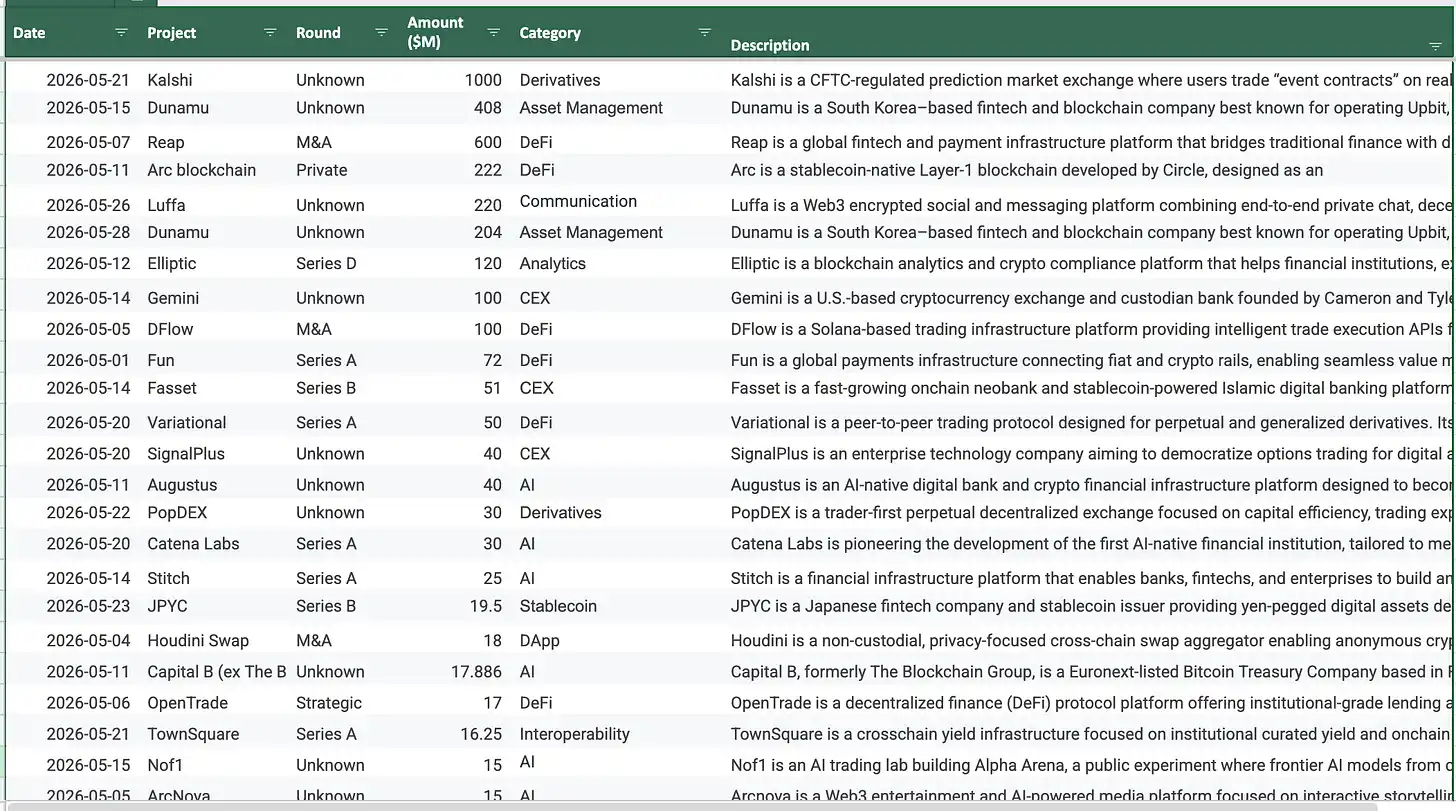
May Crypto VC Fund Raise Announcements

A quieter month for new fund announcements after a busy April, but two big moves...

Haun Ventures | Fund II $1B | May 2026

Katie Haun's firm raised $1B across an early-stage fund and a later-stage companion fund, pushing AUM above $2B. Top three priority themes: next-gen financial infrastructure, asset tokenization and new markets, and the "agent economy" where AI systems transact on behalf of humans. Capital will be deployed over the next 2-3 years.

a16z crypto | Crypto Fund V $2.2B | May 2026

The fund we flagged in March as targeting ~$2B closed officially at $2.2B. All stages, 10-year investment horizon, focused on real-world utility: stablecoins, payments, financial services, perps, lending, prediction markets, asset tokenization. a16z's framing is that crypto fundamentals are "at all-time highs."

Reminder, if you're interested in learning more about Bankless Ventures Fund II, please fill out this form and we'll be in touch!

ETHGlobal New York 2026 | June 12-14, 2026

NYC, in-person. Preceded by ETHConf NYC (June 8-10) and Pragma NYC.

Base Onchain Summer Hackathon | ~June 2026 (Date TBD)

Virtual. Base's flagship on-chain hackathon; last one attracted 7,500+ builders, sponsors included Stripe, Shopify, Farcaster, and Zora. (2026 dates not confirmed yet, please verify on Devfolio.)

ETHGlobal Lisbon 2026 | July 24-26, 2026

Lisbon, Portugal, in-person. Pragma Lisbon July 25.

Solana Frontier Hackathon | Apr 6 - May 11, 2026

Virtual. Crypto's largest startup competition, ~2,857 submissions over five weeks. Prizes: $30K grand champion, $10K each for 20 standout teams, plus $2.5M in venture funding and accelerator admission from Colosseum. Winners not announced by month-end; judging in progress, watch blog.colosseum.com early to mid-June.

ETHPrague 2026 | May 8-10, 2026

Prague, Czech Republic (City Hall). Fifth edition; conference plus hackathon, focused on Ethereum's "solarpunk" future.

Solana Mobile Hackathon | April 2026

Virtual. Concluded, 400+ app submissions from builders in 66 countries.

Solana Frontier Demo Day | June 2026 (Date TBD)

Virtual. Final demos for Frontier hackathon teams, expected after winners announcement.

ETHGlobal New York Showcase Day | June 14, 2026

NYC. Project judging and showcases on final day of hackathon.

ETHPrague 2026 Closing Showcase | May 10, 2026

Prague. Demos and judging on final day of ETHPrague hackathon.

Accelerator Applications Open

Solana Incubator (Cohort 5) | Apps Open / Early Deadline ~June 5

NYC. 3-month program starting Sept 2026; rolling review, preference for early applicants. Looking for 4-6 teams (existing Solana teams, web3 teams considering Solana, or web2 teams adding web3).

Alliance DAO (ALL18) | Apps Open / Rolling Review

Virtual + in-person retreats. ALL18 starts Sept 7, 2026; interview decisions ~2 weeks post-application. ~5% acceptance rate; median graduate raise $3.5M at $25M valuation.

a16z Crypto Startup Accelerator (CSX) | Apps Open (Please verify next cohort)

In-person, 9-week program, hosted twice annually in different cities. $500K for 7% equity; ~3% acceptance rate.

Outlier Ventures Base Camp | Rolling Applications

Virtual + in-person. 12-week accelerator, accepting early applications for 2026 DeAI, DeFi, RWA, and DePIN tracks.

Techstars Web3 | Apps Open

Virtual + in-person. Reportedly open for 2026 applications.

That's a wrap for May!

Thanks everyone, and good luck!

Ben Lakoff, CFA

https://twitter.com/benlakoff

Domande pertinenti

QWhat does the author mean by 'Ethereum's Ballmer moment'?

AThe author uses the term 'Ethereum's Ballmer moment' to draw a parallel between Microsoft's period under CEO Steve Ballmer (2000-2014) and Ethereum's current state. During Ballmer's tenure, Microsoft stock was seen as stagnant and the company was criticized for missing key trends (like mobile and search), while its core enterprise business (like Office and Windows) continued to grow steadily underneath the surface negative narrative. Similarly, despite current bearish narratives about Ethereum (e.g., slow product pace, competition, lack of young developer interest), the author argues its core fundamentals—like institutional adoption, staking, and regulatory clarity—are strengthening beneath the noise, setting the stage for potential future growth.

QWhat are the main bearish arguments against Ethereum mentioned in the article?

AThe main bearish arguments cited in the article are: 1) Ethereum's roadmap prioritizes abundant, low-cost block space over high fee capture, which limits its value accrual as a fee-driven asset. 2) Cultural 'ossification' and a lack of 'killer instinct,' with younger developers and entrepreneurial energy flowing to chains like Solana, Monad, and Hyperliquid instead. 3) The Ethereum Foundation is seen as overly cautious and risk-averse, focused on protecting network integrity rather than aggressively competing. 4) Ethereum's lead in areas like tokenized assets and stablecoins is narrowing as alternatives gain adoption.

QAccording to the author, why is Ethereum's circulating supply shrinking despite the bearish narrative?

AThe author argues that Ethereum's circulating supply is shrinking due to several factors: 1) Approximately 30% of ETH is staked and locked. 2) Treasury corporations (like BitMine) hold over 6% and are accumulating more. 3) Spot ETFs are continuously absorbing supply. 4) The SEC/CFTC ruling in March classified staking rewards as non-securities, paving the way for staking ETFs, which would lock up even more ETH (as staked ETH via ETFs cannot be sold on price impulses). With a net annual issuance of only ~0.23%, the buying pressure from these sources is causing the circulating supply to contract faster than new ETH is issued.

QHow has the regulatory landscape for crypto changed in the last 12 months, according to the article?

AThe article states that over the past 12 months, crypto regulation has shifted from being an 'existential threat' to a 'statutory framework.' Key developments include: the GENIUS Act becoming law, creating a federal regime for payment stablecoins; the CLARITY Act passing the House and advancing in the Senate; stablecoin circulation surpassing $2.8 trillion and growing; tokenized Treasury products scaling; and spot ETFs being approved for more assets. This transition signifies crypto is becoming a regulated, trillion-dollar slice of the financial system, inviting institutional capital that was previously hesitant.

QWhat is the author's recommended investment strategy regarding major crypto assets?

AThe author recommends a 'barbell strategy' of not being a maximalist for any single asset. Specifically: 1) Hold ETH for the 'timeless/institutional/circulating supply crunch' trade. 2) Hold SOL for the 'consumer/throughput/distribution' trade. 3) Hold BTC as a macro hedge. 4) Hold a small basket of next-generation L1s and application-layer winners where the cultural and entrepreneurial energy is actually flowing. This diversified approach allows investors to capture growth across different thematic trends within the expanding crypto ecosystem.

Letture associate

What Are Some Good Paths for Chinese Web3 Entrepreneurship? (Part 5)

This article explores pathways for Chinese Web3 teams to pivot toward AI, building on a previous discussion. It focuses on two specific team profiles: **Security & Risk Control Teams:** These teams, skilled in smart contract auditing, wallet security, and on-chain monitoring, can transition to providing **Agent behavior auditing and AI security governance**. As AI Agents automate tasks, access data, and trigger payments, enterprises will need solutions to monitor permissions, audit logs, control data access, and prevent anomalies—creating a strong B2B demand. **Application & Community-Focused Teams:** Instead of completely rebranding as AI companies, these teams should use AI to **enhance their existing products**. For example, research platforms can use AI to summarize information and identify signals; community tools can automate user support and analysis; and educational products can create personalized learning paths. The key is integrating AI to solve existing user pain points, like information overload or high operational costs. The article also advises against certain AI directions for Chinese Web3 teams, such as building general-purpose large language models (too resource-intensive), creating overly broad Agent platforms (hard to monetize), developing AI traders/automated yield products (high regulatory and risk sensitivity), or simply adding superficial AI features without genuine value. The core conclusion: Successful migration depends not on chasing AI hype, but on **identifying how a team's existing Web3 capabilities—be it in data, payments, security, or user operations—can address real needs in new AI application scenarios.**

marsbit3 h fa

What Are Some Good Paths for Chinese Web3 Entrepreneurship? (Part 5)

marsbit3 h fa

Trading

Spot
Futures

Articoli Popolari

Cosa è $S$

Comprendere SPERO: Una Panoramica Completa Introduzione a SPERO Mentre il panorama dell'innovazione continua a evolversi, l'emergere delle tecnologie web3 e dei progetti di criptovaluta gioca un ruolo fondamentale nel plasmare il futuro digitale. Un progetto che ha attirato l'attenzione in questo campo dinamico è SPERO, denotato come SPERO,$$s$. Questo articolo mira a raccogliere e presentare informazioni dettagliate su SPERO, per aiutare gli appassionati e gli investitori a comprendere le sue basi, obiettivi e innovazioni nei domini web3 e crypto. Che cos'è SPERO,$$s$? SPERO,$$s$ è un progetto unico all'interno dello spazio crypto che cerca di sfruttare i principi della decentralizzazione e della tecnologia blockchain per creare un ecosistema che promuove l'impegno, l'utilità e l'inclusione finanziaria. Il progetto è progettato per facilitare interazioni peer-to-peer in modi nuovi, fornendo agli utenti soluzioni e servizi finanziari innovativi. Al suo interno, SPERO,$$s$ mira a responsabilizzare gli individui fornendo strumenti e piattaforme che migliorano l'esperienza dell'utente nello spazio delle criptovalute. Questo include la possibilità di metodi di transazione più flessibili, la promozione di iniziative guidate dalla comunità e la creazione di percorsi per opportunità finanziarie attraverso applicazioni decentralizzate (dApps). La visione sottostante di SPERO,$$s$ ruota attorno all'inclusività, cercando di colmare le lacune all'interno della finanza tradizionale mentre sfrutta i vantaggi della tecnologia blockchain. Chi è il Creatore di SPERO,$$s$? L'identità del creatore di SPERO,$$s$ rimane piuttosto oscura, poiché ci sono risorse pubblicamente disponibili limitate che forniscono informazioni dettagliate sul suo fondatore o fondatori. Questa mancanza di trasparenza può derivare dall'impegno del progetto per la decentralizzazione—un ethos che molti progetti web3 condividono, dando priorità ai contributi collettivi rispetto al riconoscimento individuale. Centrando le discussioni attorno alla comunità e ai suoi obiettivi collettivi, SPERO,$$s$ incarna l'essenza dell'empowerment senza mettere in evidenza individui specifici. Pertanto, comprendere l'etica e la missione di SPERO rimane più importante che identificare un creatore singolo. Chi sono gli Investitori di SPERO,$$s$? SPERO,$$s$ è supportato da una varietà di investitori che vanno dai capitalisti di rischio agli investitori angelici dedicati a promuovere l'innovazione nel settore crypto. Il focus di questi investitori generalmente si allinea con la missione di SPERO—dando priorità a progetti che promettono avanzamenti tecnologici sociali, inclusività finanziaria e governance decentralizzata. Queste fondazioni di investitori sono tipicamente interessate a progetti che non solo offrono prodotti innovativi, ma contribuiscono anche positivamente alla comunità blockchain e ai suoi ecosistemi. Il supporto di questi investitori rafforza SPERO,$$s$ come un concorrente degno di nota nel dominio in rapida evoluzione dei progetti crypto. Come Funziona SPERO,$$s$? SPERO,$$s$ impiega un framework multifunzionale che lo distingue dai progetti di criptovaluta convenzionali. Ecco alcune delle caratteristiche chiave che sottolineano la sua unicità e innovazione: Governance Decentralizzata: SPERO,$$s$ integra modelli di governance decentralizzati, responsabilizzando gli utenti a partecipare attivamente ai processi decisionali riguardanti il futuro del progetto. Questo approccio favorisce un senso di proprietà e responsabilità tra i membri della comunità. Utilità del Token: SPERO,$$s$ utilizza il proprio token di criptovaluta, progettato per servire varie funzioni all'interno dell'ecosistema. Questi token abilitano transazioni, premi e la facilitazione dei servizi offerti sulla piattaforma, migliorando l'impegno e l'utilità complessivi. Architettura Stratificata: L'architettura tecnica di SPERO,$$s$ supporta la modularità e la scalabilità, consentendo un'integrazione fluida di funzionalità e applicazioni aggiuntive man mano che il progetto evolve. Questa adattabilità è fondamentale per mantenere la rilevanza nel panorama crypto in continua evoluzione. Coinvolgimento della Comunità: Il progetto enfatizza iniziative guidate dalla comunità, impiegando meccanismi che incentivano la collaborazione e il feedback. Nutrendo una comunità forte, SPERO,$$s$ può affrontare meglio le esigenze degli utenti e adattarsi alle tendenze di mercato. Focus sull'Inclusione: Offrendo basse commissioni di transazione e interfacce user-friendly, SPERO,$$s$ mira ad attrarre una base utenti diversificata, inclusi individui che potrebbero non aver precedentemente interagito nello spazio crypto. Questo impegno per l'inclusione si allinea con la sua missione generale di empowerment attraverso l'accessibilità. Cronologia di SPERO,$$s$ Comprendere la storia di un progetto fornisce preziose intuizioni sulla sua traiettoria di sviluppo e sui traguardi. Di seguito è riportata una cronologia suggerita che mappa eventi significativi nell'evoluzione di SPERO,$$s$: Fase di Concettualizzazione e Ideazione: Le idee iniziali che formano la base di SPERO,$$s$ sono state concepite, allineandosi strettamente con i principi di decentralizzazione e focus sulla comunità all'interno dell'industria blockchain. Lancio del Whitepaper del Progetto: Dopo la fase concettuale, è stato rilasciato un whitepaper completo che dettaglia la visione, gli obiettivi e l'infrastruttura tecnologica di SPERO,$$s$ per suscitare interesse e feedback dalla comunità. Costruzione della Comunità e Prime Interazioni: Sono stati effettuati sforzi attivi di outreach per costruire una comunità di early adopters e potenziali investitori, facilitando discussioni attorno agli obiettivi del progetto e ottenendo supporto. Evento di Generazione del Token: SPERO,$$s$ ha condotto un evento di generazione del token (TGE) per distribuire i propri token nativi ai primi sostenitori e stabilire una liquidità iniziale all'interno dell'ecosistema. Lancio della Prima dApp: La prima applicazione decentralizzata (dApp) associata a SPERO,$$s$ è stata attivata, consentendo agli utenti di interagire con le funzionalità principali della piattaforma. Sviluppo Continuo e Partnership: Aggiornamenti e miglioramenti continui alle offerte del progetto, inclusi partnership strategiche con altri attori nello spazio blockchain, hanno plasmato SPERO,$$s$ in un concorrente competitivo e in evoluzione nel mercato crypto. Conclusione SPERO,$$s$ rappresenta una testimonianza del potenziale del web3 e delle criptovalute di rivoluzionare i sistemi finanziari e responsabilizzare gli individui. Con un impegno per la governance decentralizzata, il coinvolgimento della comunità e funzionalità progettate in modo innovativo, apre la strada verso un panorama finanziario più inclusivo. Come per qualsiasi investimento nello spazio crypto in rapida evoluzione, si incoraggiano potenziali investitori e utenti a ricercare approfonditamente e a impegnarsi in modo riflessivo con gli sviluppi in corso all'interno di SPERO,$$s$. Il progetto mostra lo spirito innovativo dell'industria crypto, invitando a ulteriori esplorazioni delle sue innumerevoli possibilità. Mentre il percorso di SPERO,$$s$ è ancora in fase di sviluppo, i suoi principi fondamentali potrebbero effettivamente influenzare il futuro di come interagiamo con la tecnologia, la finanza e tra di noi in ecosistemi digitali interconnessi.

75 Totale visualizzazioniPubblicato il 2024.12.17Aggiornato il 2024.12.17

Cosa è $S$

Cosa è AGENT S

Agent S: Il Futuro dell'Interazione Autonoma in Web3 Introduzione Nel panorama in continua evoluzione di Web3 e criptovalute, le innovazioni stanno costantemente ridefinendo il modo in cui gli individui interagiscono con le piattaforme digitali. Uno di questi progetti pionieristici, Agent S, promette di rivoluzionare l'interazione uomo-computer attraverso il suo framework agentico aperto. Aprendo la strada a interazioni autonome, Agent S mira a semplificare compiti complessi, offrendo applicazioni trasformative nell'intelligenza artificiale (AI). Questa esplorazione dettagliata approfondirà le complessità del progetto, le sue caratteristiche uniche e le implicazioni per il dominio delle criptovalute. Cos'è Agent S? Agent S si presenta come un innovativo framework agentico aperto, progettato specificamente per affrontare tre sfide fondamentali nell'automazione dei compiti informatici: Acquisizione di Conoscenze Specifiche del Dominio: Il framework apprende in modo intelligente da varie fonti di conoscenza esterne ed esperienze interne. Questo approccio duale gli consente di costruire un ricco repository di conoscenze specifiche del dominio, migliorando le sue prestazioni nell'esecuzione dei compiti. Pianificazione su Lungo Orizzonte di Compiti: Agent S impiega una pianificazione gerarchica potenziata dall'esperienza, un approccio strategico che facilita la suddivisione e l'esecuzione efficiente di compiti complessi. Questa caratteristica migliora significativamente la sua capacità di gestire più sottocompiti in modo efficiente ed efficace. Gestione di Interfacce Dinamiche e Non Uniformi: Il progetto introduce l'Interfaccia Agente-Computer (ACI), una soluzione innovativa che migliora l'interazione tra agenti e utenti. Utilizzando Modelli Linguistici Multimodali di Grandi Dimensioni (MLLM), Agent S può navigare e manipolare senza sforzo diverse interfacce grafiche utente. Attraverso queste caratteristiche pionieristiche, Agent S fornisce un framework robusto che affronta le complessità coinvolte nell'automazione dell'interazione umana con le macchine, preparando il terreno per innumerevoli applicazioni nell'AI e oltre. Chi è il Creatore di Agent S? Sebbene il concetto di Agent S sia fondamentalmente innovativo, informazioni specifiche sul suo creatore rimangono elusive. Il creatore è attualmente sconosciuto, il che evidenzia sia la fase embrionale del progetto sia la scelta strategica di mantenere i membri fondatori sotto anonimato. Indipendentemente dall'anonimato, l'attenzione rimane sulle capacità e sul potenziale del framework. Chi sono gli Investitori di Agent S? Poiché Agent S è relativamente nuovo nell'ecosistema crittografico, informazioni dettagliate riguardanti i suoi investitori e sostenitori finanziari non sono documentate esplicitamente. La mancanza di approfondimenti pubblicamente disponibili sulle fondazioni di investimento o sulle organizzazioni che supportano il progetto solleva interrogativi sulla sua struttura di finanziamento e sulla roadmap di sviluppo. Comprendere il supporto è cruciale per valutare la sostenibilità del progetto e il suo potenziale impatto sul mercato. Come Funziona Agent S? Al centro di Agent S si trova una tecnologia all'avanguardia che gli consente di funzionare efficacemente in contesti diversi. Il suo modello operativo è costruito attorno a diverse caratteristiche chiave: Interazione Uomo-Computer Simile a Quella Umana: Il framework offre una pianificazione AI avanzata, cercando di rendere le interazioni con i computer più intuitive. Mimando il comportamento umano nell'esecuzione dei compiti, promette di elevare le esperienze degli utenti. Memoria Narrativa: Utilizzata per sfruttare esperienze di alto livello, Agent S utilizza la memoria narrativa per tenere traccia delle storie dei compiti, migliorando così i suoi processi decisionali. Memoria Episodica: Questa caratteristica fornisce agli utenti una guida passo-passo, consentendo al framework di offrire supporto contestuale mentre i compiti si sviluppano. Supporto per OpenACI: Con la capacità di funzionare localmente, Agent S consente agli utenti di mantenere il controllo sulle proprie interazioni e flussi di lavoro, allineandosi con l'etica decentralizzata di Web3. Facile Integrazione con API Esterne: La sua versatilità e compatibilità con varie piattaforme AI garantiscono che Agent S possa adattarsi senza problemi agli ecosistemi tecnologici esistenti, rendendolo una scelta attraente per sviluppatori e organizzazioni. Queste funzionalità contribuiscono collettivamente alla posizione unica di Agent S all'interno dello spazio crittografico, poiché automatizza compiti complessi e multi-fase con un intervento umano minimo. Man mano che il progetto evolve, le sue potenziali applicazioni in Web3 potrebbero ridefinire il modo in cui si svolgono le interazioni digitali. Cronologia di Agent S Lo sviluppo e le tappe di Agent S possono essere riassunti in una cronologia che evidenzia i suoi eventi significativi: 27 Settembre 2024: Il concetto di Agent S è stato lanciato in un documento di ricerca completo intitolato “Un Framework Agentico Aperto che Usa i Computer Come un Umano”, mostrando le basi per il progetto. 10 Ottobre 2024: Il documento di ricerca è stato reso pubblicamente disponibile su arXiv, offrendo un'esplorazione approfondita del framework e della sua valutazione delle prestazioni basata sul benchmark OSWorld. 12 Ottobre 2024: È stata rilasciata una presentazione video, fornendo un'idea visiva delle capacità e delle caratteristiche di Agent S, coinvolgendo ulteriormente potenziali utenti e investitori. Questi indicatori nella cronologia non solo illustrano i progressi di Agent S, ma indicano anche il suo impegno per la trasparenza e il coinvolgimento della comunità. Punti Chiave su Agent S Man mano che il framework Agent S continua a evolversi, diversi attributi chiave si distinguono, sottolineando la sua natura innovativa e il potenziale: Framework Innovativo: Progettato per fornire un uso intuitivo dei computer simile all'interazione umana, Agent S porta un approccio nuovo all'automazione dei compiti. Interazione Autonoma: La capacità di interagire autonomamente con i computer attraverso GUI segna un passo avanti verso soluzioni informatiche più intelligenti ed efficienti. Automazione di Compiti Complessi: Con la sua metodologia robusta, può automatizzare compiti complessi e multi-fase, rendendo i processi più veloci e meno soggetti a errori. Miglioramento Continuo: I meccanismi di apprendimento consentono ad Agent S di migliorare dalle esperienze passate, migliorando continuamente le sue prestazioni e la sua efficacia. Versatilità: La sua adattabilità attraverso diversi ambienti operativi come OSWorld e WindowsAgentArena garantisce che possa servire un'ampia gamma di applicazioni. Man mano che Agent S si posiziona nel panorama di Web3 e delle criptovalute, il suo potenziale per migliorare le capacità di interazione e automatizzare i processi segna un significativo avanzamento nelle tecnologie AI. Attraverso il suo framework innovativo, Agent S esemplifica il futuro delle interazioni digitali, promettendo un'esperienza più fluida ed efficiente per gli utenti in vari settori. Conclusione Agent S rappresenta un audace passo avanti nell'unione tra AI e Web3, con la capacità di ridefinire il modo in cui interagiamo con la tecnologia. Sebbene sia ancora nelle sue fasi iniziali, le possibilità per la sua applicazione sono vaste e coinvolgenti. Attraverso il suo framework completo che affronta sfide critiche, Agent S mira a portare le interazioni autonome al centro dell'esperienza digitale. Man mano che ci addentriamo nei regni delle criptovalute e della decentralizzazione, progetti come Agent S giocheranno senza dubbio un ruolo cruciale nel plasmare il futuro della tecnologia e della collaborazione uomo-computer.

532 Totale visualizzazioniPubblicato il 2025.01.14Aggiornato il 2025.01.14

Cosa è AGENT S

Come comprare S

Benvenuto in HTX.com! Abbiamo reso l'acquisto di Sonic (S) semplice e conveniente. Segui la nostra guida passo passo per intraprendere il tuo viaggio nel mondo delle criptovalute.Step 1: Crea il tuo Account HTXUsa la tua email o numero di telefono per registrarti il tuo account gratuito su HTX. Vivi un'esperienza facile e sblocca tutte le funzionalità,Crea il mio accountStep 2: Vai in Acquista crypto e seleziona il tuo metodo di pagamentoCarta di credito/debito: utilizza la tua Visa o Mastercard per acquistare immediatamente SonicS.Bilancio: Usa i fondi dal bilancio del tuo account HTX per fare trading senza problemi.Terze parti: abbiamo aggiunto metodi di pagamento molto utilizzati come Google Pay e Apple Pay per maggiore comodità.P2P: Fai trading direttamente con altri utenti HTX.Over-the-Counter (OTC): Offriamo servizi su misura e tassi di cambio competitivi per i trader.Step 3: Conserva Sonic (S)Dopo aver acquistato Sonic (S), conserva nel tuo account HTX. In alternativa, puoi inviare tramite trasferimento blockchain o scambiare per altre criptovalute.Step 4: Scambia Sonic (S)Scambia facilmente Sonic (S) nel mercato spot di HTX. Accedi al tuo account, seleziona la tua coppia di trading, esegui le tue operazioni e monitora in tempo reale. Offriamo un'esperienza user-friendly sia per chi ha appena iniziato che per i trader più esperti.

1.1k Totale visualizzazioniPubblicato il 2025.01.15Aggiornato il 2026.06.02

Come comprare S

Discussioni

Benvenuto nella Community HTX. Qui puoi rimanere informato sugli ultimi sviluppi della piattaforma e accedere ad approfondimenti esperti sul mercato. Le opinioni degli utenti sul prezzo di S S sono presentate come di seguito.

活动图片














