Ethereum Foundation Backs SEAL Initiative as LiquidChain L3 Protocol Gains Traction

bitcoinistPubblicato 2026-02-10Pubblicato ultima volta 2026-02-10

Introduzione

The Ethereum Foundation has officially backed the Security Alliance (SEAL), a coalition of white-hat hackers and researchers, to strengthen the crypto industry’s coordinated defense against drainer attacks. SEAL’s "SEAL 911" initiative enables real-time reporting of exploits, helping intercept stolen funds before they are laundered. This move signals a shift from reactive security measures to more structural solutions that reduce complexity and risk. LiquidChain ($LIQUID), a Layer 3 protocol, is gaining traction as a architectural solution to cross-chain vulnerabilities. By unifying liquidity across Bitcoin, Ethereum, and Solana into a single execution layer, it eliminates the need for risky bridging operations—a common attack vector. The project has raised over $533K in its presale, reflecting growing institutional interest in infrastructure that abstracts away cross-chain complexity and enhances security through design rather than intervention.

Trusted Editorial content, reviewed by leading industry experts and seasoned editors. Ad Disclosure

Quick Facts:

  • ➡️ The Ethereum Foundation has officially backed the Security Alliance (SEAL), strengthening the industry’s coordinated response against crypto drainers.
  • ➡️ Market focus is shifting from reactive security measures to architectural solutions that reduce complexity.
  • ➡️ LiquidChain is capitalizing on this trend by unifying Bitcoin, Ethereum, and Solana liquidity into a single, secure L3 execution layer.
  • ➡️ Institutional support for white-hat initiatives signals a maturing market where security is treated as a public good rather than a luxury.

The decentralized finance security landscape just shifted.

By formally backing the Security Alliance (SEAL), the Ethereum Foundation is acknowledging a hard truth: code audits alone aren’t enough to stop the rising tide of sophisticated crypto drainers.

SEAL, a coalition of white-hat hackers and researchers, has quietly become the industry’s emergency response team. Their ‘SEAL 911’ initiative lets victims and protocols report active exploits in real-time, often intercepting funds before they hit mixers.

The Foundation’s backing isn’t just financial; it’s an institutional nod to coordinated defense. Previously, protocols fought threats in silos. Now, the centralization of threat intelligence creates a “herd immunity” effect that makes drainer-as-a-service operations significantly harder to scale.

But let’s be honest: while SEAL treats the symptoms (exploits), the market is hunting for a cure to the root cause: complexity. Most losses happen during the intricate dance of bridging assets and signing obscure permissions.

Ironically, for an industry built on trustless code, our security still relies heavily on human intervention. Recognizing this, investors are rotating toward architectural solutions that remove the need for risky bridging entirely.

This thesis is driving capital into LiquidChain ($LIQUID), a Layer 3 infrastructure project designed to unify liquidity across Bitcoin, Ethereum, and Solana.

Learn more about LiquidChain here.

LiquidChain Unifies Liquidity To Remove Bridge Risk

Fragmentation is the enemy of security. Every time you wrap an asset or use a third-party bridge, you introduce a new point of failure, a vector that drainers exploit with ruthless efficiency. LiquidChain ($LIQUID) positions itself as the structural antidote, fusing the liquidity of the three largest ecosystems into a single execution environment.

By operating as a Layer 3 (L3) protocol, LiquidChain allows developers to deploy applications once that access Bitcoin, Ethereum, and Solana simultaneously.

For the end-user, this means ‘single-step execution.’ Instead of the perilous multi-step process of bridging $ETH to $SOL, swapping, and then staking, actions that often require signing multiple blind approvals, LiquidChain handles the cross-chain complexity at the protocol level.

This creates a verifiable settlement layer where the friction (and risk) of interoperability is abstracted away. The project’s unique proposition isn’t building a better bridge; it’s creating an environment where bridges are rendered invisible. Developers gain access to a Cross-Chain VM, allowing them to tap into Bitcoin’s capital base while using Solana’s speed.

No more navigating the dark forest of cross-chain transfers.

$LIQUID is available here.

Smart Money Rotates Into L3 Infrastructure As Presale Crosses $533K

While the broader market reacts to security headlines, astute capital is quietly positioning itself in infrastructure plays that streamline the user experience. The data tells the story: LiquidChain ($LIQUID) has raised over $533K to date.

Currently priced at $0.0136, the token represents a bet on the ‘abstraction narrative’, the idea that the next billion users won’t care (or know) which chain they’re using.
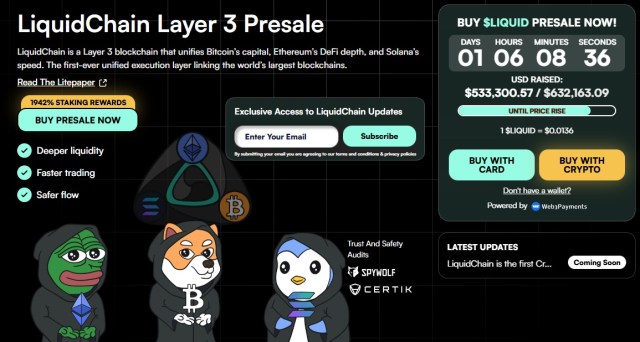
The capital inflow suggests investors are looking beyond commoditized Layer 2 scaling solutions toward Layer 3 protocols with specific interoperability use cases.

The utility of the $LIQUID token extends beyond simple governance. It functions as the transaction fuel for this cross-chain environment and facilitates liquidity staking. In a market where yield is often chased at the expense of safety, LiquidChain’s model offers a compelling alternative: rewards derived from the friction of unifying the world’s disparate blockchains.

With the presale gaining momentum, the window for early entry at these valuations is narrowing as the project approaches mainnet deployment.

Buy $LIQUID here.

Disclaimer: The content provided in this article is for informational purposes only and does not constitute financial advice. Cryptocurrency investments carry inherent risks, including high volatility and potential loss of principal. Always conduct your own research.

Editorial Process for bitcoinist is centered on delivering thoroughly researched, accurate, and unbiased content. We uphold strict sourcing standards, and each page undergoes diligent review by our team of top technology experts and seasoned editors. This process ensures the integrity, relevance, and value of our content for our readers.

patrubogdan

Follow

Full Profile

Related Posts

Crypto Exchange Backpack Targets Token Launch Soon, as BMIC Fires Up Quantum Defense

Vitalik Buterin Outlines Ethereum’s AI Future, While SUBBD Token Targets the Creator Economy

Binance Dominates Trump’s USD1 Supply as Bitcoin Hyper Breaks Records

Cathie Wood’s Ark Invest Buys More Bullish Assets Just Days After Last Purchase, While LiquidChain Turns Heads

Polymarket Sues Massachusetts Over Prediction Market Regulation – SUBBD Token Takes Advantage

Bitcoin Hyper Could Conquer 2026 if Bitcoin Regains Lost Ground

Crypto di tendenza

Domande pertinenti

QWhat is the SEAL initiative and why is the Ethereum Foundation backing it?

AThe SEAL (Security Alliance) initiative is a coalition of white-hat hackers and researchers that serves as the industry's emergency response team against crypto drainers. The Ethereum Foundation is backing it to strengthen the coordinated defense against exploits, providing both financial support and institutional validation for centralized threat intelligence to create a 'herd immunity' effect.

QHow does LiquidChain's L3 protocol address security concerns in DeFi?

ALiquidChain's Layer 3 protocol unifies liquidity from Bitcoin, Ethereum, and Solana into a single execution layer, eliminating the need for risky cross-chain bridges. It reduces complexity by allowing 'single-step execution' and abstracting away interoperability friction, thereby removing common attack vectors used by drainers.

QWhat is the current presale status and token price of LiquidChain ($LIQUID)?

ALiquidChain's presale has raised over $533,000 to date, with the $LIQUID token currently priced at $0.0136.

QHow does SEAL's 'SEAL 911' initiative work?

ASEAL's 'SEAL 911' initiative allows victims and protocols to report active exploits in real-time, enabling white-hat hackers to intercept funds before they reach mixers or are laundered.

QWhat is the core investment thesis behind capital flowing into L3 infrastructure like LiquidChain?

AThe investment thesis centers on the 'abstraction narrative' - that next-generation users won't care about underlying blockchain complexity. Investors are betting on infrastructure that streamlines user experience by unifying liquidity across chains and eliminating bridging risks, treating security as a fundamental architectural feature rather than an add-on.

Letture associate

Stocks Fell Even More Violently Than Crypto, Where Did the Money Go?

From June to late July 2026, global stock markets, particularly technology and semiconductor stocks, experienced severe declines, with South Korea's KOSPI index facing historic circuit breakers and shedding 40% from its June peak. Key catalysts included SK Hynix's earnings miss despite record profits and competitive pressures from China's CXMT IPO. A global forced deleveraging event unfolded, devastating highly leveraged instruments like the 2x leveraged SK Hynix ETF, which lost over 80% of its value. Surprisingly, Bitcoin showed relative stability during this period, rising roughly 15% from its July low. The article clarifies this wasn't due to an inflow of equity flight capital but because Bitcoin had already undergone a significant correction in May and June, with U.S. spot Bitcoin ETFs seeing record outflows. True safe-haven flows went to gold, severing Bitcoin's short-term "digital gold" narrative. The sell-off is characterized not as an AI story collapse but a liquidity-driven清算 of crowded leveraged positions, potentially halfway through according to some analysts. For substantial capital to return to Bitcoin, the article cites necessary conditions: eased global liquidity pressure, a soft-landing Fed rate cut, and regulatory clarity from the stalled U.S. CLARITY Act. The conclusion is that Bitcoin is not a current safe haven but a pre-cleared asset. Its decoupling from tech stocks highlights its potential future role as a non-correlated asset for institutional portfolios, positioning it favorably for when global capital reallocates post-crisis.

marsbit6 min fa

Stocks Fell Even More Violently Than Crypto, Where Did the Money Go?

marsbit6 min fa

"The Final Phase Before the New Cycle". What Will Happen to Bitcoin in August

"Bitcoin Faces Crucial Test in August: Experts Predict Consolidation or Further Decline" The price of Bitcoin (BTC) is expected to remain under pressure in August, with experts anticipating either consolidation within a narrow range or a potential drop below $60,000. Despite a double-digit recovery from its July low near $58,000, BTC ended the month trading around $63,500, still roughly 50% below its October 2025 peak of $126,200. Analysts cite several headwinds: a challenging macroeconomic environment with high US interest rates and persistent inflation, which makes fixed-income assets more attractive than speculative ones like crypto. Furthermore, competition for capital is intense, with many investors favoring AI-related stocks. This is reflected in significant outflows from US spot Bitcoin ETFs, with a record $4.5 billion leaving in June and a net outflow of $5.4 billion for the first half of the year. Historically, August is a weak month for crypto, with a median return of -7.49% from 2013 to 2025. Experts also note regulatory uncertainty in the US, particularly the stalled CLARITY Act, as a dampening factor. Despite the bearish near-term outlook, several experts view the current phase as the "last phase before a new Bitcoin cycle" begins, potentially in Q4 2024. This makes it a favorable time for accumulating Bitcoin for the long term. Key price levels to watch are support at $60,000-$61,000, with a break below $58,000 potentially leading to $53,000-$55,000. A move above $67,000 could target $70,000-$75,000, though this is considered a lower probability scenario.

cryptonews.ru11 min fa

"The Final Phase Before the New Cycle". What Will Happen to Bitcoin in August

cryptonews.ru11 min fa

What Structural Changes Have Occurred in the Cryptocurrency Industry by 2026?

By 2026, the crypto industry is undergoing profound structural shifts, moving beyond price speculation towards deeper integration with the real-world economy. Major changes are driven by four key areas. First, stablecoins, now a $300B+ market, are evolving from crypto-native trading tools into real-world payment and B2B settlement backbones, extending business chains and creating complex accounting and tax obligations. Second, global regulation is maturing. Frameworks like the EU's MiCA are moving from legislation to active enforcement, determining market access. Anti-money laundering rules, such as the Travel Rule, see wider adoption but face enforcement and cross-border challenges. Third, AI Agents are emerging as autonomous transaction entities. Protocols like Coinbase's x402 enable machine-to-machine micropayments using stablecoins, necessitating new frameworks for transaction authorization, tax attribution, and audit trails. Finally, tax transparency is entering an implementation phase. Initiatives like the OECD's CARF, EU's DAC8, and the US Form 1099-DA are shifting reporting burdens to platforms, requiring them to reconcile on-chain data with user identity and tax residency information. Collectively, these trends signify that crypto compliance is becoming foundational infrastructure, requiring consistent data and control systems to meet cross-border operational, regulatory, and audit demands.

marsbit32 min fa

What Structural Changes Have Occurred in the Cryptocurrency Industry by 2026?

marsbit32 min fa

Trading

Spot

Articoli Popolari

Come comprare L3

Benvenuto in HTX.com! Abbiamo reso l'acquisto di Layer3 (L3) semplice e conveniente. Segui la nostra guida passo passo per intraprendere il tuo viaggio nel mondo delle criptovalute.Step 1: Crea il tuo Account HTXUsa la tua email o numero di telefono per registrarti il tuo account gratuito su HTX. Vivi un'esperienza facile e sblocca tutte le funzionalità,Crea il mio accountStep 2: Vai in Acquista crypto e seleziona il tuo metodo di pagamentoCarta di credito/debito: utilizza la tua Visa o Mastercard per acquistare immediatamente Layer3L3.Bilancio: Usa i fondi dal bilancio del tuo account HTX per fare trading senza problemi.Terze parti: abbiamo aggiunto metodi di pagamento molto utilizzati come Google Pay e Apple Pay per maggiore comodità.P2P: Fai trading direttamente con altri utenti HTX.Over-the-Counter (OTC): Offriamo servizi su misura e tassi di cambio competitivi per i trader.Step 3: Conserva Layer3 (L3)Dopo aver acquistato Layer3 (L3), conserva nel tuo account HTX. In alternativa, puoi inviare tramite trasferimento blockchain o scambiare per altre criptovalute.Step 4: Scambia Layer3 (L3)Scambia facilmente Layer3 (L3) nel mercato spot di HTX. Accedi al tuo account, seleziona la tua coppia di trading, esegui le tue operazioni e monitora in tempo reale. Offriamo un'esperienza user-friendly sia per chi ha appena iniziato che per i trader più esperti.

204 Totale visualizzazioniPubblicato il 2024.12.06Aggiornato il 2026.06.02

Come comprare L3

Discussioni

Benvenuto nella Community HTX. Qui puoi rimanere informato sugli ultimi sviluppi della piattaforma e accedere ad approfondimenti esperti sul mercato. Le opinioni degli utenti sul prezzo di L3 L3 sono presentate come di seguito.

活动图片