Ethereum Derivatives See Heavy Unwind As Open Interest Falls Hard – A Leveraged Flush?

bitcoinistPubblicato 2025-12-22Pubblicato ultima volta 2025-12-22

Introduzione

Amidst a volatile market, Ethereum's price briefly reclaimed $3,000, but its derivatives market is signaling a significant shift. Open Interest (OI) has plummeted by 50% since August, indicating a massive unwind of leveraged positions and a sharp decline in trader risk appetite. This drop, observed across major exchanges like Binance (-31%), suggests robust market deleveraging and a lower probability of explosive short-term price moves. Concurrently, ETH withdrawals from exchanges have spiked to multi-year lows, reducing immediate sell pressure. While this points to a more cautious, consolidating market, such a flush of leverage has historically preceded major structural shifts.

On Sunday, the Ethereum price retested the $3,000 mark after trading below the level for the past few days due to a volatile market environment. ETH’s price may be gradually regaining upside momentum, but other aspects are still experiencing downward pressure, such as the Open Interest (OI).

Sharp Drop In Ethereum Open Interest

In the current volatile state of the cryptocurrency landscape, the Ethereum derivatives market is signaling a key indicator. This crucial signal is coming from the ETH Open interest, which has witnessed a significant pullback in the past few months. According to the research from the advanced investment and on-chain data analytics platform Alphractal, the metric has dropped by half or 50% since August this year.

A significant drop in this metric is a clear indication that trader positioning and risk appetite have shifted notably. Following a period of high leverage and aggressive speculation, the sharp collapse indicates that positions are being unwound, exposure is being decreased, and momentum is cooling across futures markets.

Alphractal highlighted that the Ethereum open interest is valued at roughly half of what it was in August 2025, suggesting a drastic decline in market risk. Such a move points to institutions and large whale holders who have closed leveraged ETH positions. The exiting of positions by big investors shows that they are reducing exposure and speculative pressure.
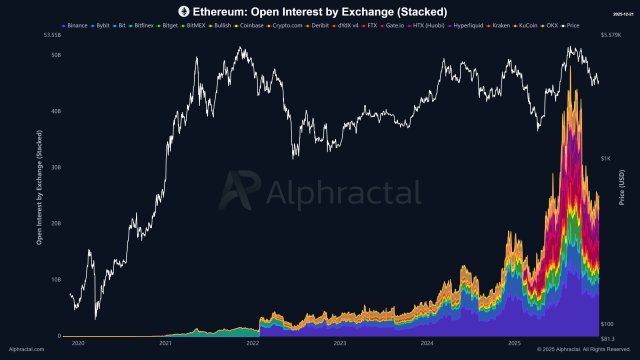
Source: Chart from Alphractal on X

ETH’s open interest has also fallen sharply on cryptocurrency exchanges. After examining the Ethereum Open Interest distribution by exchange, Alphractal unveiled a 31% decline to $7.64 billion on the world’s largest exchange, Binance.

On Gateio, open interest is at $3.72 billion, indicating a 15% decrease, while HTX (formerly known as House) has fallen by 12.65% to $3.12 million. Furthermore, Bybit has $2.53 billion with a 10.25% drop, HyperLiquid has $2.51 billion with a 10.18%, and Bitget has $1.79 billion with a 7.25% decline.

With exchanges’ open interest dropping, this tells a compelling story of the current market structure. This outlines robust deleveraging across the Ethereum market and a lower probability of explosive moves in the short term.

Typically, an atmosphere that is more cautious and protective implies stages of consolidation or preparation for the next trend leg. However, deep declines in open interest have historically frequently preceded significant structural changes, either a healthier reversal or a downward continuation with less leverage.

ETH Withdrawals From Crypto Exchanges Have Spiked

Ethereum’s open interest drop comes at a time of a massive drop in ETH supply on crypto exchanges. Currently, ETH withdrawals have reached their lowest levels since 2016, reflecting growing trader caution and dampened short-term sell pressure.

As more ETH is taken out of exchanges and placed in long-term holding locations, the liquid supply keeps decreasing. While the supply decrease bolsters ETH’s volatility, it also encourages price pressure to rise.

ETH trading at $3,048 on the 1D chart | Source: ETHUSDT on Tradingview.com

Crypto di tendenza

Domande pertinenti

QWhat has happened to Ethereum's Open Interest (OI) since August this year, according to the article?

AEthereum's Open Interest has dropped by 50% since August this year, indicating a significant unwind of leveraged positions and a decrease in market risk.

QWhich cryptocurrency exchange saw the largest decline in Ethereum Open Interest, and by how much?

ABinance, the world's largest exchange, saw the largest decline in Ethereum Open Interest, with a 31% drop to $7.64 billion.

QWhat does a sharp drop in Open Interest typically signal about trader behavior and market conditions?

AA sharp drop in Open Interest signals that traders are unwinding positions, decreasing their exposure, and reducing leverage. It indicates a shift to a more cautious and protective atmosphere, often leading to market consolidation or preparation for the next trend.

QAlongside the drop in Open Interest, what other on-chain activity suggests growing trader caution?

AAlongside the drop in Open Interest, the supply of ETH on cryptocurrency exchanges has reached its lowest level since 2016, as more ETH is being withdrawn to long-term holding locations, which dampens short-term sell pressure.

QWhat is the potential implication of a decreasing liquid supply of ETH on exchanges for its price?

AA decreasing liquid supply of ETH on exchanges reduces the available coins for immediate selling, which can bolster ETH's volatility and create upward price pressure.

Letture associate

From South Korea to the United States: Blue-Collar Jobs Are Becoming Increasingly Popular, Thanks to AI

AI is reshaping the labor market's value proposition. The traditional four-year college degree is losing its appeal as a guaranteed career path, while skilled blue-collar trades like electricians, welders, and plumbers are experiencing historic demand and wage premiums. This shift is driven by dual pressures: AI's displacement of certain white-collar roles and a booming need for physical infrastructure and data center construction. Data confirms the trend. In the U.S., vocational school revenue surged, and a significant portion of recent layoffs are AI-related. Surveys show a majority of Gen Z adults plan to pursue blue-collar work, citing better job security against AI automation. Vocational education interest has exploded recently. Experts cite a psychological shift as younger generations seek tangible, AI-resistant careers and avoid high student debt. In many cases, salaries for skilled trades now match or exceed those requiring a bachelor's degree. In South Korea, semiconductor vocational high schools boast near-total employment, with graduates securing high-paying roles at companies like Samsung. The shortage is structural, exacerbated by a retiring baby boomer workforce and massive infrastructure projects. Companies like JPMorgan Chase, Meta, and Lowe's are investing heavily in training programs. However, overcoming historical stigma and a "perception gap" around trade careers remains a key challenge to closing the talent gap.

marsbit28 min fa

From South Korea to the United States: Blue-Collar Jobs Are Becoming Increasingly Popular, Thanks to AI

marsbit28 min fa

Qualcomm: AI Hype Subsides, When Will Smartphones Emerge from the Gloom?

Qualcomm reported its Q3 FY2026 results (ending June 2026), with revenue of $9.95B, down 4% YoY but above expectations. Gross margin declined to 53.1%, pressured by rising costs across manufacturing and memory. Key business segments showed mixed performance: Handset revenue fell 19.6% YoY to $5.09B, dragged by an 11% decline in non-Apple Android shipments and weaker high-end mix. Conversely, Automotive revenue surged 61% to $1.59B, and IoT grew 9% to $1.83B. Core operating profit dropped 41% YoY due to margin compression and higher expenses. Management's Q4 FY2026 guidance projects revenue of $9.7B-$10.5B, in line with consensus, but Non-GAAP EPS guidance of $2.05-$2.25 fell short of expectations. Amidst persistent weakness in its core handset market, Qualcomm is pursuing growth in AI, focusing on Edge AI (smartphones, PCs, automotive) and Data Center AI. Its data center strategy includes four pillars: AI accelerators (e.g., AI200), commercial CPUs (Dragonfly C1000), custom silicon, and connectivity solutions. While these initiatives initially boosted its stock, concerns over AI capital expenditure sustainability have since erased those gains. The company targets $5B in data center revenue for FY2027 and $15B for FY2029. The report concludes that with the traditional handset business still under pressure, the data center opportunity is currently viewed as a longer-term option, and a more conservative valuation based on core operations may be warranted until AI contributions materialize.

marsbit33 min fa

Qualcomm: AI Hype Subsides, When Will Smartphones Emerge from the Gloom?

marsbit33 min fa

From TPU to Self-Evolving Agents: How Jeff Dean Predicts the Next Step in AI

At the 2026 YC Startup School, Jeff Dean outlined his vision for AI's next phase, shifting focus from simply scaling models to building intelligent, autonomous systems. He believes AI's progress is no longer just about creating smarter models, but about integrating them into systems capable of long-term, iterative work, automated experimentation, and continuous learning. This evolution moves the competition from "who has the bigger model" to "who can best organize intelligence." Dean suggests AI capabilities are now comparable to a junior engineer, enabling the automation of complex workflows. However, the true challenge and opportunity lie in managing these AI "workers" at scale. He emphasizes the importance of **context engineering**—structuring tools, memory, and feedback loops—over raw model power. For startups, this means building deep expertise in niche domains where general models currently fail (near 0-1% success rates), leveraging proprietary data, specialized tools, and domain-specific evaluators. A recurring theme is re-examining fundamental constraints. Dean's past work, like moving Google's search index to memory or creating the TPU, stemmed from questioning outdated assumptions about hardware and cost. He sees similar inflection points today, particularly in **specialized inference hardware** to drastically reduce latency and energy consumption for real-time Agent operation. Notably, he points out that in modern AI systems, the dominant cost is often not computation but **data movement**. Reliable, long-running Agents require robust system design, borrowing concepts from distributed computing like checkpointing, state management, and parallel exploration to handle failures and maintain progress over days or weeks. As AI automates execution, the scarcest human skills will shift to **defining clear specifications**, **judging what problems are worth solving** (taste), and designing effective feedback loops. Ultimately, Dean's framework prioritizes understanding the problem deeply, identifying the true bottlenecks, and systematically building closed-loop systems where AI can not only perform tasks but also improve AI itself.

marsbit33 min fa

From TPU to Self-Evolving Agents: How Jeff Dean Predicts the Next Step in AI

marsbit33 min fa

Trading

Spot

Articoli Popolari

Come comprare O

Benvenuto in HTX.com! Abbiamo reso l'acquisto di O1 exchange (O) semplice e conveniente. Segui la nostra guida passo passo per intraprendere il tuo viaggio nel mondo delle criptovalute.Step 1: Crea il tuo Account HTXUsa la tua email o numero di telefono per registrarti il tuo account gratuito su HTX. Vivi un'esperienza facile e sblocca tutte le funzionalità,Crea il mio accountStep 2: Vai in Acquista crypto e seleziona il tuo metodo di pagamentoCarta di credito/debito: utilizza la tua Visa o Mastercard per acquistare immediatamente O1 exchangeO.Bilancio: Usa i fondi dal bilancio del tuo account HTX per fare trading senza problemi.Terze parti: abbiamo aggiunto metodi di pagamento molto utilizzati come Google Pay e Apple Pay per maggiore comodità.P2P: Fai trading direttamente con altri utenti HTX.Over-the-Counter (OTC): Offriamo servizi su misura e tassi di cambio competitivi per i trader.Step 3: Conserva O1 exchange (O)Dopo aver acquistato O1 exchange (O), conserva nel tuo account HTX. In alternativa, puoi inviare tramite trasferimento blockchain o scambiare per altre criptovalute.Step 4: Scambia O1 exchange (O)Scambia facilmente O1 exchange (O) nel mercato spot di HTX. Accedi al tuo account, seleziona la tua coppia di trading, esegui le tue operazioni e monitora in tempo reale. Offriamo un'esperienza user-friendly sia per chi ha appena iniziato che per i trader più esperti.

586 Totale visualizzazioniPubblicato il 2026.06.19Aggiornato il 2026.06.29

Come comprare O

Come comprare PROS

Benvenuto in HTX.com! Abbiamo reso l'acquisto di Pharos (PROS) semplice e conveniente. Segui la nostra guida passo passo per intraprendere il tuo viaggio nel mondo delle criptovalute.Step 1: Crea il tuo Account HTXUsa la tua email o numero di telefono per registrarti il tuo account gratuito su HTX. Vivi un'esperienza facile e sblocca tutte le funzionalità,Crea il mio accountStep 2: Vai in Acquista crypto e seleziona il tuo metodo di pagamentoCarta di credito/debito: utilizza la tua Visa o Mastercard per acquistare immediatamente PharosPROS.Bilancio: Usa i fondi dal bilancio del tuo account HTX per fare trading senza problemi.Terze parti: abbiamo aggiunto metodi di pagamento molto utilizzati come Google Pay e Apple Pay per maggiore comodità.P2P: Fai trading direttamente con altri utenti HTX.Over-the-Counter (OTC): Offriamo servizi su misura e tassi di cambio competitivi per i trader.Step 3: Conserva Pharos (PROS)Dopo aver acquistato Pharos (PROS), conserva nel tuo account HTX. In alternativa, puoi inviare tramite trasferimento blockchain o scambiare per altre criptovalute.Step 4: Scambia Pharos (PROS)Scambia facilmente Pharos (PROS) nel mercato spot di HTX. Accedi al tuo account, seleziona la tua coppia di trading, esegui le tue operazioni e monitora in tempo reale. Offriamo un'esperienza user-friendly sia per chi ha appena iniziato che per i trader più esperti.

550 Totale visualizzazioniPubblicato il 2026.06.22Aggiornato il 2026.06.29

Come comprare PROS

Cosa è VERONA

I. Introduzione al Progetto VERONA è una blockchain costruita per tutti, ovunque attraverso l'astrazione della catena. Utilizzando il suo livello di astrazione generalizzato, VERONA si distingue integrando funzionalità blockchain complesse, come conti, firme e interoperabilità, direttamente a livello di protocollo. Questo approccio consente di interagire con le applicazioni blockchain senza la necessità di comprendere le tecnologie sottostanti.1) Informazioni di Base Nome:VERONA(VERONA)III. Link Correlati Link al sito ufficiale:https://xion.burnt.com/ Whitepaper:https://xion.burnt.com/whitepaper.pdf Esploratori:https://explorer.burnt.com/ Social Media: https://x.com/burnt_xion Nota: L'introduzione al progetto proviene dai materiali pubblicati o forniti dal team ufficiale del progetto, che è solo a scopo di riferimento e non costituisce consulenza per investimenti. HTX non si assume responsabilità per eventuali perdite dirette o indirette risultanti.

534 Totale visualizzazioniPubblicato il 2026.06.22Aggiornato il 2026.06.22

Cosa è VERONA

Discussioni

Benvenuto nella Community HTX. Qui puoi rimanere informato sugli ultimi sviluppi della piattaforma e accedere ad approfondimenti esperti sul mercato. Le opinioni degli utenti sul prezzo di A A sono presentate come di seguito.

活动图片














