Escalation of US-Iran Conflict: How Did Prediction Markets Price War Risk Ahead of Oil Prices?

marsbitPubblicato 2026-03-05Pubblicato ultima volta 2026-03-05

Introduzione

The article analyzes how the escalation of U.S.-Iran tensions—triggered by reports of Ayatollah Khamenei’s death and military actions—was rapidly priced into global markets, despite occurring during a weekend when traditional markets were closed. Crypto assets and on-chain commodity contracts (e.g., oil and gold perpetuals) saw immediate volatility, reflecting early risk sentiment. Prediction markets like Polymarket and Opinion played a key role by quantifying event probabilities—such as leadership changes or military strikes—in real time, with significant trading volumes. When traditional markets reopened, oil, gold, and equities adjusted to reflect the risk premium already established on-chain. The event illustrates a structural shift: digital, 24/7 markets now facilitate real-time financialization of geopolitical risk, often ahead of traditional exchanges. Risk pricing is migrating from reactive post-event adjustments to continuous, probabilistic markets that participate in shaping outcomes.

CoinW Research Institute

Abstract

This article takes the escalation of the US-Iran conflict as a starting point to analyze how a geopolitical event is rapidly transformed into a global risk variable in the contemporary financial system. Since the event occurred over the weekend when traditional financial markets were closed, on-chain markets were still operating. Crypto assets and on-chain commodity contracts experienced sharp fluctuations first, completing the initial expression of risk; prediction markets directly probabilized war and political changes, achieving real-time pricing of the event path. After traditional markets opened on Monday, energy, the US dollar, US bonds, and risk assets completed systemic confirmation, with risk premiums transmitted layer by layer along the macro chain. The article points out that in the 24/7 operating environment of digital markets, risk is no longer priced only at the opening bell. Geopolitics is being financialized in real time; markets are not just passively reacting to events but are participating in the pricing of risk itself during the development of events.

1. Conflict Escalation: How a Geopolitical Event Becomes a Global Risk Variable

Recently, tensions between the US and Iran escalated sharply. Multiple media reports indicated that Iran's Supreme Leader Ayatollah Ali Khamenei was killed in an airstrike, leading to a rapid deterioration of the regional situation. Military actions and strong statements combined quickly turned the situation from a regional friction point into a global focus.

Subsequently, the Islamic Revolutionary Guard Corps of Iran announced restrictions on ship passage through the Strait of Hormuz. As one of the world's most important energy transport channels, this key hub, which long carries about one-fifth of global crude oil and liquefied natural gas shipments, faced severe restrictions, with several shipping companies suspending passage or choosing detours.

The impact of the conflict is no longer limited to the military level. The Middle East is the core region for global energy supply, and disturbances in the Strait of Hormuz directly push up energy risk premiums, which are quickly transmitted to global markets through oil prices, inflation expectations, and capital flows.

Thus, this conflict has become a systemic global risk variable. It affects not only the regional security landscape but also the energy supply-demand balance, the US dollar liquidity environment, and the valuation system of risk assets.

When war escalates into a systemic risk, where is the risk traded first? In a structure where traditional markets operate on a time-bound basis while on-chain markets operate 24/7, the timing sequence of price discovery is changing.

2. Weekend Time Frame: On-Chain Markets Complete the First Round of Price Discovery

Notably, this conflict occurred over the weekend. When the news broke, most global traditional financial markets were closed: spot gold paused quotes, crude oil futures halted trading, and stock markets were closed. Risk had emerged, but the traditional system could not price it immediately. However, on-chain markets were still operating, and risk sentiment shifted to a still-open pricing venue.

Crypto Assets Lead with Sharp Fluctuations

After the conflict news emerged, Bitcoin's price briefly approached $63,000 before rebounding to around $66,000, completing significant volatility in a short time. This volatility was not simply safe-haven buying or panic selling but a concentrated gamble on risk expectations in the absence of traditional anchors like gold and crude oil. When other assets were untradeable, the crypto market became an outlet for risk expression.

On-Chain Commodity Contracts: Risk Premiums Form Instantly

Over the weekend, multiple media reports indicated that on the Hyperliquid platform, perpetual contracts linked to crude oil, gold, and silver showed significant increases: crude oil perpetual contracts rose about 5% to approximately $70.6/barrel; gold perpetual contracts rose about 1.3% to around $5,323/ounce; silver perpetual contracts rose about 2% to about $94.9/ounce. Trading volumes also expanded. The 24-hour trading volume for silver contracts exceeded $227 million, and gold contracts reached about $173 million, showing real capital participation. These were prices truly formed in the 24/7 on-chain market, reflecting the immediate judgment of market participants on supply risks and geopolitical premiums during the closure of traditional markets.

Monday Opening: Traditional Markets "Catch Up"

When traditional markets reopened, prices quickly adjusted in the direction of the weekend on-chain movements. International oil prices opened higher on Monday, with Brent crude rising to $82.37/barrel at one point and WTI crude jumping above $75; spot gold broke through $5,300/ounce; major global stock index futures generally weakened, with risk assets under pressure. The price sequence was clear: risk emerged over the weekend; on-chain markets fluctuated first; traditional markets completed larger-scale confirmation and diffusion on Monday.

During the time window when traditional markets were closed, on-chain markets assumed the function of the first wave of risk expression. This structural time difference is changing the pricing rhythm of global risk events.

3. Prediction Markets: War Is Probabilized in Real Time for the First Time

Polymarket: Explosive Pricing of Conflict Nodes

During this event, the trading volume of contracts related to the conflict escalation on the on-chain prediction platform Polymarket significantly expanded.

The series of contracts on "Will the US or Israel strike Iran by a certain date?" accumulated a trading volume of over $500 million, with the trading volume on the day of the airstrike alone reaching about $90 million, making it one of the largest geopolitical markets in the platform's history.

After the confirmation of the leader's death, contracts related to "Will Khamenei lose his position as Supreme Leader of Iran by March 31?" were quickly settled, with a trading volume of about $57 million. The implied probability of long-term political direction contracts like "Will the Iranian regime collapse by June 30?" once rose to nearly 50%, indicating that the market had begun pricing deeper institutional risks. These data show that betting was not scattered behavior but formed concentrated and high-intensity capital participation.
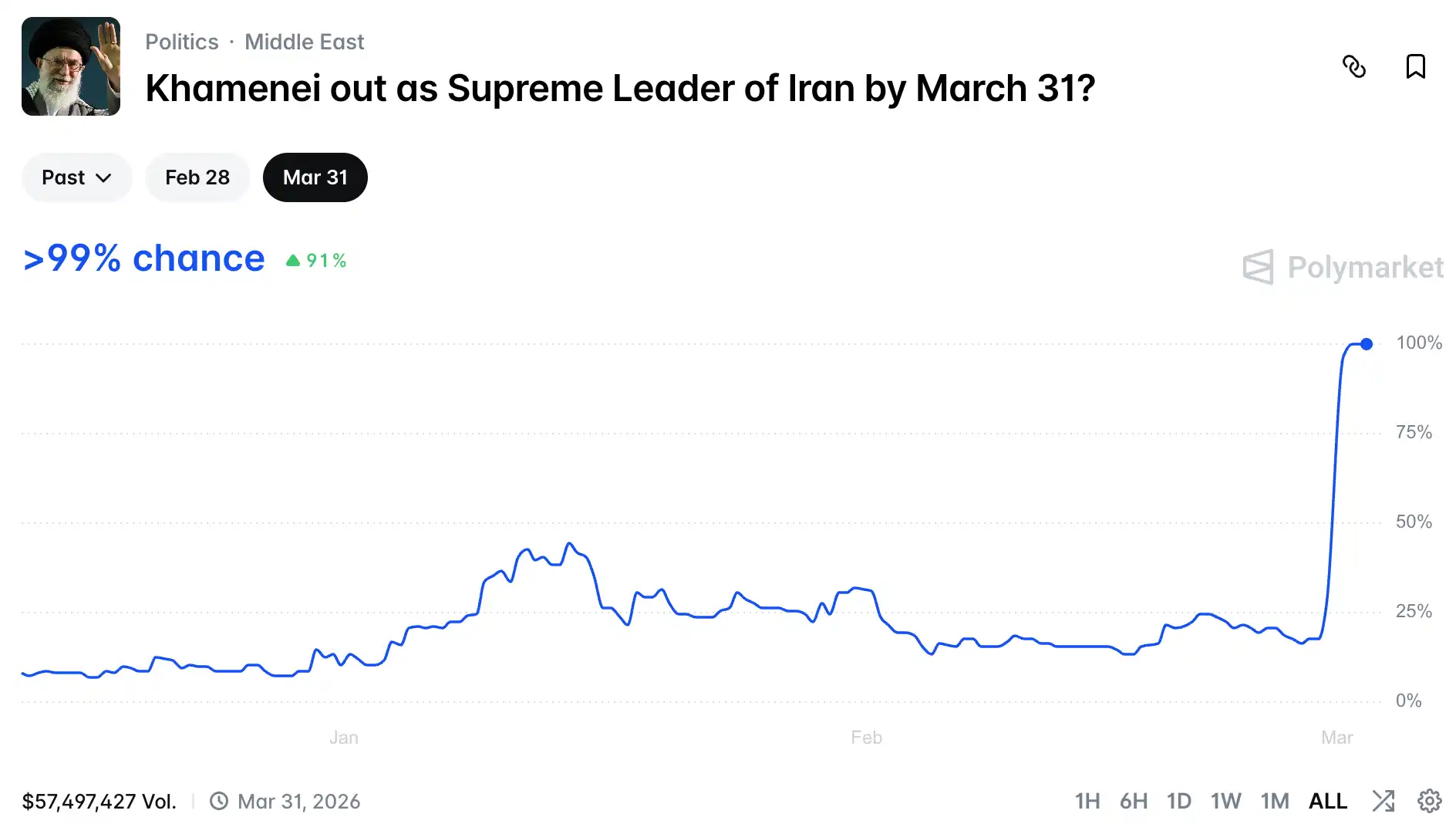
Source: https://polymarket.com/event/khamenei-out-as-supreme-leader-of-iran-by-march-31

Opinion: Multi-Dimensional Pricing of Conflict Paths and Institutional Risks

On Opinion, contracts related to the US-Iran conflict also showed high activity. One type of market precisely defines military triggers. For example, "Will the US strike Iran by a certain date?" specifies that it is only judged as Yes if the US military actually hits Iranian territory or official embassies with drones, missiles, or airstrikes; intercepted weapons or other forms of military action are not counted. The trading volume of this contract has exceeded $12.6 million, showing the market's high attention to specific military trigger conditions.
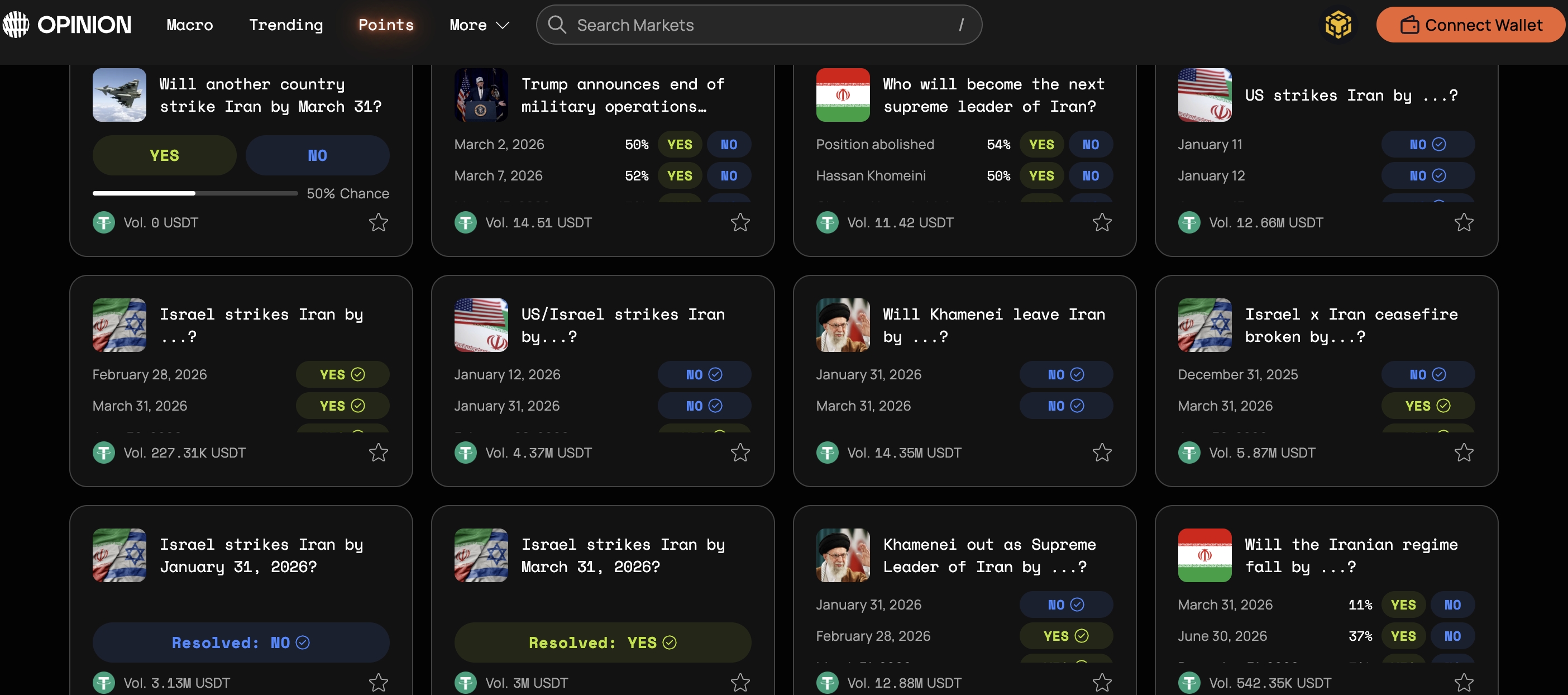
Source:https://app.opinion.trade/search?q=Iran

Another type of market turns to institutional layer risks. "Khamenei out as Supreme Leader of Iran by ...?" prices whether Iran's Supreme Leader Ali Khamenei loses power within a specific time window. The rules include resignation, detention, loss of position, or inability to perform duties as judgment standards and use credible media consensus as the settlement basis, with a trading volume of about $12.9 million. Additionally, markets like "Will the Iranian regime collapse by XX date?" and "Will the ceasefire between Israel and Iran be broken by XX date?" probabilistically express regime stability and ceasefire sustainability, respectively.

Although the number of related contracts and overall trading scale are still lower than Polymarket, Opinion presents a clearer risk stratification structure: military actions, ceasefire status, leader retention, and regime direction are decomposed into multiple independent variables for parallel pricing. Thus, war is no longer just a single-point question of "whether it happens" but a risk path that can be segmented, quantified, and continuously corrected. Prediction markets here serve as real-time measurement tools for sovereign risk and institutional stability.

Probability Curve as a "Risk Thermometer"

Unlike crude oil or gold, prediction markets do not indirectly express risk through assets but directly probabilistically price "whether an event will happen." When the probability of conflict escalation rises, odds jump; when the situation eases, the probability falls. The odds curve itself becomes an immediate scale of risk sentiment. Some analysis pointed out that a few hours before the airstrike news spread widely, a small number of new wallets concentrated on buying related contracts and profited after the event was confirmed. This phenomenon sparked discussions on whether information entered the market early, making the time sensitivity of prediction markets particularly prominent.

Traditional markets typically reflect outcomes through rising oil prices or falling stock markets; prediction markets directly trade "whether it escalates" and "whether it spreads." The former prices the impact, the latter prices the path. When traditional markets are not yet open, risk is already quantified and bet on on-chain.

4. Traditional Asset Opening Confirmation: How Are Risk Premiums Transmitted?

When on-chain markets fluctuate first, true cross-asset linkage occurs after traditional markets reopen.

Energy: The First Stop for Risk Premiums

Energy remains the first stop for risk premiums. The Strait of Hormuz carries about 20% of global crude oil shipments. As long as the market worries that supply may be hindered, oil prices will提前计入 risk premiums. Conflict escalation pushes oil prices up, thereby boosting inflation expectations and affecting interest rate policies and corporate cost structures.

US Dollar and US Bonds: Tug-of-War Between Safety and Inflation

When uncertainty rises, funds usually flow to the most liquid assets, so the US dollar and US bonds benefit short-term. The dollar strengthens, and US bond yields fall temporarily, reflecting increased safe-haven demand. But if the conflict continues and pushes up inflation expectations, US bond yields may face a tug-of-war between safe-haven buying and inflationary pressure.

Positioning of Risk Assets and Bitcoin

Gold serves the traditional safe-haven function, crude oil embodies risk premiums, and US bonds provide a liquidity safety net. Bitcoin's performance is closer to a high-elasticity risk asset. In the initial stage of the conflict, it did not rise unilaterally but fluctuated sharply, showing its high sensitivity to liquidity and risk appetite. Therefore, in the initial stage of extreme uncertainty, Bitcoin behaves more like a high-beta risk asset than a pure safe-haven tool.

Overall, on-chain markets express risk first, prediction markets probabilize risk, and traditional assets complete systemic confirmation after opening. Risk premiums are transmitted layer by layer along energy, interest rates, and asset valuations, eventually forming a联动 reaction in global markets.

5. Structural Changes: Is the Risk Pricing Mechanism Migrating?

The significance of this event may lie not only in the conflict itself but in how risk was priced.

Geopolitics Is Being Financialized in Real Time

In the past, geopolitics remained more at the news and diplomatic levels; now, it is being financialized in real time. Whether war escalates, whether sanctions are implemented, and how election results evolve can all be bet on, hedged, and probabilized in the market. Risk is no longer only interpreted after the fact but is traded during its occurrence.

On-Chain Markets Become 24/7 Risk Buffers

On-chain markets are beginning to assume a new function. Traditional markets have weekend closures and holiday breaks. When major events happen during this gap, prices cannot reflect sentiment immediately. But on-chain markets operate 24/7, becoming buffers for the first wave of sentiment release. Prices and probabilities fluctuate there first, and then traditional markets reopen for larger-scale confirmation and diffusion.

Price Discovery Rights Are Marginally Migrating

This time structure difference is bringing a deeper change: the marginal migration of price discovery rights. If on-chain contracts fluctuate first, if the odds curve of prediction markets jumps before oil prices and stock indices, will institutional investors start monitoring these data? Will macro models incorporate on-chain fluctuations as reference variables? Will media and traders regard prediction market probabilities as early warning signals for risk?

These questions are not yet settled, but the direction is clear. The "first expression" of risk is shifting from the opening bell of traditional exchanges to digital markets that operate 24/7. When war can be traded in real time, markets are no longer just passively responding to the outcomes of events but are participating in the pricing process of risk itself.


Domande pertinenti

QHow did the crypto and on-chain markets react to the escalation of the US-Iran conflict during the weekend when traditional markets were closed?

ACrypto assets like Bitcoin experienced significant volatility, and on-chain perpetual contracts for commodities such as crude oil, gold, and silver saw price increases and high trading volumes, completing the first round of risk pricing.

QWhat role did prediction markets like Polymarket and Opinion play in pricing the geopolitical risk of the conflict?

APrediction markets provided real-time, probability-based pricing on specific event outcomes, such as military strikes, leadership changes, and regime stability, allowing for the quantification and trading of conflict pathways before traditional markets opened.

QHow did traditional markets respond when they reopened after the weekend, following the initial price discovery in on-chain markets?

ATraditional markets 'caught up' by adjusting prices in the direction of the weekend's on-chain movements, with oil prices gapping higher, gold rising, and risk assets like equities coming under pressure, confirming the risk premium.

QWhat structural change in global risk pricing does the article suggest is occurring due to 24/7 digital markets?

AThe article suggests that price discovery is marginally migrating to always-on digital markets, which now act as a risk buffer and complete the first expression of risk, forcing traditional markets to respond and confirm when they open.

QHow was the function of Bitcoin characterized in the initial phase of the conflict, and how does it differ from traditional safe-haven assets?

ABitcoin was characterized not as a pure safe-haven asset like gold but as a high-beta risk asset, highly sensitive to liquidity and risk sentiment, evidenced by its sharp volatility rather than a unilateral rise.

Letture associate

Borrowing Money from a Hundred Years Later, Building Incomprehensible AI

Tech giants like Alphabet, Amazon, Meta, and Microsoft are undergoing a radical financial transformation due to AI. Their traditional "light-asset, high-free-cash-flow" model is being dismantled by staggering capital expenditures on AI infrastructure—data centers, GPUs, and power. Combined 2026 guidance exceeds $700 billion, a 4.5x increase from 2022, causing free cash flow to plummet (e.g., Amazon's fell 95%). To fund this, they are borrowing unprecedented sums through long-dated, multi-currency bonds (e.g., Alphabet's 100-year bond). The world's most conservative capital—pensions, insurers—is now funding Silicon Valley's most speculative bet. This shift makes these companies resemble heavy-asset industrials (railroads, utilities) rather than software firms, threatening their premium valuations. Historically, such infrastructure booms (railroads, fiber optics) followed a pattern: genuine technology, overbuilding fueled by competitive frenzy, aggressive debt financing, and a crash triggered by financial conditions—not technology failure. The infrastructure remained, but many original builders and financiers did not survive. The core gamble is a "time arbitrage": using cheap debt today to build scale and lock in customers before AI capabilities commoditize. They are betting that AI revenue will materialize before debt comes due. Their positions vary: Amazon is under immediate cash pressure; Meta's path to monetization is unclear; Alphabet has a robust core business buffer; Microsoft has the shortest path from infrastructure to revenue. The contract is set: the most risk-averse global capital has lent its time to Silicon Valley, awaiting a future that is promised but uncertain.

marsbit25 min fa

Borrowing Money from a Hundred Years Later, Building Incomprehensible AI

marsbit25 min fa

The 'VVV' Concept Soars 9x in Half a Year, The New AI Narrative on Base Chain

"The article explores the 'VVV' concept as the new AI-focused narrative within the Base ecosystem, centered around the token $VVV of the privacy-focused, uncensored generative AI platform Venice, led by crypto veteran Erik Voorhees. Venice has seen significant growth in 2026, with its API users surging, partly attributed to exposure from OpenClaw. The platform now boasts over 2 million total users and 55,000 paid subscribers. Correspondingly, the $VVV token price has risen over 9x this year. Key to its performance are tokenomics designed for value accrual: reduced annual emissions, subscription revenue used for buyback-and-burn, and a unique staking mechanism. Staking $VVV yields $sVVV, which can be used to mint $DIEM tokens. Each staked $DIEM provides a daily $1 credit for using Venice's API services, creating tangible utility. The article also highlights other tokens associated with the 'VVV' narrative. $POD, the token of distributed AI network Dolphin (which co-developed Venice's default AI model), saw a massive price surge. $cyb3rwr3n, a project for a Venice credit auction market, gained attention due to perceived connections to Venice's team despite official denials. Finally, $SR of robotics platform STRIKEROBOT.AI rose after announcing a partnership with Venice for robot vision-language model development. Overall, the 'VVV' ecosystem combines AI platform growth, deflationary tokenomics, and innovative utility mechanisms, driving significant investor interest and price action in related tokens."

marsbit34 min fa

The 'VVV' Concept Soars 9x in Half a Year, The New AI Narrative on Base Chain

marsbit34 min fa

Anthropic and OpenAI Have Single-Handedly Severed the Logic of Pre-IPO Stock Tokenization

The pre-IPO stock token market is experiencing significant turmoil following strong statements from AI giants Anthropic and OpenAI. Both companies have updated their official policies, declaring that any transfer of their company shares—including sales, transfers, or assignments of share interests—without prior board approval is "invalid" and will not be recognized in their corporate records. This means buyers in such unauthorized transactions would not be recognized as shareholders and would have no shareholder rights. A major point of contention is the use of Special Purpose Vehicles (SPVs), which are legal entities commonly used by pre-IPO token platforms to pool investor funds and indirectly acquire shares from employees or early investors. The companies explicitly state they do not permit SPVs to acquire their shares, and any such transfer violates their restrictions. They warn that third parties selling shares through SPVs, direct sales, forward contracts, or stock tokens are likely engaged in fraud or are offering worthless investments due to these transfer limits. This stance directly threatens the core model of many pre-IPO token platforms, which rely on SPV structures. The announcement revealed additional risks within this model, such as complex "SPV-within-SPV" layering that obscures legal transparency, increases management fees, and creates a chain reaction risk of invalidation. Following the news, tokens like ANTHROPIC and OPENAI on platforms like PreStocks fell sharply (over 20%). The market reaction highlights a divergence: while asset-backed pre-IPO tokens plummeted, purely speculative pre-IPO futures contracts, which are bilateral bets on future IPO prices with no claim to actual shares, remained relatively stable as they are unaffected by the transfer restrictions. The industry is split on the implications. Some believe the fundamental logic of pre-IPO token trading is broken if leading companies reject SPV-held shares, potentially causing a domino effect. Others, like Rivet founder Nick Abouzeid, argue that buyers of such unofficial tokens always knowingly accepted the risk of non-recognition by the company. The statements serve as a stark risk warning and a corrective measure for a market where valuations for some AI-related pre-IPO tokens had soared to irrational levels, far exceeding recent funding round valuations.

marsbit1 h fa

Anthropic and OpenAI Have Single-Handedly Severed the Logic of Pre-IPO Stock Tokenization

marsbit1 h fa

Anthropic and OpenAI Personally Sever the Logic of Pre-IPO Crypto-Stocks

The pre-IPO token market has been rocked by strong statements from Anthropic and OpenAI. Both AI giants have updated official warnings, declaring that any sale or transfer of their company shares without explicit board approval is "invalid" and will not be recognized on their corporate records. This directly targets Special Purpose Vehicles (SPVs), the common legal structure used by pre-IPO token platforms. These platforms typically use an SPV to acquire shares from employees or early investors, then issue blockchain-based tokens representing a claim on the SPV's economic benefits. Anthropic and OpenAI's position means that if an SPV's share purchase lacked authorization, the underlying asset could be deemed worthless, nullifying the token's value. Anthropic explicitly warned that any third party selling its shares—via direct sales, forwards, or tokens—is likely fraudulent or offering a valueless investment. The crackdown highlights risks in the popular SPV model, including complex multi-layered "Russian doll" SPV structures that obscure legal ownership, add fees, and concentrate risk. If one layer is invalidated, the entire chain could collapse. Following the announcements, tokens like ANTHROPIC and OPENAI on platforms like PreStocks fell sharply (over 20%). In contrast, purely speculative pre-IPO prediction contracts remained stable, as they involve no actual share ownership. The move is seen as a corrective measure amid a market frenzy where some pre-IPO token valuations (e.g., Anthropic's token hitting a $1.4 trillion implied valuation) far exceeded recent official funding rounds. Opinions are split: some believe this undermines the core logic of pre-IPO token trading if top companies reject SPVs, while others argue buyers always assumed this legal risk when accessing unofficial channels. The statements serve as a stark warning and a potential catalyst for market de-leveraging and clearer boundaries.

Odaily星球日报1 h fa

Anthropic and OpenAI Personally Sever the Logic of Pre-IPO Crypto-Stocks

Odaily星球日报1 h fa

The Waged Worker Driven to Poverty by AI Subscriptions

"AI Membership: The Hidden Cost Pushing Workers Toward 'Poverty'" The widespread corporate push for AI adoption is creating a hidden financial burden for employees. Companies, from giants like Alibaba to small firms, are mandating AI use, often tying token consumption to KPIs, but frequently refuse to cover the costs. Workers are forced to pay for subscriptions out of pocket to stay competitive and avoid being replaced. Front-end developer Long Shen spends up to 2000 RMB monthly on tools like Cursor and ChatGPT Plus, seeing it as a necessary 3% salary investment to handle 90% of his coding tasks. While it boosted his performance and led to promotions, he now faces idle time at work, pretending to be busy. Designer Peng Peng navigates strict company firewalls by using personal devices and accounts for AI image generation tools like Midjourney, spending hundreds monthly without reimbursement, while her boss demands faster, more numerous revisions. The pressure creates workplace anxiety and suspicion. Programmer Li Huahua, after a friend's experience of raised KPIs following AI success, fears being branded a "traitor" for using it yet worries about falling behind if she doesn't. The dynamic allows management to demand results without understanding the tools or covering expenses, treating employees like AI "agents." While some, like entrepreneur Jin Tu, find high value in paid AI, building entire systems and winning competitions, for most, it's a trap. Free tools like Kimi and Doubao are introducing fees, closing off alternatives. The initial efficiency gains individual advantage, but as AI becomes ubiquitous, the personal edge disappears, workloads increase, and a cycle of dependency begins. Workers like Long Shen realize they cannot maintain AI-generated code without AI, making stopping harder than continuing to pay. The tool promising liberation is instead becoming a compulsory, costly chain in the modern workplace.

marsbit2 h fa

The Waged Worker Driven to Poverty by AI Subscriptions

marsbit2 h fa

Trading

Spot
Futures
活动图片




