Borrowing Money from a Hundred Years Later, Building Incomprehensible AI

marsbitPubblicato 2026-05-12Pubblicato ultima volta 2026-05-12

Introduzione

Tech giants like Alphabet, Amazon, Meta, and Microsoft are undergoing a radical financial transformation due to AI. Their traditional "light-asset, high-free-cash-flow" model is being dismantled by staggering capital expenditures on AI infrastructure—data centers, GPUs, and power. Combined 2026 guidance exceeds $700 billion, a 4.5x increase from 2022, causing free cash flow to plummet (e.g., Amazon's fell 95%). To fund this, they are borrowing unprecedented sums through long-dated, multi-currency bonds (e.g., Alphabet's 100-year bond). The world's most conservative capital—pensions, insurers—is now funding Silicon Valley's most speculative bet. This shift makes these companies resemble heavy-asset industrials (railroads, utilities) rather than software firms, threatening their premium valuations. Historically, such infrastructure booms (railroads, fiber optics) followed a pattern: genuine technology, overbuilding fueled by competitive frenzy, aggressive debt financing, and a crash triggered by financial conditions—not technology failure. The infrastructure remained, but many original builders and financiers did not survive. The core gamble is a "time arbitrage": using cheap debt today to build scale and lock in customers before AI capabilities commoditize. They are betting that AI revenue will materialize before debt comes due. Their positions vary: Amazon is under immediate cash pressure; Meta's path to monetization is unclear; Alphabet has a robust core business buffer; ...

On February 10, 2026, Alphabet, Google's parent company, issued a bond in London with a maturity date a hundred years in the future.

A hundred years.

Anyone buying this bond is betting that by the time their grandchildren retire, this company will still be alive and have the money to pay it back.

Historically, century bonds are extremely rare. Disney issued one in 1993, Coca-Cola did, and further back, Norfolk Southern Railway did. In fact, this term length was standard for 19th-century railroad companies because laying tracks, digging tunnels, and building bridges had investment payback periods so long they had to be calculated in 'centuries'.

But now, an internet company is borrowing money like a railroad company. Why?

Over the past eighteen months, the answer has gradually emerged. It's not in the PPT of any AI launch event, not on the benchmark leaderboards, and not in the debates about 'when AGI will arrive'. It's hidden in the capital expenditure line of financial reports, in the spread changes of bond issuances, in the cliff-like plunge of free cash flow.

To understand this answer, you first need to see what has disappeared.

The Money-Printing Machine Smashed by Its Own Hand

First, we need to understand that over the past two decades, what Wall Street believed in most was not a particular tech company itself, but a financial structure adopted by this cohort of companies.

These tech companies' revenue came from advertising, cloud services, platform commissions—all delivered digitally, with marginal costs approaching zero. No factories needed, no inventory, no mines or oil wells. The more users, the thinner the cost spread, the higher the profit margin.

The direct product of this structure is free cash flow. Unlike net profit, which on the income statement can be polished by accounting rules, free cash flow is the real money flowing into bank accounts, money that can be used for stock buybacks, dividends, and investing in the future. This is why US tech stocks get premium valuations.

There was an old joke about Apple sitting on over $200 billion in cash not knowing how to spend it; Google generating tens of billions in free cash flow year after year, as if the search box was directly connected to a gold mine; Amazon, under the guise of a low-margin e-commerce business, having a cloud computing money printer underneath; Meta making heaps of money from over two billion people seeing ads every day.

Investors weren't just buying growth; they were buying the 'light-asset, high-cash-flow' narrative because it promised these companies would never be dragged down by factories like General Motors, crushed by infrastructure debt like AT&T, or tortured by the capital expenditure cycles of oil companies. They could directly ignore the gravity of industrial capitalism.

Then AI arrived. And AI brought a surprisingly counterintuitive result.

At the end of April this year, Amazon released its Q1 earnings. Revenue, profit, AWS growth were all decent. Over the past twelve months, Amazon's operating cash flow was $148.5 billion, up 30% year-over-year, looking good. But during the same period, free cash flow dropped from $25.9 billion to $1.2 billion, evaporating by 95%.
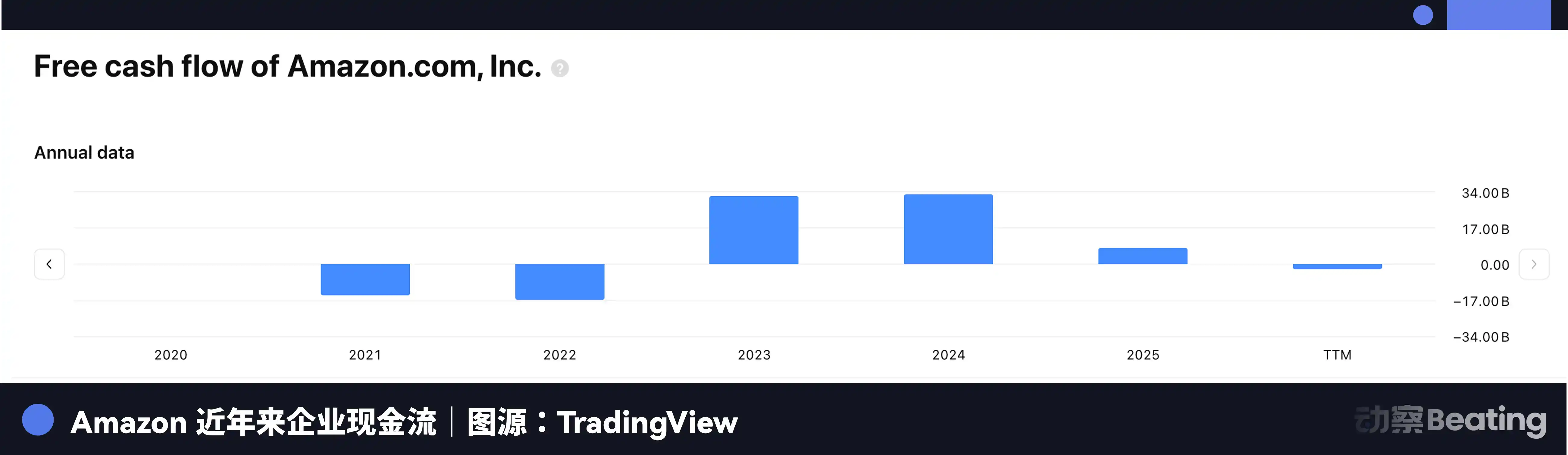
Where did the money go? Amazon's Q1 capital expenditure alone was $44.2 billion, up 76.7% year-over-year, with full-year guidance around $200 billion. Almost all of this money is being thrown into AI infrastructure—data centers, GPUs, networking equipment, power contracts.

Amazon isn't making less money; on the contrary, they're making more than before. It's just that they're throwing almost every penny of it into the bottomless pit of AI. Operating cash flow is the Yangtze River, capital expenditure is the Three Gorges Dam, and free cash flow has become a trickle downstream.

The others aren't much better.

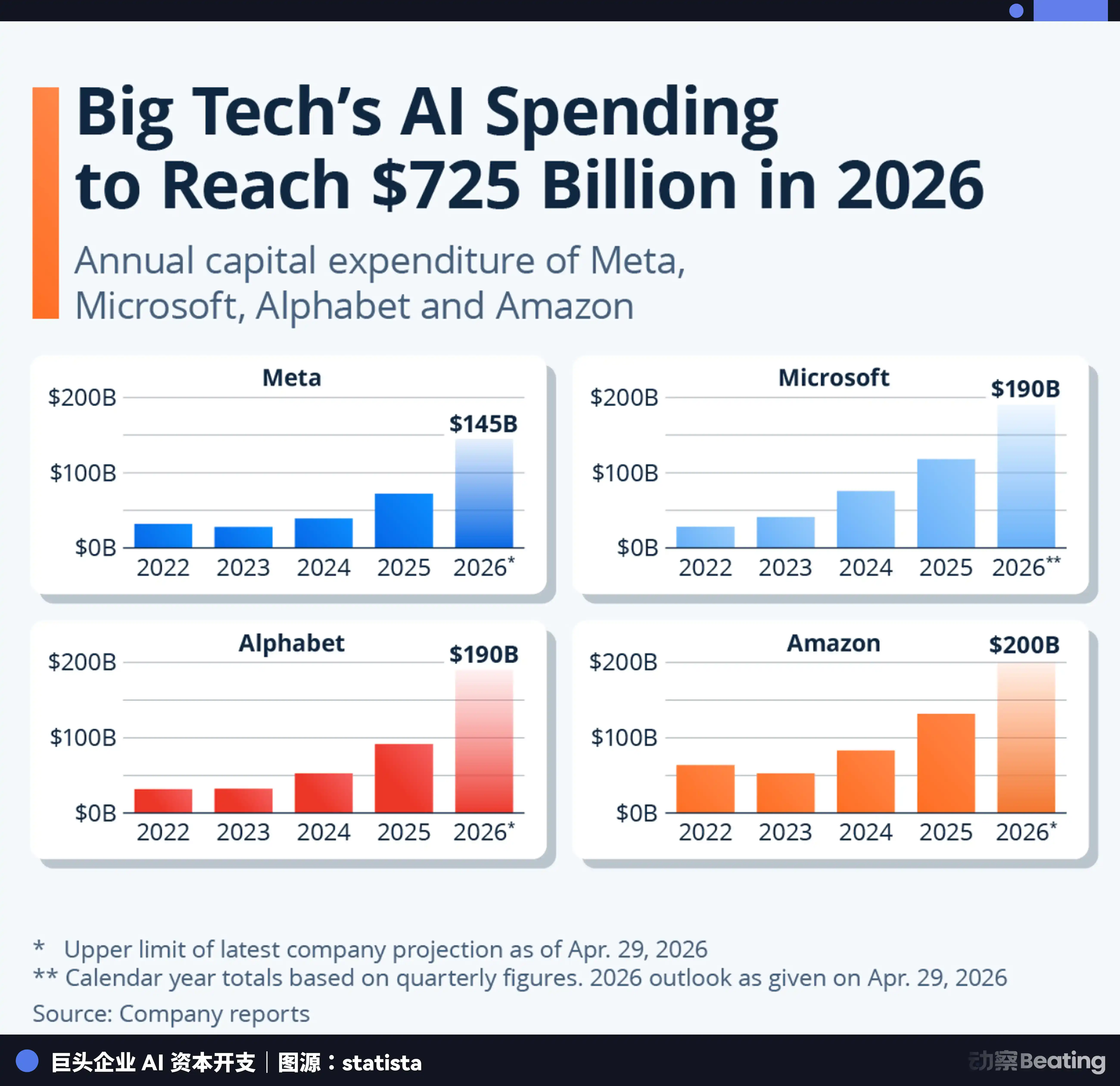
In 2026, the combined capital expenditure guidance for the four giants is $700 to $725 billion: Amazon ~$200B, Microsoft ~$190B, Alphabet ~$185B, Meta $125-145B. In 2022, the four combined spent $162 billion, a 4.5x increase in four years. Just in Q1 2026 alone, the four spent over $130 billion combined, more than the annual GDP of many countries.
On the surface, these companies still look shiny. Revenue is growing, profit margins are holding up well, and the AI launch events are still lively. But 'Free Cash Flow' doesn't agree.

'Profit' is, ultimately, an opinion. How depreciation periods are set, how R&D is capitalized, how revenue is recognized—all have room for creative accounting. But 'Cash Flow' is a fact. Money in, money out, clear as day. Profit tells a story; cash flow tells the truth.

So the truth is that the core financial advantage of being 'light-asset, high-cash-return' that these companies built over two decades is being eaten away, bite by bite, by AI capital expenditures.

The immediate question follows: Free cash flow is at rock bottom, yet their investments are ramping up. So where is this money coming from?

Borrowing. And the way they're borrowing now is unprecedented.

In Three Months, Borrowing Half the World's Money

Alphabet borrowed $32 billion in February.

One month later, in March, Amazon completed a $36.9 billion bond issuance, with 11 tranches ranging from two-year to fifty-year maturities. Investor orders totaled $126 billion, 3.4 times oversubscribed. After this bond, Amazon's total debt nearly doubled in a year. Another month later. On April 30, Meta issued $25 billion in bonds.

Another month later, on May 11, Alphabet announced it was preparing its first yen-denominated bond. This is interesting; Alphabet's February bond issuance wasn't just in dollars, it also included 3.1 billion Swiss francs.

This is a company based in California, USA, with revenue almost entirely in US dollars, yet it went to Switzerland to borrow money. And in May, it set its sights on the yen. Amazon's March deal also included euro tranches.

This isn't currency diversification by the giants' finance departments for appearances; this is forced.

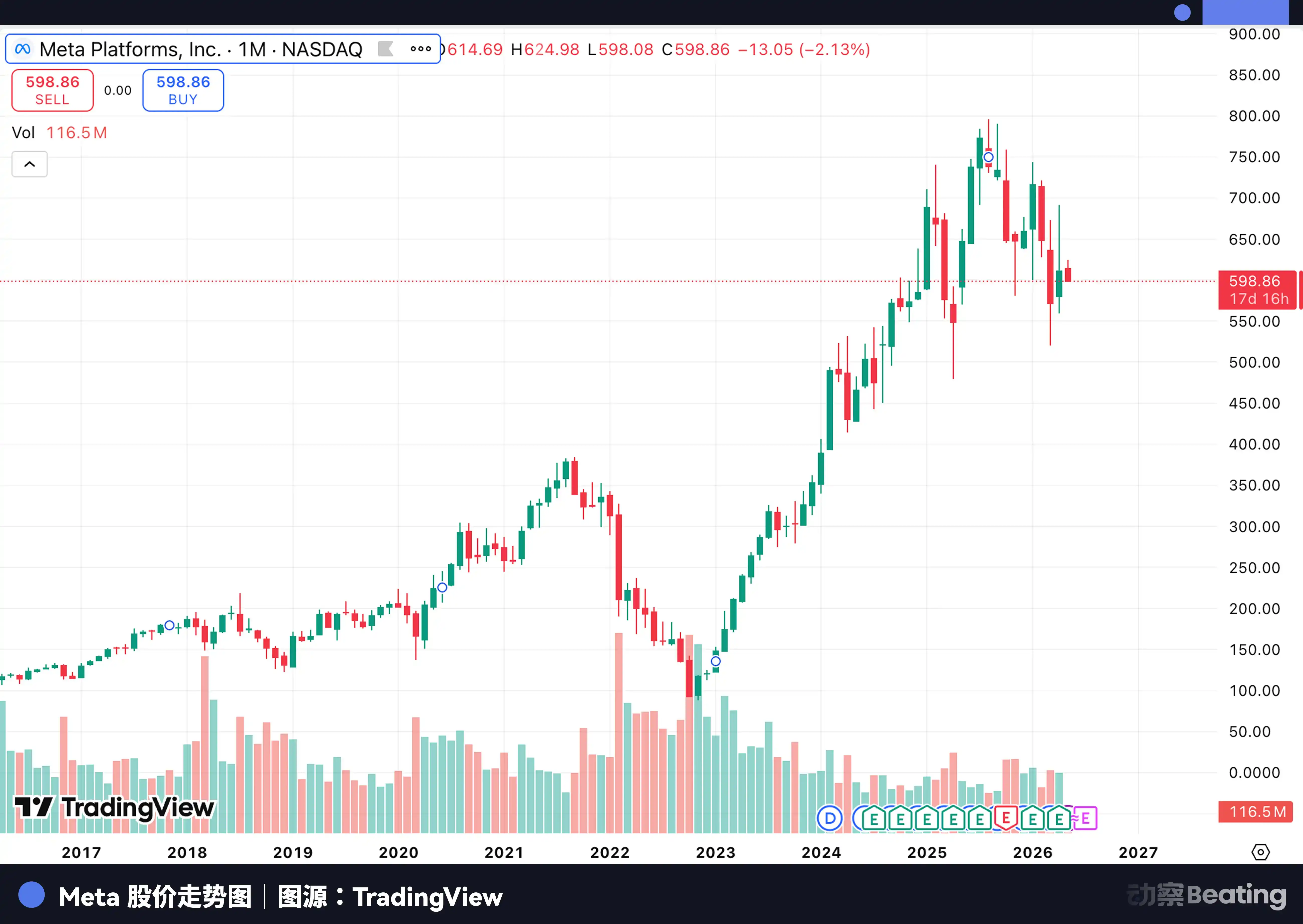
Look at Meta. Its April $25 billion bond, the longest 2066 maturity tranche was priced at a spread of 1.47 percentage points—the risk premium investors demanded over US Treasuries. Six months earlier, in October 2025, when Meta issued a similar forty-year tranche, the spread was only 1.10. It widened by 37 basis points in six months, and not just for the longest tranche; the premium for almost all six tranches it issued was higher than the last round.
So, these giants need to find places with lower interest rates. The Swiss National Bank's policy rate is the lowest among major economies, and Swiss franc bond yields are far lower than dollar ones. Japan, while having ended the negative interest rate era, still offers a huge advantage in yen financing costs. More critically, investors in Zurich and Tokyo aren't yet flooded with Silicon Valley tech debt; their appetite is fresh, not as picky as New York's. For a top-tier borrower like Alphabet, borrowing elsewhere is both cheaper and avoids the queue.

AI's capital expenditures land in the US (data centers) and Taiwan, China (chips), but the money to pay for it is pulled from Switzerland, from Japan, from Europe. Silicon Valley globalized technologically for two decades; now it's globalizing in debt.

And the buyers of these bonds aren't hedge funds or venture capital. Those who can digest century, fifty-year bonds are pension funds, insurance companies, sovereign wealth funds—the most risk-averse money in the global financial system. Their mission is capital preservation, stability, beating inflation, not taking risks.

But now, the pension fund of a retired teacher in Zurich, the reserves a Tokyo insurance company sets aside for life insurance policies, are flowing through the transmission chain of the bond market into a data center in Oregon or Virginia, turning into GPUs on racks and cooling towers on roofs. Most of these holders don't know the underlying assets of their bonds. Their fund managers buy 'Alphabet Aa2 credit', 'Amazon A1 credit'; the rating agencies' letters give a sense of security. As for what buildings this money ultimately builds, what equipment it installs, what models it runs, whether those models can earn enough to repay the debt—there are too many intermediate layers; it's impossible to see clearly from Zurich and Tokyo.

The world's most conservative money is now funding the world's most radical technology bet.

When Internet Companies Grow Smokestacks

But this money hasn't become ad spending, user subsidies, or stock buybacks. None of the usual ways tech companies spent money over the past two decades have been followed this time.

This money has turned into concrete, steel, copper wire, transformers, and cooling pipes.

Amazon's $200 billion 2026 capital expenditure guidance means it spends $550 million per day, $23 million per hour, $380,000 per minute. Microsoft announced plans to invest $10 billion in AI infrastructure in Japan alone from 2026 to 2029.

This isn't a software company's expansion pace; this is infrastructure.

And the essence of infrastructure is making a company heavy.

The construction cycle, investment scale, and operational complexity of a large data center are on the same order of magnitude as an auto assembly plant or a semiconductor fab. Site selection, environmental impact assessment, power connection agreements, water source guarantees, physical security—the whole process has to be run through.

GPUs in AI play a role similar to high-end machine tools in manufacturing: expensive, capacity-constrained, rapidly depreciating. The chips bought with heavy money today may be obsolete in two or three years, but you can't wait, because your competitors won't.

Electricity has become a strategic resource. A large AI data center's power consumption is equivalent to a mid-sized city. Giants are signing long-term power purchase agreements, investing in nuclear power, negotiating dedicated power lines with utility companies.

Cooling water is starting to compete with residents for water rights; many communities in arid regions find an unwelcome guest on their water usage rankings.

These scenes were impossible for tech companies twenty years ago. Site negotiations, grid access, water rights disputes, local tax incentives—these are things railroad companies, power companies, and refineries do. And century bonds, fifty-year bonds, cross-currency issuances—the last time these financial instruments were used intensively was also during the great era of railroad and telecom construction.

Opening the 2026 balance sheets and cash flow statements, these companies' numbers now look closer to TSMC, Duke Energy, or Union Pacific Railroad than they do to their own ten years ago.

This touches on valuation. The core assumption of the past investor pricing logic for tech giants was marginal cost decrease—one more user, one more ad, incremental cost near zero, so profit margins would keep expanding. But the AI infrastructure layer isn't like that. Every additional model trained, every inference cluster deployed, every data center built requires real money invested. Whether the investment pays off depends on whether customers will pay, how model efficiency evolves, and how the competitive landscape changes.

And all of this is uncertain.

This is more like semiconductors: each new process node requires a bigger fab, and returns depend on yield and the market. It's also like power: generation capacity is built first, and returns depend on electricity prices and demand. And it's like railroads: tracks are laid first, and returns depend on whether the economy along the line develops.

So, since tech giants' financial structures are becoming more like heavy-asset companies, the valuation multiples the market gives them will eventually converge toward those of heavy-asset companies.

Some might say once the infrastructure is built, they'll return to a light-asset model. Too naive. Railroads have been built for over a hundred years and are still being built; power grids have been built for a century without stopping; semiconductor fabs need upgrades every few years. The infrastructure of a general-purpose technology has never been 'finished.'

AI may not be a continuation of the internet; it might be a resurgence of industrial capitalism, wearing a cloak of code and standing on a concrete foundation. The internet spent twenty years letting tech companies escape gravity; AI is pulling them back in two years.

Every General-Purpose Technology Revolution

In 1840s Britain, railroads were the AI of that era. Freight speed jumped from a few miles per hour with horse-drawn carriages to tens of miles per hour with trains—an order-of-magnitude efficiency leap, also quite exaggerated.

Capital flooded in. In 1846, the total railway investment authorized by the British Parliament was about £600 million, while Britain's annual GDP was only around £500 million. A nation bet more than a full year's national income on a new technology. Today, that's like the US throwing over $25 trillion into AI.

Early railroads mainly relied on selling stock for financing. Buyers were filled with imagination about the future. Later, as construction scale snowballed and returns were delayed, with later projects deteriorating in quality, equity financing wasn't enough; debt financing stepped into the spotlight. Railway companies began issuing bonds, mortgaging future revenues from uncompleted lines. Financing became increasingly aggressive, from domestic to international borrowing.

What killed the boom wasn't a problem with railway technology; it was interest rates. In 1846, the Bank of England tightened monetary policy, triggered by grain imports and gold outflows due to the Irish famine, which had nothing to do with railways. But interest rates don't care about the reason; they just kill the borrowers with the weakest cash flow. Railway stocks crashed, and many railway companies went bankrupt.

But fortunately, the railways themselves remained. Tracks, stations, tunnels, bridges didn't disappear because investors lost money. They were taken over at a discount by later players, integrated, and operated, eventually becoming the arteries of the British Industrial Revolution. The rise and fall of cities, industrial layouts, and population flows were rearranged along the tracks.

Twenty years later, the same play repeated across the Atlantic. After the US Civil War, the federal government encouraged western railroad construction with land grants and loan guarantees. Over 35,000 miles of new track were laid during the boom. Railway bond yields of 6.4% to 6.7% were the most attractive fixed-income product at the time. Money poured in from the East Coast, from Europe, into the wilderness of the American West.

In 1873, Jay Cooke & Company, the main financier of the Northern Pacific Railway and one of the largest investment banks in the US at the time, declared bankruptcy. The chain reaction ultimately led to 18,000 businesses failing within two years, with 89 railroads going bankrupt over six years.

But America's railway network was ultimately built. It became the physical foundation for the US becoming a 20th-century super industrial power. However, the people who built the railroads and the people who ultimately made money from them were not the same people.

Fiber optics were similar.

In the late 1990s, the rise of the internet fueled huge imaginations about bandwidth. Telecom companies began laying fiber optics frantically, not just connecting cities but also linking continents and crossing oceans. Between 1996 and 2001, US telecom companies issued over $500 billion in new bonds to finance this construction, burying tens of millions of miles of fiber optic cable underground and on seabeds.

But the laying speed far outpaced demand. When the bubble burst, only about 5% of the fiber laid across the US was connected to equipment and carrying data. The remaining 95% was 'dark fiber,' lying underground, waiting for an unknown future.

WorldCom, the second-largest US long-distance operator, with $107 billion in assets, filed for bankruptcy in 2002—the largest bankruptcy in US history at the time. Global Crossing, which built one of the world's largest fiber networks, also fell that year. Winstar, 360networks, McLeodUSA—a string of names fell on the excess of dark fiber.

But fiber optics also ultimately remained. Those undersea cables and metropolitan networks ridiculed as overbuilt in the 1990s became the backbone of the entire internet economy over the next two decades. Netflix streaming, Google search, Amazon's cloud all ran on that fiber, or on its upgraded versions.

The same logical chain appears repeatedly in these three historical episodes.

First, the technology itself is real. Railroads were indeed faster than carriages, fiber optics were indeed faster than copper wires, and AI indeed can do things previously impossible. No one denies the value of the technology itself in hindsight.

But the construction speed far exceeded short-term demand because competition among peers didn't allow anyone to stop and wait for demand to catch up. You believed it was a winner-take-all game where the first to build locked in customers and ecosystems, so you had to keep running.

Everyone was running, leading to collective overbuilding. To sustain the overbuilding speed, financing became increasingly aggressive: equity wasn't enough, so debt was used; short-term wasn't enough, so long-term was used; domestic currency wasn't enough, so foreign currency was used. Railroads were like this, fiber optics were like this, and Swiss franc bonds, yen bonds, century bonds are also like this.

What ultimately triggered the correction was often not a problem with the technology, but a change in financial conditions. In 1846, it was rising interest rates; in 1873, it was an investment bank's bankruptcy triggering a credit chain break; in 2001, it was the dot-com bubble combined with recession. The technology kept advancing, but companies couldn't hold on.

In the end, the infrastructure remained, but a significant portion of the builders did not. The beneficiaries of the railroads were the cities and factories along the lines, not necessarily the original shareholders of the railroad companies. The beneficiaries of the fiber optics were Google, Netflix, Amazon, not WorldCom's bondholders.

Of course, we can't directly equate today's tech giants with 19th-century railroad tycoons or 1990s telecom adventurers. The difference is that today's companies have massive, still-growing core business cash flows. Amazon has AWS and e-commerce; Alphabet has Search and YouTube; Meta has the world's largest social advertising network; Microsoft has Office and Azure.

They aren't startups building data centers by burning investor money; they are giants with real profits mortgaging their own futures.

So the question is whether the payback period for capital expenditure can outrun the repayment period of the debt. Railroads were good, but borrowing money for six years to build lines that take twenty years to pay back can kill you just the same. Fiber optics were good, but borrowing for five years to lay cables only 5% of which are used can't save a balance sheet either.

AI data centers are certainly good. But what scale of AI revenue is needed to break even on $200 billion in annual capital expenditure? How many years are needed to recoup $700 billion in combined investment? If model efficiency advances faster than expected—say, a new architecture makes the same task require one-tenth the computing power—could the computing power built at great cost today become the new generation of dark fiber?

All Bonds Issued Are Buying the Same Thing

Back to that century bond at the beginning.

The institutional investor who bought it—maybe a Swiss pension fund, maybe a British insurance company—made a decision that day: lend money to Alphabet, to be repaid in a hundred years.

Behind this decision is a chain of beliefs: believing AI will be widely adopted, Alphabet will survive this race, its Search and advertising businesses will continue to generate cash, the data centers it builds will be fully utilized, and no disaster will destroy this company over the next century in the global economy.

The holders of Amazon's fifty-year bonds have a similar, though perhaps slightly shorter, chain of beliefs in their minds. Meta's bondholders accepted record-high CDS premiums, but the chain is shorter because the market is clearly giving Meta a narrower credit window than the others.

The chains vary in length, but they are buying the same thing. Not GPUs, not data centers, not fiber optics and transformers—those are intermediates. What they are truly buying is time.

AI models are trending towards homogenization. Open source is catching up with closed source; small models are approaching large models; the capability gap is narrowing. Before this window closes, before everyone can run similar models, whoever can first scale up computing power and lock enterprise customers onto their cloud can turn temporary technological leadership into a lasting commercial moat.

So the giants aren't betting on 'whose model is smartest,' but on a more fundamental proposition: before AI capabilities fully diffuse, can I build infrastructure and customer relationships to a scale others can't catch up with?

This is time arbitrage—using today's low-cost money to buy tomorrow's market position.

Time arbitrage has a cruel prerequisite: the future must arrive on time.

The four companies face different time pressures.

Amazon is the most urgent. Free cash flow has been swallowed by capital expenditure to a mere $1.2 billion. AWS's AI service revenue must reach scale within two or three years; otherwise, debt pressure will seep from the balance sheet into the income statement.

Meta is the most fragile. Social advertising profits are rich, but there's a missing bridge between them and the commercialization of AI infrastructure. Azure and AWS can directly sell computing power to enterprise clients. After Meta spends over a hundred billion building infrastructure, what it turns into, who it sells to, and how it charges—the story isn't fully fleshed out yet. The market's impatience is already written in its stock price and CDS.

Alphabet is the most composed. Search and YouTube require little maintenance to keep generating cash. Even if AI yields no short-term returns, the core business can provide a safety net. The market gave it century-long credit—the longest time window among the four. But $185 billion in capital expenditure is 2.5 times last year's; the acceleration itself consumes patience. Composure doesn't equal safety.

Microsoft is the clearest. Its deep tie-up with OpenAI has made Azure a direct beneficiary of AI commercialization. Copilot is already charging; GitHub Copilot is one of the highest-paid-for AI products among programmers. The path from infrastructure to revenue is the shortest. But $190 billion in capital expenditure means that even with a clear path, the bet's size is so large that everything must go according to script to break even.

All four are betting on the same thing, which in a nutshell is: borrowing money from the future to build something not fully understood today, betting that use cases explode before the debt comes due.

This road has been traveled by railroads, by fiber optics. Each time, the technology ultimately proved its worth, and the infrastructure remained. But each time, there were also a group—sometimes a large group—of people who paid for the construction and didn't live to see it pay off. The technology was right, the timing was wrong, and financial markets don't give wrong timing a second chance.

No one knows if AI's 'future' will arrive on time. The only certainty is this: the world's most conservative pool of money has already, by buying these century, fifty-year, forty-year bonds, signed a contract with Silicon Valley.

The contract's terms are simple: We lend you time, you give us the future.

As for whether the future will keep its promise, no one can say for sure now.

Domande pertinenti

QAccording to the article, what fundamental financial transformation has the rise of AI caused for major tech companies?

AThe rise of AI has forced major tech companies (Amazon, Microsoft, Alphabet, Meta) to fundamentally transform from a 'light-asset, high-cash-flow' model to a 'heavy-asset' model, reminiscent of traditional infrastructure or industrial companies. Their massive, skyrocketing capital expenditures on AI infrastructure (data centers, GPUs) are consuming their once-plentiful free cash flow, leading them to finance this buildout through unprecedented debt issuance.

QWhy are these tech giants issuing long-term bonds in foreign currencies like Swiss Francs and Yen?

AThey are issuing bonds in foreign currencies like Swiss Francs and Yen because investors in major US debt markets (like New York) are becoming more demanding, requiring higher risk premiums (spreads) for their bonds. Markets like Switzerland and Japan currently offer lower interest rates and have investors who are less saturated with tech debt, providing a cheaper and more accessible source of capital to fund their massive AI investments.

QWhat historical parallels does the article draw between the current AI infrastructure build-out and past technological revolutions?

AThe article draws parallels to the 19th-century British and American railway booms and the late-1990s fiber-optic network build-out. All three episodes involved: 1) A transformative, real technology. 2) Frenzied, competitive overbuilding that far outpaced immediate demand. 3) Increasingly aggressive financing (shifting from equity to long-term, often international debt). 4) A collapse or crisis often triggered by external financial conditions (rising interest rates, banking failures) rather than the technology itself. 5) The infrastructure ultimately remaining and becoming foundational, but many of the original builders/financiers not surviving to reap the rewards.

QWhat is the 'time arbitrage' that the article describes these companies are attempting?

AThe 'time arbitrage' is using today's relatively low-cost capital (from bond sales) to build AI infrastructure at a massive scale *now*, in order to lock in customers and establish market dominance *before* AI capabilities become commoditized and widely diffused. They are betting that securing this time advantage will create a durable commercial moat that justifies the huge upfront debt.

QHow does the article differentiate the financial pressures and timelines facing the four major tech companies (Amazon, Meta, Alphabet, Microsoft)?

AAmazon faces the most urgent pressure as its free cash flow has nearly vanished; its AWS AI services need to generate significant revenue quickly to manage its growing debt. Meta is seen as the most vulnerable because it lacks a direct, clear path from its massive infrastructure spend to a monetizable AI product for enterprise customers, worrying investors. Alphabet is the most从容 (composed/stable) due to its robust core search and YouTube businesses providing a cash cushion, giving it the longest perceived time horizon (evidenced by its century bond). Microsoft has the clearest path, with its close OpenAI partnership and existing products like Copilot already generating AI revenue, but its enormous capital expenditure still represents a massive bet that requires everything to go according to plan.

Letture associate

Casper Network Publishes the Casper Manifest, a Multi-Year Roadmap to Power Regulated Real-World Assets and the Machine Economy

The Casper Association has published "The Casper Manifest," a multi-year technical roadmap for Casper Network. Introduced at the Digital Finance Forum in Bermuda, the roadmap outlines nine coordinated initiatives designed to position the layer-1 blockchain as the infrastructure for regulated real-world asset (RWA) tokenization and the machine-to-machine economy. Key initiatives focus on: 1. **Developer Access:** Adding full Ethereum Virtual Machine (EVM) compatibility alongside its existing WebAssembly (Wasm) execution layer. 2. **User Experience:** Implementing gasless transactions, batch operations, and smart accounts with biometric authentication. 3. **Institutional Compliance & Privacy:** Building compliant security tokens aligned with the ERC-3643 standard and a multi-phase roadmap for confidential transactions with built-in audit tools. 4. **Machine Economy:** Implementing the X402 open payment standard to enable AI agents and machines to make autonomous, programmatic micropayments. 5. **Token Infrastructure:** Creating a Native Token Registry to give all tokens protocol-level status with fixed, predictable costs. 6. **Quantum Safety:** Developing hybrid accounts with both classical and quantum-resistant keys. The first initiative, X402 micropayments, is expected within weeks. Subsequent releases through 2026 and 2027 will include EVM compatibility, compliant security tokens, the Native Token Registry, gasless transactions, and quantum-safe features. The goal is to create a blockchain that is frictionless for users, trusted by institutions, and native for machines.

TheNewsCrypto1 h fa

Casper Network Publishes the Casper Manifest, a Multi-Year Roadmap to Power Regulated Real-World Assets and the Machine Economy

TheNewsCrypto1 h fa

Trading

Spot
Futures

Articoli Popolari

Cosa è GROK AI

Grok AI: Rivoluzionare la Tecnologia Conversazionale nell'Era Web3 Introduzione Nel panorama in rapida evoluzione dell'intelligenza artificiale, Grok AI si distingue come un progetto notevole che collega i domini della tecnologia avanzata e dell'interazione con l'utente. Sviluppato da xAI, un'azienda guidata dal rinomato imprenditore Elon Musk, Grok AI cerca di ridefinire il modo in cui interagiamo con l'intelligenza artificiale. Mentre il movimento Web3 continua a prosperare, Grok AI mira a sfruttare il potere dell'IA conversazionale per rispondere a query complesse, offrendo agli utenti un'esperienza che è non solo informativa ma anche divertente. Cos'è Grok AI? Grok AI è un sofisticato chatbot di intelligenza artificiale conversazionale progettato per interagire dinamicamente con gli utenti. A differenza di molti sistemi di intelligenza artificiale tradizionali, Grok AI abbraccia un'ampia gamma di domande, comprese quelle tipicamente considerate inappropriate o al di fuori delle risposte standard. Gli obiettivi principali del progetto includono: Ragionamento Affidabile: Grok AI enfatizza il ragionamento di buon senso per fornire risposte logiche basate sulla comprensione contestuale. Supervisione Scalabile: L'integrazione dell'assistenza degli strumenti garantisce che le interazioni degli utenti siano sia monitorate che ottimizzate per la qualità. Verifica Formale: La sicurezza è fondamentale; Grok AI incorpora metodi di verifica formale per migliorare l'affidabilità delle sue uscite. Comprensione del Lungo Contesto: Il modello di IA eccelle nel trattenere e richiamare una vasta storia di conversazione, facilitando discussioni significative e consapevoli del contesto. Robustezza Adversariale: Concentrandosi sul miglioramento delle sue difese contro input manipolati o malevoli, Grok AI mira a mantenere l'integrità delle interazioni degli utenti. In sostanza, Grok AI non è solo un dispositivo di recupero informazioni; è un partner conversazionale immersivo che incoraggia un dialogo dinamico. Creatore di Grok AI Il cervello dietro Grok AI non è altri che Elon Musk, un individuo sinonimo di innovazione in vari campi, tra cui automotive, viaggi spaziali e tecnologia. Sotto l'egida di xAI, un'azienda focalizzata sull'avanzamento della tecnologia AI in modi benefici, la visione di Musk mira a rimodellare la comprensione delle interazioni con l'IA. La leadership e l'etica fondamentale sono profondamente influenzate dall'impegno di Musk nel superare i confini tecnologici. Investitori di Grok AI Sebbene i dettagli specifici riguardanti gli investitori che sostengono Grok AI rimangano limitati, è pubblicamente riconosciuto che xAI, l'incubatore del progetto, è fondato e supportato principalmente dallo stesso Elon Musk. Le precedenti imprese e partecipazioni di Musk forniscono un robusto sostegno, rafforzando ulteriormente la credibilità e il potenziale di crescita di Grok AI. Tuttavia, al momento, le informazioni riguardanti ulteriori fondazioni di investimento o organizzazioni che supportano Grok AI non sono facilmente accessibili, segnando un'area per potenziali esplorazioni future. Come Funziona Grok AI? Le meccaniche operative di Grok AI sono innovative quanto il suo framework concettuale. Il progetto integra diverse tecnologie all'avanguardia che facilitano le sue funzionalità uniche: Infrastruttura Robusta: Grok AI è costruito utilizzando Kubernetes per l'orchestrazione dei container, Rust per prestazioni e sicurezza, e JAX per il calcolo numerico ad alte prestazioni. Questo trio garantisce che il chatbot operi in modo efficiente, si scaldi efficacemente e serva gli utenti prontamente. Accesso alla Conoscenza in Tempo Reale: Una delle caratteristiche distintive di Grok AI è la sua capacità di attingere a dati in tempo reale attraverso la piattaforma X—precedentemente nota come Twitter. Questa capacità consente all'IA di accedere alle informazioni più recenti, permettendole di fornire risposte e raccomandazioni tempestive che altri modelli di IA potrebbero perdere. Due Modalità di Interazione: Grok AI offre agli utenti la scelta tra “Modalità Divertente” e “Modalità Normale”. La Modalità Divertente consente uno stile di interazione più giocoso e umoristico, mentre la Modalità Normale si concentra sulla fornitura di risposte precise e accurate. Questa versatilità garantisce un'esperienza su misura che soddisfa varie preferenze degli utenti. In sostanza, Grok AI sposa prestazioni con coinvolgimento, creando un'esperienza che è sia arricchente che divertente. Cronologia di Grok AI Il viaggio di Grok AI è segnato da traguardi fondamentali che riflettono le sue fasi di sviluppo e distribuzione: Sviluppo Iniziale: La fase fondamentale di Grok AI si è svolta in circa due mesi, durante i quali sono stati condotti l'addestramento iniziale e il perfezionamento del modello. Rilascio Beta di Grok-2: In un significativo avanzamento, è stata annunciata la beta di Grok-2. Questo rilascio ha introdotto due versioni del chatbot—Grok-2 e Grok-2 mini—ognuna dotata delle capacità per chattare, programmare e ragionare. Accesso Pubblico: Dopo lo sviluppo beta, Grok AI è diventato disponibile per gli utenti della piattaforma X. Coloro che hanno account verificati tramite un numero di telefono e attivi per almeno sette giorni possono accedere a una versione limitata, rendendo la tecnologia disponibile a un pubblico più ampio. Questa cronologia racchiude la crescita sistematica di Grok AI dall'inizio all'impegno pubblico, enfatizzando il suo impegno per il miglioramento continuo e l'interazione con gli utenti. Caratteristiche Chiave di Grok AI Grok AI comprende diverse caratteristiche chiave che contribuiscono alla sua identità innovativa: Integrazione della Conoscenza in Tempo Reale: L'accesso a informazioni attuali e rilevanti differenzia Grok AI da molti modelli statici, consentendo un'esperienza utente coinvolgente e accurata. Stili di Interazione Versatili: Offrendo modalità di interazione distinte, Grok AI soddisfa varie preferenze degli utenti, invitando alla creatività e alla personalizzazione nella conversazione con l'IA. Avanzata Struttura Tecnologica: L'utilizzo di Kubernetes, Rust e JAX fornisce al progetto un solido framework per garantire affidabilità e prestazioni ottimali. Considerazione del Discorso Etico: L'inclusione di una funzione di generazione di immagini mette in mostra lo spirito innovativo del progetto. Tuttavia, solleva anche considerazioni etiche riguardanti il copyright e la rappresentazione rispettosa di figure riconoscibili—una discussione in corso all'interno della comunità AI. Conclusione Come entità pionieristica nel campo dell'IA conversazionale, Grok AI incarna il potenziale per esperienze utente trasformative nell'era digitale. Sviluppato da xAI e guidato dall'approccio visionario di Elon Musk, Grok AI integra conoscenze in tempo reale con capacità di interazione avanzate. Si sforza di spingere i confini di ciò che l'intelligenza artificiale può realizzare, mantenendo un focus su considerazioni etiche e sicurezza degli utenti. Grok AI non solo incarna il progresso tecnologico, ma rappresenta anche un nuovo paradigma conversazionale nel panorama Web3, promettendo di coinvolgere gli utenti con sia conoscenze esperte che interazioni giocose. Man mano che il progetto continua a evolversi, si erge come testimonianza di ciò che l'incrocio tra tecnologia, creatività e interazione simile a quella umana può realizzare.

453 Totale visualizzazioniPubblicato il 2024.12.26Aggiornato il 2024.12.26

Cosa è GROK AI

Cosa è ERC AI

Euruka Tech: Una Panoramica di $erc ai e delle sue Ambizioni in Web3 Introduzione Nel panorama in rapida evoluzione della tecnologia blockchain e delle applicazioni decentralizzate, nuovi progetti emergono frequentemente, ciascuno con obiettivi e metodologie uniche. Uno di questi progetti è Euruka Tech, che opera nel vasto dominio delle criptovalute e del Web3. L'obiettivo principale di Euruka Tech, in particolare del suo token $erc ai, è presentare soluzioni innovative progettate per sfruttare le crescenti capacità della tecnologia decentralizzata. Questo articolo si propone di fornire una panoramica completa di Euruka Tech, un'esplorazione dei suoi obiettivi, della funzionalità, dell'identità del suo creatore, dei potenziali investitori e della sua importanza nel contesto più ampio del Web3. Cos'è Euruka Tech, $erc ai? Euruka Tech è caratterizzato come un progetto che sfrutta gli strumenti e le funzionalità offerte dall'ambiente Web3, concentrandosi sull'integrazione dell'intelligenza artificiale nelle sue operazioni. Sebbene i dettagli specifici sul framework del progetto siano piuttosto sfuggenti, è progettato per migliorare l'engagement degli utenti e automatizzare i processi nello spazio crypto. Il progetto mira a creare un ecosistema decentralizzato che non solo faciliti le transazioni, ma incorpori anche funzionalità predittive attraverso l'intelligenza artificiale, da cui il nome del suo token, $erc ai. L'obiettivo è fornire una piattaforma intuitiva che faciliti interazioni più intelligenti e un'elaborazione delle transazioni più efficiente all'interno della crescente sfera del Web3. Chi è il Creatore di Euruka Tech, $erc ai? Attualmente, le informazioni riguardanti il creatore o il team fondatore di Euruka Tech rimangono non specificate e piuttosto opache. Questa assenza di dati solleva preoccupazioni, poiché la conoscenza del background del team è spesso essenziale per stabilire credibilità nel settore blockchain. Pertanto, abbiamo classificato queste informazioni come sconosciute fino a quando dettagli concreti non saranno resi disponibili nel dominio pubblico. Chi sono gli Investitori di Euruka Tech, $erc ai? Allo stesso modo, l'identificazione degli investitori o delle organizzazioni di supporto per il progetto Euruka Tech non è prontamente fornita attraverso la ricerca disponibile. Un aspetto cruciale per i potenziali stakeholder o utenti che considerano di impegnarsi con Euruka Tech è la garanzia che deriva da partnership finanziarie consolidate o dal supporto di società di investimento rispettabili. Senza divulgazioni sulle affiliazioni di investimento, è difficile trarre conclusioni complete sulla sicurezza finanziaria o sulla longevità del progetto. In linea con le informazioni trovate, anche questa sezione rimane allo stato di sconosciuto. Come funziona Euruka Tech, $erc ai? Nonostante la mancanza di specifiche tecniche dettagliate per Euruka Tech, è essenziale considerare le sue ambizioni innovative. Il progetto cerca di sfruttare la potenza computazionale dell'intelligenza artificiale per automatizzare e migliorare l'esperienza dell'utente all'interno dell'ambiente delle criptovalute. Integrando l'IA con la tecnologia blockchain, Euruka Tech mira a fornire funzionalità come operazioni automatizzate, valutazioni del rischio e interfacce utente personalizzate. L'essenza innovativa di Euruka Tech risiede nel suo obiettivo di creare una connessione fluida tra gli utenti e le vaste possibilità presentate dalle reti decentralizzate. Attraverso l'utilizzo di algoritmi di apprendimento automatico e IA, mira a ridurre le sfide degli utenti alle prime armi e semplificare le esperienze transazionali all'interno del framework Web3. Questa simbiosi tra IA e blockchain sottolinea l'importanza del token $erc ai, fungendo da ponte tra le interfacce utente tradizionali e le avanzate capacità delle tecnologie decentralizzate. Cronologia di Euruka Tech, $erc ai Sfortunatamente, a causa delle limitate informazioni disponibili riguardo a Euruka Tech, non siamo in grado di presentare una cronologia dettagliata dei principali sviluppi o traguardi nel percorso del progetto. Questa cronologia, tipicamente preziosa per tracciare l'evoluzione di un progetto e comprendere la sua traiettoria di crescita, non è attualmente disponibile. Man mano che le informazioni su eventi notevoli, partnership o aggiunte funzionali diventano evidenti, gli aggiornamenti miglioreranno sicuramente la visibilità di Euruka Tech nella sfera crypto. Chiarimento su Altri Progetti “Eureka” È importante sottolineare che più progetti e aziende condividono una nomenclatura simile con “Eureka.” La ricerca ha identificato iniziative come un agente IA della NVIDIA Research, che si concentra sull'insegnamento ai robot di compiti complessi utilizzando metodi generativi, così come Eureka Labs ed Eureka AI, che migliorano l'esperienza utente nell'istruzione e nell'analisi del servizio clienti, rispettivamente. Tuttavia, questi progetti sono distinti da Euruka Tech e non dovrebbero essere confusi con i suoi obiettivi o funzionalità. Conclusione Euruka Tech, insieme al suo token $erc ai, rappresenta un attore promettente ma attualmente oscuro nel panorama del Web3. Sebbene i dettagli sul suo creatore e sugli investitori rimangano non divulgati, l'ambizione centrale di combinare intelligenza artificiale e tecnologia blockchain si erge come un punto focale di interesse. Gli approcci unici del progetto nel promuovere l'engagement degli utenti attraverso l'automazione avanzata potrebbero distinguerlo mentre l'ecosistema Web3 progredisce. Con l'evoluzione continua del mercato crypto, gli stakeholder dovrebbero tenere d'occhio gli sviluppi riguardanti Euruka Tech, poiché lo sviluppo di innovazioni documentate, partnership o una roadmap definita potrebbe presentare opportunità significative nel prossimo futuro. Così com'è, attendiamo ulteriori approfondimenti sostanziali che potrebbero svelare il potenziale di Euruka Tech e la sua posizione nel competitivo panorama crypto.

473 Totale visualizzazioniPubblicato il 2025.01.02Aggiornato il 2025.01.02

Cosa è ERC AI

Cosa è DUOLINGO AI

DUOLINGO AI: Integrare l'apprendimento delle lingue con Web3 e innovazione AI In un'era in cui la tecnologia rimodella l'istruzione, l'integrazione dell'intelligenza artificiale (AI) e delle reti blockchain annuncia una nuova frontiera per l'apprendimento delle lingue. Entra in scena DUOLINGO AI e la sua criptovaluta associata, $DUOLINGO AI. Questo progetto aspira a fondere la potenza educativa delle principali piattaforme di apprendimento delle lingue con i benefici della tecnologia decentralizzata Web3. Questo articolo esplora gli aspetti chiave di DUOLINGO AI, esaminando i suoi obiettivi, il framework tecnologico, lo sviluppo storico e il potenziale futuro, mantenendo chiarezza tra la risorsa educativa originale e questa iniziativa indipendente di criptovaluta. Panoramica di DUOLINGO AI Alla sua base, DUOLINGO AI cerca di stabilire un ambiente decentralizzato in cui gli studenti possono guadagnare ricompense crittografiche per il raggiungimento di traguardi educativi nella competenza linguistica. Applicando smart contracts, il progetto mira ad automatizzare i processi di verifica delle competenze e le allocazioni di token, aderendo ai principi di Web3 che enfatizzano la trasparenza e la proprietà da parte degli utenti. Il modello si discosta dagli approcci tradizionali all'acquisizione linguistica, facendo forte affidamento su una struttura di governance guidata dalla comunità, che consente ai detentori di token di suggerire miglioramenti ai contenuti dei corsi e alle distribuzioni delle ricompense. Alcuni degli obiettivi notevoli di DUOLINGO AI includono: Apprendimento Gamificato: Il progetto integra traguardi blockchain e token non fungibili (NFT) per rappresentare i livelli di competenza linguistica, promuovendo la motivazione attraverso ricompense digitali coinvolgenti. Creazione di Contenuti Decentralizzati: Apre opportunità per educatori e appassionati di lingue di contribuire con i propri corsi, facilitando un modello di condivisione dei ricavi che beneficia tutti i collaboratori. Personalizzazione Guidata dall'AI: Utilizzando modelli avanzati di machine learning, DUOLINGO AI personalizza le lezioni per adattarsi ai progressi individuali, simile alle funzionalità adattive presenti nelle piattaforme consolidate. Creatori del Progetto e Governance A partire da aprile 2025, il team dietro $DUOLINGO AI rimane pseudonimo, una pratica comune nel panorama decentralizzato delle criptovalute. Questa anonimato è inteso a promuovere la crescita collettiva e il coinvolgimento degli stakeholder piuttosto che concentrarsi su sviluppatori individuali. Lo smart contract distribuito sulla blockchain di Solana annota l'indirizzo del wallet dello sviluppatore, che segna l'impegno verso la trasparenza riguardo alle transazioni, nonostante l'identità dei creatori sia sconosciuta. Secondo la sua roadmap, DUOLINGO AI mira a evolversi in un'Organizzazione Autonoma Decentralizzata (DAO). Questa struttura di governance consente ai detentori di token di votare su questioni critiche come l'implementazione di funzionalità e le allocazioni del tesoro. Questo modello si allinea con l'etica dell'empowerment della comunità presente in varie applicazioni decentralizzate, enfatizzando l'importanza del processo decisionale collettivo. Investitori e Partnership Strategiche Attualmente, non ci sono investitori istituzionali o capitalisti di rischio identificabili pubblicamente legati a $DUOLINGO AI. Invece, la liquidità del progetto proviene principalmente da scambi decentralizzati (DEX), segnando un netto contrasto con le strategie di finanziamento delle aziende tradizionali di tecnologia educativa. Questo modello di base indica un approccio guidato dalla comunità, riflettendo l'impegno del progetto verso la decentralizzazione. Nel suo whitepaper, DUOLINGO AI menziona la formazione di collaborazioni con “piattaforme educative blockchain” non specificate, mirate ad arricchire la sua offerta di corsi. Sebbene partnership specifiche non siano ancora state divulgate, questi sforzi collaborativi suggeriscono una strategia per mescolare innovazione blockchain con iniziative educative, ampliando l'accesso e il coinvolgimento degli utenti attraverso diverse vie di apprendimento. Architettura Tecnologica Integrazione AI DUOLINGO AI incorpora due componenti principali guidate dall'AI per migliorare la sua offerta educativa: Motore di Apprendimento Adattivo: Questo sofisticato motore apprende dalle interazioni degli utenti, simile ai modelli proprietari delle principali piattaforme educative. Regola dinamicamente la difficoltà delle lezioni per affrontare le sfide specifiche degli studenti, rinforzando le aree deboli attraverso esercizi mirati. Agenti Conversazionali: Utilizzando chatbot alimentati da GPT-4, DUOLINGO AI offre una piattaforma per gli utenti per impegnarsi in conversazioni simulate, promuovendo un'esperienza di apprendimento linguistico più interattiva e pratica. Infrastruttura Blockchain Costruito sulla blockchain di Solana, $DUOLINGO AI utilizza un framework tecnologico completo che include: Smart Contracts per la Verifica delle Competenze: Questa funzionalità assegna automaticamente token agli utenti che superano con successo i test di competenza, rinforzando la struttura di incentivi per risultati di apprendimento genuini. Badge NFT: Questi token digitali significano vari traguardi che gli studenti raggiungono, come completare una sezione del loro corso o padroneggiare competenze specifiche, consentendo loro di scambiare o mostrare digitalmente i loro successi. Governance DAO: I membri della comunità dotati di token possono partecipare alla governance votando su proposte chiave, facilitando una cultura partecipativa che incoraggia l'innovazione nell'offerta di corsi e nelle funzionalità della piattaforma. Cronologia Storica 2022–2023: Concettualizzazione I lavori per DUOLINGO AI iniziano con la creazione di un whitepaper, evidenziando la sinergia tra i progressi dell'AI nell'apprendimento delle lingue e il potenziale decentralizzato della tecnologia blockchain. 2024: Lancio Beta Un lancio beta limitato introduce offerte in lingue popolari, premiando i primi utenti con incentivi in token come parte della strategia di coinvolgimento della comunità del progetto. 2025: Transizione DAO Ad aprile, avviene un lancio completo della mainnet con la circolazione di token, stimolando discussioni nella comunità riguardo a possibili espansioni nelle lingue asiatiche e ad altri sviluppi dei corsi. Sfide e Direzioni Future Ostacoli Tecnici Nonostante i suoi obiettivi ambiziosi, DUOLINGO AI affronta sfide significative. La scalabilità rimane una preoccupazione costante, in particolare nel bilanciare i costi associati all'elaborazione dell'AI e nel mantenere una rete decentralizzata reattiva. Inoltre, garantire la creazione e la moderazione di contenuti di qualità in un'offerta decentralizzata presenta complessità nel mantenere standard educativi. Opportunità Strategiche Guardando al futuro, DUOLINGO AI ha il potenziale per sfruttare partnership di micro-credentialing con istituzioni accademiche, fornendo validazioni verificate dalla blockchain delle competenze linguistiche. Inoltre, l'espansione cross-chain potrebbe consentire al progetto di attingere a basi utenti più ampie e a ulteriori ecosistemi blockchain, migliorando la sua interoperabilità e portata. Conclusione DUOLINGO AI rappresenta una fusione innovativa di intelligenza artificiale e tecnologia blockchain, presentando un'alternativa focalizzata sulla comunità ai sistemi tradizionali di apprendimento delle lingue. Sebbene il suo sviluppo pseudonimo e il modello economico emergente comportino alcuni rischi, l'impegno del progetto verso l'apprendimento gamificato, l'istruzione personalizzata e la governance decentralizzata illumina un percorso per la tecnologia educativa nel regno di Web3. Man mano che l'AI continua a progredire e l'ecosistema blockchain evolve, iniziative come DUOLINGO AI potrebbero ridefinire il modo in cui gli utenti interagiscono con l'istruzione linguistica, potenziando le comunità e premiando il coinvolgimento attraverso meccanismi di apprendimento innovativi.

431 Totale visualizzazioniPubblicato il 2025.04.11Aggiornato il 2025.04.11

Cosa è DUOLINGO AI

Discussioni

Benvenuto nella Community HTX. Qui puoi rimanere informato sugli ultimi sviluppi della piattaforma e accedere ad approfondimenti esperti sul mercato. Le opinioni degli utenti sul prezzo di AI AI sono presentate come di seguito.

活动图片