ENS Governance Restructuring Approved: Foundation Formalized, Finally Able to Pursue .ens Top-Level Domain

marsbitPubblicato 2026-08-13Pubblicato ultima volta 2026-08-13

Introduzione

ENS token holders have approved the "Next Era of the ENS DAO" proposal, formally establishing the ENS Foundation as a legal entity. This enables the Foundation to represent ENS in institutional matters such as pursuing the .ens top-level domain with ICANN, engaging with standard-setting bodies like IETF and W3C, participating in regulatory discussions, defending trademarks, and hiring dedicated staff. The new structure clarifies roles: ENS Labs focuses on core protocol development (like ENSv2), the DAO retains control over protocol contracts and treasury (holding 54.6% of ENS tokens), and the Foundation handles off-chain, institutional representation. The five-member inaugural Foundation Board, appointed and overseen by token holders, includes an Executive Director and independent directors. This governance upgrade aims to strengthen ENS's role as credibly neutral, publicly governed internet infrastructure for the long term.

Author: ENS Foundation

Compiled by: Deep Tide TechFlow

Deep Tide Introduction: ENS token holders have approved a governance proposal, formally establishing the Foundation as a legal entity capable of representing ENS in regulatory matters, standards organizations, and top-level domain negotiations. This addresses a long-standing weakness of the DAO, which previously lacked the ability to handle institutional affairs, while preserving token holders' ultimate control over the protocol and the Foundation's personnel. For those focused on ENS's infrastructure status and governance boundaries, this is a crucial step.

ENS token holders have approved the "Next Era for the ENS DAO" proposal, and the relevant executable content has been completed on-chain. The ENS Foundation is now a fully operational organization with a full-time Executive Director, staff, and a five-member board of directors. This article explains the motivation behind this structure, what the Foundation can now do, and how it allows token holders to retain control over the protocol and the Foundation itself.

Why ENS Needs an Institution-Facing Foundation

Over the past decade, ENS has evolved into core infrastructure: hosting millions of domain names, integrated across wallets, applications, and L2s, with other systems relying on it for resolution. ENS has also engaged with policymakers and institutions like ICANN, which are responsible for coordinating the stable and secure operation of internet naming infrastructure. In 2021, the core team at ENS Labs launched the ENS DAO to safeguard the protocol. Specifically, the DAO placed the protocol's core contracts, pricing, and treasury under the control of token holders. These funds are used to finance public goods, service providers, and community projects within the ecosystem.

By itself, the DAO lacks the legal and operational capacity to act in many of the arenas this infrastructure now needs to represent. It cannot advocate for recognition and management rights of the .ens top-level domain at ICANN. It cannot sign agreements required to participate in standards work at IETF and W3C, cannot hire full-time employees, cannot enforce trademark rights against phishing campaigns impersonating ENS, cannot respond to legal proceedings, and cannot represent ENS in regulatory discussions concerning decentralized naming.

For years, some of this work went undone, while some informally fell to ENS Labs. ENS Labs is an engineering organization never authorized to act as the protocol's representative at the institutional level. Naming policies are being shaped within ICANN, standards bodies, and global regulatory discussions. Until now, ENS has lacked a formal entity to represent it in these settings.

The Foundation is that entity. Specifically, it can now:

  • Represent ENS where naming standards are made. The Foundation can actively participate in ICANN, IETF, W3C, and related forums; pursue recognition and management rights for the .ens top-level domain; and coordinate with the SEAL and DNS infrastructure communities.
  • Engage in policy work. As a legal entity, the Foundation can directly meet with regulators and legislators to discuss issues affecting ENS and decentralized naming.
  • Hold and defend the brand. ENS's trademarks, brand assets, and other intellectual property will be consolidated within the Foundation, enabling it to take action against scams and impersonation.
  • Hire people accountable to the mission. The Foundation can hire full-time staff to manage operations, grants, and endowment fund management, supervised by a board of directors appointed and removable by token holders.
  • Act as the protocol's institutional counterparty. Courts, registries, standards organizations, and other entities will have a clear entity to engage with on behalf of ENS.

This also clarifies the role of ENS Labs. Previously, Labs implicitly shouldered some institutional work while also focusing on core tasks like developing the protocol and applications and supporting the integration of ENS standards across the crypto ecosystem. With the Foundation operational, Labs can focus on product and engineering work, including ENSv2 and the infrastructure supporting the protocol.

Three Institutions, One Protocol

This vote creates a system where the different parts of ENS reinforce each other. ENS Labs, the ENS Foundation, and the broader community and token holders (including service providers and public goods beneficiaries) acting through the ENS DAO are all aligned around one thing: protecting and expanding the ENS protocol for decades to come.

To be clear, under the new proposal, the assets of the endowment fund, funded by .eth domain registration fee revenue, remain in place, and related transactions are now subject to a 9-day timelock, during which the ENS Security Council can cancel any transactions exceeding the Foundation's mandate. The Foundation will only spend according to a public, board-approved budget and will provide transparent reporting through annual audited financial statements and quarterly grant updates.

The ENS tokens held by the DAO (54.6% of the total ENS supply) remain untouched, continuing to be held by the DAO under the full control of token holders, with one approved exception: a one-time transfer of 1 million ENS tokens to the Foundation, exclusively for employee compensation under a public framework.

Furthermore, the ENS Foundation and ENS Labs are separate legal and operational entities, each with its own management and board. The Foundation does not own Labs. Labs has no governance rights over the Foundation, the endowment fund, the DAO-held ENS tokens, or the protocol. Its only presence in Foundation governance is the founder's seat among the five board seats, which will recuse itself from decisions involving funding support for ENS Labs.
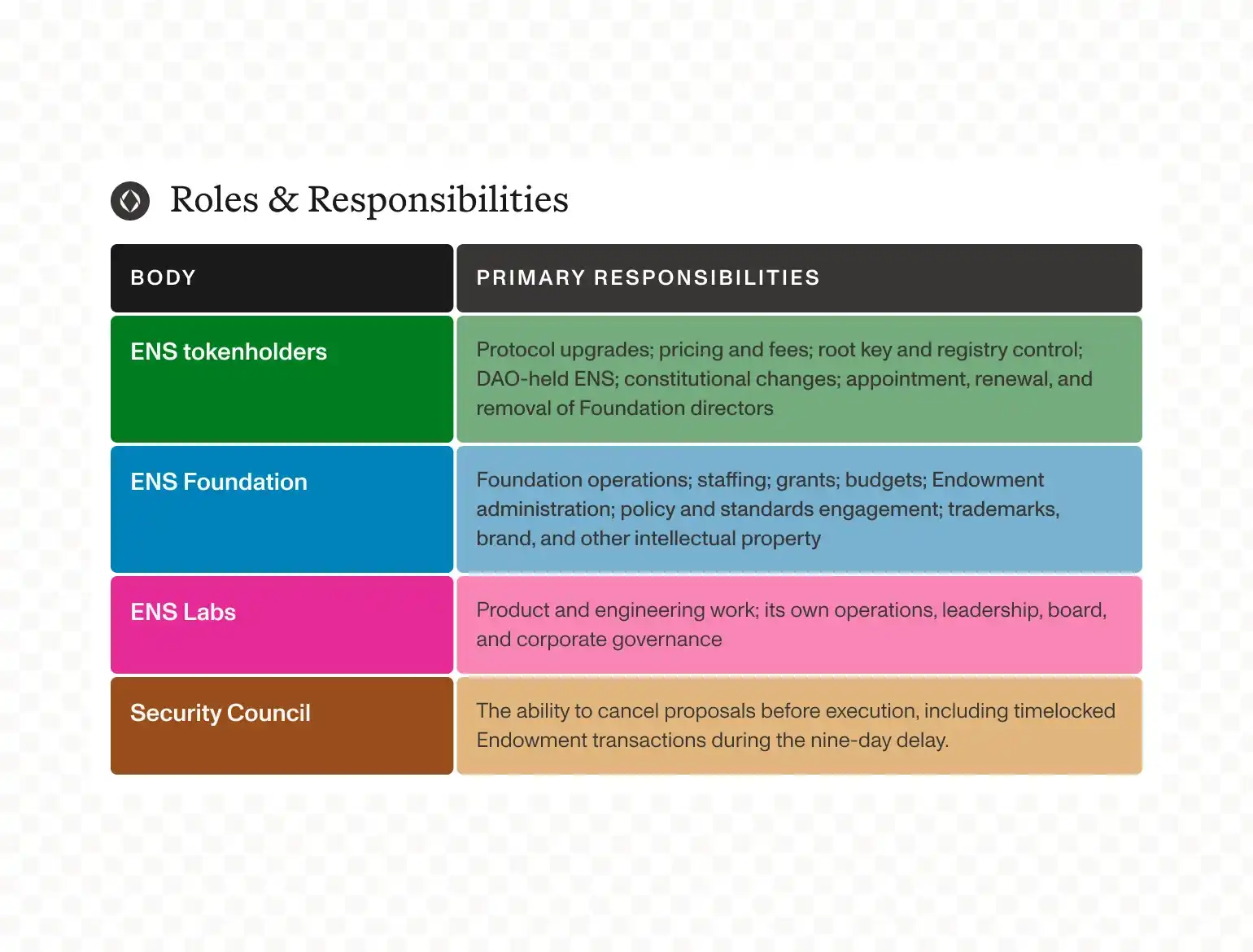
ENS Labs continues to lead core development of the ENS protocol, which is governed by token holders. Token holders also oversee the institutions representing them, including through the power to appoint or remove Foundation directors. The Foundation handles the off-chain work necessary to support the protocol, with its board responsible for overseeing operations and ensuring sustainable funding for ecosystem contributors, including ENS Labs. ENS Labs, the DAO, and the Foundation play different but complementary roles, aligned around the long-term stewardship of ENS. This symbiotic relationship makes ENS stronger while helping the on-chain protocol remain credibly neutral.

Foundation Board of Directors

The inaugural five-member board of the Foundation consists of:

  • Alexander Urbelis, Executive Director. Career spans cybersecurity law, DNS threat intelligence, and policy: former General Counsel & Chief Information Security Officer at ENS Labs, former Chief Information Security Officer at the NFL, former Chief Compliance Officer at Richemont.
  • Nick Johnson, Director. Founder of ENS, CEO of ENS Labs, previously at the Ethereum Foundation and Google.
  • Kartik Talwar, Independent Director. General Partner at A.Capital Ventures, Co-founder of ETHGlobal.
  • Brett Sun, Independent Director. Co-founder of Prelude, previously led technical work at Aragon, including early ENS integration AragonID.
  • Anthony Leutenegger, Independent Director. CEO of Aragon, a key ENS integrator, and also a delegate for Lido and Morpho.

Independent directors serve two-year terms, renewable by token holders. Each director brings distinct experience needed by ENS in this first term.

What Happens Next

Existing commitments will continue according to their agreed terms: stewards, active funding streams, grants, and current term commitments will persist. The Foundation will work with relevant parties to develop transition plans for grant programs, SPP3, and the current working group structure. Foundation positions will be publicly posted as staffing needs become clear.

With the proposal executed, the Foundation can begin fulfilling its approved operational, financial, policy, and institutional responsibilities. ENS Labs will continue to operate under its own management and governance, building ENSv2 and the products and infrastructure supporting the ENS protocol, while token holders retain control over protocol decisions and oversight of Foundation directors.

ENS aims to demonstrate that critical internet infrastructure can be credibly neutral, publicly governed, and outlast any single company. The complete governance record can be viewed in the executable proposal, on-chain votes, and execution transactions.


Crypto di tendenza

Domande pertinenti

QWhat is the primary purpose of establishing the ENS Foundation as a legal entity?

ATo formally represent the ENS protocol in institutional settings, enabling it to engage in regulatory discussions, standard-setting organizations (like ICANN, IETF, W3C), and negotiate for the .ens top-level domain, which the DAO itself lacked the legal and operational capacity to do.

QHow does the new governance structure ensure that ENS token holders retain ultimate control over the protocol and the Foundation?

AToken holders control the core protocol contracts, treasury, and pricing via the DAO. They also have the power to appoint or remove the Foundation's Board of Directors. A 9-day timelock and the ENS Security Committee provide oversight for treasury transactions, and the Foundation must operate under a publicly approved budget with transparent financial reporting.

QWhat specific new capabilities does the ENS Foundation gain that the ENS DAO or ENS Labs could not previously perform?

AThe Foundation can now: 1) Actively participate in standard-setting bodies like ICANN to pursue the .ens TLD. 2) Engage directly with regulators and policymakers. 3) Hold and defend ENS trademarks and intellectual property against scams. 4) Hire full-time employees for operations and grant management. 5) Serve as a legal counterparty for courts, registries, and other institutions.

QWhat is the relationship between the ENS Foundation, ENS Labs, and the ENS DAO according to the new proposal?

AThey are three independent but complementary entities aligned around protecting and extending the ENS protocol. ENS Labs focuses on core protocol development (like ENSv2). The ENS DAO, governed by token holders, controls the protocol and treasury. The Foundation handles off-chain institutional representation and operations, overseen by a Board appointed by the DAO. The Foundation does not own or govern Labs.

QHow are the assets of the ENS DAO's endowment fund managed under the new structure, and what safeguards are in place?

AThe endowment fund, funded by .eth registration fees, remains under DAO control. Transactions now require a 9-day timelock, during which the ENS Security Committee can cancel any transaction deemed outside the Foundation's mandate. The Foundation spends only according to its publicly approved budget and undergoes annual audits and quarterly reporting.

Letture associate

Upbit is Anxious: A Hasty Counterattack Aimed at Regaining Stablecoin Market Share

Title: Upbit's Rushed Counterattack to Reclaim Stablecoin Market Share Facing a dramatic shift in South Korea's stablecoin market, leading exchange Upbit launched a promotional campaign from July 26 to August 9, waiving the 0.05% trading fee for stablecoins paired with the Korean Won (KRW) and rapidly listing new stablecoins like RLUSD and USDG. This move is a direct response to its plummeting market share in this sector. Historically a duopoly with Bithumb, the market has been reshaped since October 2025 when Coinone permanently removed fees for USDC trading. By June 2026, Coinone led with 34.8% of stablecoin volume, followed by Bithumb (31.1%) and Upbit (30.1%). This contrasts sharply with the overall crypto market, where Upbit commands 60%. The data shows stablecoin demand is highly sensitive to fees, as users primarily buy them to transfer capital overseas for derivatives trading or forex arbitrage. South Korean exchanges have seen a net outflow of stablecoins for 18 consecutive months, totaling approximately 14.9 trillion KRW, underscoring their role as a cross-border capital conduit. Upbit's limited-time promotion initially boosted its daily stablecoin volume by 162%, but the surge was almost entirely in USDT (98.1% of volume). The newly listed stablecoins saw negligible, fleeting interest. Furthermore, the promotional effect quickly waned in the second week, with volume dropping 33% on weekdays. A concurrent weakening of the KRW also contributed to the trading spike, independent of the fee waiver. The analysis suggests that once the promotion ends, Upbit is unlikely to retain its temporary gains unless it matches Coinone's permanent zero-fee policy, forcing a choice between market share and fee revenue. Upbit's strategic push may be less about immediate profit and more about preparing for future regulatory shifts. With South Korea's *Digital Asset Basic Act* on the horizon, which will regulate KRW-backed stablecoins, and following Dunamu's (Upbit's parent) integration into Naver Financial to build a payment ecosystem, securing a dominant position in the dollar stablecoin distribution channel holds long-term strategic value. However, potential regulatory conflicts could prevent Upbit from listing a future Naver-issued KRW stablecoin, making the current fight for dollar stablecoin flow even more critical.

marsbit5 h fa

Upbit is Anxious: A Hasty Counterattack Aimed at Regaining Stablecoin Market Share

marsbit5 h fa

Michael Saylor Compares Bitcoin and Gold!

Michael Saylor, founder of MicroStrategy, argues that Bitcoin fundamentally changes how wealth is stored and transferred by transforming digital scarcity into economic value. He describes Bitcoin as the first digital monetary network, combining computers, digital networks, and cryptography. It digitizes monetary assets, allowing their supply to be controlled by public protocols rather than institutions, thus converting economic value into information transmissible over global networks. Comparing Bitcoin to gold, Saylor states that while increasing Bitcoin's supply is harder, its integration with software and transfer is easier. He highlights Bitcoin's proof-of-work mechanism, which ties it to the physical world by consuming real energy to secure the ledger, making past transactions immutable. This creates a shared security system involving miners, energy companies, and investors. Saylor suggests "digital monetary energy" is a more accurate term than "digital gold." He emphasizes that the Bitcoin network is an adaptive ecosystem of miners, nodes, developers, and users. Its core design is intentionally simple, focused on maintaining a secure ledger for scarce digital assets, with complex functionalities built in higher-layer applications. This architecture allows Bitcoin to serve as a foundation for transmitting value and fostering innovation in payments and financial services. Saylor notes Bitcoin's deeper impact lies in creating digital sovereignty, where private keys give individuals permissionless control over their economic power, with ownership verified mathematically, not by institutions. He concludes that while gold's physical scarcity makes it money, Bitcoin's digital scarcity does the same, characterizing Bitcoin as the monetary energy of the digital age.

cryptonews.ru6 h fa

Michael Saylor Compares Bitcoin and Gold!

cryptonews.ru6 h fa

Trading

Spot

Articoli Popolari

Come comprare ENS

Benvenuto in HTX.com! Abbiamo reso l'acquisto di Ethereum Name Service (ENS) semplice e conveniente. Segui la nostra guida passo passo per intraprendere il tuo viaggio nel mondo delle criptovalute.Step 1: Crea il tuo Account HTXUsa la tua email o numero di telefono per registrarti il tuo account gratuito su HTX. Vivi un'esperienza facile e sblocca tutte le funzionalità,Crea il mio accountStep 2: Vai in Acquista crypto e seleziona il tuo metodo di pagamentoCarta di credito/debito: utilizza la tua Visa o Mastercard per acquistare immediatamente Ethereum Name ServiceENS.Bilancio: Usa i fondi dal bilancio del tuo account HTX per fare trading senza problemi.Terze parti: abbiamo aggiunto metodi di pagamento molto utilizzati come Google Pay e Apple Pay per maggiore comodità.P2P: Fai trading direttamente con altri utenti HTX.Over-the-Counter (OTC): Offriamo servizi su misura e tassi di cambio competitivi per i trader.Step 3: Conserva Ethereum Name Service (ENS)Dopo aver acquistato Ethereum Name Service (ENS), conserva nel tuo account HTX. In alternativa, puoi inviare tramite trasferimento blockchain o scambiare per altre criptovalute.Step 4: Scambia Ethereum Name Service (ENS)Scambia facilmente Ethereum Name Service (ENS) nel mercato spot di HTX. Accedi al tuo account, seleziona la tua coppia di trading, esegui le tue operazioni e monitora in tempo reale. Offriamo un'esperienza user-friendly sia per chi ha appena iniziato che per i trader più esperti.

269 Totale visualizzazioniPubblicato il 2024.12.10Aggiornato il 2026.06.02

Come comprare ENS

Discussioni

Benvenuto nella Community HTX. Qui puoi rimanere informato sugli ultimi sviluppi della piattaforma e accedere ad approfondimenti esperti sul mercato. Le opinioni degli utenti sul prezzo di ENS ENS sono presentate come di seguito.

活动图片