‘Elite’ traders hunt dopamine-seeking retail on prediction markets: 10x Research

cointelegraphPubblicato 2025-12-09Pubblicato ultima volta 2025-12-09

Introduzione

Prediction markets are becoming a new arena in crypto where elite, well-equipped traders are systematically profiting from retail participants who often treat trading like gambling, driven by dopamine and narratives rather than discipline. According to 10x Research, a small, informed minority accurately prices probabilities and hedges exposure to extract value from retail-driven longshots. Data shows that on Polymarket, only 16.7% of wallets are profitable, while 83% have lost money. Concerns about insider trading are growing, with some users showing near-perfect win rates. Additionally, a bug was discovered that double-counts trading volume on third-party dashboards, though this is due to data errors rather than illegal wash trading.

Prediction markets are emerging as a new battleground in the crypto economy, where the best-informed traders are competing against casual retail bettors for profits.

Most users are behaving more like sports bettors than disciplined traders, according to a Tuesday report from research firm 10x Research, which said they are trading “dopamine and narrative for discipline and edge.” “Accuracy and profit are driven not by the crowd, but by a tiny, informed elite who price probability, hedge exposure, and extract premium from retail-driven longshots.”

The rising liquidity and retail participation are incentivizing professional trading desks to increase their prediction market activity and capture the spread and “misinformation asymmetry” arising from this market structure, 10x added.
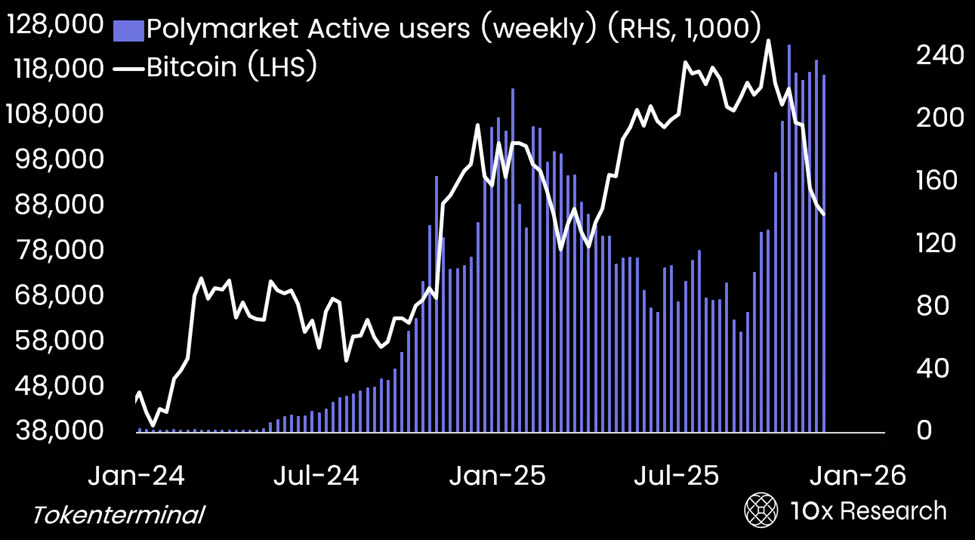
Polymarket active users, weekly, Bitcoin left-hand-side price, year-to-date chart. Source: 10x Research

Related: Bitcoin now settles Visa-scale volumes, but most is for wholesale, not coffee

The report is a concerning sign for casual traders looking to make easy money on prediction markets, as blockchain data suggests that most users lose their initial investment.
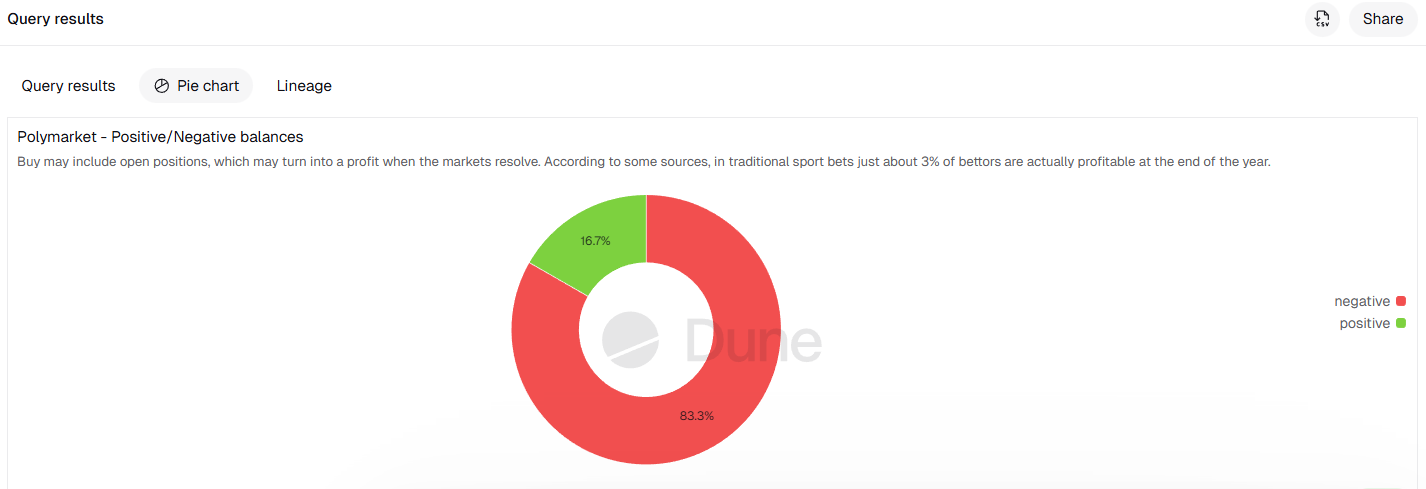
Polymarket, positive/negative wallet balances. Source: Dune.com

Only about 16.7% of wallets on Polymarket are in profit, while the remaining 83% have incurred losses, according to blockchain data from Dune.

Related: Prediction markets emerge as speculative ‘arbitrage arena’ for crypto traders

Perfect win rates fuel insider concerns

The flawless track record of some prediction market accounts is stoking concerns about possible insider trading, as certain users appear to win every time.

Polymarket user “pony-pony” boasts a 100% win rate with over $77,000 in realized profit by betting on events related to the artificial intelligence development company, OpenAI, prediction market data aggregator Polymarket Money said in a Monday X post.

Another user, “AlphaRaccoon,” also triggered insider allegations after generating over $1 million in a single day by successfully winning 22 out of 23 bets related to Google search trends.
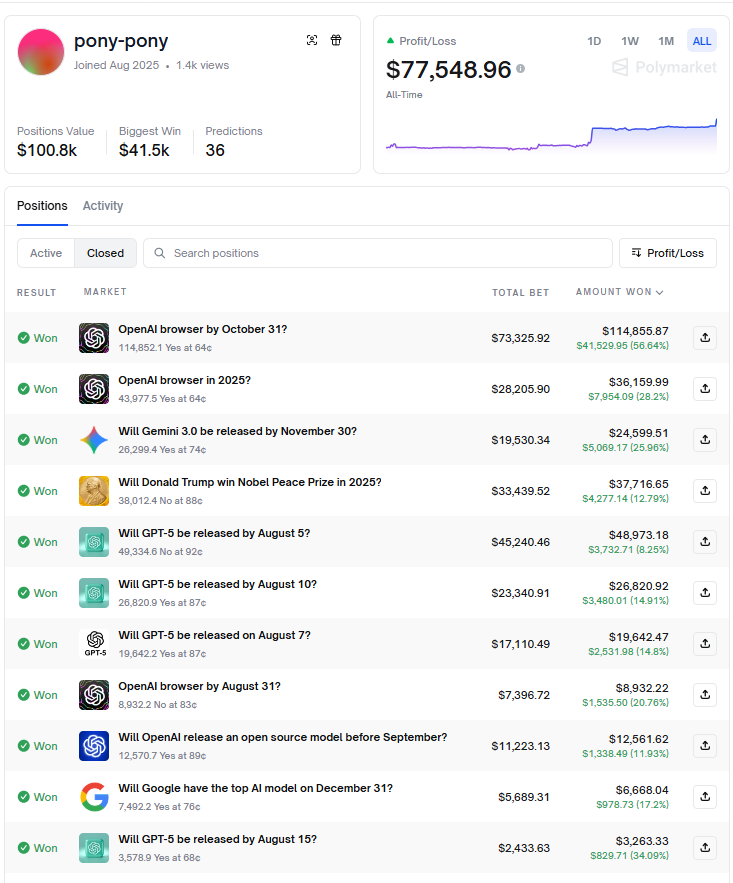
Source: Polymarket Money

Meanwhile, concerns are brewing over the reliability of Polymarket data on third-party data dashboards after a Paradigm researcher discovered a bug that double-counts the prediction market’s trading volume, Cointelegraph reported earlier on Tuesday.

The bug is inflating the primary volume metrics used to gauge prediction market activity, including the notional volume, which counts the number of contracts traded, and the cashflow volume, which measures the dollar value traded at the time of each trade, wrote Paradigm researcher Storm in a Tuesday X post.

However, the inflated volumes on data dashboards are due to errors in data interpretation, not wash trading, which is a deceptive and illegal practice in which entities buy and trade the same instrument to create a false impression of growing market activity.

Paradigm’s newly discovered bug was “validated” by multiple data dashboards, including AlliumLabs and DefiLlama, which are now updating their Polymarket dashboards to eliminate the double-counting error.

Magazine: Train AI agents to make better predictions... for token rewards
Letture associate

Five Core Forms of AI Agent in YC's Eyes

The article outlines five core architectural patterns for effective AI Agents, emerging from tools like Codex and Claude, that move beyond simple prompts towards reusable, process-based capabilities. 1. **Skills**: Reusable, parameterized workflows that function like method calls, allowing a single process (e.g., "/investigate") to handle various tasks based on input parameters. 2. **Thin Harness**: A lightweight execution framework (~200 lines) that manages the AI model's "hands and feet"—handling loops, file I/O, and context—without becoming bloated. 3. **Resolvers**: Routing tables that map tasks to specific Skills, preventing "context corruption" when managing dozens of Skills and ensuring outputs go to the correct locations. 4. **Latent vs. Deterministic Layer**: A critical separation where LLMs handle judgment, synthesis, and pattern recognition, while deterministic code handles tasks requiring precision, consistency, and low cost (like calculations). 5. **Memory**: A persistent, accumulating knowledge base (e.g., a markdown folder) with a "current trusted conclusion" section and an append-only timeline, enabling the system to learn and retain context over time. Together, these patterns create a "process power"—a durable competitive advantage. Unlike one-off prompt-based applications whose value quickly commoditizes, a well-designed AI Agent system encodes experience into reusable, parameterized workflows, offloads stable rules to code, and continuously learns through memory. This creates a structured, hard-to-replicate capability that can provide sustained value for individuals or businesses, such as an accountant automating client reviews while preserving privacy and accumulating expertise.

marsbit30 min fa

Five Core Forms of AI Agent in YC's Eyes

marsbit30 min fa

Tiger Research: On-Chain Risk Operators, The Market Cap Gap Between 147 Trillion and 70 Billion

This report by Tiger Research examines the evolution of risk management in decentralized finance (DeFi) lending. It highlights a power shift from protocol developers to specialized professional risk operators who manage on-chain capital. The era of protocols and community governance solely dictating DeFi lending is ending. A new professional asset management layer has emerged. While the sector is nascent, capital and distribution channels are rapidly consolidating around top risk operator teams, whose past performance is now a key criterion for institutional entry. The industry's development, accelerated by modular infrastructures like Morpho, has led to a clear division of labor mirroring traditional finance: distribution channels (e.g., exchanges), strategy/risk management (the risk operators), and product infrastructure/asset custody (smart contract protocols). This structure lowers the entry barrier for traditional institutions. Currently, the total value managed by risk operators is approximately $70 billion, dominated by a few leading teams like Steakhouse (RWA focus), Sentora (AI models), and Gauntlet (crisis management). Competition now centers on collateral standards, distribution access, and crisis response capabilities. The report outlines three primary entry paths for institutions: 1) **Distribution Model**: Leveraging external risk operators as backend service providers (common for exchanges). 2) **Asset Supply Model**: Onboarding real-world assets to DeFi as collateral. 3) **Independent Operator Model**: Building an in-house team to become a risk operator (e.g., Bitwise). The core opportunity lies in the strategy/risk management layer, where traditional financial institutions can leverage their existing expertise in due diligence and risk assessment without deep technical development. A vast opportunity gap exists: the global traditional asset management industry manages ~$147 trillion, while the entire DeFi sector is only ~$800 billion, with the risk operator niche at ~$70 billion. This disparity signifies immense growth potential. Once robust risk frameworks and clearer regulations are established, even a minor allocation from traditional markets could trigger exponential DeFi growth. Early movers who help build these foundational systems will gain significant rule-setting influence and first-mover advantages.

marsbit37 min fa

Tiger Research: On-Chain Risk Operators, The Market Cap Gap Between 147 Trillion and 70 Billion

marsbit37 min fa

Interview with Circle's Chief Economist: USDC's Entry into Hyperliquid Benefits Circle and HYPE, Stablecoins Are Becoming Marginal Buyers of U.S. Treasuries

In an interview with Circle's Chief Economist Gordon Liao, the conversation covers the strategic significance of USDC replacing USDH as the reference asset on the decentralized perpetual exchange Hyperliquid. This shift, facilitated by Coinbase as the reserve manager and Circle providing technical infrastructure, aims to capture net interest income for the platform, with 90% of reserve earnings directed back to Hyperliquid for HYPE token buybacks. Liao discusses how stablecoins like USDC, with their substantial on-chain settlement volumes (e.g., $21 trillion in Q1 2026), are emerging as marginal buyers of U.S. Treasuries, concentrating on short-term debt and effectively reducing the weighted duration of the market, which may provide underlying support for long-term rates. The dialogue also explores the evolving nature of stablecoins as both a medium of exchange and a vehicle for capital and collateral liquidity. Additionally, the panel touches on the CLARITY Act's legislative progress, noting compromises around "activity-based rewards" and remaining hurdles like ethics concerns. On AI, there's debate over value capture, with predictions that distribution and application layers, rather than foundational model companies like OpenAI, will accrue most value. Regarding the bond market, Liao attributes the rise in 30-year yields primarily to an increased term premium (around 80 bps) driven by supply-demand dynamics, including fiscal expansion and changing investor demand, rather than expectations of Fed rate hikes.

marsbit42 min fa

Interview with Circle's Chief Economist: USDC's Entry into Hyperliquid Benefits Circle and HYPE, Stablecoins Are Becoming Marginal Buyers of U.S. Treasuries

marsbit42 min fa

Trading

Spot
Futures
活动图片