Eight Years Later, Behind Monero's New High, the Privacy Narrative Is Returning to the Core of Crypto

Odaily星球日报Pubblicato 2026-01-13Pubblicato ultima volta 2026-01-13

Introduzione

Amidst market volatility and fleeting meme coin trends, privacy is re-emerging as a core narrative in crypto. Monero (XMR) recently broke its 8-year all-time high, surging over 500% since early 2024, symbolizing a return to privacy-first principles. Its design, featuring ring signatures, stealth addresses, and RingCT, ensures strong anonymity by default. Zcash (ZEC) initially led this privacy resurgence but faced a governance crisis when its development team, ECC, collectively resigned due to disputes with the Bootstrap board, causing a 40% price drop. Despite this, Zcash remains a decentralized protocol. Other projects are expanding privacy beyond transactions. Humanity Protocol uses palm recognition and zero-knowledge proofs to create a private digital identity system, partnering with Mastercard. Railgun acts as a private wallet layer for DeFi, allowing anonymous interactions with smart contracts, with Vitalik Buterin among its users. Pirate Chain enforces 100% privacy using zk-SNARKs. Tornado Cash, despite U.S. sanctions and legal battles, saw significant ETH inflows in 2025, showing persistent demand for privacy. Dusk Network takes a compliance-friendly approach, offering auditable privacy for regulated assets like RWA, aligning with EU regulations. This shift indicates privacy is evolving from a niche tool into essential infrastructure for crypto's sustainable growth.

Original | Odaily Planet Daily (@OdailyChina)

Author | DingDang (@XiaMiPP)
Amidst the current severe market volatility and the rapid creation and swift abandonment of Chinese Memes, if there's one narrative still worth our sustained attention, privacy is undoubtedly among them.

From the surge of Zcash in 2025 to Monero breaking its 8-year high in 2026, the performance of privacy-related assets is no longer just a brief emotional resurgence but is being repositioned within the long-term proposition of crypto infrastructure.

In their latest article "Privacy trends for 2026" released at the beginning of the year, a16z re-examined the role of privacy in the next phase of crypto technology evolution from multiple perspectives including decentralized communication, data access control, and security engineering methodologies (Recommended reading: "Zcash is Just the Beginning, How a16z Redefines the Privacy Narrative for 2026?").

Against this backdrop, privacy is no longer just a tool for "resisting regulation" but a fundamental infrastructural capability supporting the sustainable operation of crypto systems. This issue of Odaily Planet Daily systematically reviews multiple privacy-related assets. Let's take a look at which projects are truly gaining market favor recently.

Monero(#15): The Return of Privacy Fundamentalism After 8 Years

On January 13th, the price of Monero (XMR) broke through $650. Its upward trend started at the beginning of 2024, with an increase of over 500%. But more symbolic than the increase is that this is the first time XMR has effectively broken through the historical high of the 2017 bull cycle after an 8-year interval.

In the cryptocurrency world, Monero is perhaps one of the most thorough and tenacious existences in terms of privacy attributes. Since its birth in 2014, it has consistently adhered to "default privacy, mandatory privacy, and untraceability" as its core design philosophy.

In specific implementation, Monero systematically erases on-chain analyzability through multi-layered cryptographic mechanisms. Ring Signatures are used to hide the identity of the transaction sender: the real input is mixed with multiple historical "decoy" outputs on the blockchain into a "ring". External observers can only determine that "someone in the ring is spending funds" but cannot determine who it is; Stealth Addresses automatically generate a one-time receiving address for each transaction. Only the recipient can identify this income through the view key, thus severing the permanent association between the recipient and the public address; and Ring Confidential Transactions (RingCT) further hide the transaction amount. Using Pedersen Commitments and Bulletproofs++ range proof technology, it ensures the amount remains invisible while still allowing the network to verify that no coins are created out of thin air or double-spent.

After these mechanisms are superimposed, the sender, receiver, and amount of all transactions are hidden by default. The entire chain has no traceable transparent records, providing extremely high anonymity and fungibility, far exceeding that of coins with optional privacy.

But as the saying goes, "怀璧其罪" (To be innocent yet possess a treasure is to be guilty), this extreme design has also made Monero one of the most unfriendly existences from a regulatory perspective. Under continuous compliance pressure, by 2024, mainstream exchanges like Binance and OKX had delisted all spot trading pairs for XMR, retaining only futures trading.

Zcash(#28): A Severe Governance Shock

The biggest contributor to this round of privacy resurgence is Zcash. Related reading: "Privacy Coin Revival: From Binance Delisting Candidate to a 13x Surge, ZEC's Lightning Rebirth".

However, on January 8th, Josh Swihart, CEO of the Zcash (ZEC) development team Electric Coin Company (ECC), stated in a post that the majority of the Bootstrap board members (the non-profit organization behind ECC, which supports Zcash by managing ECC), particularly the Zaki Manian, Christina Garman, Alan Fairless, and Michelle Lai combination (referred to as the ZCAM group), had significantly deviated from Zcash's mission. Under the ZCAM group's decision for a constructive dismissal, the entire ECC team chose to resign collectively. It should be added that since 2020, after the majority of shareholders chose to donate their shares, ECC had gradually transitioned to a non-profit structure, with Bootstrap taking over governance functions. After the news was announced, ZEC once fell below $362, a drop of over 40%.

Bootstrap subsequently issued a clarification statement, saying the dispute stemmed from legal restrictions encountered while seeking external investment. Discussions have now begun on "alternative structures for external investment and the privatization of Zashi," and they are working with legal counsel to ensure all paths comply with US non-profit organization laws, without deviating from Zcash's long-term mission or harming broader community interests.

However, this statement did not immediately reverse market sentiment.

Nevertheless, the Zcash Foundation also stated that Zcash has always been a decentralized open-source protocol, and no single contributor, team, or organization can control Zcash.

From its inception, Zcash has made "resilience" one of its core goals. Its codebase is completely open source, consensus rules are maintained by independent nodes globally, and ecosystem development is supported by diverse organizations and contributors. As a protocol guardian, the Zcash Foundation's mission includes: maintaining protocol security, funding independent research and engineering practices, promoting decentralized governance, and advocating for privacy as a fundamental human right.

Humanity(#215): Not a Privacy Coin, Reconstructing "Private Identity"

Unlike the aforementioned projects, Humanity Protocol (H) does not focus on "financial privacy" but attempts to reconstruct the balance between privacy and trust at the digital identity level.

Humanity uses palm print biometrics combined with zero-knowledge proofs to verify that a user is a real human without leaking any personal data, aiming to build a decentralized trust layer resistant to Sybil attacks. The project was launched in 2023, and its token H went live in June 2025.

In terms of application, Humanity has announced a partnership with Mastercard to combine its open financial connectivity with the Human ID identity system, enabling users to access real-world financial services like credit and loans without exposing their privacy.

In July 2025, Nasdaq-listed company Prenetics announced the inclusion of H tokens in its crypto asset treasury. The company had previously purchased 187 BTC for $20 million, being the first healthcare company to configure a Bitcoin treasury. Perhaps also because of this, coupled with actions on the funding side, the price of the H token rose from $0.026 to $0.4, a maximum increase of 14 times, before falling back and experiencing a round of full turnover. It has currently rebounded to around $0.17.

Compared to other privacy projects, Humanity is still in an earlier stage. But the "private identity" direction it切入 undoubtedly provides another way to open up the privacy narrative.

Railgun(#331): DeFi's "Private Wallet Layer"

Railgun is a decentralized privacy protocol based on zero-knowledge proofs, operating on Ethereum and multiple EVM-compatible chains. Its core goal is not simple anonymous transfers but to provide DeFi users with composable private interaction capabilities.

Unlike mixers like Tornado Cash, Railgun is more like a "private wallet layer." Users can directly build private balances within the protocol and then interact privately with any EVM smart contract. The entire process is non-custodial, open source, and requires no trust in a third party. It allows users to completely hide wallet addresses, transaction amounts, and strategy details when performing operations such as trading, lending, providing liquidity, or mining, without sacrificing the decentralized nature of DeFi.

The project was launched in 2021. After Tornado Cash was sanctioned, Railgun introduced a "Proof of Innocence" mechanism in 2024 to reduce the risk of being misjudged as an illegal tool, while gradually expanding to Layer2 to reduce usage costs.

Ethereum co-founder Vitalik Buterin is an early supporter of Railgun and has多次 used the protocol for donations to avoid on-chain tracking.

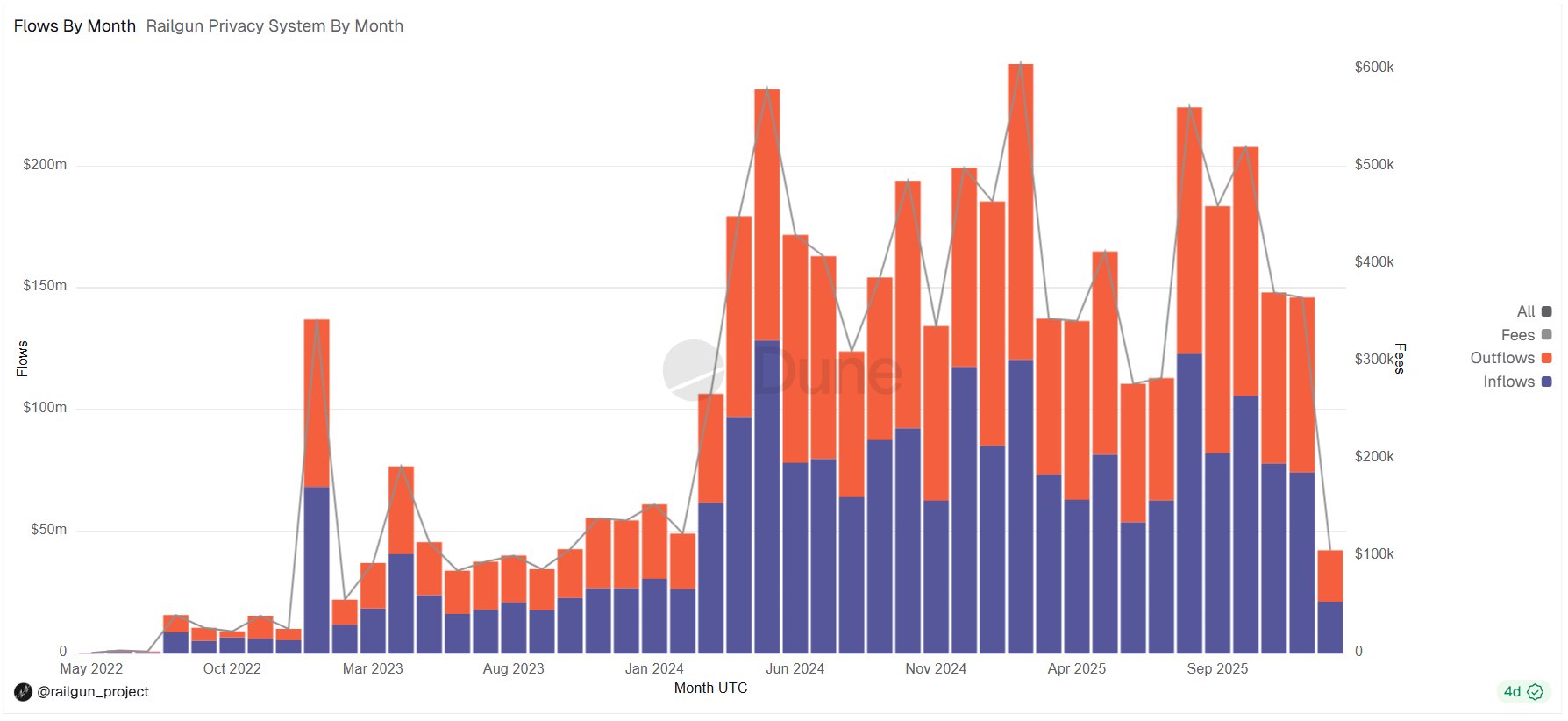
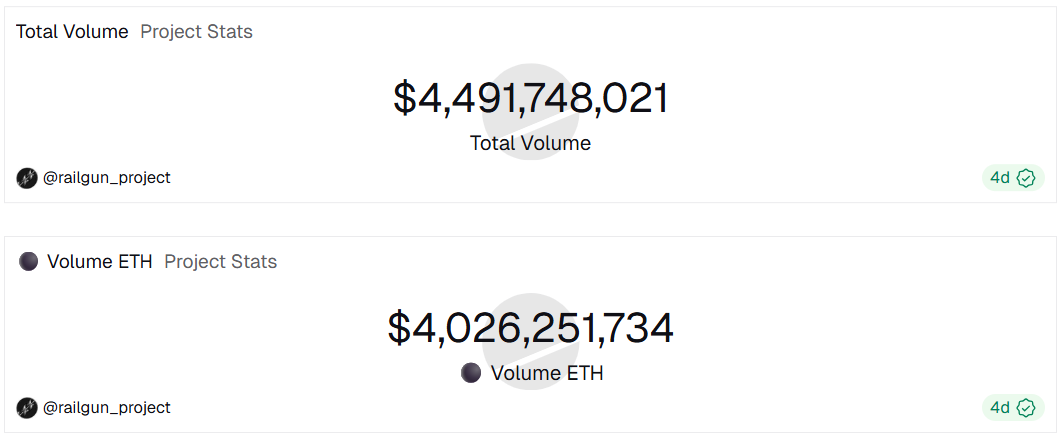
Dune data shows that since 2022, Railgun's fund usage has remained active, especially after Ethereum Gas costs significantly decreased in 2024, activity noticeably increased. To date, the cumulative transaction volume has reached $4.49 billion, of which ETH accounts for approximately $4.03 billion.
Pirate Chain(#488): Taking "Privacy" as the Only Prerequisite, Making No Compromises

Pirate Chain (ARRR) is a cryptocurrency project also focused on privacy protection, aiming to provide the most anonymous digital currency. The project was launched in 2018, inspired by Zcash's zk-SNARKs technology. However, unlike Zcash's optional privacy, Pirate Chain is 100% mandatory privacy, forming the world's largest organic anonymity set, preventing information leakage through network activity, and supporting fast verification without exposing data. The project has no ICO, no pre-mining, no developer tax. Development and maintenance rely mainly on community contributions. Its core developers have backgrounds spanning multiple ecosystems including Bitcoin, Zcash, Komodo, and Monero. Talent is the core of the project.

In terms of consensus mechanism, Pirate Chain uses Equihash PoW and introduces Delayed Proof of Work (dPoW) as an additional security layer. dPoW significantly increases the cost of launching a 51% attack by notarizing blocks on an external chain, which is also a common defense method for small-scale PoW networks.

It is worth noting that after Komodo announced its acquisition by Gleec in December 2025, the market might be concerned about Pirate Chain's reliance on Komodo's infrastructure. In response, the project announced on January 7, 2026, that dPoW has been successfully migrated from the original Komodo to Komodo Classic, the security mechanism has been seamlessly continued, and the network has achieved independent operation.

Tornado Cash(#769): Still Operating After Sanctions

Tornado Cash (TORN) is a mixing protocol running on Ethereum, using zk-SNARKs technology to break the direct link between on-chain transactions. Simply put, it uses a "fund pool mixing" method to make ETH or ERC-20 tokens lose traceability between deposit and withdrawal.

It was once one of the star projects on Ethereum. But in 2022, the US Treasury Department's OFAC directly listed Tornado Cash's smart contracts on the SDN sanctions list. This was the first time in history that immutable smart contracts were sanctioned. Subsequently, developer Alexey Pertsev was sentenced in the Netherlands, and Roman Storm and Roman Semenov faced trial in the US. Affected by this, Tornado Cash's governance token TORN was also delisted from mainstream exchanges.

A turning point occurred at the end of 2024. The Fifth Circuit Court of Appeals ruled that OFAC had overstepped its authority—immutable smart contract code does not constitute "property" and cannot be sanctioned, thus overturning the sanctions decision against the contracts themselves.

But the legal disputes did not end there. In 2025, Storm was partially convicted on charges of "illegally operating a money transmission business," while the jury failed to reach a consensus on money laundering and sanctions-related charges. Related cases may continue in 2026.

It is worth noting that since its launch in 2019, Tornado Cash has operated in the form of a DAO. The protocol is completely open source, the initial developers have long lost control, and the contracts are immutable once deployed.

According to monitoring by crypto regulatory technology company Bitrace, in 2025, Tornado Cash addresses received a total inflow of 693,412 ETH, with a total value of approximately $2.5 billion; calculated in US dollars, the net inflow for the year was about $1.4 billion, mainly in ETH. This means that even after the sanctions turmoil, among native crypto users, the demand for private Ethereum transfers remains significant.

Dusk Network(#781): Putting Privacy Inside the System, Not Against It

If most of the aforementioned projects choose to keep their distance from regulation, then Dusk Network represents another route within the privacy track—attempting to coexist with compliance frameworks from the protocol level.

Dusk Network (DUSK) was founded in 2018. It is a Layer 1 blockchain protocol focused on privacy protection and compliance, founded by technical experts Jelle Pol and Emanuele Francioni, primarily targeting financial applications and real-world asset (RWA) tokenization. Its mainnet officially launched in early 2025, and its consensus mechanism is a variant of Proof of Stake (PoS).

The technical core of Dusk is not "hiding everything completely" but revolves around "auditable privacy." By combining zero-knowledge proofs (ZK) and homomorphic encryption (HE), Dusk allows transaction information to remain private by default, but enables auditing through selective disclosure under compliance or legal requirements.

Precisely because of this, Dusk has positioned itself as compliant financial infrastructure from the beginning, explicitly supporting MiCA, MiFID II, and the EU DLT pilot regime. This design means it faces less pressure and has a larger survival space.

From a narrative perspective, Dusk treads two main lines currently receiving high market attention: privacy + RWA. As traditional financial institutions begin to explore on-chain asset issuance and settlement, "regulatory-friendly privacy" should gradually become a real demand.

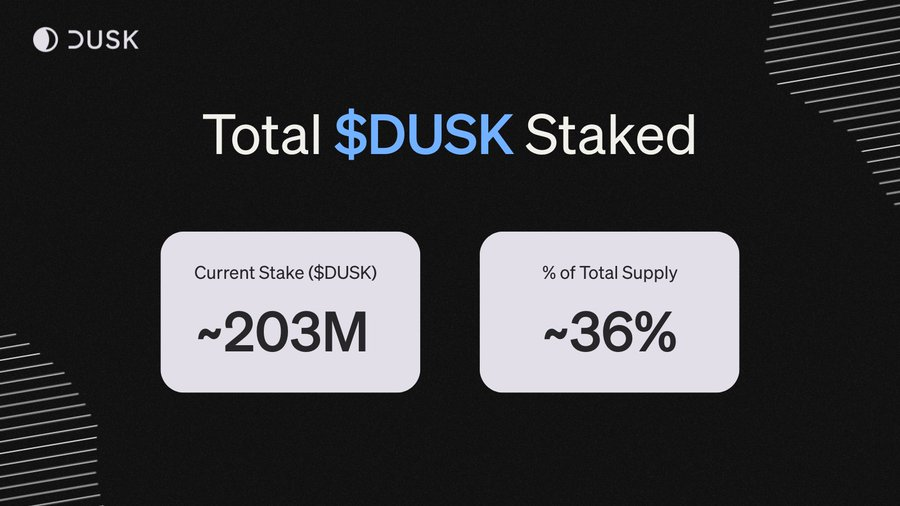
The latest data disclosed by the Dusk Foundation on December 29th shows that over 200 million DUSK is currently staked, accounting for 36% of the supply. This, to some extent, also reflects token holders' recognition of its long-term positioning.
Crypto di tendenza

Domande pertinenti

QWhat is the main reason behind Monero's (XMR) recent price surge to an 8-year high?

AMonero's price surge is attributed to a broader resurgence of interest in privacy narratives within the crypto space, with its price increasing over 500% since the beginning of 2024, effectively breaking its previous all-time high from 2017.

QWhat key technological features does Monero use to ensure transaction privacy?

AMonero uses Ring Signatures to hide the sender's identity, Stealth Addresses to create one-time addresses for recipients, and Ring Confidential Transactions (RingCT) to conceal the transaction amount, providing default and mandatory privacy for all transactions.

QWhat major governance event recently impacted Zcash (ZEC) and caused a significant price drop?

AThe entire development team at Electric Coin Company (ECC), the core developers of Zcash, collectively resigned following a dispute with the majority of the Bootstrap board members, leading to a price drop of over 40%.

QHow does the Railgun protocol differ from a simple privacy mixer like Tornado Cash?

ARailgun is a decentralized privacy protocol that acts as a 'private wallet layer,' allowing users to privately interact with any EVM smart contract for DeFi activities, whereas Tornado Cash is primarily a mixing service for breaking on-chain links between deposits and withdrawals.

QWhat is the core design philosophy of the Dusk Network (DUSK) regarding privacy and regulation?

ADusk Network is designed for 'auditable privacy,' combining zero-knowledge proofs and homomorphic encryption to keep transactions private by default while allowing for selective disclosure to comply with regulatory frameworks like MiCA and MiFID II, positioning itself as compliant financial infrastructure.

Letture associate

After Three Consecutive Quarters of Decline, Can the Crypto Market Find a Window for Stabilization in Q3?

The cryptocurrency market has just concluded its worst-performing quarter since 2022, with total capitalization dropping 12.6% to $2.1 trillion. All core metrics indicate capital is leaving the sector, not just rotating within it. Bitcoin fell 14.2% and Ethereum dropped 25.4% in Q2, breaking their previous correlation with US tech stocks. A key driver is the reversal in US spot Bitcoin ETF flows, which saw a net outflow of approximately $4.67 billion in Q2, including a record monthly outflow near $4.5 billion in June. While recent data suggests long-term holders are accumulating again, sustained ETF outflows mean continued selling pressure. Market focus is now singularly on the Federal Reserve. The upcoming July FOMC meeting is seen as the most critical event for Q3. A dovish signal could support Bitcoin reclaiming a $68,000-$84,000 range, while a hawkish stance might establish a new trading band around $50,000-$56,000. Additionally, regulatory uncertainty persists, with the progress of the crucial *CLARITY Act* stalling in the Senate, reducing its perceived 2026 passage probability to 40-45%. Despite the broad downturn, a few sectors showed growth. Prediction markets saw nominal volume surge 48.7% year-over-year to $113.8 billion, and tokenized collectibles transaction volume rose 143% quarterly to $1.4 billion. The Real-World Asset (RWA) tokenization sector also continued steady growth, now representing ~$28.1 billion in on-chain value. The market's foundation for an extreme crash appears limited, with Bitcoin price hovering near its 200-week moving average. However, the trading paradigm has shifted from narrative-driven speculation to decisions based on price action, policy developments, and interest rate expectations, making a broad sentiment-driven rally unlikely in the near term.

marsbit17 h fa

After Three Consecutive Quarters of Decline, Can the Crypto Market Find a Window for Stabilization in Q3?

marsbit17 h fa

BIT Trading Moment: BTC Still Suppressed by Weekly 200 EMA, Rejection May Restart Decline; Storage and Semiconductors that Surged Last Night Begin Falling in Evening Trading

**Crypto & Stock Market Wrap: Bitcoin Tests Resistance, Stocks Retreat After AI Surge** Bitcoin consolidates around $66,000, facing key resistance near $68,000—an area seen as a major psychological and technical hurdle where previous rallies have failed. Analysts note the cryptocurrency is caught between its 200-week moving average (~$63,333) and 200-week EMA (~$68,328). A clear break above $68k is needed to signal a stronger bullish trend, while a rejection could lead to a retest of $63k support. Market sentiment remains cautious, with low futures open interest pointing to a low-liquidity rebound rather than a full bull market. Bitcoin spot ETFs saw another $203 million inflow. US stock futures pointed lower after a strong Tuesday session led by a massive rebound in semiconductors and memory stocks. The rally was fueled by renewed optimism about AI-driven hardware demand, with Micron, SanDisk, and SK Hynix surging. However, those gains reversed in pre-market trading. Super Micro Computer (SMCI) soared over 20% after hours on strong guidance and a record backlog. Other standouts included Rocket Lab and nuclear energy plays Oklo and X-Energy. Rising oil prices (Brent above $91) and climbing Treasury yields (10-year near 4.64%), however, are reigniting inflation concerns and acting as a headwind for equities. In Asia, markets were mixed. South Korea's KOSPI pared early gains to close slightly higher as semiconductor stocks like SK Hynix gave back initial surges. Japan's Nikkei edged lower as the yen hit a fresh 38-year low against the dollar, raising fears of potential market intervention. Key events to watch include the Samsung Galaxy launch, AMD's AI event, and a slew of major tech earnings from Alphabet, Tesla, and IBM after the close on Wednesday, followed by the ECB meeting and Intel's earnings on Thursday.

marsbit17 h fa

BIT Trading Moment: BTC Still Suppressed by Weekly 200 EMA, Rejection May Restart Decline; Storage and Semiconductors that Surged Last Night Begin Falling in Evening Trading

marsbit17 h fa

Former CFTC Chairman, Circle President Tarbert: Preaching Long-Termism While Cashing Out $30 Million Himself

Former CFTC Chairman and Circle President Heath Tarbert has consistently advocated for a long-term vision in public, urging patience from investors as Circle’s stock price has fallen significantly from its peak. However, it has been revealed that since Circle’s IPO, Tarbert has continuously sold his CRCL shares through pre-arranged trading plans, cashing out approximately $30 million, without making any public market purchases. This contrast between his public messaging and personal actions has drawn criticism. Tarbert joined Circle in July 2023 as Chief Legal Officer, leveraging his regulatory experience to help guide the company through its IPO and expansion. Despite promoting stablecoins as long-term infrastructure, he established a 10b5-1 trading plan just before Circle went public, leading to substantial stock sales over the following year. In March 2026, he initiated another plan to sell more shares. His career trajectory highlights a pattern of moving between high-level regulatory roles and influential positions in the financial sector. After resigning as CFTC Chairman in early 2021, he joined Citadel Securities as Chief Legal Officer just 27 days later, during a period of intense regulatory scrutiny for the firm. He later joined Circle, aiding its efforts to navigate regulatory challenges for its public listing. While Tarbert's expertise in policy and compliance is valuable to companies like Circle, his actions—advocating long-term confidence while personally divesting—raise questions about the alignment between his public statements and his private financial decisions, leaving investors who followed his advice to bear the market risks.

marsbit17 h fa

Former CFTC Chairman, Circle President Tarbert: Preaching Long-Termism While Cashing Out $30 Million Himself

marsbit17 h fa

Gate Research Institute: The 'Wall Street-ization' Wave of Crypto Financial Products – Competition or Integration?

The article titled "Gate Research Institute: Are Crypto Financial Products Sparking a 'Wall Street' Wave—Competition or Convergence?" explores the evolving relationship between the crypto ecosystem and traditional finance (TradFi). The piece begins by reflecting on Bitcoin's original 2009 vision of decentralization, disintermediation, and moving away from banks. It then contrasts this with the 2024 landscape, where key crypto assets like Bitcoin are increasingly held through Wall Street products like ETFs issued by giants like BlackRock. The article questions whether this signifies that TradFi is systematically taking over the rights to issue, price, custody, and distribute crypto financial assets. The core argument is that this is not a zero-sum takeover but rather a bidirectional convergence where each side addresses the other's weaknesses. Crypto offers 24/7 global markets, programmable settlement, and open access but lacks compliant channels, institutional-grade custody, deep fiat liquidity, and mainstream distribution. TradFi possesses these but is constrained by legacy systems, limited operating hours, and slow settlement. Two primary convergence paths are highlighted: * **Path A (CEX to TradFi):** Exemplified by Gate, which has progressed from offering tokenized stocks and CFDs to providing direct, real stock trading (US, Hong Kong, South Korea) within its platform, using USDT. * **Path B (TradFi to Crypto):** Exemplified by Robinhood, which has integrated crypto trading, acquired exchanges like Bitstamp, and is moving traditional assets like stocks onto the blockchain via tokenization and its own Layer 2. Both paths are ultimately competing to become the next-generation, unified financial account—a "super account" where users can seamlessly trade cryptocurrencies, stocks, ETFs, RWA (Real World Assets), and tokenized treasury products in one interface. The growth of RWA and tokenized treasuries (e.g., BlackRock's BUIDL) is presented as the asset-layer fusion, providing stable, yield-bearing assets on-chain and acting as a bridge between the two worlds. In conclusion, the "Wall Street-ization" of crypto is framed as a mutual transformation. Decentralized ideals persist in the protocol layer, while at the application layer, a more efficient, global, and accessible unified capital market is emerging from this convergence. The future competition lies not between crypto exchanges and stockbrokers, but between platforms vying to offer the most comprehensive asset coverage, liquidity, and user experience within a single account.

marsbit18 h fa

Gate Research Institute: The 'Wall Street-ization' Wave of Crypto Financial Products – Competition or Integration?

marsbit18 h fa

Trading

Spot

Articoli Popolari

Come comprare CORE

Benvenuto in HTX.com! Abbiamo reso l'acquisto di CORE (CORE) semplice e conveniente. Segui la nostra guida passo passo per intraprendere il tuo viaggio nel mondo delle criptovalute.Step 1: Crea il tuo Account HTXUsa la tua email o numero di telefono per registrarti il tuo account gratuito su HTX. Vivi un'esperienza facile e sblocca tutte le funzionalità,Crea il mio accountStep 2: Vai in Acquista crypto e seleziona il tuo metodo di pagamentoCarta di credito/debito: utilizza la tua Visa o Mastercard per acquistare immediatamente CORECORE.Bilancio: Usa i fondi dal bilancio del tuo account HTX per fare trading senza problemi.Terze parti: abbiamo aggiunto metodi di pagamento molto utilizzati come Google Pay e Apple Pay per maggiore comodità.P2P: Fai trading direttamente con altri utenti HTX.Over-the-Counter (OTC): Offriamo servizi su misura e tassi di cambio competitivi per i trader.Step 3: Conserva CORE (CORE)Dopo aver acquistato CORE (CORE), conserva nel tuo account HTX. In alternativa, puoi inviare tramite trasferimento blockchain o scambiare per altre criptovalute.Step 4: Scambia CORE (CORE)Scambia facilmente CORE (CORE) nel mercato spot di HTX. Accedi al tuo account, seleziona la tua coppia di trading, esegui le tue operazioni e monitora in tempo reale. Offriamo un'esperienza user-friendly sia per chi ha appena iniziato che per i trader più esperti.

253 Totale visualizzazioniPubblicato il 2024.12.13Aggiornato il 2026.06.02

Come comprare CORE

Discussioni

Benvenuto nella Community HTX. Qui puoi rimanere informato sugli ultimi sviluppi della piattaforma e accedere ad approfondimenti esperti sul mercato. Le opinioni degli utenti sul prezzo di CORE CORE sono presentate come di seguito.

活动图片