Earning $100,000 in 10 Days: An Interview with OpenClaw's Practical Experience in Prediction Markets

Odaily星球日报Pubblicato 2026-03-16Pubblicato ultima volta 2026-03-16

Introduzione

In an interview with Odaily Planet Daily, Kevin, a former ERP architect and Web3 investor, shares how he used OpenClaw to generate a profit of approximately $100,000 in just 10 days, turning a $30,000 investment into over $130,000 at its peak (currently around $112,000). Kevin began his crypto journey during the "inscription summer" of 2023, earning his first significant returns from ORDI. He later transitioned to prediction markets, specifically Polymarket, in mid-2025, attracted by its improved liquidity and user experience. Initially, he used self-developed algorithmic strategies for arbitrage, primarily in sports betting markets, doubling a $100,000 investment over several months. Since integrating OpenClaw in late February, Kevin adopted a hybrid approach: 60% of his strategy remains automated arbitrage, while 40% uses OpenClaw for predictive betting. OpenClaw helps gather and analyze factors like smart money movements, public sentiment, team lineups, and player conditions—even identifying new influencing variables. It also automates backtesting, strategy discovery, and execution, making it effective in Polymarket due to its AI-friendly API. While currently focused on sports markets with limited automated capital ($1,000 per test account), Kevin plans to expand into other domains and may later offer paid OpenClaw "Skills" based on his methodology.

Original | Odaily Planet Daily (@OdailyChina)

Author | Golem (@web 3_golem)

Currently, "raising lobsters" is no longer difficult, but how to master OpenClaw and actually use it to make money still puzzles many lobster farmers.

Last week, I spoke with some deep users of OpenClaw in the crypto space. Some mentioned that OpenClaw's heartbeat mechanism and scheduled tasks can improve the efficiency of news trading, but more interviewees believed that using OpenClaw to trade cryptocurrencies for profit is still challenging.(Related reading:Odaily Editorial Tea Party)

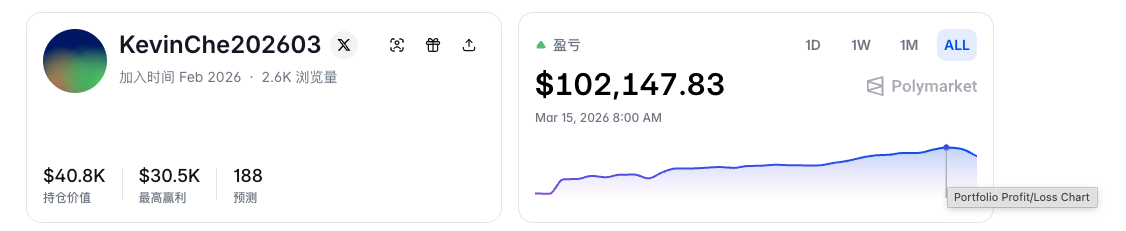
However, where there's a will, there's a way. A trader named Kevin , with the assistance of OpenClaw, turned a $30,000 principal into 4 times its value in 10 days, achieving a net profit of $100,000 (currently slightly retraced to $82,000). Kevin himself stated that this was initially just an experiment, but he didn't expect to actually make money.
So how did Kevin transform OpenClaw from a toy that only burns tokens into a money-making machine? Odaily Planet Daily spoke with Kevin, who shared his personal crypto journey and how he leveraged OpenClaw in prediction markets, hoping readers can gain some inspiration.

Transition from "Scientist" to "Prophet"

Kevin's early career primarily involved designing ERP architectures for enterprises. He later joined a Top 3 domestic internet giant to build a sports event betting software system from scratch. This professional background laid the foundation for Kevin's current achievements in prediction markets. After 2018, Kevin entered the Web3 investment sector, mainly incubating and accelerating startups.

However, Kevin's first real windfall came five years after entering the crypto space. In 2023, ordi emerged, ushering in the "Inscription Summer" for the crypto market. With a background in computers and code, Kevin became one of the highly sought-after "scientists" at that time(Odaily Note: Scientists refer to those who could write programs and code to quickly participate in new asset deployments during the inscription craze).

"The period when ordi was listed on Binance was when my account assets reached their peak. I ultimately pocketed about over 2 million RMB," Kevin said, noting that he was also among the first batch of people to participate in the ordi launch, with a cost of less than 1 RMB per token, subsequently enjoying a thousand-fold increase.

After inscriptions completely cooled down, Kevin began searching for other opportunities and finally started seriously researching and participating in the prediction market Polymarket in the summer of 2025. "I had played Polymarket before, but the liquidity was poor, so I ignored it," Kevin said. For someone who had worked in traditional sports betting, the early Polymarket's trading depth was completely insufficient.

However, after Polymarket successfully predicted Trump becoming the 47th President of the United States in 2025, Kevin's attention returned to Polymarket. "After 2025, Polymarket's reputation grew, its liquidity could handle large orders, and more importantly, deposits and withdrawals became very convenient," so Kevin began experimenting with algorithms on Polymarket, becoming a "prophet".

Kevin's journey in prediction markets is divided into two stages: before using OpenClaw assistance and after using OpenClaw assistance. For clarity, Odaily Planet Daily has condensed Kevin's sharing as follows, enjoy~

How to Play Prediction Markets Before Using OpenClaw

Odaily Planet Daily: When you started playing Polymarket in the summer of 2025, how much money did you invest, and what was the final profit?

Kevin: I invested a total of about $100,000 at that time, and the total profit by this year is approximately double the principal.

Odaily Planet Daily: What strategy did you mainly use?

Kevin: I don't bet directly; instead, I wrote programs for automated arbitrage to make money. My previous experience building sports event betting systems in a Web3 internet company, which also involved order book design, was very helpful in understanding Polymarket's order book. Therefore, I used programs to capture spreads between order books, especially in sports events, where a lot of emotional arbitrage can be done.

Odaily Planet Daily: Do you have a dedicated team, and is anyone providing you with funds?

Kevin: I'm doing this alone; AI assistance is enough. Initially, I was afraid Polymarket might hinder withdrawals, so I ran dozens of accounts. But later, I found the deposit and withdrawal process very smooth, so I reduced the number of accounts. I mainly use my own money to run strategies, but indeed, some people provide funds for me to run strategies for them, but this is just one way to make money.

How to Play Prediction Markets After Using OpenClaw

Odaily Planet Daily: So when did you start using OpenClaw to play prediction markets?

Kevin: At the end of February. This was itself an experiment to see how much money OpenClaw could make at the trading level, but I didn't expect it to actually make money. For example, the account KevinChe202603, I used $30,000 in capital and made up to $100,000 at its peak, all within just 10 days.

Odaily Planet Daily: So what is your specific strategy?

Kevin: Frankly, this account's strategy is mixed. Currently, 60% is still running the previous automated arbitrage algorithm, and 40% is using the "Lobster" (OpenClaw) for subjective betting. Compared to market making arbitrage, betting is a complex decision, requiring consideration of the prediction market's smart money, sentiment, lineups, player form, etc. OpenClaw's role here is to actively collect various factors that determine the outcome of a match and turn them into an indicator. After several training sessions, it can also find other influencing factors that I might overlook, saving me a lot of time and mental effort.

Odaily Planet Daily: But isn't this just AI predicting matches? Conversational AI can do that too, and some developers have even specifically created AI prediction tools for matches. What's special about OpenClaw?

Kevin: Having an information advantage is just one of OpenClaw's strengths. It can also mine new strategies by itself, conduct its own backtesting, and perform automated betting in matches. If the strategy is good, we just need to give the money to OpenClaw; everything else is automated, which AI prediction tools cannot do. For example, it can actively discover some smart money addresses and fool addresses, either following the smart money's bets or using the fool addresses as a counter-indicator.

Additionally, this is why Polymarket, among all prediction markets, integrates particularly well with OpenClaw—because Polymarket's API is the most AI-friendly, making data access very convenient for AI.

Odaily Planet Daily: In which areas is OpenClaw primarily betting now? Is it fully automated already?

Kevin: Based on my areas of expertise, OpenClaw is currently also experimenting mainly in the sports competition领域. But once mature, I will consider expanding OpenClaw to other areas. Right now, I give OpenClaw small amounts of capital for automated betting, around $1000. I still don't dare to put too much money in a fully automated account.

Odaily Planet Daily: Is your strategy replicable? Or will you write a Skill for the market in the future?

Kevin: Also trying. Because there is indeed user demand for this, to see if my methodology can be combined to allow everyone to build a money-making Lobster. Later, I also plan to package some Skills for the market to use, which will certainly be paid.

Domande pertinenti

QWhat was Kevin's initial investment and profit using OpenClaw in the prediction market?

AKevin started with a $30,000 investment and achieved a peak profit of $100,000 within 10 days, though it later retraced to $82,000.

QWhat was Kevin's professional background before using OpenClaw in prediction markets?

AKevin initially designed ERP systems for enterprises, then worked at a top-three internet company in China to build sports betting systems from scratch, and later moved to Web3 investment to incubate startups.

QHow did Kevin use OpenClaw to assist in his prediction market strategy?

AKevin used OpenClaw to collect various factors influencing game outcomes, transform them into indicators, and automate betting. It also helped identify smart money addresses and automate strategies, with 40% of his account using OpenClaw for subjective betting.

QWhat was Kevin's strategy in prediction markets before using OpenClaw?

ABefore OpenClaw, Kevin used automated arbitrage programs to profit from spreads between different market makers, particularly in sports events, leveraging emotional arbitrage without personally gambling.

QWhy does Kevin believe Polymarket is well-suited for integration with OpenClaw?

AKevin believes Polymarket is ideal for OpenClaw integration because it has user-friendly APIs that make data access easy for AI, good liquidity for large orders, and smooth deposit and withdrawal processes.

Letture associate

You Bet on the News, the Pros Read the Rules: The True Cognitive Gap in Losing Money on Polymarket

The article explains that the key to profiting on Polymarket, a prediction market platform, lies not just predicting real-world events correctly, but in meticulously understanding the specific rules that govern how each market will be resolved. It illustrates this with examples, such as a market on Venezuela's 2026 leader, where the official rules defining "officially holds" the office overruled the intuitive answer of who was in practical control. Other examples include debates over the definition of a "token" or what constitutes an "agreement." The core argument is that a "reality vs. rules" gap creates pricing discrepancies that savvy traders ("车头" or "whales") exploit. The platform has a formal dispute resolution process managed by UMA token holders to settle ambiguous outcomes. This process involves proposal submission, a challenge window, a discussion period, and a final vote. However, the article highlights a critical flaw in this system compared to a traditional court: the lack of separation between the arbiters (UMA voters) and the interested parties (traders with financial stakes in the outcome). This conflict of interest undermines the discussion phase, leads to herd mentality, and results in opaque final decisions without explanatory rulings. Consequently, the system lacks a body of precedent, making it difficult for users to learn from past disputes. The ultimate takeaway is that success on Polymarket requires a lawyer-like scrutiny of the rules to identify and capitalize on the cognitive gap between how events appear and how they are contractually defined for settlement.

marsbit13 min fa

You Bet on the News, the Pros Read the Rules: The True Cognitive Gap in Losing Money on Polymarket

marsbit13 min fa

Will the Fed Still Cut Interest Rates? Tonight's Data Is Crucial

The core debate surrounding the Federal Reserve's potential interest rate cuts is intensifying amid geopolitical conflict and rebounding inflation. The key question is whether high energy prices will cause persistent inflation or weaken consumer demand enough to force the Fed to cut rates. Citigroup presents a bullish case for cuts, arguing that oil supply disruptions from the Strait of Hormuz are temporary and will not lead to lasting inflationary pressure. They point to receding bond yields and oil prices as evidence the market is pricing in a short-lived shock. Citi's data also shows tightening financial conditions, a stabilizing labor market, and healthy tax returns, supporting their view that the path to lower rates remains open. Conversely, Deutsche Bank offers a starkly contrasting, more hawkish outlook. They argue the Fed's current policy is already neutral and expect rates to remain unchanged indefinitely. Their view is based on stalled disinflation progress and a shift toward more hawkish rhetoric from key Fed officials like Waller, who cited risks from prolonged Middle East conflict and tariffs. Other officials, including Williams and Hammack, signaled rates would likely stay on hold for a "considerable time." The market pricing has shifted dramatically, now forecasting zero cuts in 2026. The imminent release of the March retail sales "control group" data is highlighted as a critical test. This metric, which excludes gas station sales, will reveal if high gasoline prices are eroding consumer spending in other areas. A weak reading could support the case for imminent rate cuts, while a strong one would bolster the argument for the Fed to hold steady. This data is pivotal for determining the near-term policy path.

marsbit34 min fa

Will the Fed Still Cut Interest Rates? Tonight's Data Is Crucial

marsbit34 min fa

The Second Half of Macro Influencer Fu Peng's Career

Fu Peng, a prominent Chinese macroeconomist and former chief economist of Northeast Securities, has joined Hong Kong-based digital asset management firm Bitfire Group (formerly New Huo Group) as its chief economist. This move, announced in April 2026, triggered an 11% surge in Bitfire's stock price. Fu, known for his accessible macroeconomic commentary and large social media following, will focus on integrating digital assets into global asset allocation frameworks, particularly combining FICC (fixed income, currencies, and commodities) with cryptocurrencies for institutional clients. His career includes roles at Lehman Brothers and Solomon International, with significant influence gained through public communication. However, in late 2024, Fu faced temporary social media bans after a controversial private speech at HSBC on China's economic challenges, though he denied regulatory sanctions. He later left Northeast Securities citing health reasons. Bitfire, a licensed virtual asset manager serving high-net-worth clients, seeks to build trust and attract traditional capital through Fu’s expertise and credibility. The partnership represents a strategic shift for both: Fu enters the crypto sector after a traditional finance peak, while Bitfire aims to leverage his macro framework for institutional adoption. Outcomes remain uncertain regarding capital inflows and compatibility within corporate structure.

marsbit1 h fa

The Second Half of Macro Influencer Fu Peng's Career

marsbit1 h fa

Trading

Spot
Futures
活动图片