Dumping US Bonds, Buying Japanese Bonds: Wall Street Prepares for 'Capital Repatriation to Japan'

marsbitPubblicato 2026-05-18Pubblicato ultima volta 2026-05-18

Introduzione

Wall Street is bracing for a potential "great repatriation" of Japanese capital as yields on Japanese Government Bonds (JGBs) soar to multi-decade highs. The 10-year JGB yield recently hit 2.73%, its highest since 1997, while the 30-year yield broke 4% for the first time. This dramatic shift is causing global asset managers to reassess a long-ignored risk: that Japanese investors, who hold roughly $1 trillion in U.S. Treasury debt, could start bringing that money home. For decades, Japan's ultra-low interest rates pushed domestic insurers, pension funds, and banks to seek yield overseas, primarily in U.S. Treasuries. Now, with the Bank of Japan hiking rates and JGB yields climbing, the incentive is reversing. Firms like BlueBay Asset Management are preparing for this shift, believing new Japanese investments will be directed domestically rather than to foreign bonds. Early signs of repatriation are emerging, with record monthly inflows into Japanese sovereign bond funds in March. Some managers, like Ruffer's Matt Smith, hold yen as a hedge, anticipating that market stress could trigger a rapid acceleration of capital returning to Japan. However, analysts caution that a mass exodus hasn't begun yet. Japanese investors were still net buyers of foreign bonds over the past year. Uncertainty remains high as Japan's government fiscal plans could push JGB yields even higher, making investors hesitant to buy immediately. Furthermore, the Bank of Japan's withdrawal as a dominant bo...

Japan's government bond market is experiencing volatility unseen in decades, prompting global asset management institutions to re-examine a long-ignored risk: will Japanese investors, who hold approximately $1 trillion in US Treasury bonds, move their money back home?

According to a recent report by the Financial Times, several investment firms have begun preparing for the potential large-scale repatriation of Japanese capital, betting that Japanese investors will gradually sell US Treasuries and instead buy Japanese Government Bonds (JGBs) with their continuously rising yields.

Soaring JGB Yields Hit Multi-Decade Highs

On Friday, Japan's benchmark 10-year government bond yield rose to 2.73% in intraday trading, its highest level since May 1997.

The yield on 30-year JGBs broke through 4% for the first time—a level never reached since these bonds were first issued in 1999. Yields on 5-year and 20-year bonds also hit record highs earlier this week.
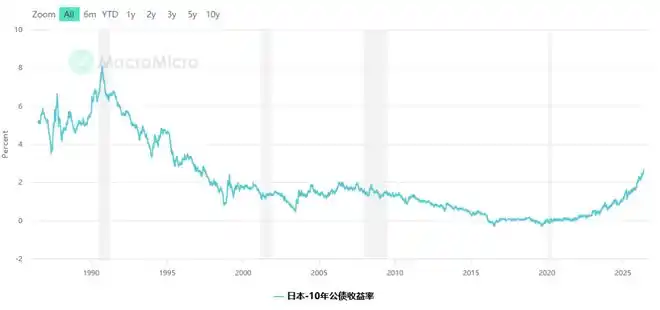
Japanese Finance Minister Satsuki Katayama told reporters on Friday that yields on benchmark bonds in major global markets are rising, "These dynamics influence each other, creating a compounding effect."

Analysts expect JGB yields to continue climbing. The Bank of Japan raised its policy rate to 0.75% in December last year, the highest in thirty years, and the market widely anticipates another 25 basis point hike to 1% this June.

The $1 Trillion 'Repatriation to Japan' Logic

To understand this bet, one must first understand why Japanese investors hold such vast assets overseas.

For decades, Japan maintained ultra-low interest rates, offering almost no return on domestic bonds. To seek yields, Japanese institutional investors such as insurance companies, pension funds, and banks went on a massive overseas buying spree, purchasing US Treasuries, European bonds, and various global assets.

Currently, Japanese investors hold roughly $1 trillion in US Treasury bonds, making them the largest foreign holder of US debt, far surpassing other countries.

Now, with Japanese bond yields rising sharply, this logic is reversing. Mark Dowding, Chief Investment Officer at British asset manager BlueBay, directly highlighted this shift. BlueBay just launched its first Japanese bond fund in March this year.

Dowding stated: "New money will not be deployed overseas. It won't go into US corporate bonds, it won't go into US Treasuries; it will come back and be deployed domestically in Japan."

'Trickle' of Capital Repatriation Has Begun

Market data shows signs of capital returning, although the scale is still small.

According to fund tracker EPFR, investors netted about $700 million into Japanese sovereign bond funds in March, setting a record for the largest monthly inflow in the category's history. April saw a net inflow of $86 million, returning to recent normal levels.

Ruffer fund manager Matt Smith offered a more direct assessment. He said: "The pressure is building—long-end domestic yields keep going up, and the signal at an institutional level is 'please bring your money back to Japan'. We think the yen appreciation will happen slowly at first, then all at once."

Smith also said Ruffer currently holds a long yen position as a core hedging tool. "In a market dislocation, particularly one centered around US credit markets, you will get Japanese investors bringing capital back home, and the yen will strengthen."

Large-Scale Repatriation Not Yet Happening, JGBs Have Their Own Concerns

However, analysts caution that Japanese institutional investors are still net buyers of foreign bonds.

RBC Capital Markets Asia macro strategist Abbas Keshvani pointed out that although JGB yields now "superficially offer better compensation for investors," over the past 12 months, Japanese investors have still been net buyers of about $50 billion in foreign bonds.

The reason lies in the uncertainty within the JGB market itself. Japanese Prime Minister Sanae Takaichi won the election this February, with campaign promises including expanded government spending and subsidies to ease inflation pressures. Analysts increasingly warn that the government will be forced to compile a supplementary budget later this year, which would further depress JGB prices and push yields higher.

Keshvani said: "Both supply and demand dynamics point to yields moving higher. As an investor, it's very difficult to have the will to step in now if you know yields will continue to rise."

Previously, the Bank of Japan, through quantitative easing and yield curve control policies, was the market's most significant buyer of JGBs. As the BOJ gradually exits, the market returns to traditional supply-demand logic, leading to noticeably increased volatility in JGB prices.

Implications for the US Treasury Market

The potential scale of Japanese capital repatriation forces the US Treasury market to take this risk seriously.

Japan is the largest foreign holder of US Treasury bonds, with holdings of approximately $1 trillion. If Japanese institutional investors begin systematically reducing their holdings, the impact on the supply-demand dynamics of US Treasuries would be substantial.

Currently, Wall Street's bet is more of a forward-looking positioning rather than a reaction to an established fact. But as Japanese bond yields continue to climb—with analysts viewing a 10-year JGB yield reaching 3% later this year as a realistic target—the logic behind this bet will become increasingly clear.


Domande pertinenti

QAccording to the article, why are global asset managers beginning to reassess the risk of Japanese capital outflows from foreign bonds?

AThey are reassessing this risk due to unprecedented volatility in the Japanese government bond (JGB) market, where yields are soaring to multi-decade highs. This creates a new incentive for Japanese investors, who hold roughly $1 trillion in US Treasuries, to potentially repatriate capital to buy higher-yielding domestic bonds.

QWhat specific recent yield levels for Japanese government bonds are highlighted in the article as being particularly significant?

AThe article highlights that the 10-year JGB yield rose to 2.73%, its highest since May 1997. The 30-year JGB yield surpassed 4% for the first time since its issuance in 1999. Yields on 5-year and 20-year JGBs also recently hit record highs.

QWhat is the core investment logic behind the potential 'repatriation to Japan' trade, as explained by BlueBay's Mark Dowding?

AThe core logic is reversal. For decades, Japanese investors sought higher yields abroad due to near-zero rates at home. Now, with JGB yields rising sharply, the incentive has flipped. New capital will no longer be allocated to foreign assets like US Treasuries or corporate bonds, but will instead be deployed back into the domestic Japanese bond market.

QWhat evidence does the article provide that some capital is already starting to flow back to Japan, and what counter-evidence suggests a large-scale shift hasn't happened yet?

AEvidence of early flows: In March, Japanese sovereign bond funds saw a record $700 million in net inflows. Evidence against a large-scale shift: Over the past 12 months, Japanese investors have remained net *buyers* of foreign bonds, purchasing about $50 billion worth. Analysts cite ongoing uncertainty in the JGB market, with expectations of further yield increases, as a reason for hesitation.

QWhat is the potential implication for the US Treasury market if Japanese investors begin a systematic sell-off of their holdings?

AThe implication is a substantial and material impact on the supply-demand dynamics of the US Treasury market. Japan is the largest foreign holder of US debt, with approximately $1 trillion in holdings. Systematic selling by Japanese institutions would remove a major source of demand, putting upward pressure on US yields and creating volatility.

Letture associate

After Three Consecutive Quarters of Decline, Can the Crypto Market Find a Window for Stabilization in Q3?

The cryptocurrency market has just concluded its worst-performing quarter since 2022, with total capitalization dropping 12.6% to $2.1 trillion. All core metrics indicate capital is leaving the sector, not just rotating within it. Bitcoin fell 14.2% and Ethereum dropped 25.4% in Q2, breaking their previous correlation with US tech stocks. A key driver is the reversal in US spot Bitcoin ETF flows, which saw a net outflow of approximately $4.67 billion in Q2, including a record monthly outflow near $4.5 billion in June. While recent data suggests long-term holders are accumulating again, sustained ETF outflows mean continued selling pressure. Market focus is now singularly on the Federal Reserve. The upcoming July FOMC meeting is seen as the most critical event for Q3. A dovish signal could support Bitcoin reclaiming a $68,000-$84,000 range, while a hawkish stance might establish a new trading band around $50,000-$56,000. Additionally, regulatory uncertainty persists, with the progress of the crucial *CLARITY Act* stalling in the Senate, reducing its perceived 2026 passage probability to 40-45%. Despite the broad downturn, a few sectors showed growth. Prediction markets saw nominal volume surge 48.7% year-over-year to $113.8 billion, and tokenized collectibles transaction volume rose 143% quarterly to $1.4 billion. The Real-World Asset (RWA) tokenization sector also continued steady growth, now representing ~$28.1 billion in on-chain value. The market's foundation for an extreme crash appears limited, with Bitcoin price hovering near its 200-week moving average. However, the trading paradigm has shifted from narrative-driven speculation to decisions based on price action, policy developments, and interest rate expectations, making a broad sentiment-driven rally unlikely in the near term.

marsbit10 h fa

After Three Consecutive Quarters of Decline, Can the Crypto Market Find a Window for Stabilization in Q3?

marsbit10 h fa

BIT Trading Moment: BTC Still Suppressed by Weekly 200 EMA, Rejection May Restart Decline; Storage and Semiconductors that Surged Last Night Begin Falling in Evening Trading

**Crypto & Stock Market Wrap: Bitcoin Tests Resistance, Stocks Retreat After AI Surge** Bitcoin consolidates around $66,000, facing key resistance near $68,000—an area seen as a major psychological and technical hurdle where previous rallies have failed. Analysts note the cryptocurrency is caught between its 200-week moving average (~$63,333) and 200-week EMA (~$68,328). A clear break above $68k is needed to signal a stronger bullish trend, while a rejection could lead to a retest of $63k support. Market sentiment remains cautious, with low futures open interest pointing to a low-liquidity rebound rather than a full bull market. Bitcoin spot ETFs saw another $203 million inflow. US stock futures pointed lower after a strong Tuesday session led by a massive rebound in semiconductors and memory stocks. The rally was fueled by renewed optimism about AI-driven hardware demand, with Micron, SanDisk, and SK Hynix surging. However, those gains reversed in pre-market trading. Super Micro Computer (SMCI) soared over 20% after hours on strong guidance and a record backlog. Other standouts included Rocket Lab and nuclear energy plays Oklo and X-Energy. Rising oil prices (Brent above $91) and climbing Treasury yields (10-year near 4.64%), however, are reigniting inflation concerns and acting as a headwind for equities. In Asia, markets were mixed. South Korea's KOSPI pared early gains to close slightly higher as semiconductor stocks like SK Hynix gave back initial surges. Japan's Nikkei edged lower as the yen hit a fresh 38-year low against the dollar, raising fears of potential market intervention. Key events to watch include the Samsung Galaxy launch, AMD's AI event, and a slew of major tech earnings from Alphabet, Tesla, and IBM after the close on Wednesday, followed by the ECB meeting and Intel's earnings on Thursday.

marsbit10 h fa

BIT Trading Moment: BTC Still Suppressed by Weekly 200 EMA, Rejection May Restart Decline; Storage and Semiconductors that Surged Last Night Begin Falling in Evening Trading

marsbit10 h fa

Former CFTC Chairman, Circle President Tarbert: Preaching Long-Termism While Cashing Out $30 Million Himself

Former CFTC Chairman and Circle President Heath Tarbert has consistently advocated for a long-term vision in public, urging patience from investors as Circle’s stock price has fallen significantly from its peak. However, it has been revealed that since Circle’s IPO, Tarbert has continuously sold his CRCL shares through pre-arranged trading plans, cashing out approximately $30 million, without making any public market purchases. This contrast between his public messaging and personal actions has drawn criticism. Tarbert joined Circle in July 2023 as Chief Legal Officer, leveraging his regulatory experience to help guide the company through its IPO and expansion. Despite promoting stablecoins as long-term infrastructure, he established a 10b5-1 trading plan just before Circle went public, leading to substantial stock sales over the following year. In March 2026, he initiated another plan to sell more shares. His career trajectory highlights a pattern of moving between high-level regulatory roles and influential positions in the financial sector. After resigning as CFTC Chairman in early 2021, he joined Citadel Securities as Chief Legal Officer just 27 days later, during a period of intense regulatory scrutiny for the firm. He later joined Circle, aiding its efforts to navigate regulatory challenges for its public listing. While Tarbert's expertise in policy and compliance is valuable to companies like Circle, his actions—advocating long-term confidence while personally divesting—raise questions about the alignment between his public statements and his private financial decisions, leaving investors who followed his advice to bear the market risks.

marsbit11 h fa

Former CFTC Chairman, Circle President Tarbert: Preaching Long-Termism While Cashing Out $30 Million Himself

marsbit11 h fa

Gate Research Institute: The 'Wall Street-ization' Wave of Crypto Financial Products – Competition or Integration?

The article titled "Gate Research Institute: Are Crypto Financial Products Sparking a 'Wall Street' Wave—Competition or Convergence?" explores the evolving relationship between the crypto ecosystem and traditional finance (TradFi). The piece begins by reflecting on Bitcoin's original 2009 vision of decentralization, disintermediation, and moving away from banks. It then contrasts this with the 2024 landscape, where key crypto assets like Bitcoin are increasingly held through Wall Street products like ETFs issued by giants like BlackRock. The article questions whether this signifies that TradFi is systematically taking over the rights to issue, price, custody, and distribute crypto financial assets. The core argument is that this is not a zero-sum takeover but rather a bidirectional convergence where each side addresses the other's weaknesses. Crypto offers 24/7 global markets, programmable settlement, and open access but lacks compliant channels, institutional-grade custody, deep fiat liquidity, and mainstream distribution. TradFi possesses these but is constrained by legacy systems, limited operating hours, and slow settlement. Two primary convergence paths are highlighted: * **Path A (CEX to TradFi):** Exemplified by Gate, which has progressed from offering tokenized stocks and CFDs to providing direct, real stock trading (US, Hong Kong, South Korea) within its platform, using USDT. * **Path B (TradFi to Crypto):** Exemplified by Robinhood, which has integrated crypto trading, acquired exchanges like Bitstamp, and is moving traditional assets like stocks onto the blockchain via tokenization and its own Layer 2. Both paths are ultimately competing to become the next-generation, unified financial account—a "super account" where users can seamlessly trade cryptocurrencies, stocks, ETFs, RWA (Real World Assets), and tokenized treasury products in one interface. The growth of RWA and tokenized treasuries (e.g., BlackRock's BUIDL) is presented as the asset-layer fusion, providing stable, yield-bearing assets on-chain and acting as a bridge between the two worlds. In conclusion, the "Wall Street-ization" of crypto is framed as a mutual transformation. Decentralized ideals persist in the protocol layer, while at the application layer, a more efficient, global, and accessible unified capital market is emerging from this convergence. The future competition lies not between crypto exchanges and stockbrokers, but between platforms vying to offer the most comprehensive asset coverage, liquidity, and user experience within a single account.

marsbit11 h fa

Gate Research Institute: The 'Wall Street-ization' Wave of Crypto Financial Products – Competition or Integration?

marsbit11 h fa

Trading

Spot
活动图片




