Dogecoin ETF Records Worst Trader Activity Since Launch

bitcoinistPubblicato 2025-12-10Pubblicato ultima volta 2025-12-10

Introduzione

An ETF tracking Dogecoin is recording its lowest trading activity since its launch, signaling a significant shift in trader behavior. Retail interest in this passive investment vehicle is waning, while the overall appetite for risk remains strong. Traders are increasingly moving away from the "buy and hold" approach, finding it boring, and are instead seeking excitement, leverage, and community-driven, speculative formats. This trend is evident in the booming meme token sector, where new characters, trading communities, and subcultures are emerging. In contrast to the static value storage offered by an institutional ETF, retail traders are searching for identity, gamification, and the chance to maximize gains from every market move. At this intersection of Dogecoin fatigue and a craving for extreme risk emerges Maxi Doge ($MAXI). It positions itself not just as a meme but as a "pump cult," combining the imagery of a muscular dog with a culture of maximum leverage and competitive mechanics for retail investors. The project, built on Ethereum, features a treasury fund, staking rewards, and trading competitions. Having raised $4.3 million in its presale, $MAXI aims to cater to traders with a "maxi mentality" who seek high returns and active participation, rejecting the sluggish statistics of traditional funds.

Trading activity around Dogecoin this cycle is increasingly shifting from large institutional products to more speculative and "playful" formats. The decline in volume of the Dogecoin exchange-traded fund shows: retail interest in the passive exposure instrument is fading, while the appetite for risk remains.

For many traders, Dogecoin has long transformed from a meme into a "blue chip" among joke tokens, but it is precisely this that kills the adrenaline over time. If the ETF is seeing minimal volumes since its launch, it means traders are getting bored of simply holding DOGE through a traditional fund. They need thrill, leverage, and a community where growth is felt physically.

Simultaneously, the meme token market continues to boil: new characters are emerging, trading communities are appearing, and their own subcultures are forming. Where an institutional product merely offers a store of value, retail seeks identity, play, and the opportunity to "squeeze the maximum" out of every market move. This is especially noticeable from the spikes in activity on platforms with derivatives and yield competitions, as well as from top meme token rankings on specialized resources.

It is at this intersection—fatigue with the "official" Dogecoin and a thirst for extreme risk—that Maxi Doge ($MAXI) emerges. The project offers not just a meme, but a pump cult, combining the image of a buff dog with the culture of maximum leverage and competitive mechanics for retail traders.

BUY MAXI DOGE

Why Meme Tokens and Trading Communities Are Shifting Focus Away from Dogecoin

The declining volumes of the Dogecoin ETF show that the classic "buy and forget" model is ceasing to be the center of retail focus. In a bull market, traders are increasingly choosing assets with the potential for multiple growth and active participation, rather than a boring exchange product.
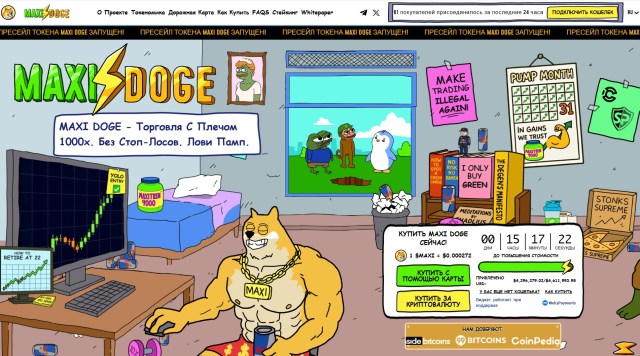
Competition in the meme token segment is intensifying: alongside Dogecoin and Shiba Inu, a whole lineup of new coins with aggressive marketing, gaming mechanics, and their own cults of strength is emerging. Here, not only quotes matter but also engagement in chats, leaderboards, tournaments, and joint actions with derivatives platforms.

Against this backdrop, demand arises for projects that are directly tailored to the retail investor with a "maxi mentality": a drive for high returns, a willingness to take risks, and a desire to compete. Maxi Doge positions itself as one such option, combining a meme, a culture of extreme trading, and tools for gamifying returns, without replacing it with boring institutional play.

Maxi Doge as a Response to Fatigue with Passive Dogecoin

Retail segment traders often lack the capital or confidence of large players but strive for comparable results. Maxi Doge builds a whole philosophy on this: the buff dog symbolizes 1000x leverage, where every community member competes, rather than just watching the chart.

The key idea is "Leverage King Culture": the token and brand convey the energy of maximum leverage and constant competition among traders. Closed competitions for holders with leaderboards for profitability, prize distributions, and partnership events with derivatives platforms turn holding $MAXI into a constant results-driven game, not passive storage.

The token operates on the Ethereum network with supply and distribution management via a smart contract. A treasury Maxi Fund has been created to support liquidity and fund partnerships. Already at the pre-sale stage, $4.3 million was raised at a price of approximately $0.0002725 per $MAXI, signaling significant interest in the concept of a meme token with a trading focus.

An additional layer is the staking mechanic with dynamic yield: daily automatic reward distribution by the smart contract from a specially allocated pool of 5% for up to one year. Combined with meme marketing and an emphasized goal to outperform even the original DOGE in dynamics, this positions $MAXI as a tool for those who do not want to put up with sluggish ETF statistics.

Domande pertinenti

QWhat does the decline in trading volume for the Dogecoin ETF indicate about retail investor behavior?

AThe decline in trading volume for the Dogecoin ETF indicates that retail interest in passive, exposure-based investment instruments is waning, while their appetite for risk remains. Traders are shifting towards more speculative and 'playful' formats that offer excitement, leverage, and a sense of community.

QAccording to the article, what are retail traders seeking instead of traditional ETFs for meme coins like Dogecoin?

AInstead of traditional ETFs, retail traders are seeking identity, a sense of game, and the opportunity to 'squeeze the maximum' out of every market move. They are drawn to platforms with derivatives, yield competitions, and new meme tokens that offer aggressive marketing, gaming mechanics, and their own cults.

QWhat is the name of the ticker symbol for the new project that combines the 'pump cult' with extreme leverage culture?

AThe new project is called Maxi Doge and its ticker symbol is $MAXI.

QWhat is the 'Leverage King Culture' promoted by the Maxi Doge project?

AThe 'Leverage King Culture' promoted by Maxi Doge is a philosophy that symbolizes 1000x leverage. It focuses on constant competition among community members through closed competitions with leaderboards for profitability, prize distributions, and partnership events with derivatives platforms, rather than passive holding.

QWhat are some of the tokenomics and features of the $MAXI token mentioned in the article?

AThe $MAXI token operates on the Ethereum network. It features a managed supply and distribution via a smart contract, a treasury called the Maxi Fund to support liquidity and finance partnerships, and a staking mechanism with dynamic yield. This includes daily automatic reward distribution from a specially allocated pool of 5% for up to one year. The pre-sale raised $4.3 million.

Letture associate

ECB's Schnabel says central bank money 'should move to blockchain'

ECB Executive Board member Isabel Schnabel stated that central bank money "must move onto the blockchain." She argued that stablecoins lack the independent ability to scale liquidity during financial stress—a gap only a central bank can fill. Her proposed solution involves tokenization, which she says can make transactions faster, safer, and more programmable, but only if the safest asset (central bank money) is on the same "rails" as other tokenized assets. This marks a notable shift for the Eurosystem, which had previously viewed Distributed Ledger Technology (DLT) mainly as a tool for regulating stablecoins and crypto, not as infrastructure to adopt directly. The first step is Project Pontes, launching in September. It will initially synchronize the ECB’s existing TARGET services with private DLT platforms. Eventually, it aims to enable settlement finality on a Eurosystem-managed DLT platform with smart contract functionality and 24/7 operation. The long-term strategy is Project Appia, tasked with developing the architecture, standards, and legal framework for a genuine European tokenized asset market by 2028. Trials have already processed around €1.6 billion, and since March 2026, the ECB accepts DLT-based assets as collateral. While not directly impacting Bitcoin's price, these developments signal that a major G7 central bank is preparing to settle transactions on-chain, lending legitimacy to the underlying infrastructure of crypto markets. The ECB's move to avoid "disintermediation" by private tokenization shows that debates in central bank boardrooms are now aligning with discussions long followed in the crypto space.

cryptonews.ru6 min fa

ECB's Schnabel says central bank money 'should move to blockchain'

cryptonews.ru6 min fa

Ripple Labs Warns of a New Challenge for Blockchains

Ripple Labs is preparing the XRP Ledger for quantum threats but now emphasizes a broader challenge: ensuring financial infrastructure can adapt simultaneously to quantum computing and artificial intelligence. Senior Director of Engineering Ayo Akinyele states the goal is not merely anticipating a "Q-Day" but building infrastructure capable of preemptively adopting new security mechanisms without network disruption. The shift to post-quantum cryptography involves more than swapping algorithms; it requires flexible infrastructure, improved key management, and clear upgrade paths. Financial systems were not designed with quantum computers in mind, necessitating a rethink of transaction, identity, asset, and data protection. This is underscored by significant investments, such as the $2 billion U.S.-IBM quantum factory initiative and a 2030 U.S. government mandate for post-quantum cryptography adoption. AI introduces distinct risks by driving automation and autonomous economic activity, increasing demand for an always-on, internet-oriented payment infrastructure. AI agents could soon conduct transactions independently, creating new security requirements. Ripple Labs advocates for proactive, orderly preparation rather than a crisis-driven transition, having outlined a four-phase strategy aiming for a full XRP Ledger transition by 2028, now expanded to address both quantum and AI-driven challenges.

cryptonews.ru6 min fa

Ripple Labs Warns of a New Challenge for Blockchains

cryptonews.ru6 min fa

"We're Back": Michael Saylor Hints Company May Resume Bitcoin Purchases

Speculation that MicroStrategy (MSTR) may resume buying Bitcoin surged after executive chairman Michael Saylor posted a cryptic message on X on August 30. The post consisted of the phrase "We're ₿ack" and an accompanying chart showing the company's holdings of 840,447 BTC, valued at approximately $65.72 billion. This came after two consecutive weeks with no Bitcoin transactions reported by the company. MicroStrategy's last SEC filing, dated August 24, confirmed its holdings of 840,447 BTC were acquired for $63.36 billion at an average price of $75,385 per Bitcoin. The company reported no purchases or sales between August 17 and 23. Instead, it raised capital by selling MSTR shares for about $2.01 billion, boosting its total US dollar liquidity to $6.69 billion. This capital reorganization had paused Bitcoin acquisitions. Saylor's post followed a significant Bitcoin price recovery from around $65,000 on August 19 to over $79,000 by August 30. As the largest publicly traded corporate Bitcoin holder, controlling roughly 4% of the total 21 million supply, MicroStrategy's potential return to the buyer's market is closely watched. The company has $1.59 billion in flexible cash reserves that the board could allocate for further Bitcoin purchases, dividends, debt repayment, or other treasury purposes. The next corporate report will clarify if the "We're ₿ack" message signaled an actual new acquisition.

cryptonews.ru8 min fa

"We're Back": Michael Saylor Hints Company May Resume Bitcoin Purchases

cryptonews.ru8 min fa

Trading

Spot
活动图片