Diversification Beyond Digital Assets

insights.glassnodePubblicato 2026-06-29Pubblicato ultima volta 2026-06-29

Introduzione

The article describes a major wealth transfer in the crypto market from late 2025 into 2026, where long-term Bitcoin holders sold to a new wave of institutional and traditional wealth buyers. This "cohort handover" occurred as capital rotated within crypto, moving into stablecoins rather than exiting during corrections. For private banks, this presents an opportunity but also an operational challenge: onboarding crypto-native high-net-worth individuals (HNIs) requires clear visibility into the provenance of their on-chain wealth. The compliance bottleneck hinders these clients from diversifying into traditional finance and blocks banks from accessing new capital. Cense, a Glassnode spin-out, addresses this by providing bank-ready, auditable documentation of digital wealth histories. This bridges the gap, allowing crypto wealth to enter the banking system for diversification and liquidity management, while enabling banks to onboard new clients and assets. The future points toward convergence, where seamless movement between crypto and traditional assets defines wealth management, with infrastructure like Cense's resolving the key compliance hurdle.

The current phase of the digital asset market is being defined by a clear on-chain signal. As Bitcoin advanced into the cycle peak in late 2025, Long-Term Holders began distributing into strength – a measurable redistribution of supply from seasoned holders to newer market participants. Active Supply rose to 37% of BTC in Q4 2025, while long-dormant supply declined modestly.

Through the Q1 2026 correction, the picture sharpened further: total crypto market capitalization excluding stablecoins fell by roughly 18%, yet stablecoin supply grew from $308B to $318B. Capital was not leaving crypto markets – it was rotating into cash-like instruments while awaiting clearer signals.
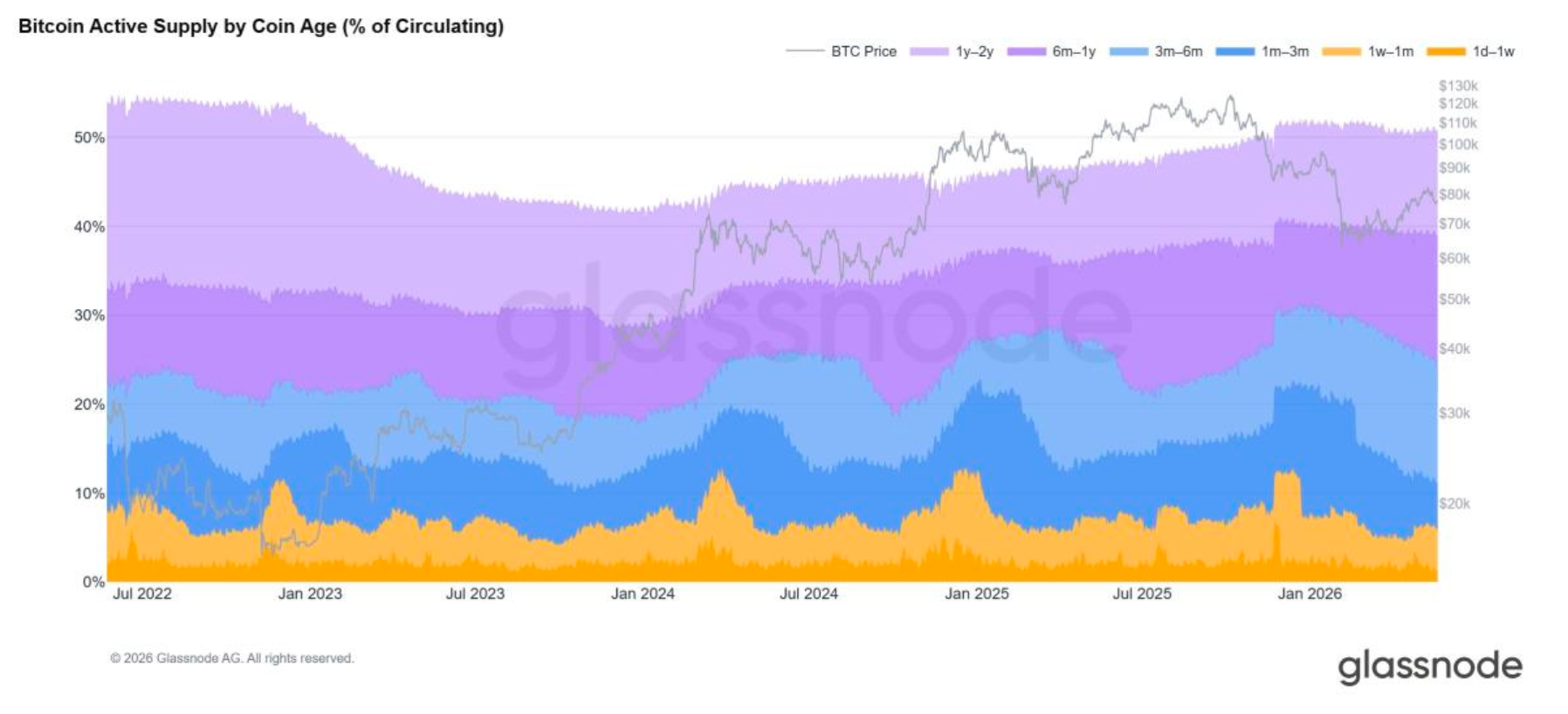
Bitcoin Active Supply by Coin Age (% of Circulating). The expansion of younger cohorts through late 2025 and into 2026 illustrates the redistribution from seasoned holders to newer participants. Source: Glassnode.

This is what wealth-cycle maturation looks like in the data. Early accumulators are realizing significant capital. New cohorts of buyers - institutional, corporate, and increasingly traditional wealth - are stepping into that supply. The result is the most concrete handover of crypto wealth between cohorts the asset class has ever seen, and it is happening at the same moment that private banking infrastructure is finally beginning to engage with digital assets seriously.
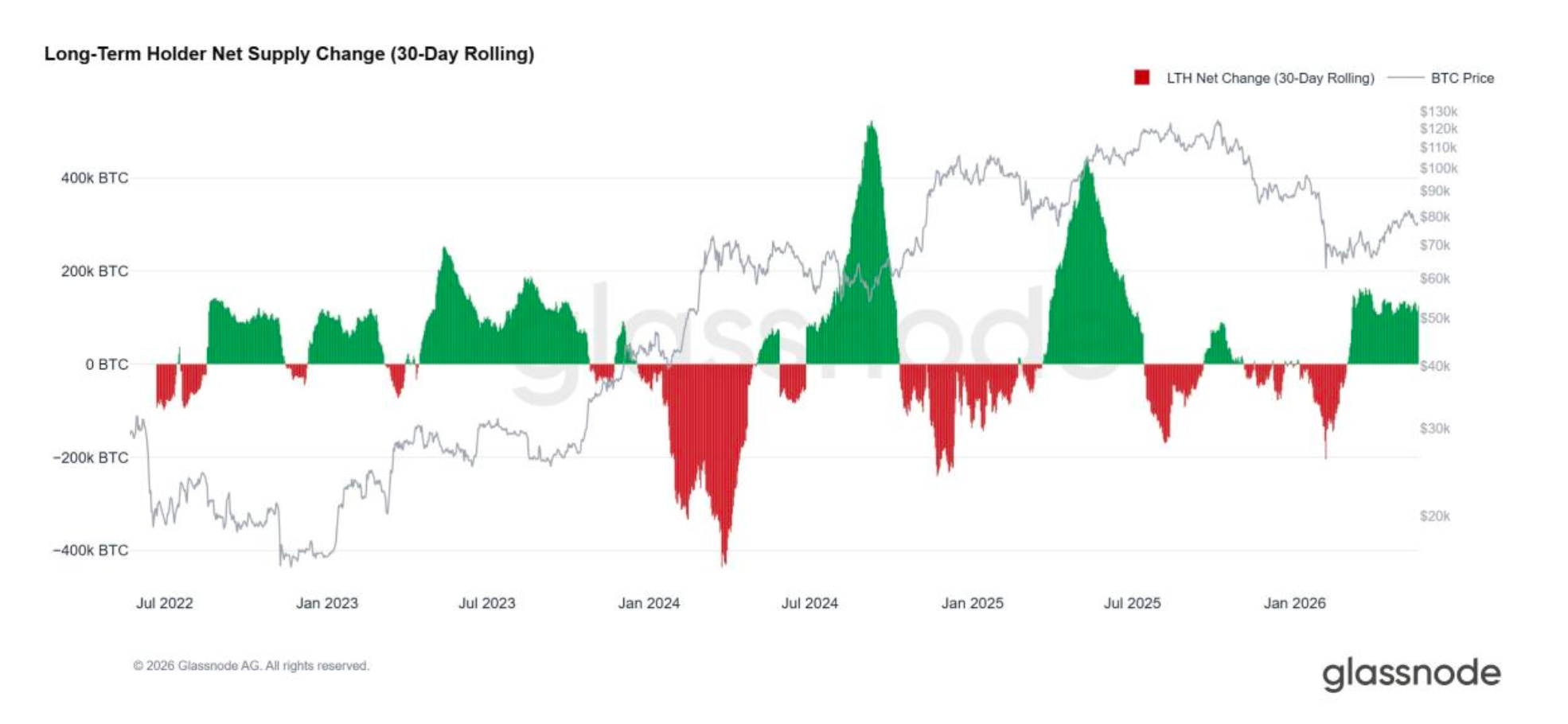
Long-Term Holder Net Supply Change (30-Day Rolling). Green bars indicate accumulation; red bars indicate distribution. The 2025 distribution waves represent the largest cohort handover in Bitcoin's history. Source: Glassnode

For private banks and wealth managers, this represents a structural opportunity. The HNIs realizing profit are not exiting the asset class - they are looking to diversify, manage liquidity, and access the full wealth-management stack: equities, fixed income, private markets, lending, succession planning. The dynamic also moves in the other direction. As banks become more open to crypto-native clients, they bring new capital and new buyers into digital assets, deepening the institutional demand base that has already absorbed a record share of Long-Term Holder distributions. The flow runs both ways.

The constraint, however, is operational. Effective movement of wealth between digital assets and the banking system depends on one thing: transparent, auditable wealth provenance.

Compliance is the Operational Layer

Private banks were not originally built for clients whose wealth histories sit primarily on a public ledger. Even sophisticated, fully legitimate crypto-native HNIs routinely encounter onboarding friction, repeated information requests, or extended delays as institutions seek clear visibility into the origin and legitimacy of digital assets. To address this - and to allow value to move in both directions between crypto wealth and traditional finance – Glassnode spun out Cense in 2023.

According to Michiel Hoogenboom, Chief Commercial Officer at Cense, the issue is structural rather than procedural. “This goes beyond compliance inconvenience - it is a wealth management issue. When crypto wealth cannot enter the banking system cleanly, the client remains concentrated in a single asset class and unable to deploy capital as efficiently as the overall wealth profile should allow. The same friction also blocks the reverse flow - banking clients who want to allocate into digital assets cannot do so through their trusted institutions.”

Cense leverages the same on-chain analytics foundations that power Glassnode's institutional market intelligence, applied at the client level. Translated into a wealth-management context, that rigor produces auditable, bank-ready documentation of digital wealth histories, a cleaner entry point into private banking and a credible pathway for traditional capital to move the other way.

Benefits Flow in Both Directions

Once crypto wealth becomes bankable, the advantages compound on both sides.

HNIs gain the ability to diversify beyond digital assets, access broader investment opportunities, manage liquidity across traditional and crypto portfolios, and unlock the operational dimensions of private wealth - lending, structured solutions, succession. Private banks, in turn, gain access to a compliant, high-quality deposit base and a durable channel for long-term AUM growth.
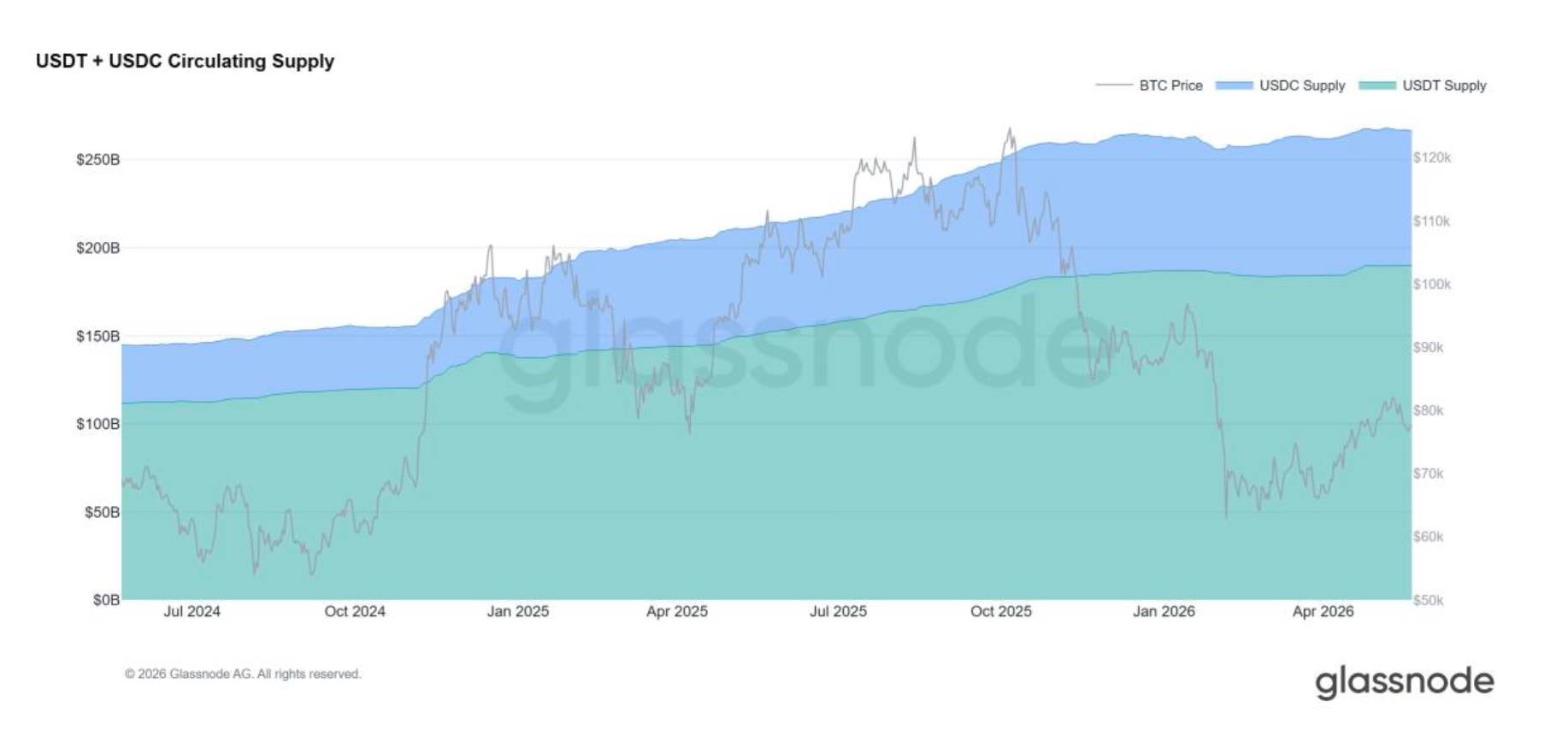
USDT + USDC Circulating Supply. Aggregate stablecoin supply continued to expand through the Q1 2026 correction, evidence that capital was rotating within crypto markets rather than exiting. Source: Glassnode.

The institutional backdrop reinforces the logic. Digital asset markets entered 2026 on firmer footing after last year's deleveraging, with Bitcoin retaining structural leadership. Q2 2026 added nuance: 82% of surveyed institutions now place the market in a bear or late-bear phase, up from 31% in December - yet the rotation into stablecoins and the recovery in BTC derivatives open interest, particularly in perpetuals, point to a rebuilding of risk appetite within the asset class. Institutional allocators are repositioning, not withdrawing.

“Crypto wealth becomes significantly more valuable when it is fully bankable. Once a client has a clean route into private banking, they can diversify beyond crypto, access broader investment opportunities, and manage liquidity across digital and traditional assets. And once banks have a clean route to onboard crypto-native wealth, capital starts moving the other way too.”
- Michiel Hoogenboom, Cense

Looking Ahead: Convergent Wealth

The coming years are likely to be defined less by “crypto versus traditional finance” and more by the convergence of the two - a wealth landscape where HNIs hold a mix of crypto, equities, fixed income, private markets, and cash, and where institutions are equipped to move capital fluidly between them.

The on-chain signal is consistent with this view. The redistribution of supply from Long-Term Holders to new participants through 2025 and into 2026 is, in effect, the largest cohort handover in Bitcoin's history. The capital absorbing it is increasingly institutional. The infrastructure connecting it back to the broader wealth-management stack is where the bottleneck still sits.

“Markets will continue to fluctuate,” Hoogenboom concludes, “but the structural advantages of proactive preparation remain. Investors and institutions who invest the time now to build transparent crypto readiness will be best positioned when conditions accelerate again. Some of Europe's most forward-looking banks - including Van Lanschot Kempen, a leading Dutch private bank - are already on this path. That is a vote of confidence not just in Cense, but in the entire crypto ecosystem's transition into mainstream wealth management.”


About Cense

Cense is a Swiss crypto intelligence specialist, founded in 2023 as a spinout of Glassnode. Its first design partner was a Swiss crypto-native financial institution, where the most complex use cases surfaced early. Today, Cense operates as an independent crypto-intelligence partner between digital asset holders and leading retail and private banks, with a focus on compliance, onboarding, and risk intelligence.

Start a conversation with the experts at Cense.

Book your demo

Disclaimer: This report is for informational and educational purposes only. The analysis represents a limited case study with significant constraints and should not be interpreted as investment advice or definitive trading signals. Past performance patterns do not guarantee future results. Always conduct thorough due diligence and consider multiple factors before making investment decisions.


Domande pertinenti

QWhat is the main on-chain signal defining the current phase of the digital asset market according to the article?

AThe main on-chain signal is the distribution of Bitcoin by Long-Term Holders into strength as it approached its cycle peak in late 2025. This led to a measurable redistribution of supply from seasoned holders to newer market participants, with Active Supply rising to 37% of BTC in Q4 2025.

QWhat does the growth in stablecoin supply during the Q1 2026 correction indicate about capital movement?

AThe growth in stablecoin supply from $308B to $318B during the Q1 2026 correction indicates that capital was not leaving crypto markets. Instead, it was rotating into cash-like instruments (stablecoins) within the crypto ecosystem while investors awaited clearer market signals.

QWhat is identified as the key operational constraint for moving wealth between digital assets and the banking system?

AThe key operational constraint is the need for transparent, auditable wealth provenance. Private banks require clear visibility into the origin and legitimacy of digital assets to onboard clients smoothly, which is often lacking for crypto-native high-net-worth individuals.

QWhat are the main benefits for High-Net-Worth Individuals (HNIs) once their crypto wealth becomes 'bankable'?

AOnce crypto wealth becomes bankable, HNIs gain the ability to diversify beyond digital assets, access broader traditional investment opportunities (equities, fixed income, private markets), manage liquidity across both portfolios, and unlock services like lending, structured solutions, and succession planning.

QAccording to the article, what is Cense's role and how does it address the operational bottleneck?

ACense, spun out from Glassnode in 2023, acts as a crypto intelligence specialist. It leverages on-chain analytics to provide private banks with auditable, bank-ready documentation of a client's digital wealth history. This addresses the bottleneck by creating a cleaner, compliant entry point for crypto wealth into banking and a credible pathway for traditional capital to flow into digital assets.

Letture associate

In Conversation with Ray Dalio: We Are Currently in an AI Bubble, with 1% of My Portfolio in Bitcoin

Ray Dalio, founder of Bridgewater Associates, warns in an interview that the current AI boom shows classic bubble characteristics, which could lead to significant economic downturns as seen in past cycles like 1929 or 2000. He explains that speculative enthusiasm, fueled by debt and overvaluation, often precedes a crash when rising rates or taxation force asset sales, causing widespread losses and recession. Dalio also outlines his "Big Cycle" theory, describing an approximate 80-year pattern where widening wealth gaps, massive government deficits, and shifting geopolitical power (like China's rise) create internal conflict and global instability. He emphasizes that we are in a late-cycle, transitional phase where traditional powers like the US and UK face decline. For personal wealth protection, Dalio advises diversification beyond cash into assets like stocks, bonds, real estate, and particularly gold, which he prefers over Bitcoin. While he holds about 1% of his portfolio in Bitcoin as a non-printable hard asset, he views gold as more secure from technological or governmental threats. Regarding AI's impact, Dalio believes it will disproportionately benefit capital owners, worsening inequality by replacing both physical and cognitive labor. He suggests that human intuition and emotional intelligence, combined with AI, will be key for future workers. On taxation, Dalio argues that wealth taxes are impractical and risk triggering asset sell-offs, reducing productive investment. He points to the UK as a cautionary example of debt, low productivity, and political strife. Geopolitically, Dalio foresees a more regionalized world, with the US showing weakness in prolonged conflicts like with Iran, akin to past imperial declines. The ideal outcome, he suggests, is coexisting powerful blocs (e.g., Americas, China-Asia Pacific) without major war.

marsbit2 h fa

In Conversation with Ray Dalio: We Are Currently in an AI Bubble, with 1% of My Portfolio in Bitcoin

marsbit2 h fa

Daily 7.2 Trillion KRW: Foreign Capital's Record Net Buying on Friday! Wall Street Says Headwinds for Korean Stock Fund Flows Have Subsided

South Korean stock market sees a dramatic shift in fund flows. On July 31, foreign investors made a record net purchase of approximately KRW 7.2 trillion in KOSPI stocks, marking a fundamental reversal from the persistent large-scale net outflows seen in previous months. This contributed to a significant narrowing of foreign net selling in July to KRW 9.8 trillion, down sharply from KRW 48.4 trillion in June and KRW 44.5 trillion in May. Simultaneously, domestic institutional pressure eased. South Korean pension funds and asset managers turned to a net buying position in July, purchasing KRW 1.0 trillion worth of KOSPI shares, contrasting with net sales in May and June. Market volatility is expected to be dampened by new financial regulations. Effective July 31, the Financial Services Commission tightened access for retail investors to single-stock leveraged ETFs by raising the minimum cash deposit requirement. Trading volumes for these products subsequently dropped to about 50% of their monthly average. Citigroup Research maintains its year-end KOSPI target of 10,000 points. The firm cites several supportive factors: the substantial easing of headwinds from capital outflows, a robust fundamental outlook for the semiconductor sector, historically low market valuations, strong economic fundamentals, and the potential for policy support from financial authorities if needed.

marsbit2 h fa

Daily 7.2 Trillion KRW: Foreign Capital's Record Net Buying on Friday! Wall Street Says Headwinds for Korean Stock Fund Flows Have Subsided

marsbit2 h fa

Thanks to Dice Rolls, Bitcoin Keys Are Stored Offline, But Not Everyone Will Do It

The article discusses using dice rolls to generate secure Bitcoin wallet seeds, providing entropy independent of potentially flawed hardware random number generators. It explains that each fair dice roll offers about 2.585 bits of entropy, with around 50 rolls needed for a standard 12-word seed phrase and 99+ recommended for higher security. This method gained attention after a vulnerability was revealed in some Coldcard hardware wallets, where a faulty firmware RNG (dating back to 2021) compromised generated keys. The analysis notes that while a dice-generated main seed was safe from this specific flaw, other Coldcard functions (like creating paper wallets, backup keys, or passwords) could still be vulnerable if they used the defective RNG. The piece argues that while dice-based entropy is technically robust, the manual process is error-prone, tedious, and unrealistic for most new users, who might make mistakes in recording or inputting rolls. It concludes that while manual entropy generation should remain an option for advanced users, the long-term goal is to develop reliable, user-friendly hardware and software that securely generates randomness without requiring specialized knowledge. Coldcard users are advised to check their firmware version and replace any secondary secrets (like paper wallet keys) created with vulnerable devices, while also considering multi-signature setups with devices from different manufacturers for added security.

cryptonews.ru8 h fa

Thanks to Dice Rolls, Bitcoin Keys Are Stored Offline, But Not Everyone Will Do It

cryptonews.ru8 h fa

Trading

Spot
活动图片




