Interview: The Round Trip
Compilation & Editing: Yuliya, PANews
In the increasingly competitive DEX landscape, liquidity and user experience are becoming the most scarce and valuable core elements globally. With Aster completing its TGE a few months ago and achieving explosive growth, this DEX, backed by YZi Labs, has attracted even greater external attention.
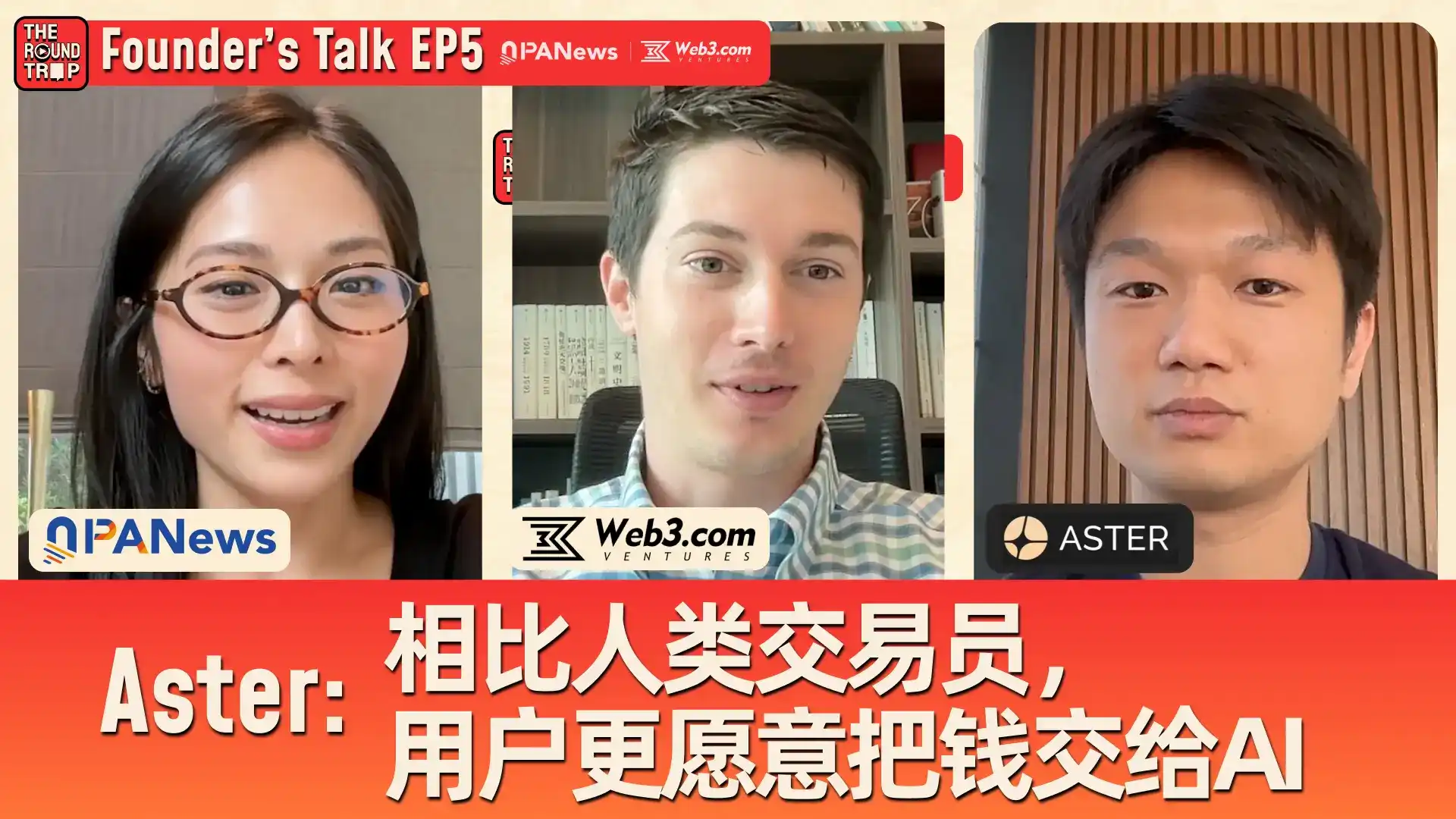
In the new Founder’s Talk series of "The Round Trip," co-produced by PANews and Web3.com Ventures, hosts John Scianna and Cassidy Huang invited Leonard, founder and CEO of Aster, to delve into the story behind Aster's success, how to handle "overwhelming traffic" and retain users, and how to build a complete business blueprint for "trustless" asset management.
Unexpected Gains from the Human vs. AI Trading Battle
PANews: Hello Leonard, we know Aster recently concluded a highly anticipated "Human vs. AI" trading competition. This contest seemed challenging for both sides, and we’d love to hear your thoughts on it, perhaps combined with your observations on the current market?
Leonard: I think it was a very interesting experiment. Many people focused too much on the performance of human traders versus AI agents, but I believe it’s hard to define what a 'pure human trader' is nowadays, as almost everyone uses some form of AI tool for research or decision support. Therefore, adaptability is far more important than profitability in any specific period, for both AI and humans.
However, we did have a very interesting observation: AI can actually enable more trustless asset management and copy trading. When we spoke with users, we found that people subconsciously speculate about the motives behind human traders. Human traders' behavior can change due to being observed or changes in incentives, but AI agents do not. As long as you give it instructions and resources, it will execute faithfully. Therefore, even if an AI agent's performance is comparable to, or slightly worse than, a human trader, users are more inclined to entrust their funds to the AI. Because the input of the AI (i.e., its strategy logic) is explicit, which is crucial in a "trustless" infrastructure.
We believe the future breakthrough lies in creating a truly "permissionless, trustless" AI trading product. This is a direction we plan to invest more resources in and explore deeply next quarter.
When CZ "Knocks": From Overwhelming Traffic to a "Sweet Burden"
PANews: Speaking of attention, many people started noticing Aster because of CZ. He recently publicly disclosed that he holds over $2 million worth of Aster tokens and has been very active in the community, even joking that he is "bagholding." CZ's involvement is undoubtedly a huge validation and endorsement for Aster. What’s your take on this?
Leonard: CZ's attention and personal investment are absolutely positive for us. Any project would be happy to receive this level of attention. Of course, this support also brings enormous expectations and pressure, which is reflected in the market and price.
But I would rather bear the pressure than be marginalized by the market. To do extraordinary things, one must first bear extraordinary weight. This "discomfort" keeps us alert and moving forward. I certainly hope that in the future, more respected industry figures like CZ will cast their vote of confidence with "real money." This attention can bring heat and users to the ecosystem, which, in the long run, helps us iterate our product better.
PANews: When CZ brought this sudden wave of attention and traffic, how did your team handle it? I'm curious because often, the product might not be fully ready to handle demand of this scale.
Leonard: This can be looked at from two aspects.
First is "toughing it out." When traffic surges, the pressure exposes various system issues. There are no shortcuts; you just have to work around the clock to scale up servers and mobilize all available experts to "fight the fire." This ultimately tests how strong your and your team's determination to succeed is and whether you are willing to invest extraordinary resources, time, and effort.
Second, after surviving the initial crisis mode, you need to calm down and think about how to convert this traffic more efficiently. We admit that we weren't fully prepared initially, leading to a poor experience for some early users. Winning back a流失 user who has been "hurt" is much harder than acquiring a new one. We are facing this issue now. But the good side is that these stress tests and user feedback forced us to make huge strides in UI/UX and system stability over the past three months.
Every entrepreneur dreams of the moment their product is in high demand, but for those who haven't experienced it yet, my advice is "be careful what you wish for," as it is indeed a sweet burden.
Survival Rules in the Era of DEX "Involution": Returning to Product and the Value Flywheel
PANews: Competition in the Perp DEX赛道 is becoming increasingly fierce nowadays, with new projects and features emerging constantly, all vying for users with airdrop expectations and other methods. After the TGE hype, how do you maintain market heat and retain users in this environment?
Leonard: This is indeed a major challenge in the current market, a process every project in a hot赛道 must go through. We believe the ultimate answer lies in returning to the product itself.
For Web3 projects, a key point is how "user-driven" your product is. Can you create an environment where users feel they are part of the product? Can they participate in governance and decisions regarding the product roadmap? When the community feels they have a "stake" in the project, stickiness is created.
Ultimately, you need to run a sustainable closed loop:
- Create a product that truly generates value.
- Find a model where users are willing to pay for that value.
- Effectively return the captured value to your token holders.
Once this flywheel starts spinning, the project becomes sustainable. The rest is about finding your differentiated advantage in the fierce competition—either offering something others don't have or providing an experience far superior to competitors for the same functionality.
From Privacy "Shield" to Focusing on "Appchain"
PANews: I found a very interesting feature on Aster DEX called "Shield Mode," which seems to be a new privacy trading feature. Why did you make privacy a core strategic focus? What gap in the market are you hoping to fill?
Leonard: We have been working on the privacy narrative for a while. As early as June this year, discussions about "liquidation sniping" were very intense in the industry. Regardless of the truth behind these controversies, it revealed a clear market demand: traders want to protect their trading privacy while maintaining self-custody and verifiability. Currently, there is no perfect solution on the market that meets all these requirements simultaneously.
Our team believes that to achieve mass adoption of cryptocurrency, we must address the needs of this part of the market. Therefore, we have been experimenting with various features that include "privacy options." "Shield Mode" is one such experiment. It not only provides privacy, but we are also testing other new features within it, such as leverage of up to 1000x, and these trades do not enter the public order book, making them suitable for traders with specific strategy needs. We are also testing a "profit-sharing" model, where we only charge fees if your trade is profitable.
Our goal is to provide users with more diverse choices, whether in terms of different fee structures, leverage levels, or privacy options, so that users with different preferences can find a trading method that suits them on the DEX.
PANews: Since we're talking about products, Aster Chain is also about to launch. How do you view Aster Chain as an independent product? Does this mean Aster is evolving from a single DEX application into a broader ecosystem?
Leonard: First, I want to be clear: Aster's core product is still trading. For at least the next two to three quarters, we will not focus excessive energy on building a large ecosystem around Aster Chain.
We believe there are already enough general-purpose public chains to meet most needs. The reason we are building our own chain is for a very specific goal: to serve our own trading product. We need a chain that can provide the performance we expect, the transparency we require, and support privacy options. Among existing solutions, we couldn't find one that satisfied this "impossible triangle" simultaneously, so we had to build one tailored for ourselves.
So, currently, Aster Chain is more like an "appchain"; its primary task is to optimize Aster's own trading experience. Of course, in the future, other projects might discover they also need similar blockchain infrastructure, but that is not our current focus. In such a competitive industry, you must be in the top 1% at what you do best to survive. For us, that is refining the ultimate trading experience.
PANews: Aster Chain is expected to launch its mainnet in 2026. What is your view on the market行情 in 2026? (Disclaimer: Not investment advice)
Leonard: I hope so. I'm not good at predicting prices, as it involves too many complex variables like market liquidity and macro sentiment. But I am personally quite confident. As long as we keep building, I believe we have the opportunity to reach new heights in the next cycle.
Aster Chain aims to launch its mainnet by the end of Q1, which will undoubtedly赋予 our token more utility, which is positive from a fundamental perspective. We are probably at the market bottom now, so future performance is likely to be better than the present.
How We Build Confidence with the Community
PANews: In the current market environment, what is the sentiment in the community? After all, price performance directly affects holders' confidence.
Leonard: We understand this very well. A lot of community sentiment is indeed tied to price performance, as people are investing real money. Our team has been carefully listening to community feedback and continuously improving our economic model based on it. For example, we have持续优化 the buyback and burn mechanism based on protocol revenue, ensuring that the value captured by the protocol is fairly returned to token holders.
We cannot control the market, but we can control our actions—how many value-creating new features we launch and how we design the economic model. We are a project with sustainable positive cash flow, and we will持续 use the fees generated for buybacks. I believe that as long as we persist in doing the right thing and keep this value cycle repeating, we will eventually accumulate enough buying power to push the token price to new all-time highs. This might take a month, two months, or even a year, but as long as the direction is right, we will see the right results.
Looking Ahead to 2026: Three Anticipations for AI, Privacy, and "Perpetual Everything"
PANews: Finally, for 2026, what are you personally most looking forward to happening?
Leonard: I look forward to three things.
- First, the adoption of privacy features. We've invested in this direction for a long time, and I'm curious to see how many users will choose public trading versus private trading. This will be an important validation of our assumptions about user needs.
- Second, the combination of AI and asset management. I firmly believe AI will shine in the field of "trustless" asset management. Letting AI take over investment decisions and building user trust in this model—I think this will催生 many exciting innovative products.
- Third, "Perpetual Everything." Perpetual contracts are a superior trading product due to their 24/7 trading, low fees, and high leverage. As long as an asset has sufficient liquidity and can be quantified, it has the potential to be "perpetualized." Last year, everyone was talking about stocks and commodities. I'm curious what new, even more "qualitative" assets (like influencer indices, project reputation, etc.) will be created and mature enough for perpetual contract trading in 2026, especially driven by the growing popularity of prediction markets. This unknown is what excites me the most.