DeFi Enters a Moment of Value Reassessment: Risks and Opportunities Behind the $70 Billion TVL

marsbitPubblicato 2026-07-02Pubblicato ultima volta 2026-07-02

Introduzione

DeFi Enters a Moment of Value Reassessment: Peril and Opportunity Behind $70 Billion TVL On July 1st, the total value locked (TVL) across all DeFi protocols fell below $70 billion to approximately $69.358 billion, hitting its lowest point since February 2024. This decline signals a significant contraction in DeFi liquidity and marks a new adjustment phase for the industry, far from its 2021 peak of over $180 billion. The primary drivers of this TVL drop are a general decrease in crypto market risk appetite, which leads capital to exit volatile sectors like DeFi first, and the fading effectiveness of the high-yield liquidity incentive models that fueled the initial DeFi boom. Many protocols' high TVL figures were built on temporary subsidy-driven capital rather than genuine demand. Furthermore, capital is migrating to newer narratives like AI, RWA, and modular infrastructure. This cooldown exposes DeFi's growth bottlenecks: innovation has slowed with rampant protocol copycats, real yields have normalized to single digits, and poor user experience continues to hinder mass adoption beyond crypto-natives. However, the TVL decline does not spell the end for DeFi. The metric itself is limited, as it fluctuates with underlying asset prices. The industry is shifting from capital accumulation to efficiency competition, leveraging Layer 2 solutions and modular architecture to do more with less locked value. Crucially, DeFi is expanding into real-world financial use cases like the t...

Author: Flora, CryptoPulse Labs

On July 1, according to DeFiLlama data, the total value locked (TVL) in DeFi across all networks has fallen below $70 billion. Currently at approximately $69.358 billion, it has hit a new low since February 2024, a figure that quickly drew market attention.

As a crucial indicator measuring the activity level of the decentralized finance ecosystem, changes in TVL not only reflect on-chain capital flow but also, to some extent, mirror market sentiment and industry cycles.

Compared to its peak size of over $180 billion during 2021, the current DeFi market is clearly entering a new adjustment phase. Does TVL breaking through this key level signify that DeFi is entering a downturn cycle, or is the industry undergoing a new round of reshuffling and restructuring?

I. TVL Falls Below $70 Billion: Why is DeFi Liquidity Continuously Shrinking?

TVL, or Total Value Locked, has long been regarded as a core metric for gauging the health of the DeFi ecosystem. It represents the total value of assets users have locked in protocols such as lending, DEXs, derivatives, and yield aggregators.
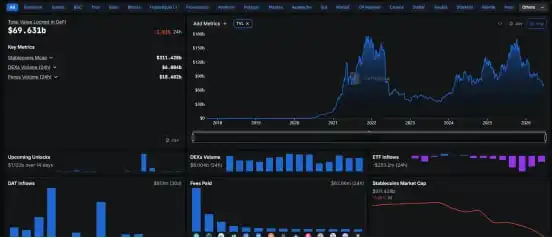
Therefore, an increase in TVL typically signals capital inflow and market activity, while a decrease indicates capital withdrawal and liquidity contraction. The recent drop of the entire network's TVL below $70 billion essentially reflects the continuous shrinkage of overall DeFi liquidity.

The primary reason for this phenomenon is the decline in overall risk appetite across the crypto market. When core assets like Bitcoin and Ethereum enter phases of consolidation or even correction, risk capital in the market often withdraws first from highly volatile sectors.

DeFi, being a field highly dependent on market sentiment, naturally bears the brunt. Users become less frequent in conducting leveraged trading, lending, and liquidity mining operations, leading to a subsequent decrease in on-chain capital activity.

Simultaneously, the liquidity incentive model that DeFi heavily relied on in recent years is losing its effectiveness. During the DeFi Summer period from 2020 to 2021, numerous protocols attracted massive capital inflows through high token subsidies, with APYs often reaching tens or even hundreds of percent, leading to rapid capital accumulation.

However, this growth model was essentially subsidy-driven rather than real demand-driven. Once incentives weakened, capital quickly exited. The market is now becoming increasingly aware that the high TVL of many protocols does not represent real value but is more a result of short-term arbitrage capital accumulation.

Additionally, the migration of capital towards other popular narratives is also a significant factor. Over the past two years, market focus has gradually shifted from DeFi to new sectors such as AI, RWA, stablecoin payments, and modular infrastructure.

Capital naturally chases higher growth expectations. When new narratives continuously attract attention, the appeal for capital in the traditional DeFi sector weakens. In other words, the decline in TVL does not merely signify capital leaving the chain; it also indicates that the market is reallocating capital.

II. Behind the DeFi Cooling: The Industry is Facing Growth Bottlenecks

Looking back at the development history of DeFi, it was once one of the most revolutionary innovative directions in the entire crypto industry. Protocols represented by Uniswap, Aave, and MakerDAO successfully reconstructed mechanisms for trading, lending, and stablecoin issuance found in traditional finance, allowing users to perform complex financial operations without banks or brokers.

This concept of permissionless finance was once considered one of the core application scenarios of blockchain.

However, after several market cycles (bull and bear), the growth bottlenecks of DeFi have become increasingly apparent. First, the pace of innovation has significantly slowed down. In the early DeFi ecosystem, there was clear differentiation between protocols—some focused on trading, some on lending, and some explored synthetic assets. But now, many new projects are merely copies or slight tweaks of old models.

New AMMs, new lending protocols, and new yield farms emerge endlessly but rarely bring about real structural innovation. Intensified homogeneous competition leads to reduced willingness among users to migrate.

Secondly, the substantial decline in yields has weakened the appeal of DeFi. Many of the high yields common in 2021 came from token inflation and market bubbles. As the market matures, real yields are gradually returning to rationality.

Currently, returns for stablecoin lending, market making, and basic yield products have generally dropped to single-digit percentages. For average users, when DeFi yields gradually approach those of traditional financial products, its complex operations and smart contract risks become disadvantages.

A deeper issue lies in the stagnation of user growth. Despite years of development, DeFi still struggles to break out of the crypto-native user circle. For the average user, concepts like wallet management, gas fees, cross-chain bridges, private key security, and liquidation risks remain significant barriers.

Compared to using traditional payment systems like PayPal or Visa, the user experience in DeFi is still relatively complex. Technological advancement does not equate to product ease of use. This user experience bottleneck prevents DeFi from achieving truly large-scale adoption.

III. TVL Decline Does Not Mean the End: DeFi May Be Moving Towards a New Stage

Although TVL has dropped to a phase low, this does not signify the end of DeFi. In fact, viewing TVL as the sole metric itself has limitations.
Since TVL is usually denominated in USD, price fluctuations of crypto assets directly affect its numerical value. Even if the amount of user lock-up remains unchanged, TVL can shrink significantly simply because the price of assets like Ethereum falls. Therefore, a decline in TVL does not entirely equate to real capital outflow.

More importantly, the industry is shifting from capital accumulation to efficiency competition. With the continuous maturation of Layer 2, modular architecture, intent-driven trading, and cross-chain liquidity solutions, future DeFi protocols may no longer need massive TVL to support their business scale.

Improvements in capital efficiency mean that less locked capital can create higher trading volumes and better user experiences. This will change the market's past singular reliance on TVL.

Simultaneously, DeFi is also extending into more real-world financial scenarios. One of the most watched directions is RWA, or Real World Asset tokenization. Through tokenization, traditional assets like US Treasury bonds, funds, real estate, and private credit are gradually entering the on-chain financial system.

This means the source of DeFi's yield is beginning to shift from "token subsidies" to real cash flows, providing a more solid value foundation.

On the other hand, the rapid expansion of the stablecoin ecosystem is also propelling DeFi into a new stage. USD Coin issued by Circle and Tether issued by Tether have gradually become the core liquidity foundation of on-chain finance.

From a longer-cycle perspective, the core future competition in DeFi might no longer be "whose APY is higher," but rather "who can provide more stable, secure, and efficient financial services." Protocols that can truly weather cycles often possess four characteristics: real revenue, strong user stickiness, high capital efficiency, and robust security.

A TVL of $70 billion might seem like a low point, but it more closely resembles a watershed moment after the industry bubble has cleared. DeFi is bidding farewell to the old era reliant on subsidies and speculation and moving towards a new, more rational and mature stage. The next industry explosion might no longer be about financial speculation, but rather about who gets closer to real-world financial needs.

Conclusion

The decline of DeFi's total value locked below $70 billion, on the surface, signals a cooling market, but behind it reflects that the industry is undergoing a profound value reassessment. From the wild growth driven by liquidity mining to today's return of capital to rationality and accelerated market clearing, DeFi is leaving behind the old narrative built on high-yield myths.

In the short term, liquidity contraction, slowing user growth, and intensified sector competition will continue to put considerable pressure on the industry. However, from a long-term perspective, the continuous evolution of RWA, stablecoin payments, and on-chain financial infrastructure also opens up new growth space for DeFi.


Domande pertinenti

QWhat is the primary reason for the continued contraction of DeFi liquidity, as indicated by TVL dropping below $70 billion?

AThe primary reason is the decline in overall risk appetite in the crypto market. As core assets like Bitcoin and Ethereum enter volatile or correction phases, risk capital tends to withdraw from high-volatility sectors like DeFi first.

QAccording to the article, what are the main growth bottlenecks currently facing the DeFi industry?

AThe main growth bottlenecks are: 1) A significant slowdown in genuine innovation, with many new projects being slight variations of existing models. 2) A sharp decline in yields, making DeFi less attractive compared to its complexity and risks. 3) Stagnant user growth due to high barriers like wallet management, gas fees, and security concerns, preventing mass adoption.

QWhy does the article argue that a falling TVL doesn't necessarily signal the end for DeFi?

AThe article argues that TVL is a limited metric because its dollar value is heavily influenced by crypto asset price fluctuations. More importantly, the industry is shifting from capital accumulation to efficiency competition. Advancements in Layer 2, modular architecture, and cross-chain solutions mean future protocols can operate with higher capital efficiency, requiring less locked value to facilitate significant activity.

QWhat new direction is mentioned as a potential source of more stable value and real cash flow for DeFi?

AThe tokenization of Real World Assets (RWA) is mentioned as a key direction. Bringing assets like US Treasury bonds, funds, real estate, and private credit on-chain provides DeFi with real-world cash flows and more solid value backing, moving away from reliance on token subsidies.

QWhat does the article suggest will be the core of future competition in the DeFi space, replacing the focus on high APY?

AThe future competitive core will shift from 'who offers the highest APY' to 'who can provide more stable, secure, and efficient financial services.' Protocols that can endure market cycles will be characterized by real revenue, strong user stickiness, high capital efficiency, and robust security.

Letture associate

Will There Be a Next Wave of Web3 Games? Veteran Player's Review: At the Peak of Hype, You Should at Least Sell Half

**Title: Is There Another Wave for Web3 Gaming? A Veteran Player's Review: When Hype Peaks, You Must Exit at Least Half** **Summary:** In an interview, veteran player "Earn Money Chicken" shares his journey and reflections on Web3 gaming. He transitioned from being a traditional in-game trader to a Web3 gamer, having profited from games like Mobox, StepN, and Seraph, but also experiencing significant losses. He defines himself primarily as a player, not an investor, attracted to Web3 games for the blend of earning potential, engaging gameplay, and the satisfaction of researching game mechanics. While he enjoys strategic "gambling" within games, he emphasizes it's not about zero-sum competition with other players. The interview explores the complex, often adversarial relationship between players, projects, and major investors (whales). The player's experience as a traditional game merchant helped develop his analytical mindset for spotting opportunities, but wasn't directly transferable. He identifies the core sources of profit in early Web3 gaming as **"era红利" (era-specific红利)** and strategic foresight, not just simple calculations. He warns that the biggest mistake ordinary players make is calculating their return-on-investment (ROI) period at peak hype, as asset and yield depreciation can trap them. Reflecting on his wins and losses, he now advocates for managing expectations. His most successful exit was from Seraph, where he sold at a relatively good time. The key problem with current Web3 games, he argues, is that most are not mature games first. A successful Web3 game must primarily be a **good, fun game** with a genuine player base willing to spend money for enjoyment, not just participants seeking profit. The blockchain element should solve problems within that context, not be the primary driver. While he believes the sector might see another speculative boom (possibly another strong "Ponzi" model attracting hype), a truly mature and sustainable Web3 game likely needs to come from a traditional major game studio. It would leverage a proven IP, mature content, a functional NFT trading system, and attract both traditional and crypto-native players, offering more normalized returns rather than extreme暴利. His final advice: Newcomers without prior experience should avoid the space now, as it's like searching for a diamond in the rough. For those remaining, the rule is: be brave when assets are low and overlooked, but **when everyone is talking about it (at peak hype), you must sell at least half your holdings.**

marsbit24 min fa

Will There Be a Next Wave of Web3 Games? Veteran Player's Review: At the Peak of Hype, You Should at Least Sell Half

marsbit24 min fa

The Most Hidden AI Winners

"The Most Under-the-Radar AI Winners" While core AI giants and their direct suppliers have dominated headlines, a group of seemingly unrelated, decades-old manufacturing companies have emerged as major beneficiaries. A key example is Japan's TOTO, famous for bathroom fixtures. Its stock soared 145% in a year, driven not by its mainstay toilet business but by its nearly 40-year-old semiconductor ceramic component unit. Specifically, TOTO manufactures electrostatic chucks—critical, hard-to-replace parts for advanced chip manufacturing processes like etching and EUV lithography. This segment, though only 9% of revenue, contributed over 54% of operating profit in FY2025 with a 43% margin. High barriers to entry, including deep know-how in high-purity ceramic sintering and long supplier certification cycles (5+ years), secure its position. This pattern repeats across industries. Nitto Boseki, a 128-year-old glass fiber maker, saw its stock rise 325% due to near-monopoly supply of T-glass, an essential low-expansion material for AI chip substrates. Similarly, Ajinomoto, the global MSG leader, commands 80-95% of the market for ABF film, a vital insulating layer in chip packaging. These "hidden" segments, often born from deep materials science expertise, are now bottleneck supplies in the AI hardware chain, enjoying pricing power and high margins. In China's A-share market, the theme combines this AI-driven demand with domestic substitution. Companies like Zhongci Electronic (advancing in electrostatic chucks) and Honghe Technology & Feilihua (in high-end electronic glass fabrics) are gaining traction. The investment thesis hinges on whether these domestic players can rapidly scale qualified capacity to capture the supply gap within the critical time window. Ultimately, these cases show that in the AI supply chain, high-profit concentrations exist not only at the cutting-edge tech frontier but also in indispensable, difficult-to-replicate materials and components. Market recognition often lags behind fundamental profit shifts, creating potential for significant re-ratings as traditional industrial firms are re-evaluated as key enablers of advanced semiconductor manufacturing.

marsbit49 min fa

The Most Hidden AI Winners

marsbit49 min fa

The Most Secretive Winners of the AI Boom

"The Most Hidden AI Winners" An unlikely group of companies are emerging as major beneficiaries of the AI boom, not from designing chips, but from supplying critical materials and components essential for advanced semiconductor manufacturing. These 'hidden winners' are traditional manufacturers whose deep expertise in materials science has become indispensable. Japanese companies are leading this trend. Toto, globally known for bathroom fixtures, has seen its stock surge 145% over the past year, driven by its 40-year-old semiconductor ceramics business, which now contributes over half of its operating profit. Its electrostatic chucks are vital for advanced chip production and require years of expertise to manufacture. Similarly, Nittobo, a 128-year-old textile firm, controls 90% of the market for T-glass, a low-expansion glass fiber essential for AI chip substrates. Ajinomoto, the world's largest MSG producer, dominates the market (80-95% share) for ABF insulating film used in chip packaging. The core insight is that chasing "advanced" chips paradoxically increases reliance on traditional, high-precision material science where supply cannot be quickly replicated. These materials are now critical bottlenecks in the AI supply chain. This trend is mirrored in China's A股 market, framed by the theme of 'import substitution'. Companies like Zhongci Dianzi (electrostatic chucks) and Honghe Technology (ultra-thin electronic cloth) are making progress, but face the test of scaling production and matching Japanese rivals' quality. The key tension lies in the slow change of market perception. While profit structures rapidly shift towards high-margin tech components, these firms retain their traditional industry classifications, creating a valuation gap that is gradually closing as their roles in the AI ecosystem become undeniable.

链捕手56 min fa

The Most Secretive Winners of the AI Boom

链捕手56 min fa

Trading

Spot
活动图片