Crypto firms lead 2026 U.S. election donations with $189M: ‘Legalized bribery!’

ambcryptoPubblicato 2026-07-02Pubblicato ultima volta 2026-07-02

Introduzione

Crypto industry leads corporate political spending for the 2026 U.S. midterm elections with a record $189 million, according to FEC data. This surpasses its 2024 total and accounts for over a third of all corporate donations. Major donors include a16z, Ripple Labs, and Coinbase, with funds largely supporting pro-crypto candidates, primarily Republicans. Key goals include passing the stalled CLARITY Act and protecting recent regulatory gains. Critics, like Senator Bernie Sanders, label the spending "legalized bribery."

Crypto has emerged as the top political spender and influencer in the U.S. 2026 midterms.

According to Federal Election Commission (FEC) data aggregated by Public Citizen, crypto lobbying in 2026 has surpassed 2024 expenditure. So far, the industry has poured $189M to decampaign anti-crypto candidates and support lawmakers aligned with the sector.

This was nearly $20M more than the 2024 expenditure of $170M.

In terms of sector spending, crypto has donated three times more than the next segment, AI and big tech ($60M). Betting came in third in terms of top corporate donors trying to influence the outcome of the American vote.
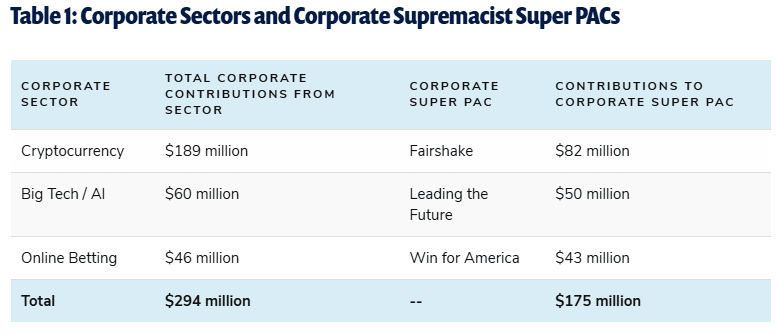
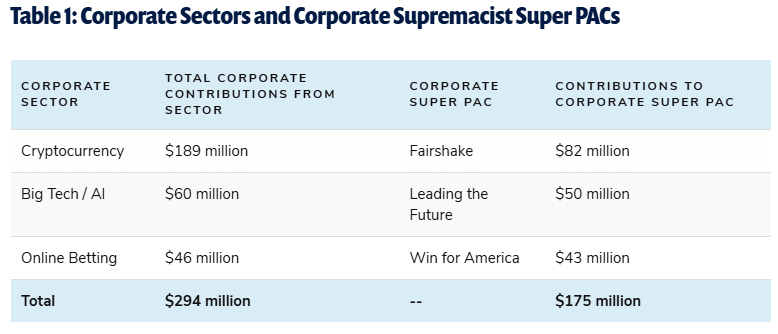
Source: Public Citizen/FEC

Overall, corporate political spending continues to rise, underscoring their significant influence in U.S elections outcome.

According to FEC data, the total corporate spending has hit $517.5M, meaning crypto alone has contributed to 36.5% of the overall donations – that’s more than a third of corporate lobbying money in the 2026 midterms.

a16z, Coinbase, and Ripple lead crypto donors

Unsurprisingly, most of the crypto donations have been directed to push corporate agendas or back Republicans. For the unfamiliar, most of the Republicans have been supportive of the industry, starting with President Donald Trump.

At the firm level, venture firm a16z led the list of top donors, with a whopping $51.65M. Ripple Labs came in second with about $50M, while Crypto.com and Coinbase contributed $38M and $35M each.

Coinbase, unlike others, is actively backing Democrats who are pro-crypto.

Fairshake PAC, one of the largest lobby groups for the sector, received most of the donations from Ripple Labs and Coinbase. In fact, the PAC has been active in Georgia, Alabama, Nebraska, Kentucky, and Texas to ensure only pro-crypto candidates win the midterms.

According to Josh Vlasto, Fairshake’s spokesperson, “everything was on the table” to ensure they achieve their mission.

For his part, Senator Bernie Sanders estimated crypto spending to be about $288M, calling it ‘legalized bribery.’
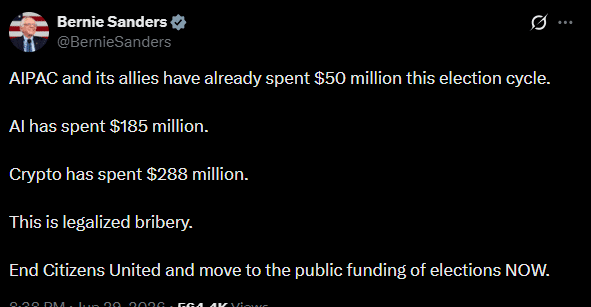
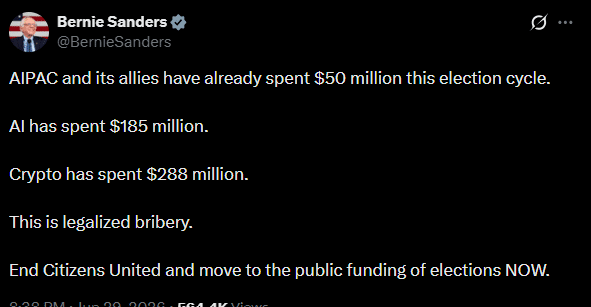
Source: X

U.S. crypto: What’s at stake in 2026 elections

That said, the crypto lobbying efforts in 2024 are partly what propelled the Trump faction to win the elections. And the administration has partially delivered on its pledges.

The anti-SEC regime led by Gary Gensler was replaced, and the GENIUS Act, clear rules for stablecoins, was passed. In fact, even crypto debanking was investigated, and broader integration with the banking sector was pushed.

However, the most critical one, the CLARITY Act, has remained stuck amid a tight Senate calendar.

In other words, the bill could extend to 2027, and the next Congress will determine if it becomes law. That’s why the industry is backing pro-crypto candidates to push the bill to the finish line and defend the gains from being reversed.


Final Summary

  • The crypto industry has led in corporate spending in the 2026 midterm elections with $189M
  • Ripple Labs and Coinbase have increased donations as the CLARITY Act passage in 2026 remains uncertain.


Domande pertinenti

QHow much has the crypto industry spent on the 2026 U.S. midterm elections according to the article?

AThe crypto industry has spent $189 million on the 2026 U.S. midterm elections.

QWhat are the names of the top three crypto donor firms mentioned, and how much did they contribute?

AThe top three crypto donor firms are venture firm a16z ($51.65M), Ripple Labs (about $50M), and Crypto.com ($38M). Coinbase is also a major donor at $35M.

QAccording to the article, which U.S. Senator criticized the crypto spending and what term did they use?

ASenator Bernie Sanders criticized the crypto spending, calling it 'legalized bribery'.

QWhat is one of the main legislative goals that the crypto industry is pushing for, as mentioned in the article?

AOne of the main legislative goals is the passage of the CLARITY Act, which the industry is backing pro-crypto candidates to help push forward.

QWhat percentage of the total reported corporate political spending for the 2026 midterms did the crypto industry's donations constitute?

AThe crypto industry's donations constituted 36.5% of the total reported corporate political spending of $517.5 million for the 2026 midterms.

Letture associate

Will There Be a Next Wave of Web3 Games? Veteran Player's Review: At the Peak of Hype, You Should at Least Sell Half

**Title: Is There Another Wave for Web3 Gaming? A Veteran Player's Review: When Hype Peaks, You Must Exit at Least Half** **Summary:** In an interview, veteran player "Earn Money Chicken" shares his journey and reflections on Web3 gaming. He transitioned from being a traditional in-game trader to a Web3 gamer, having profited from games like Mobox, StepN, and Seraph, but also experiencing significant losses. He defines himself primarily as a player, not an investor, attracted to Web3 games for the blend of earning potential, engaging gameplay, and the satisfaction of researching game mechanics. While he enjoys strategic "gambling" within games, he emphasizes it's not about zero-sum competition with other players. The interview explores the complex, often adversarial relationship between players, projects, and major investors (whales). The player's experience as a traditional game merchant helped develop his analytical mindset for spotting opportunities, but wasn't directly transferable. He identifies the core sources of profit in early Web3 gaming as **"era红利" (era-specific红利)** and strategic foresight, not just simple calculations. He warns that the biggest mistake ordinary players make is calculating their return-on-investment (ROI) period at peak hype, as asset and yield depreciation can trap them. Reflecting on his wins and losses, he now advocates for managing expectations. His most successful exit was from Seraph, where he sold at a relatively good time. The key problem with current Web3 games, he argues, is that most are not mature games first. A successful Web3 game must primarily be a **good, fun game** with a genuine player base willing to spend money for enjoyment, not just participants seeking profit. The blockchain element should solve problems within that context, not be the primary driver. While he believes the sector might see another speculative boom (possibly another strong "Ponzi" model attracting hype), a truly mature and sustainable Web3 game likely needs to come from a traditional major game studio. It would leverage a proven IP, mature content, a functional NFT trading system, and attract both traditional and crypto-native players, offering more normalized returns rather than extreme暴利. His final advice: Newcomers without prior experience should avoid the space now, as it's like searching for a diamond in the rough. For those remaining, the rule is: be brave when assets are low and overlooked, but **when everyone is talking about it (at peak hype), you must sell at least half your holdings.**

marsbit25 min fa

Will There Be a Next Wave of Web3 Games? Veteran Player's Review: At the Peak of Hype, You Should at Least Sell Half

marsbit25 min fa

The Most Hidden AI Winners

"The Most Under-the-Radar AI Winners" While core AI giants and their direct suppliers have dominated headlines, a group of seemingly unrelated, decades-old manufacturing companies have emerged as major beneficiaries. A key example is Japan's TOTO, famous for bathroom fixtures. Its stock soared 145% in a year, driven not by its mainstay toilet business but by its nearly 40-year-old semiconductor ceramic component unit. Specifically, TOTO manufactures electrostatic chucks—critical, hard-to-replace parts for advanced chip manufacturing processes like etching and EUV lithography. This segment, though only 9% of revenue, contributed over 54% of operating profit in FY2025 with a 43% margin. High barriers to entry, including deep know-how in high-purity ceramic sintering and long supplier certification cycles (5+ years), secure its position. This pattern repeats across industries. Nitto Boseki, a 128-year-old glass fiber maker, saw its stock rise 325% due to near-monopoly supply of T-glass, an essential low-expansion material for AI chip substrates. Similarly, Ajinomoto, the global MSG leader, commands 80-95% of the market for ABF film, a vital insulating layer in chip packaging. These "hidden" segments, often born from deep materials science expertise, are now bottleneck supplies in the AI hardware chain, enjoying pricing power and high margins. In China's A-share market, the theme combines this AI-driven demand with domestic substitution. Companies like Zhongci Electronic (advancing in electrostatic chucks) and Honghe Technology & Feilihua (in high-end electronic glass fabrics) are gaining traction. The investment thesis hinges on whether these domestic players can rapidly scale qualified capacity to capture the supply gap within the critical time window. Ultimately, these cases show that in the AI supply chain, high-profit concentrations exist not only at the cutting-edge tech frontier but also in indispensable, difficult-to-replicate materials and components. Market recognition often lags behind fundamental profit shifts, creating potential for significant re-ratings as traditional industrial firms are re-evaluated as key enablers of advanced semiconductor manufacturing.

marsbit50 min fa

The Most Hidden AI Winners

marsbit50 min fa

The Most Secretive Winners of the AI Boom

"The Most Hidden AI Winners" An unlikely group of companies are emerging as major beneficiaries of the AI boom, not from designing chips, but from supplying critical materials and components essential for advanced semiconductor manufacturing. These 'hidden winners' are traditional manufacturers whose deep expertise in materials science has become indispensable. Japanese companies are leading this trend. Toto, globally known for bathroom fixtures, has seen its stock surge 145% over the past year, driven by its 40-year-old semiconductor ceramics business, which now contributes over half of its operating profit. Its electrostatic chucks are vital for advanced chip production and require years of expertise to manufacture. Similarly, Nittobo, a 128-year-old textile firm, controls 90% of the market for T-glass, a low-expansion glass fiber essential for AI chip substrates. Ajinomoto, the world's largest MSG producer, dominates the market (80-95% share) for ABF insulating film used in chip packaging. The core insight is that chasing "advanced" chips paradoxically increases reliance on traditional, high-precision material science where supply cannot be quickly replicated. These materials are now critical bottlenecks in the AI supply chain. This trend is mirrored in China's A股 market, framed by the theme of 'import substitution'. Companies like Zhongci Dianzi (electrostatic chucks) and Honghe Technology (ultra-thin electronic cloth) are making progress, but face the test of scaling production and matching Japanese rivals' quality. The key tension lies in the slow change of market perception. While profit structures rapidly shift towards high-margin tech components, these firms retain their traditional industry classifications, creating a valuation gap that is gradually closing as their roles in the AI ecosystem become undeniable.

链捕手57 min fa

The Most Secretive Winners of the AI Boom

链捕手57 min fa

DeFi Enters a Moment of Value Reassessment: Risks and Opportunities Behind the $70 Billion TVL

DeFi Enters a Moment of Value Reassessment: Peril and Opportunity Behind $70 Billion TVL On July 1st, the total value locked (TVL) across all DeFi protocols fell below $70 billion to approximately $69.358 billion, hitting its lowest point since February 2024. This decline signals a significant contraction in DeFi liquidity and marks a new adjustment phase for the industry, far from its 2021 peak of over $180 billion. The primary drivers of this TVL drop are a general decrease in crypto market risk appetite, which leads capital to exit volatile sectors like DeFi first, and the fading effectiveness of the high-yield liquidity incentive models that fueled the initial DeFi boom. Many protocols' high TVL figures were built on temporary subsidy-driven capital rather than genuine demand. Furthermore, capital is migrating to newer narratives like AI, RWA, and modular infrastructure. This cooldown exposes DeFi's growth bottlenecks: innovation has slowed with rampant protocol copycats, real yields have normalized to single digits, and poor user experience continues to hinder mass adoption beyond crypto-natives. However, the TVL decline does not spell the end for DeFi. The metric itself is limited, as it fluctuates with underlying asset prices. The industry is shifting from capital accumulation to efficiency competition, leveraging Layer 2 solutions and modular architecture to do more with less locked value. Crucially, DeFi is expanding into real-world financial use cases like the tokenization of real-world assets (RWA) and the growth of the stablecoin ecosystem, moving its value proposition from speculative token subsidies to real cash flows. In conclusion, while short-term pressures from liquidity contraction and user growth stagnation persist, the sector is undergoing a necessary value reassessment. DeFi is transitioning from a subsidy-driven, hype-based era toward a more mature, rational, and efficiency-focused phase, with long-term growth hinging on meeting real-world financial needs through RWA, stablecoins, and robust infrastructure.

marsbit1 h fa

DeFi Enters a Moment of Value Reassessment: Risks and Opportunities Behind the $70 Billion TVL

marsbit1 h fa

Trading

Spot
活动图片