Deciphering Aave V4: A Transformation from Product to "Bank"

marsbitPubblicato 2026-03-31Pubblicato ultima volta 2026-03-31

Introduzione

On March 30, Aave V4 officially launched on the mainnet, introducing a major architectural redesign centered around a unified liquidity model called "Hub and Spoke." The core change replaces isolated lending markets with a centralized liquidity pool (Hub) per chain or L2, which manages global liquidity, credit limits, and system constraints. Different Hubs (Core, Prime, Plus) cater to varying risk profiles and user needs. Spokes function as independent markets with custom parameters, allowing borrowers to access assets from the shared pool under specific rules. V4 improves capital efficiency by introducing risk-based interest rates—where borrowers using volatile collateral pay higher rates—and a refined liquidation mechanism that only restores positions to a target health factor. Additionally, idle liquidity in Hubs can be automatically deployed to governance-approved yield strategies, boosting returns for suppliers and DAO revenue. While the update doesn’t radically change the lending experience for users with high-quality collateral, it transforms Aave from a product into a bank-like financial infrastructure. This sets the stage for future expansions into services like structured products, credit facilities, and investment banking operations.

On the evening of March 30th, Beijing time, the long-planned Aave V4 officially launched on the mainnet, bringing the first piece of good news since the Aave DAO governance debates began in 2024.
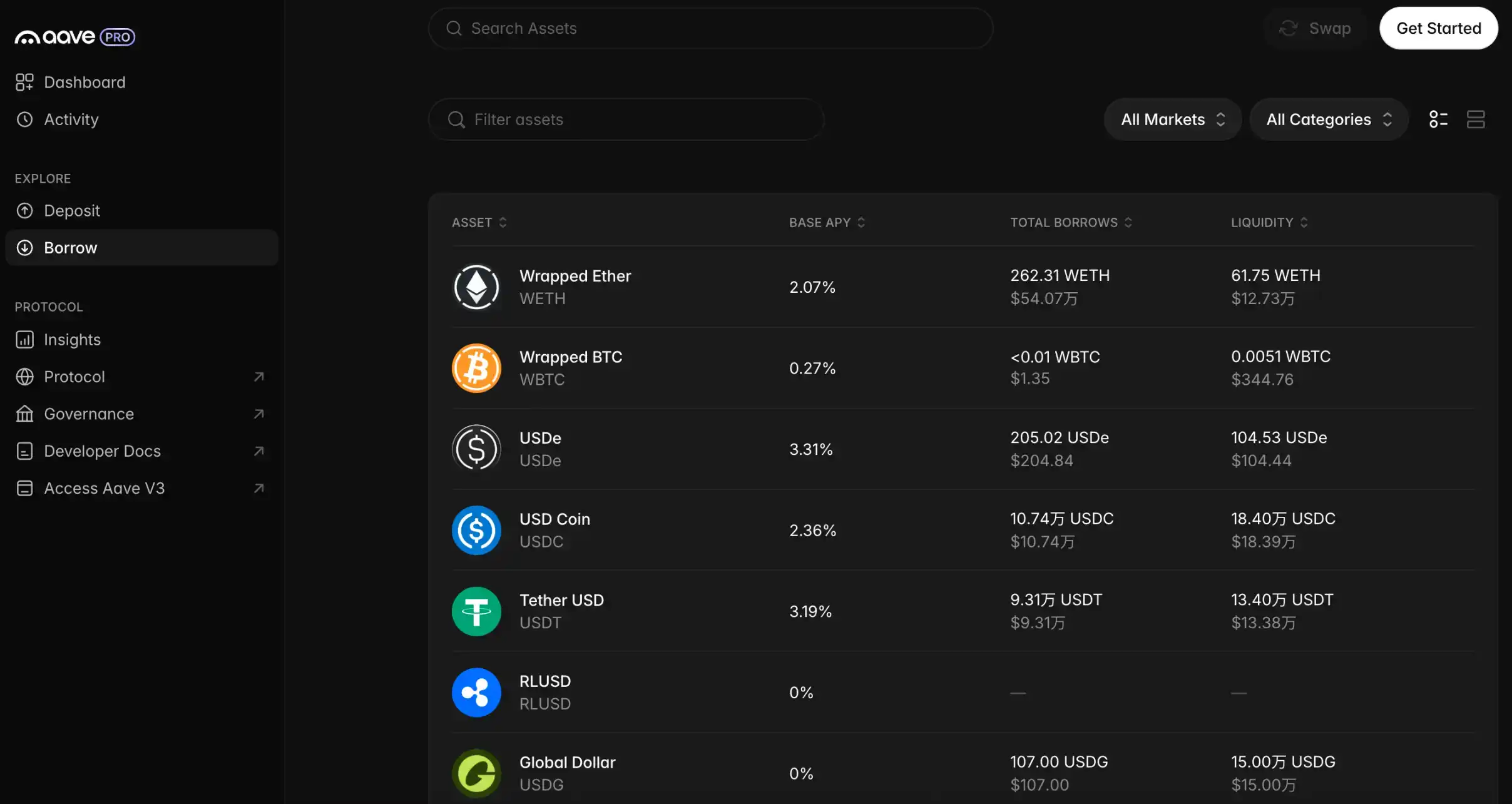
V4 can be described as a complete overhaul of Aave, with the most core change being the integration of previously independent lending markets into a unified liquidity pool architecture: the Hub and Spoke model.

In V4, each chain or L2 has a unified liquidity center (the Hub), where all assets deposited by users for lending are pooled into a single liquidity pool. The Hub is responsible for global coordination, credit limit control, system-level constraints (such as "Total Borrows ≤ Total Supply"), and emergency pauses. The Hub does not interface directly with users; it manages liquidity in the background.

It is worth noting that there is not just one Hub per chain, but different Hubs are designed based on different needs, which is essentially a form of risk isolation. For example, V4 has currently launched the Core Hub, Prime Hub, and Plus Hub. The Core Hub contains mainstream assets and is open to all users, the Prime Hub is designed for suppliers seeking more "controllable" collateral, and the Plus Hub is designed for strategic stablecoins, with its parameters needing to consider the project's scale.
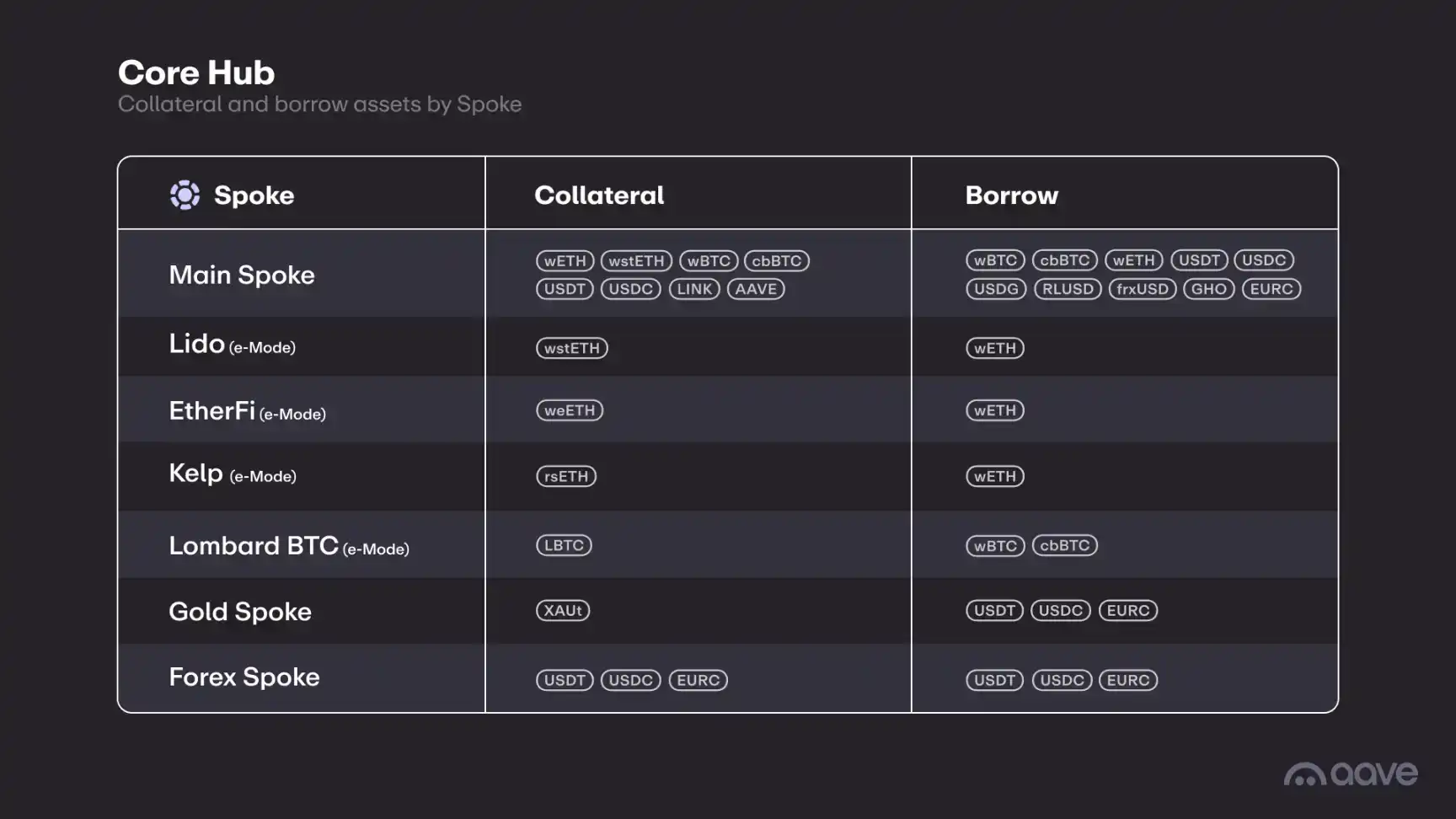
As for the Spoke, you can think of it as an independent market, each with its own lending functions, risk parameters, and collateral rules. Within a single Hub, user assets reside in the same liquidity pool, and borrowers choose different Spokes based on their needs. For example, as shown in the diagram above, a user can deposit WETH as a borrowable asset. Borrowers can borrow WETH from the first four Spokes, but only the EtherFi Spoke allows weETH to be used as collateral.

Although the official claim is that this integrates fragmented liquidity, in practice, the difference is not significant for users borrowing against high-quality collateral. For instance, if you want to抵押 ETH to borrow assets, the operation in V3 and V4 is not fundamentally different, as long as you ensure the health factor does not drop too low.

So, regarding the integration of liquidity, V4 indeed offers more精细 management than independent markets, but it's not a qualitative leap. The real differences come from the customizable parameters of the Spokes and the new liquidation engine.

In V4, a borrower's interest rate depends on the base rate and a risk premium. The base rate, like in V3, uses a utilization curve—rising slowly below optimal utilization and steeply above it. The risk premium depends on the nature of the collateral asset. If the collateral is more stable assets like USDT, ETH, or WBTC, the risk premium will be very low or even 0. However, high-risk altcoins will have a high risk premium, avoiding the situation where "good assets subsidize bad assets."

To give a simple example, in V3, the interest rate depended solely on supply and demand. When borrowing USDT, even though the loan-to-value (LTV) and liquidation threshold might differ, the interest rate for collateralizing ETH and LINK would be the same under the same supply and demand conditions, even though LINK's volatility is higher than ETH's. If the rates are the same, borrowers using LINK as collateral drive up the utilization rate, potentially causing borrowing costs for users collateralizing ETH to rise instead of fall.

V4 optimizes this flaw. Users borrowing against high-risk collateral need to pay a higher cost, while fund providers can earn higher yields. Simultaneously, the higher interest rate curbs borrowing demand, giving users borrowing against优质资产 a more明显的 cost advantage.

Regarding the liquidation mechanism, liquidators will only restore the health factor to the target value preset by the Spoke, and the lower the health factor, the higher the liquidation bonus. This design not only gives borrowers more room for maneuver but also reduces the platform's overall bad debt risk. Additionally, the new liquidation engine includes a "anti-dust mechanism," meaning if the remaining debt or collateral falls below a threshold (e.g., $1000), the liquidator must fully liquidate the position, preventing the accumulation of small残留 amounts that reduce capital efficiency.

Finally, idle liquidity in the Hub can be automatically deployed into low-risk yield strategies approved by governance (such as short-term government bonds, stablecoin LPs, money market instruments, etc.). This increases the income for fund suppliers while also boosting DAO revenue, which is perhaps one of the few advantages of "unified liquidity."

Overall, the advantages of Aave V4's unified liquidity for lending are not显著. The so-called composability—allowing borrowers to manage positions across different Spokes uniformly—is also not much more convenient than V3. But as the title suggests, V4 transforms Aave from a product into a financial infrastructure resembling a "bank."

Setting aside various complex operations, the core business of a bank is to accept deposits, retain a portion as reserves for daily user payments, transfers, etc., and earn the spread between deposits and loans through lending. As for idle funds, the bank can also allocate them to different investments within its risk tolerance.

The Bank of Saint George, established in 1407 in Genoa, Italy, is often considered the world's first bank. It not only provided deposit and loan services but also handled government debt management, currency exchange, and fund transfers, meeting the commercial needs of Genoa as a major European trade center at the time.

From the launch of ETHLend in 2017 to the mainnet release of Aave V4 in 2026, in less than 10 years, Aave has built what the earliest banks looked like. Of course, there are significant differences between Aave and a bank; this is just an analogy. Compared to P2P, the bank model, tempered by centuries of black swan events, is naturally a better choice, just as V4 is an improvement over V3.

If you look closely, you'll find that a vast amount of "innovation" in the DeFi sector has almost become历史尘埃, such as the hot DeFi 2.0 trend in the second half of 2021. Instead, projects like Aave, with simple business logic that has been成熟 in traditional finance for centuries, have survived and thrived. After years of exploration, many DeFi projects have likely discovered this truth: the ceiling for DeFi is high, but not a single step of the path taken by traditional finance can be skipped.

Aave V4's centralized liquidity opens up numerous future possibilities. For example, assets idle for a certain period (e.g., one year) could be allocated to relatively higher-risk investments, such as providing ETH/USDT liquidity on Uniswap. It could operate entirely in the mode of a commercial bank, gradually adding other commercial banking services, such as credit cards (referencing Ethfi's model of spending stablecoins borrowed against collateral), and so on.

Going a step further, Aave could expand into "investment banking." For instance, launching an ICO platform allowing users earning interest on deposited assets to borrow USDT or USDC to participate in investments, eliminating the need to withdraw and sell assets for stablecoins. This way, it could charge fees from projects on one side and collect interest on the other.

Although the Hub & Spoke mechanism doesn't bring massive innovation to lending itself, it paves the way for the next crucial steps.


Crypto di tendenza

Domande pertinenti

QWhat is the core architectural change introduced in Aave V4?

AThe core architectural change in Aave V4 is the shift to a unified liquidity pool structure called 'Hub and Spoke'. This consolidates previously isolated lending markets into a single liquidity pool per chain or L2, with a central Hub managing global liquidity, credit limits, and system constraints, while Spokes function as independent markets with their own borrowing features and risk parameters.

QHow does Aave V4's new interest rate model differ from V3?

AIn Aave V4, a borrower's interest rate is determined by a base rate and a risk premium. The base rate, similar to V3, uses a utilization curve. The key difference is the addition of a risk premium based on the collateral asset's quality. Stable assets like ETH or USDT have a low or zero risk premium, while riskier altcoins carry a higher premium, preventing 'good assets from subsidizing bad assets'.

QWhat is the purpose of the new liquidation engine in Aave V4?

AThe new liquidation engine is designed to only restore a borrower's health factor to a Spoke's preset target value, with the liquidation bonus increasing as the health factor decreases. This gives borrowers more operational flexibility and reduces the platform's bad debt risk. It also includes a 'dust prevention mechanism' that forces a full liquidation of positions if the remaining debt or collateral falls below a certain threshold.

QHow does the V4 upgrade transform Aave's business model according to the article?

AThe article posits that the V4 upgrade transforms Aave from a mere product into a 'bank-like' financial infrastructure. By centralizing liquidity, it can operate similarly to a traditional bank: taking deposits, setting aside reserves, lending to earn interest, and automatically deploying idle funds into governance-approved, low-risk yield strategies, paving the way for future banking services.

QWhat future banking-like services does the article suggest Aave could explore after V4?

AThe article suggests Aave could explore services like using long-term idle assets for higher-risk investments (e.g., providing liquidity on Uniswap), offering credit card-like products (using抵押借贷 for spending), and even expanding into investment banking activities such as launching an ICO platform where users can borrow stablecoins to participate without selling their deposited assets.

Letture associate

After Three Consecutive Quarters of Decline, Can the Crypto Market Find a Window for Stabilization in Q3?

The cryptocurrency market has just concluded its worst-performing quarter since 2022, with total capitalization dropping 12.6% to $2.1 trillion. All core metrics indicate capital is leaving the sector, not just rotating within it. Bitcoin fell 14.2% and Ethereum dropped 25.4% in Q2, breaking their previous correlation with US tech stocks. A key driver is the reversal in US spot Bitcoin ETF flows, which saw a net outflow of approximately $4.67 billion in Q2, including a record monthly outflow near $4.5 billion in June. While recent data suggests long-term holders are accumulating again, sustained ETF outflows mean continued selling pressure. Market focus is now singularly on the Federal Reserve. The upcoming July FOMC meeting is seen as the most critical event for Q3. A dovish signal could support Bitcoin reclaiming a $68,000-$84,000 range, while a hawkish stance might establish a new trading band around $50,000-$56,000. Additionally, regulatory uncertainty persists, with the progress of the crucial *CLARITY Act* stalling in the Senate, reducing its perceived 2026 passage probability to 40-45%. Despite the broad downturn, a few sectors showed growth. Prediction markets saw nominal volume surge 48.7% year-over-year to $113.8 billion, and tokenized collectibles transaction volume rose 143% quarterly to $1.4 billion. The Real-World Asset (RWA) tokenization sector also continued steady growth, now representing ~$28.1 billion in on-chain value. The market's foundation for an extreme crash appears limited, with Bitcoin price hovering near its 200-week moving average. However, the trading paradigm has shifted from narrative-driven speculation to decisions based on price action, policy developments, and interest rate expectations, making a broad sentiment-driven rally unlikely in the near term.

marsbit12 h fa

After Three Consecutive Quarters of Decline, Can the Crypto Market Find a Window for Stabilization in Q3?

marsbit12 h fa

BIT Trading Moment: BTC Still Suppressed by Weekly 200 EMA, Rejection May Restart Decline; Storage and Semiconductors that Surged Last Night Begin Falling in Evening Trading

**Crypto & Stock Market Wrap: Bitcoin Tests Resistance, Stocks Retreat After AI Surge** Bitcoin consolidates around $66,000, facing key resistance near $68,000—an area seen as a major psychological and technical hurdle where previous rallies have failed. Analysts note the cryptocurrency is caught between its 200-week moving average (~$63,333) and 200-week EMA (~$68,328). A clear break above $68k is needed to signal a stronger bullish trend, while a rejection could lead to a retest of $63k support. Market sentiment remains cautious, with low futures open interest pointing to a low-liquidity rebound rather than a full bull market. Bitcoin spot ETFs saw another $203 million inflow. US stock futures pointed lower after a strong Tuesday session led by a massive rebound in semiconductors and memory stocks. The rally was fueled by renewed optimism about AI-driven hardware demand, with Micron, SanDisk, and SK Hynix surging. However, those gains reversed in pre-market trading. Super Micro Computer (SMCI) soared over 20% after hours on strong guidance and a record backlog. Other standouts included Rocket Lab and nuclear energy plays Oklo and X-Energy. Rising oil prices (Brent above $91) and climbing Treasury yields (10-year near 4.64%), however, are reigniting inflation concerns and acting as a headwind for equities. In Asia, markets were mixed. South Korea's KOSPI pared early gains to close slightly higher as semiconductor stocks like SK Hynix gave back initial surges. Japan's Nikkei edged lower as the yen hit a fresh 38-year low against the dollar, raising fears of potential market intervention. Key events to watch include the Samsung Galaxy launch, AMD's AI event, and a slew of major tech earnings from Alphabet, Tesla, and IBM after the close on Wednesday, followed by the ECB meeting and Intel's earnings on Thursday.

marsbit12 h fa

BIT Trading Moment: BTC Still Suppressed by Weekly 200 EMA, Rejection May Restart Decline; Storage and Semiconductors that Surged Last Night Begin Falling in Evening Trading

marsbit12 h fa

Former CFTC Chairman, Circle President Tarbert: Preaching Long-Termism While Cashing Out $30 Million Himself

Former CFTC Chairman and Circle President Heath Tarbert has consistently advocated for a long-term vision in public, urging patience from investors as Circle’s stock price has fallen significantly from its peak. However, it has been revealed that since Circle’s IPO, Tarbert has continuously sold his CRCL shares through pre-arranged trading plans, cashing out approximately $30 million, without making any public market purchases. This contrast between his public messaging and personal actions has drawn criticism. Tarbert joined Circle in July 2023 as Chief Legal Officer, leveraging his regulatory experience to help guide the company through its IPO and expansion. Despite promoting stablecoins as long-term infrastructure, he established a 10b5-1 trading plan just before Circle went public, leading to substantial stock sales over the following year. In March 2026, he initiated another plan to sell more shares. His career trajectory highlights a pattern of moving between high-level regulatory roles and influential positions in the financial sector. After resigning as CFTC Chairman in early 2021, he joined Citadel Securities as Chief Legal Officer just 27 days later, during a period of intense regulatory scrutiny for the firm. He later joined Circle, aiding its efforts to navigate regulatory challenges for its public listing. While Tarbert's expertise in policy and compliance is valuable to companies like Circle, his actions—advocating long-term confidence while personally divesting—raise questions about the alignment between his public statements and his private financial decisions, leaving investors who followed his advice to bear the market risks.

marsbit13 h fa

Former CFTC Chairman, Circle President Tarbert: Preaching Long-Termism While Cashing Out $30 Million Himself

marsbit13 h fa

Gate Research Institute: The 'Wall Street-ization' Wave of Crypto Financial Products – Competition or Integration?

The article titled "Gate Research Institute: Are Crypto Financial Products Sparking a 'Wall Street' Wave—Competition or Convergence?" explores the evolving relationship between the crypto ecosystem and traditional finance (TradFi). The piece begins by reflecting on Bitcoin's original 2009 vision of decentralization, disintermediation, and moving away from banks. It then contrasts this with the 2024 landscape, where key crypto assets like Bitcoin are increasingly held through Wall Street products like ETFs issued by giants like BlackRock. The article questions whether this signifies that TradFi is systematically taking over the rights to issue, price, custody, and distribute crypto financial assets. The core argument is that this is not a zero-sum takeover but rather a bidirectional convergence where each side addresses the other's weaknesses. Crypto offers 24/7 global markets, programmable settlement, and open access but lacks compliant channels, institutional-grade custody, deep fiat liquidity, and mainstream distribution. TradFi possesses these but is constrained by legacy systems, limited operating hours, and slow settlement. Two primary convergence paths are highlighted: * **Path A (CEX to TradFi):** Exemplified by Gate, which has progressed from offering tokenized stocks and CFDs to providing direct, real stock trading (US, Hong Kong, South Korea) within its platform, using USDT. * **Path B (TradFi to Crypto):** Exemplified by Robinhood, which has integrated crypto trading, acquired exchanges like Bitstamp, and is moving traditional assets like stocks onto the blockchain via tokenization and its own Layer 2. Both paths are ultimately competing to become the next-generation, unified financial account—a "super account" where users can seamlessly trade cryptocurrencies, stocks, ETFs, RWA (Real World Assets), and tokenized treasury products in one interface. The growth of RWA and tokenized treasuries (e.g., BlackRock's BUIDL) is presented as the asset-layer fusion, providing stable, yield-bearing assets on-chain and acting as a bridge between the two worlds. In conclusion, the "Wall Street-ization" of crypto is framed as a mutual transformation. Decentralized ideals persist in the protocol layer, while at the application layer, a more efficient, global, and accessible unified capital market is emerging from this convergence. The future competition lies not between crypto exchanges and stockbrokers, but between platforms vying to offer the most comprehensive asset coverage, liquidity, and user experience within a single account.

marsbit13 h fa

Gate Research Institute: The 'Wall Street-ization' Wave of Crypto Financial Products – Competition or Integration?

marsbit13 h fa

Trading

Spot

Articoli Popolari

Cosa è $BANK

Banca AI: Un Passo Rivoluzionario nel Futuro della Banca Introduzione In un'era caratterizzata da rapidi progressi tecnologici, Banca AI si trova all'incrocio tra intelligenza artificiale (AI) e servizi bancari. Questo progetto innovativo mira a ridefinire il panorama finanziario, migliorando l'efficienza operativa, le misure di sicurezza e le esperienze dei clienti attraverso il potere dell'AI. Mentre ci impegniamo in questa esplorazione di Banca AI, esamineremo cosa comporta il progetto, le sue dinamiche operative, il suo contesto storico e i traguardi significativi. Cos'è Banca AI? Alla sua essenza, Banca AI rappresenta un'iniziativa trasformativa volta a integrare l'intelligenza artificiale in varie operazioni bancarie. Questo progetto sfrutta le capacità dell'AI per automatizzare processi, migliorare i protocolli di gestione del rischio e potenziare l'interazione con i clienti attraverso servizi personalizzati. Gli obiettivi principali di Banca AI includono: Automazione delle Funzioni Bancarie: Sfruttando le tecnologie AI, Banca AI mira ad automatizzare compiti di routine, riducendo il carico sulle risorse umane e aumentando l'efficienza. Miglioramento della Gestione del Rischio: Il progetto utilizza algoritmi AI per prevedere e identificare i rischi, rafforzando così le misure di sicurezza contro le frodi e altre minacce. Personalizzazione dei Servizi Bancari: Banca AI si concentra sull'offrire prodotti e servizi finanziari su misura analizzando i dati e i comportamenti dei clienti. Miglioramento dell'Esperienza del Cliente: L'implementazione di soluzioni guidate dall'AI, come chatbot e assistenti virtuali, mira a fornire agli utenti interazioni più umane, rivoluzionando il modo in cui i clienti si relazionano con le banche. Con questi obiettivi, Banca AI si posiziona come un attore cruciale nel rendere la banca più efficiente, sicura e centrata sull'utente. Chi è il Creatore di Banca AI? I dettagli riguardanti il creatore di Banca AI rimangono sconosciuti. Pertanto, non è stata identificata alcuna persona o organizzazione specifica nelle informazioni disponibili. L'anonimato che circonda la nascita del progetto solleva domande, ma non sminuisce la sua ambiziosa visione e obiettivi. Chi sono gli Investitori di Banca AI? Simile al creatore del progetto, informazioni specifiche riguardo gli investitori o le organizzazioni di supporto di Banca AI non sono state divulgate. Senza queste informazioni, è difficile delineare il sostegno finanziario e istituzionale che potrebbe spingere il progetto in avanti. Tuttavia, l'importanza di avere una solida base di investimento è fondamentale per sostenere lo sviluppo in un campo così innovativo. Come Funziona Banca AI? Banca AI opera su più fronti innovativi, concentrandosi su fattori unici che la differenziano dai framework bancari tradizionali. Di seguito sono riportate le caratteristiche operative chiave: Automazione: Applicando algoritmi di machine learning, Banca AI automatizza vari processi manuali all'interno delle banche. Ciò si traduce in una riduzione dei costi operativi e consente ai lavoratori umani di reindirizzare i propri sforzi verso attività più strategiche. Gestione Avanzata del Rischio: L'integrazione dell'AI nelle pratiche di gestione del rischio fornisce alle banche strumenti per prevedere con precisione potenziali minacce come le frodi, garantendo che le informazioni e i beni dei clienti rimangano al sicuro. Raccomandazioni Finanziarie Personalizzate: Attraverso l'apprendimento continuo dalle interazioni con i clienti, i sistemi AI sviluppano una comprensione sfumata delle esigenze degli utenti, consentendo loro di offrire consigli su misura per le decisioni finanziarie. Interazioni Migliorate con i Clienti: Utilizzando chatbot e assistenti virtuali alimentati dall'AI, Banca AI consente un'esperienza cliente più coinvolgente, permettendo agli utenti di risolvere rapidamente le loro richieste, riducendo così i tempi di attesa e migliorando i livelli di soddisfazione. Tutte queste caratteristiche operative posizionano Banca AI come un pioniere nel settore bancario, stabilendo nuovi standard per la fornitura di servizi e l'eccellenza operativa. Timeline di Banca AI Comprendere la traiettoria di Banca AI richiede uno sguardo al suo contesto storico. Di seguito è riportata una timeline che evidenzia traguardi e sviluppi importanti: Inizio 2010: La concettualizzazione dell'integrazione dell'AI nei servizi bancari ha cominciato a guadagnare attenzione mentre le istituzioni bancarie riconoscevano i potenziali benefici. 2018: Si è verificato un aumento significativo nell'implementazione delle tecnologie AI quando le banche hanno iniziato a utilizzare strumenti AI come i chatbot per servizi clienti di base e sistemi di gestione del rischio per migliorare la sicurezza. 2023: La sofisticazione dell'AI ha continuato ad avanzare, con l'introduzione dell'AI generativa per compiti più complessi come l'elaborazione di documenti e l'analisi degli investimenti in tempo reale. Quest'anno ha segnato un significativo salto nelle capacità offerte alle banche dalla tecnologia AI. 2024-Stato Attuale: A partire da quest'anno, Banca AI è su una traiettoria ascendente, con ricerche e sviluppi in corso pronti a migliorare ulteriormente le capacità nelle operazioni bancarie. L'esplorazione continua delle applicazioni AI suggerisce sviluppi entusiasmanti in arrivo. Punti Chiave su Banca AI Integrazione dell'AI nella Banca: Banca AI si concentra sull'adozione dell'intelligenza artificiale per snellire i processi bancari e migliorare le esperienze degli utenti. Focus su Automazione e Gestione del Rischio: Il progetto enfatizza fortemente queste aree, mirando a spostare il carico di compiti di routine mentre migliora le strutture di sicurezza attraverso analisi predittive. Soluzioni Bancarie Personalizzate: Sfruttando i dati dei clienti, Banca AI consente servizi bancari su misura che si adattano alle esigenze individuali degli utenti. Impegno per lo Sviluppo: Banca AI rimane impegnata in sforzi di ricerca e sviluppo continuativi, garantendo la sua adattabilità e rilevanza continua man mano che la tecnologia continua a evolversi. Conclusione In sintesi, Banca AI rappresenta un passo cruciale in avanti nell'industria bancaria, sfruttando l'intelligenza artificiale per rimodellare i paradigmi operativi, migliorare la sicurezza e promuovere la soddisfazione del cliente. Nonostante le lacune nelle informazioni riguardo il creatore e gli investitori, gli obiettivi chiari e i meccanismi funzionali di Banca AI forniscono una solida base per la sua continua evoluzione. Mentre la tecnologia AI continua ad avanzare e fondersi con il settore bancario, Banca AI è ben posizionata per avere un impatto significativo sul futuro dei servizi finanziari, migliorando il modo in cui comprendiamo e interagiamo con la banca.

134 Totale visualizzazioniPubblicato il 2024.04.06Aggiornato il 2024.12.03

Cosa è $BANK

Come comprare BANK

Benvenuto in HTX.com! Abbiamo reso l'acquisto di Lorenzo Protocol (BANK) semplice e conveniente. Segui la nostra guida passo passo per intraprendere il tuo viaggio nel mondo delle criptovalute.Step 1: Crea il tuo Account HTXUsa la tua email o numero di telefono per registrarti il tuo account gratuito su HTX. Vivi un'esperienza facile e sblocca tutte le funzionalità,Crea il mio accountStep 2: Vai in Acquista crypto e seleziona il tuo metodo di pagamentoCarta di credito/debito: utilizza la tua Visa o Mastercard per acquistare immediatamente Lorenzo ProtocolBANK.Bilancio: Usa i fondi dal bilancio del tuo account HTX per fare trading senza problemi.Terze parti: abbiamo aggiunto metodi di pagamento molto utilizzati come Google Pay e Apple Pay per maggiore comodità.P2P: Fai trading direttamente con altri utenti HTX.Over-the-Counter (OTC): Offriamo servizi su misura e tassi di cambio competitivi per i trader.Step 3: Conserva Lorenzo Protocol (BANK)Dopo aver acquistato Lorenzo Protocol (BANK), conserva nel tuo account HTX. In alternativa, puoi inviare tramite trasferimento blockchain o scambiare per altre criptovalute.Step 4: Scambia Lorenzo Protocol (BANK)Scambia facilmente Lorenzo Protocol (BANK) nel mercato spot di HTX. Accedi al tuo account, seleziona la tua coppia di trading, esegui le tue operazioni e monitora in tempo reale. Offriamo un'esperienza user-friendly sia per chi ha appena iniziato che per i trader più esperti.

727 Totale visualizzazioniPubblicato il 2025.05.09Aggiornato il 2026.06.02

Come comprare BANK

Discussioni

Benvenuto nella Community HTX. Qui puoi rimanere informato sugli ultimi sviluppi della piattaforma e accedere ad approfondimenti esperti sul mercato. Le opinioni degli utenti sul prezzo di BANK BANK sono presentate come di seguito.

活动图片













