December 17: BTC, ETH, SOL, PTB, IR Market Analysis

金色财经Pubblicato 2025-12-17Pubblicato ultima volta 2025-12-17

Introduzione

On December 17, the market analysis covers BTC, ETH, SOL, PTB, and IR amid mixed economic signals. Non-farm data showed both positive and negative impacts, with Wall Street focused on January data for potential rate cuts. BTC remains weak on the 4-hour chart with no clear support. It broke below the trendline with a bearish MACD cross, suggesting further downside. Key support levels are identified at 77,250–78,800 for initial entry, and 74,600–75,000 if 77,000 is breached. ETH is in a correction phase, with MACD nearing zero and potential for accelerated decline. Key supports are at 2,228 and 2,112, with 2,752–2,680 as a possible short-term rebound zone. SOL is trading between Bollinger Bands with supports at 114–102. A break below 100 could lead to a drop toward 86–85. PTB is considered highly risky due to extreme volatility and low trading reliability, often resulting in significant losses. IR has a total supply of 1 billion tokens with initial circulation of 20.5% at a price of $0.1. While it has strong backing and previous protocol revenue, current metrics show decline. Tokenomics are unclear, and cautious approach is advised. Overall, the market suggests waiting for clearer signals post-BoJ decision on the 19th, with strategic entries at key support levels.

Last night, one piece of non-farm payroll data was positive while another was negative, effectively canceling each other out. Wall Street is currently focused on January's data, as it relates to whether there will be a rate cut in January. After the non-farm data was released last night, the prediction market saw a slight increase in expectations for a January rate cut, but the magnitude was not significant.

Bitcoin has continued to weaken and adjust over the past 4 hours, with no clear signals of a halt in the decline or support being found. We will wait until the 19th, after the Bank of Japan's rate hike, to see the market's reaction.

BTC

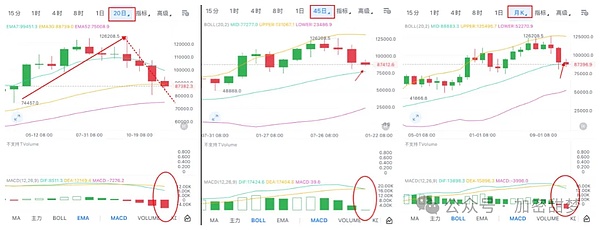
From a daily chart perspective, BTC has broken below the trend line, and the MACD has formed a death cross, indicating potential for further decline. The daily chart still shows a bearish pattern, so it is advisable to go short at resistance levels.

The monthly Bollinger Band mid-line at 88,800 was breached this week and has now turned into resistance. Therefore, we are now looking at the 45-day Bollinger Band mid-line, which corresponds to 77,250. This month, consider entering a small long position in the range of 78,800–77,250.

The 20-day chart shows a rounding top formation, with downward momentum strengthening. Its support points are the Bollinger lower band at 80,250 and the EMA52 (around 75,000). If the price breaks below 77,000, the key accumulation range for this decline will be 75,000–74,600.
ETH

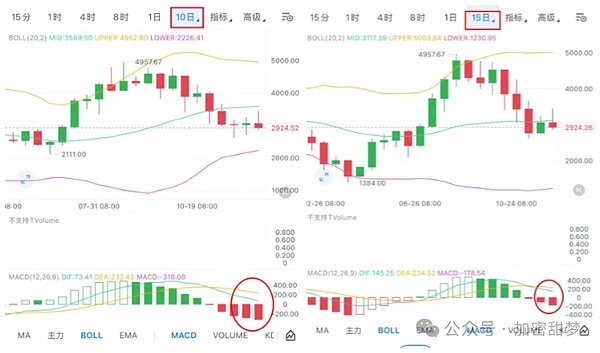
Currently in a 10–15 day correction phase within a monthly adjustment cycle. The 10-day correction is not yet over, and the MACD fast line is about to hit zero, which could accelerate the decline when it reaches the zero axis. The EMA7/30/52 have all been broken, with only the Bollinger lower band at 2,228 providing short-term support.

The 20-day chart has formed a death cross and is now on a 5-day losing streak, with the price slightly below the mid-band and far from the lower band. The primary support is the EMA52 (2,752). If this breaks, the low could test the June low of 2,112 (indicating a proportional correction and the end of the right-side adjustment). The monthly mid-band has been broken, but the lower band at 1,620 is too far to be effective. The effective support is the EMA52 (2,508).

The阶段性 bottom range for this phase: 2,222–2,112. The range of 2,752–2,680 offers some support and could serve as a short-term accumulation zone if there are no major negative catalysts causing an extreme drop.
SOL

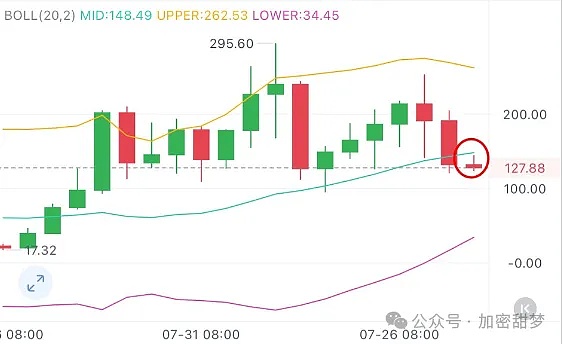
Currently trading between the 10, 15, 20-day and monthly Bollinger mid and lower bands. Their lower bands are all in the range of 114–102, which can serve as one reference for accumulation.

All the 10, 15, 20-day EMA7-30 have been broken, offering no support.

The monthly EMA52 is at 109.5. Therefore, the accumulation range before the 100 level is broken is 114–102.

Considering extreme scenarios where a sharp spike might briefly break below 100, the levels after a false break of 100 would be 96.25–95.65. A break below 95 would be considered a real break, and the price could then fall to around 86.25–84.85.
PTB

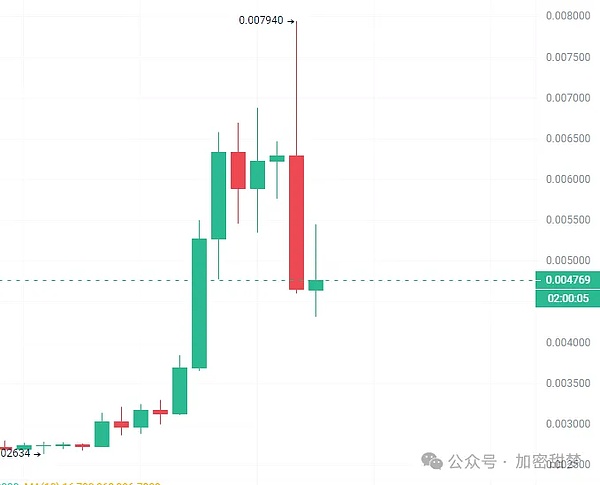
PTB is a token I wouldn't dare touch. It's like a single-player coin—going long or short is risky, and the risk-reward ratio is very low. You might get a quick profit if you're fast, but if you're slow, you'll get hit. In short, greed will eventually lead to losses. It can pump quickly and then drop over 40% in a single spike.
IR

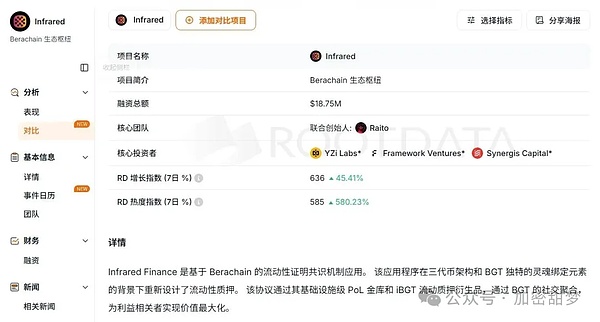
Total supply: 1 billion, initial circulating supply: 20.5%, pool price: 0.1

Pros: 1. Strong funding background—invested by Yzi Lab, co-founder of Bera. 2. Protocol revenue this year exceeded $8 million, TVL is still 210M. 3. Pool price is not expensive at 0.1, 100M. 4. Airdrop is on CEX, and participants say the airdrop is small.

Cons: 1. Protocol revenue has been declining due to the bear market—it peaked but didn't launch a token then, and is doing so now. Peak monthly revenue was $2.81 million in March, but this month it's only around $10,000 so far. 2. Tokenomics haven't been announced, and there's little community discussion.

The project's only chance is to accumulate筹码 during the sell-off, then counter-screw the community to achieve control, fully secure contract positions, and make a profit through contracts. Otherwise, there's basically no opportunity. Not planning to buy at open, will wait for the sell-off to stabilize. With the赚钱效应 of previous projects, market attention is returning to ALPHA, and recent projects have started harvesting. Better to be cautious.
If you find our content helpful, please share our public account with your friends! Welcome to follow and stay tuned for the latest updates in the crypto space! Every sharp decline is followed by vast opportunities. If you're feeling lost about planning for the next market phase, follow Tianmeng. Contact WeChat: RFGH8689


Crypto di tendenza

Domande pertinenti

QWhat is the current technical outlook for Bitcoin (BTC) according to the daily chart analysis?

AThe daily chart shows BTC has broken below the trend line with a MACD death cross, indicating a bearish outlook and potential for further decline. The analysis suggests selling at resistance levels.

QWhat are the identified support levels for Ethereum (ETH) in its current correction phase?

AKey support levels for ETH include the 20-day Bollinger lower band at 2228, the EMA52 on the 20-day chart at 2752, and the June low of 2112. The EMA52 on the monthly chart at 2508 is also noted as effective support.

QWhat is the suggested buying range for Solana (SOL) before the $100 level is broken?

AThe suggested buying range for SOL before the $100 level is broken is between 114 and 102, which corresponds to the lower Bollinger bands on the 10, 15, and 20-day charts.

QWhy does the analysis advise caution with the PTB token?

AThe analysis advises extreme caution with PTB because it behaves like a single-coin token, where both long and short positions are risky. It is prone to sharp, sudden drops of over 40%, making it a low性价比 (cost-performance) asset.

QWhat are the main bullish and bearish factors mentioned for the IR token launch?

ABullish factors: Strong funding background from Yzi Lab and Bera's co-founder, $8M+ protocol revenue this year, $210M TVL, and a low pool price of $0.1. Bearish factors: Declining protocol revenue (from $2.81M peak in March to just over $10K currently), no published tokenomics, and low community discussion.

Letture associate

Misjudged A-Shares: Resilience, Expectations, and Confidence

China's A-share market recently faced selling pressure, especially in tech sectors, initially triggered by a global tech sell-off that began in South Korea. However, the article argues this is a case of "mistaken injury" and highlights the market's underlying resilience. This resilience stems from three main pillars: **1) Tech Sector Fundamentals:** Unlike Korea's market dominated by a few memory chip stocks, China's tech sector is diversified across computing, communications, electronics, and semiconductors, supported by dual narratives of global AI supply chains and domestic substitution. Core areas like optical modules and fiber optics continue to show strong earnings growth. **2) "National Team" Support:** State-backed institutions and large corporations have made significant market purchases and announced buybacks, providing liquidity and signaling confidence. This is seen as a stabilizing policy signal, often associated with market bottoms. **3) Broader Market Pillars:** Other major sectors are showing endogenous recovery momentum. Consumer stocks benefit from stabilizing CPI and signs of sector recovery (e.g., liquor price hikes). Cyclical sectors like aluminum have high earnings, potential price increases due to tight supply, and low valuations. The financial sector offers stable dividends and low valuations. The conclusion is that the sell-off was driven by external contagion, not a collapse in fundamentals. With strong policy support and recovering momentum across key sectors, the A-share market possesses the toughness to regain stability.

marsbit10 min fa

Misjudged A-Shares: Resilience, Expectations, and Confidence

marsbit10 min fa

The Clarity Act's Journey Through Congress: The Thorny Path of Bipartisan Compromise in the U.S.

The U.S. Congress is struggling to advance the crypto market structure bill known as the Clarity Act, with bipartisan compromise proving difficult. Key hurdles include unresolved disputes over "yield" products and, more critically, the inclusion of strong ethics provisions for elected officials—a non-negotiable demand for many Democrats. While a compromise on yield was reached in May, securing only limited Democratic support in committee, the separate Senate Agriculture Committee version later passed with no Democratic votes due to the ethics impasse. As Republicans push for a full Senate vote in July, demands for ethics rules have expanded, and other contentious issues like developer protections and concerns from law enforcement and large banks further complicate negotiations. Despite consensus on the need for legislation, the path forward is unclear. Recent discussions between senators and White House officials aim to find acceptable ethics language. Some lawmakers question whether a compromise text can garner enough bipartisan support, with one Democrat stating the current proposal lacks the strong ethics provisions required for their vote. Potential short-term goals for the crypto community include symbolic Senate action before the August recess, a longer-term aim for passage by 2026, or establishing a detailed framework that addresses ethics and other compromises. The process remains arduous, relying on the traditional, vote-by-vote effort to build bipartisan support.

marsbit29 min fa

The Clarity Act's Journey Through Congress: The Thorny Path of Bipartisan Compromise in the U.S.

marsbit29 min fa

Are Kalshi and Polymarket Founders at Odds? This Business Rivalry Is More Brutal Than You Think

"The Rivalry Between Kalshi and Polymarket Founders Turns Bitter and Litigious" The intense feud between Tarek Mansour, CEO of Kalshi, and Shayne Coplan, founder of Polymarket, has escalated far beyond typical business competition into personal animosity and regulatory battles. Both lead billion-dollar prediction market platforms, but their approaches differ sharply. Kalshi positions itself as the compliant operator, securing U.S. regulatory approval before launching. In contrast, Polymarket initially operated offshore, allowing U.S. users to access its platform via VPN, which drew regulatory scrutiny. The conflict reached a peak in November 2024 when FBI agents raided Coplan's New York apartment. While Coplan publicly blamed political motives, his team privately suspected Kalshi was involved. According to sources, Kalshi's lawyers had previously reported Polymarket's operations to federal prosecutors, highlighting its accessibility to U.S. users despite a ban. This incident fueled mutual accusations and underhanded tactics, including social media smear campaigns and attempts to sabotage each other's major business deals. Their rivalry also played out in Washington, influencing regulatory debates. Kalshi actively lobbied against Polymarket's practices, framing them as illegal and unethical. Polymarket, after facing a CFTC fine and investigation, later acquired a licensed U.S. firm to launch a domestic app, regaining a foothold. Despite the hostility, both companies have seen massive growth, with combined trading volumes soaring. However, increased regulatory scrutiny, particularly around insider trading on Polymarket's platform, continues to pose challenges. The founders' deep-seated mutual disdain ensures their battle for market dominance remains as much a personal vendetta as a commercial one.

marsbit38 min fa

Are Kalshi and Polymarket Founders at Odds? This Business Rivalry Is More Brutal Than You Think

marsbit38 min fa

Trading

Spot

Articoli Popolari

Come comprare IR

Benvenuto in HTX.com! Abbiamo reso l'acquisto di Infrared Finance (IR) semplice e conveniente. Segui la nostra guida passo passo per intraprendere il tuo viaggio nel mondo delle criptovalute.Step 1: Crea il tuo Account HTXUsa la tua email o numero di telefono per registrarti il tuo account gratuito su HTX. Vivi un'esperienza facile e sblocca tutte le funzionalità,Crea il mio accountStep 2: Vai in Acquista crypto e seleziona il tuo metodo di pagamentoCarta di credito/debito: utilizza la tua Visa o Mastercard per acquistare immediatamente Infrared FinanceIR.Bilancio: Usa i fondi dal bilancio del tuo account HTX per fare trading senza problemi.Terze parti: abbiamo aggiunto metodi di pagamento molto utilizzati come Google Pay e Apple Pay per maggiore comodità.P2P: Fai trading direttamente con altri utenti HTX.Over-the-Counter (OTC): Offriamo servizi su misura e tassi di cambio competitivi per i trader.Step 3: Conserva Infrared Finance (IR)Dopo aver acquistato Infrared Finance (IR), conserva nel tuo account HTX. In alternativa, puoi inviare tramite trasferimento blockchain o scambiare per altre criptovalute.Step 4: Scambia Infrared Finance (IR)Scambia facilmente Infrared Finance (IR) nel mercato spot di HTX. Accedi al tuo account, seleziona la tua coppia di trading, esegui le tue operazioni e monitora in tempo reale. Offriamo un'esperienza user-friendly sia per chi ha appena iniziato che per i trader più esperti.

467 Totale visualizzazioniPubblicato il 2025.12.17Aggiornato il 2026.06.02

Come comprare IR

Discussioni

Benvenuto nella Community HTX. Qui puoi rimanere informato sugli ultimi sviluppi della piattaforma e accedere ad approfondimenti esperti sul mercato. Le opinioni degli utenti sul prezzo di IR IR sono presentate come di seguito.

活动图片












