DAT: The Evolution of Digital Asset Treasuries as Strategic Assets for Crypto Enterprises

marsbitPubblicato 2025-12-22Pubblicato ultima volta 2025-12-22

Introduzione

By the end of 2025, the Digital Asset Treasury (DAT) remains a significant corporate trend in the crypto industry, evolving from passive market participation to a strategic resource integrated into long-term enterprise planning. Companies are increasingly incorporating digital assets like Bitcoin and Ethereum into their balance sheets, shifting focus from mere accumulation to rational asset allocation, risk management, and strategic engagement with blockchain ecosystems. DAT strategies now emphasize diversification, cash flow stability, and participation in on-chain governance, staking, and lending, transforming digital assets into tools for operational resilience and ecosystem influence. Market structure is maturing, with indices like MSCI raising standards for transparency and governance, moving from asset-driven to capability-driven evaluations. Enterprises demonstrating robust risk controls, diversified portfolios, and synergistic business-ecosystem integration show greater resilience. The industry is experiencing differentiation: firms with clear strategic frameworks and sustainable practices are gaining competitive edges, while those reliant on single assets or market sentiment face constraints. Ultimately, DAT's value lies not in the volume of assets held but in the ability to embed them within a coherent strategy, sound governance, and active ecological participation, marking a shift from financial instruments to key strategic resources in corporate growth.

By the end of 2025, Digital Asset Treasuries (DAT) remain one of the most noteworthy corporate behaviors in the crypto industry. An increasing number of enterprises are choosing to incorporate digital assets into their balance sheets. This move is no longer merely a passive participation in market trends but an attempt to transform digital assets into long-term strategic resources. As market conditions and regulatory expectations gradually evolve, the DAT industry is undergoing structural optimization and capability screening. Its core value has shifted from单纯的 asset holding to a test of corporate strategic execution.

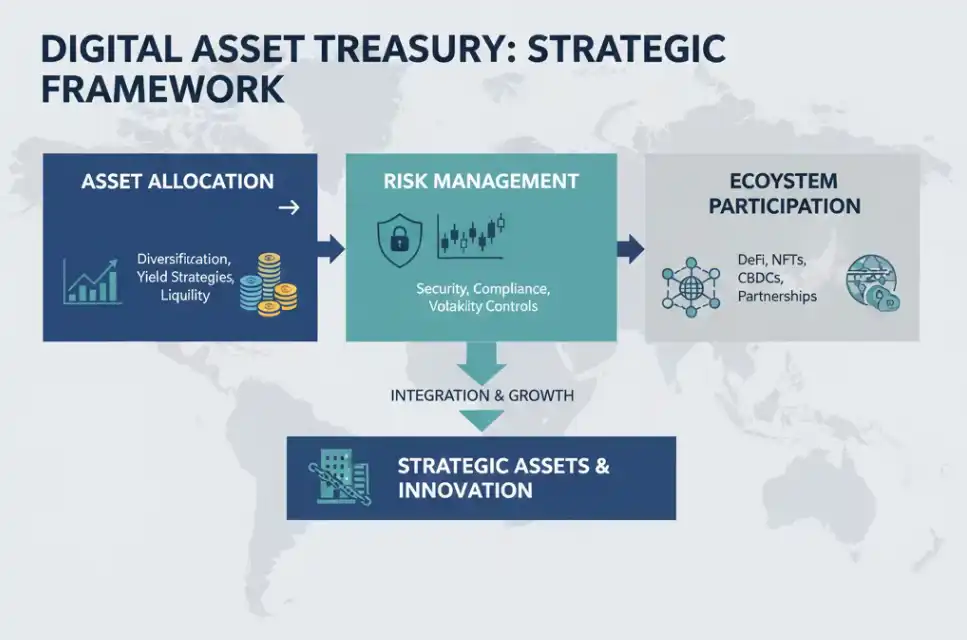
Typical DAT enterprises typically raise funds through stock financing, bond issuance, or private placements and allocate them to mainstream digital assets like Bitcoin and Ethereum. Compared to the early strategy of primarily "hoarding coins," companies now place greater emphasis on the rationality of asset allocation, risk control systems, and strategic linkages with the blockchain ecosystem. On one hand, digital assets provide enterprises with asset diversification and long-term value potential; on the other hand, companies must simultaneously establish cash flow management and risk constraint mechanisms to ensure operational sustainability. Furthermore, holding digital assets means enterprises can participate in on-chain governance, staking, and lending, thereby gaining deeper participation rights and influence at the ecosystem level. This change indicates that DAT has gradually become part of the corporate strategic management system, rather than just a book asset.
Market Structure and Corporate Performance

From recent industry performance, DAT enterprises are entering a clear phase of structural adjustment. Some companies are stabilizing market expectations and improving shareholder structure through share buybacks and asset portfolio optimization; others are gradually returning to more稳健 operational paths through strategic contraction or asset adjustments. At the same time, index agencies like MSCI are beginning to重新审视 the inclusion criteria for DAT-related companies, with significantly increased attention to corporate information disclosure, governance structure, and operational stability. This means the market is weakening its reliance on asset size and short-term price performance,转而 assessing enterprises' operational capabilities and risk management levels in complex environments.

It is worth noting that some companies with Ethereum-related assets as core allocations have shown relative resilience in recent market adjustments. This is not a reflection of a single asset's advantage but rather更多地反映了 the important role of asset diversification, business synergy, and governance capabilities in long-term corporate performance. Overall, changes in market structure are driving the DAT industry from "asset-driven" to "capability-driven."

Corporate Behavior and Strategic Choices

Starting from specific corporate behaviors, the strategic logic behind DAT can be understood more clearly.

At the asset level, enterprises no longer view digital assets as isolated investment targets but incorporate them into a long-term capital allocation framework to support future business expansion and ecosystem布局.

At the risk and stability level, companies balance market expectations and internal robustness through asset diversification, share buybacks, and operational structure improvements. The significance of such operations lies not in short-term market feedback but in securing greater strategic maneuvering space for the enterprise.

At the ecosystem level, holding digital assets enables enterprises to participate in on-chain governance and ecosystem building, transforming financial behavior into actual influence and voice. This shift from "asset management" to "ecosystem participation" is becoming an important path for DAT enterprises to build long-term competitiveness.

Overall, DAT has evolved from simple coin-holding behavior to a comprehensive practice integrating asset strategy, risk control, and ecosystem participation.

Industry Trends and Corporate Divergence

Observing from a longer cycle, the evaluation criteria of the DAT industry are undergoing substantive changes. Market focus is gradually shifting from asset size and short-term price fluctuations to corporate operational capabilities, cash flow stability, and governance transparency. This change directly promotes divergence among enterprises: those with clear asset strategies, diversified allocations, and robust governance structures are more likely to establish advantages in long-term competition; while those highly reliant on single assets or market sentiment see their strategic flexibility and sustainability significantly limited.

More importantly, some enterprises have already begun to transform digital assets into sustainable strategic resources through the combination of business synergy, ecosystem participation, and asset management. This path does not rely on a single market phase but is built on long-term capability building, constituting the core direction for the future development of the DAT industry.

Conclusion

The true value of DAT enterprises is not reflected in how many digital assets they hold, but in whether the enterprise can incorporate these assets into a clear strategic framework, establish a robust operational system and governance structure, and form sustained participation capabilities at the ecosystem level. By observing corporate behavior and industry structural changes, it can be seen that the DAT industry is moving towards a competitive stage centered on strategic capability and long-term execution.

Understanding DAT essentially means understanding how digital assets are transforming from a financial tool into a key resource within the corporate strategic system. This transformation not only reshapes how enterprises manage assets but also provides new judgment coordinates for investors and industry participants. In the future, enterprises that can form良性 synergy between asset strategy, risk management, and ecosystem participation are more likely to establish long-term, stable competitive advantages within the DAT system.


Letture associate

You Bet on the News, the Pros Read the Rules: The True Cognitive Gap in Losing Money on Polymarket

The article explains that the key to profiting on Polymarket, a prediction market platform, lies not just predicting real-world events correctly, but in meticulously understanding the specific rules that govern how each market will be resolved. It illustrates this with examples, such as a market on Venezuela's 2026 leader, where the official rules defining "officially holds" the office overruled the intuitive answer of who was in practical control. Other examples include debates over the definition of a "token" or what constitutes an "agreement." The core argument is that a "reality vs. rules" gap creates pricing discrepancies that savvy traders ("车头" or "whales") exploit. The platform has a formal dispute resolution process managed by UMA token holders to settle ambiguous outcomes. This process involves proposal submission, a challenge window, a discussion period, and a final vote. However, the article highlights a critical flaw in this system compared to a traditional court: the lack of separation between the arbiters (UMA voters) and the interested parties (traders with financial stakes in the outcome). This conflict of interest undermines the discussion phase, leads to herd mentality, and results in opaque final decisions without explanatory rulings. Consequently, the system lacks a body of precedent, making it difficult for users to learn from past disputes. The ultimate takeaway is that success on Polymarket requires a lawyer-like scrutiny of the rules to identify and capitalize on the cognitive gap between how events appear and how they are contractually defined for settlement.

marsbit13 min fa

You Bet on the News, the Pros Read the Rules: The True Cognitive Gap in Losing Money on Polymarket

marsbit13 min fa

Will the Fed Still Cut Interest Rates? Tonight's Data Is Crucial

The core debate surrounding the Federal Reserve's potential interest rate cuts is intensifying amid geopolitical conflict and rebounding inflation. The key question is whether high energy prices will cause persistent inflation or weaken consumer demand enough to force the Fed to cut rates. Citigroup presents a bullish case for cuts, arguing that oil supply disruptions from the Strait of Hormuz are temporary and will not lead to lasting inflationary pressure. They point to receding bond yields and oil prices as evidence the market is pricing in a short-lived shock. Citi's data also shows tightening financial conditions, a stabilizing labor market, and healthy tax returns, supporting their view that the path to lower rates remains open. Conversely, Deutsche Bank offers a starkly contrasting, more hawkish outlook. They argue the Fed's current policy is already neutral and expect rates to remain unchanged indefinitely. Their view is based on stalled disinflation progress and a shift toward more hawkish rhetoric from key Fed officials like Waller, who cited risks from prolonged Middle East conflict and tariffs. Other officials, including Williams and Hammack, signaled rates would likely stay on hold for a "considerable time." The market pricing has shifted dramatically, now forecasting zero cuts in 2026. The imminent release of the March retail sales "control group" data is highlighted as a critical test. This metric, which excludes gas station sales, will reveal if high gasoline prices are eroding consumer spending in other areas. A weak reading could support the case for imminent rate cuts, while a strong one would bolster the argument for the Fed to hold steady. This data is pivotal for determining the near-term policy path.

marsbit33 min fa

Will the Fed Still Cut Interest Rates? Tonight's Data Is Crucial

marsbit33 min fa

The Second Half of Macro Influencer Fu Peng's Career

Fu Peng, a prominent Chinese macroeconomist and former chief economist of Northeast Securities, has joined Hong Kong-based digital asset management firm Bitfire Group (formerly New Huo Group) as its chief economist. This move, announced in April 2026, triggered an 11% surge in Bitfire's stock price. Fu, known for his accessible macroeconomic commentary and large social media following, will focus on integrating digital assets into global asset allocation frameworks, particularly combining FICC (fixed income, currencies, and commodities) with cryptocurrencies for institutional clients. His career includes roles at Lehman Brothers and Solomon International, with significant influence gained through public communication. However, in late 2024, Fu faced temporary social media bans after a controversial private speech at HSBC on China's economic challenges, though he denied regulatory sanctions. He later left Northeast Securities citing health reasons. Bitfire, a licensed virtual asset manager serving high-net-worth clients, seeks to build trust and attract traditional capital through Fu’s expertise and credibility. The partnership represents a strategic shift for both: Fu enters the crypto sector after a traditional finance peak, while Bitfire aims to leverage his macro framework for institutional adoption. Outcomes remain uncertain regarding capital inflows and compatibility within corporate structure.

marsbit1 h fa

The Second Half of Macro Influencer Fu Peng's Career

marsbit1 h fa

Trading

Spot
Futures
活动图片