Curve Governance Upheaval: 17 Million CRV Funding Proposal Rejected, Capital Entities Become New Decision-Making Core

marsbitPubblicato 2025-12-26Pubblicato ultima volta 2025-12-26

Introduzione

A significant governance proposal within the Curve DAO, requesting 17 million CRV in funding for development team Swiss Stake AG, was recently rejected. Major veCRV holders, including Convex and Yearn, voted against the proposal, effectively blocking its passage. The rejection reflects two key concerns within the community: a demand for greater transparency and accountability regarding the use of previous grants and future spending plans, and a reluctance from large token holders to dilute the value of their veCRV holdings without a clear, direct return on investment. The article highlights a shift in DeFi governance, moving away from a model of automatic funding approval. It contrasts the veToken model, used by Curve, with standard governance systems. The ve model binds voting power to long-term token lock-ups, attracting capital-heavy players focused on long-term gains. This, combined with the prevalence of vote-aggregating protocols like Convex, is centralizing decision-making power with large capital providers rather than the broader community or even project founders. The outcome of this vote suggests that future governance power in Curve may lie primarily with these major stakeholders.

Original Author: CM(X:@cmdefi)

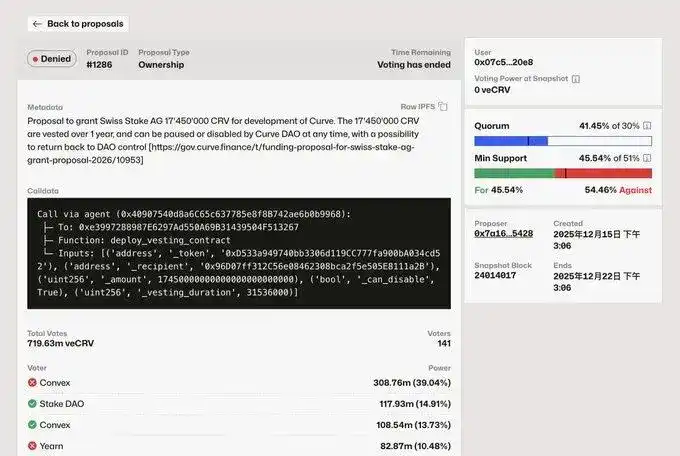
A few days ago, a funding proposal on Curve was rejected. It involved allocating 17M $CRV in development funds to the development team (Swiss Stake AG). Both Convex and Yearn voted against it, and their voting power was sufficient to influence the final outcome.

Since the governance issues at Aave began to gain attention, governance has started to be scrutinized by the market, and the habitual practice of approving funding requests is being broken. Behind this Curve proposal lie two key points:

1. Some voices in the community are not opposed to funding AG, but they want clarity on how previous funds were used, future plans for usage, sustainability, and whether the projects have generated returns for the protocol. Simultaneously, this primitive grant model means that once funds are disbursed, there are no constraints. In the future, the DAO needs to establish a Treasury, ensure transparent revenue and expenditure, or add governance constraints.

2. The large veCRV holders do not want to dilute their value. This is a clear conflict of interest. If the projects supported by CRV grants cannot foreseeably create benefits for veCRV holders, they likely won't receive support. Of course, Convex and Yearn also have their own private interests and agendas, but we won't delve into those issues here.

This proposal was initiated by Curve founder Mich. AG is also one of the teams that has been maintaining the core codebase since 2020. For this funding round, AG's presented roadmap included continuing to advance llamalend, including support for PT and LP, as well as expansion into on-chain foreign exchange markets and crvUSD. These seem like worthwhile endeavors, but whether they justify a 17M $CRV grant is another calculation. Particularly because Curve's governance differs significantly from Aave's; its power is distributed among several teams with distinct stances.

Let's compare the ve model with conventional governance models:

First, the conclusion: most conventional governance models currently have essentially no design advantages. Of course, if a DAO is mature enough, traditional structures can also function well, but unfortunately, no project in Crypto has yet matured to that level, as evidenced by the problems even at market-consensus leaders like Aave.

So, if we talk specifically about model design, the ve model has some advanced aspects. Firstly, it has cash flow; it is backed by liquidity control rights. When there is external demand for liquidity, this power is "bribed." Therefore, even if you don't want to lock your tokens long-term, you can delegate them to proxy projects like Convex/Yearn to earn收益 (yield).

Thus, the ve model binds voting rights with cash flow. Its future evolution will likely follow the path of "governance capitalism." The vetoken binds voting rights with "long-term locking," essentially筛选 (screening for) those with large capital, the ability to bear liquidity loss, and the capacity for long-term博弈 (game theory). Over time, the result is that governors gradually shift from ordinary users to the "capital class."

Furthermore, due to the existence of proxy layers like Convex/Yearn, many ordinary users, even loyal ones, who wish to gain yield without losing liquidity and flexibility, will increasingly choose to delegate their governance power to these projects.

This vote also reveals some clues. In the future, Mich may not be the main character in Curve's governance; instead, power lies with these large vote holders. When governance issues arose at Aave, some proposed ideas of "delegated governance/elite governance," which is quite similar to the current structure of Curve. As for whether this is good or bad, it will take time to tell.
Domande pertinenti

QWhat was the main reason for the rejection of the 17M CRV grant proposal for Swiss Stake AG?

AThe proposal was rejected primarily because major veCRV holders, such as Convex and Yearn, voted against it. They were concerned about the dilution of their token value and the lack of a clear, sustainable plan for how the funds would be used to generate tangible benefits for veCRV holders.

QHow does the ve (vote-escrowed) tokenomics model differ from conventional governance models according to the article?

AThe ve model binds voting rights to long-term token lock-ups, which inherently attracts large capital providers who can afford illiquidity and engage in long-term planning. This contrasts with conventional governance models, which the article argues have few inherent design advantages and often struggle without a highly mature DAO structure. The ve model also provides direct cash flow to holders through 'bribes' from protocols seeking liquidity.

QWhat role do proxy platforms like Convex and Yearn play in the Curve ecosystem?

AProxy platforms like Convex and Yearn allow ordinary CRV holders to delegate their voting power and locked tokens to them. In return, the users receive a share of the platform's revenue (e.g., from bribes) while maintaining liquidity and flexibility, as they are not locking tokens directly with Curve. This consolidation of voting power makes these platforms major decision-makers in governance.

QWhat does the article suggest about the future of Curve's governance power dynamics?

AThe article suggests that future governance power in Curve will increasingly reside with large capital holders and proxy platforms like Convex and Yearn, rather than with the founder, Michael Egorov, or the broader community. This shift represents a move towards 'governance capitalism,' where decision-making is concentrated among those with significant financial stakes.

QWhat were the key community concerns regarding the grant proposal, beyond simple opposition to funding?

ABeyond simply rejecting the grant, a part of the community wanted greater transparency and accountability. Their concerns included how previous funds had been used, the sustainability of the development plan, whether the projects would generate measurable returns for the protocol, and a desire for a more structured Treasury with transparent revenue and expenditure reporting, rather than an open-ended grant model.

Letture associate

Day 6 of the rsETH Incident: DeFi United Secures Approximately $100 Million in Intentional Commitments, but a $50 Million Gap Remains

On April 18, Kelp DAO’s rsETH LayerZero bridge was exploited, resulting in the unauthorized minting of 116.5k rsETH (approx. $292M). The attacker borrowed around $190M on Aave V3. The Arbitrum Security Council froze 30,766 ETH linked to the incident. DeFi United, a cross-protocol rescue initiative led by Awe, was formed to cover a total shortfall of 112.2k rsETH ($258M). As of April 24, several protocols have pledged around $100M in support, though most commitments are still under DAO voting or discussion. Key pledges include: - Golem: 1,000 ETH ($2.3M) - Aave founder Stani Kulechov: 5,000 ETH ($11.5M) - EtherFi: up to 5,000 ETH ($11.5M) - Lido: up to 2,500 stETH ($5.75M), contingent on full coverage - Mantle: proposed a $69M loan to Aave DAO under specific terms The remaining shortfall is estimated at $50M. Aave’s treasury and safety module (~$236M combined) can cover the worst-case bad debt scenario ($230M). Three potential loss distribution paths were outlined by DefiLlama’s 0xngmi: 1. Uniform 18.5% haircut for all rsETH holders: Aave bad debt ~$216M 2. Only protect Mainnet, abandon L2: bad debt up to $341M 3. Repay only pre-attack holders: technically difficult, ~$91M net loss KelpDAO has not yet announced a specific plan. The success of DeFi United depends heavily on KelpDAO’s final decision on loss allocation.

marsbit27 min fa

Day 6 of the rsETH Incident: DeFi United Secures Approximately $100 Million in Intentional Commitments, but a $50 Million Gap Remains

marsbit27 min fa

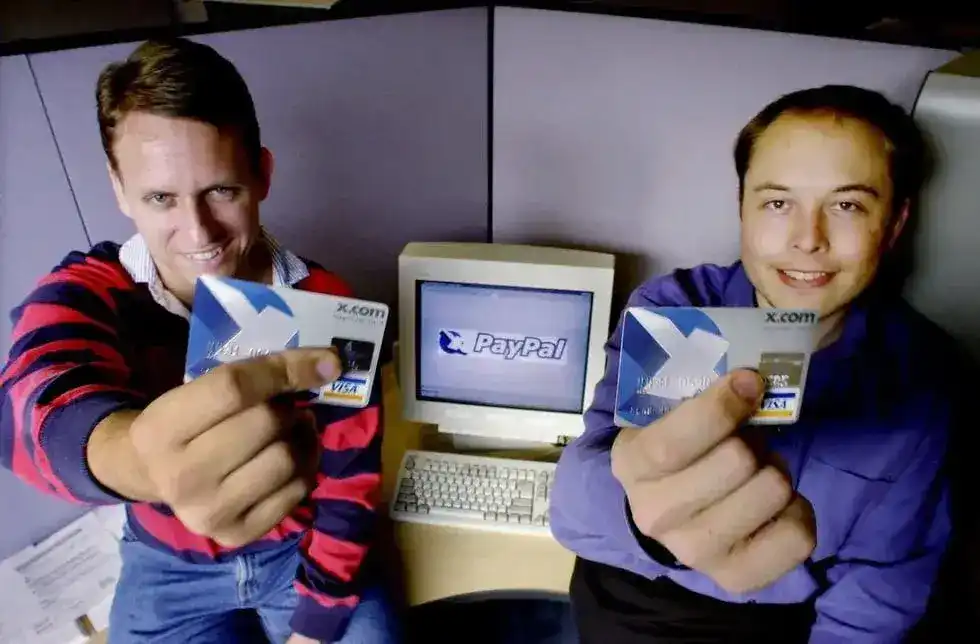
Kicked Out of PayPal, Musk Aims for a Comeback in the Crypto Market

Elon Musk's X (formerly Twitter) has launched its "Smart Cashtags" feature, generating approximately $1 billion in trading volume within days of its April 2026 pilot launch. The feature allows users to click on stock or crypto tickers (or even full Solana token contract addresses) in posts to view real-time price charts and discussions without leaving the app. Initially available to iPhone users in the US and Canada, with a partnership in Canada enabling direct trading via the Wealthsimple app. This move is part of Musk's broader "Everything App" vision, spearheaded by the upcoming X Money platform. Analysts, such as Mizuho's Dan Dolev, see this as a potential disruptor to the US payments market, even prompting a downgrade of PayPal's stock. X Money's beta offers services like 6% APY on deposits, cashback, and P2P transfers, with speculation it may later incorporate crypto trading and stablecoin settlements for faster transactions. However, the ambitious plan faces significant regulatory scrutiny. Senator Elizabeth Warren has questioned the sustainability of the high 6% yield and raised concerns over X's banking partner, Cross River Bank, which has a history of regulatory violations. Additional risks involve the "GENIUS Act," which may create loopholes for stablecoin issuance without full FDIC insurance coverage, potentially leaving users unprotected. The integration of social trading on a platform with over 500 million users could inject new liquidity and retail interest into the crypto market. Yet, it also amplifies risks like herd mentality and the blurring of lines between entertainment and financial speculation. Musk's return to finance, after his ouster from PayPal, hinges on balancing innovation with regulatory compliance.

marsbit2 h fa

Kicked Out of PayPal, Musk Aims for a Comeback in the Crypto Market

marsbit2 h fa

Trading

Spot
Futures

Articoli Popolari

Come comprare CRV

Benvenuto in HTX.com! Abbiamo reso l'acquisto di Curve DAO Token (CRV) semplice e conveniente. Segui la nostra guida passo passo per intraprendere il tuo viaggio nel mondo delle criptovalute.Step 1: Crea il tuo Account HTXUsa la tua email o numero di telefono per registrarti il tuo account gratuito su HTX. Vivi un'esperienza facile e sblocca tutte le funzionalità,Crea il mio accountStep 2: Vai in Acquista crypto e seleziona il tuo metodo di pagamentoCarta di credito/debito: utilizza la tua Visa o Mastercard per acquistare immediatamente Curve DAO TokenCRV.Bilancio: Usa i fondi dal bilancio del tuo account HTX per fare trading senza problemi.Terze parti: abbiamo aggiunto metodi di pagamento molto utilizzati come Google Pay e Apple Pay per maggiore comodità.P2P: Fai trading direttamente con altri utenti HTX.Over-the-Counter (OTC): Offriamo servizi su misura e tassi di cambio competitivi per i trader.Step 3: Conserva Curve DAO Token (CRV)Dopo aver acquistato Curve DAO Token (CRV), conserva nel tuo account HTX. In alternativa, puoi inviare tramite trasferimento blockchain o scambiare per altre criptovalute.Step 4: Scambia Curve DAO Token (CRV)Scambia facilmente Curve DAO Token (CRV) nel mercato spot di HTX. Accedi al tuo account, seleziona la tua coppia di trading, esegui le tue operazioni e monitora in tempo reale. Offriamo un'esperienza user-friendly sia per chi ha appena iniziato che per i trader più esperti.

440 Totale visualizzazioniPubblicato il 2024.12.11Aggiornato il 2025.03.21

Come comprare CRV

Discussioni

Benvenuto nella Community HTX. Qui puoi rimanere informato sugli ultimi sviluppi della piattaforma e accedere ad approfondimenti esperti sul mercato. Le opinioni degli utenti sul prezzo di CRV CRV sono presentate come di seguito.

活动图片