Curve founder proposes 17M CRV grant to fund research, dev team

cointelegraphPubblicato 2025-12-15Pubblicato ultima volta 2025-12-15

Introduzione

Curve Finance founder Michael Egorov has proposed a 17.45 million CRV token grant (worth approximately $6.6 million) to Swiss Stake AG, the firm behind Curve, to support ecosystem growth, research, and development. The funds will be used for tech and security enhancements, sustaining the 25-member team, and advancing projects like the new lending system Llamalend, onchain foreign currency swaps, and UI improvements. The grant will also support open-source development, cross-chain functionalities, and governance infrastructure. While Swiss Stake AG has generated some revenue, it remains dependent on community funding. If approved, the firm must use the grant as specified and provide bi-annual spending reports.

Curve Finance founder Michael Egorov has proposed a 17.45 million CRV token grant to support ecosystem growth, research and tech development of the lending protocol.

The grant, worth approximately $6.6 million at current prices, would be awarded to Swiss Stake AG, the firm behind Curve, and follows a previous grant awarded in late 2024.

In a proposal posted on the Curve DAO governance forum on Sunday, Egorov said that the funds would be used to support a range of tech and security enhancements for the lending protocol, as well as to sustain its contributor team.

“This grant will fund software research and development, infrastructure, security, and ecosystem support, ensuring that the 25-member team at Swiss Stake AG can continue its ongoing contributions to Curve,” Egorov said.

The founder provided a long list of objectives that Swiss Stake AG is eyeing for Curve in 2026. The list includes launching and scaling a new version of its lending system, Llamalend, creating an onchain foreign currency swap and improving Curve’s user interface.

“This proposal seeks to continue funding the development and maintenance of Curve’s smart contract ecosystem and software repositories, support further integrations, crosschain functionalities, and user interface improvements, strengthen the governance and operational infrastructure of Curve DAO,” Egorov said.
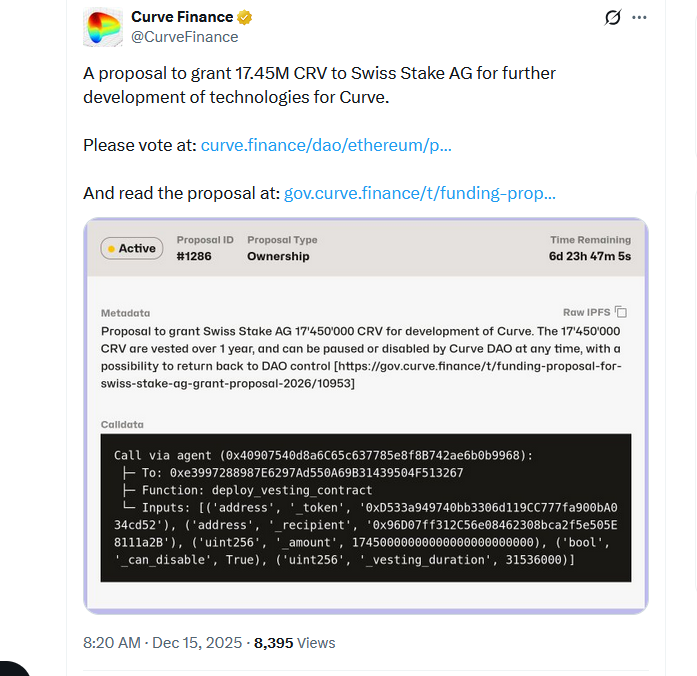
Source: Curve Finance

The firm will also release any IP created via the use of the grant as “under an open-source license compatible with the Curve software repositories.”

Related: DeFi is already 30% of the way to mass adoption: Chainlink founder

If approved, Swiss Stake AG will be permitted to stake some of the received CRV to generate additional yield for its ventures, but cannot use the funds for any purpose listed in the proposal. The firm says it will commit to “bi-annual reports on the spending of the GrantAmount.”

Swiss Stake AG pushes for self-sustainability

In the proposal, Ergorov outlined that while Swiss Stake AG has generated several revenue streams via CRV, it “remains largely dependent on community support to continue its work.”

As such, the funding will help keep the team afloat as it builds out the Curve ecosystem and pushes for self-sustainability.

“Swiss Stake AG has managed to establish some ancillary income streams, mainly through Curve Lite deployments on other networks. We have additionally earned system fees by staking veCRV via several wrapper protocols (Convex, StakeDAO, Yearn) as a minority participant,” he said.

“All such revenues have been used strictly in line with the purposes outlined in the grant. However, this revenue does not yet make the company sustainable at this stage,” the founder added.

Founded in early 2020, Curve Finance has a total value locked of around $2.2 billion, according to DefiLlama data, making it the 21st-largest DeFi protocol on the market.

Magazine: Have your stake and earn fees too: Tushar Aggarwal on double dipping in DeFi

Letture associate

Before You Jump on Any ICO Bandwagon, Read This First

Before participating in any ICO, it's crucial to understand that most projects fail, and only a few achieve success. The recent hype around ICOs, driven by projects like MegaETH and Plasma, often leads to impulsive investments without proper due diligence. Here are key points to consider: 1. **Product Fundamentals**: Evaluate if the product solves a real problem and has genuine innovation. Avoid projects based on future promises or testnet data without a working product. 2. **Team Experience**: The team's track record matters. Experienced teams can adapt to market changes, while weak teams may disappear when hype fades. 3. **Investors and Valuation**: Check if reputable VCs are involved and assess the valuation. Avoid projects where insiders have low valuations, leaving retail investors at risk. 4. **Authentic Data**: Look beyond surface metrics like TVL or user numbers. Ensure data is genuine and not inflated by incentives or fake activity. 5. **Marketing and Narrative**: Strong projects control their narrative and attract organic attention. Poor projects rely on buzzwords without substance. 6. **Tokenomics**: Understand token unlock schedules, vesting, and fully diluted valuation (FDV). Avoid structures that favor insiders and shift risk to retail. 7. **Market Conditions**: Market cycles significantly impact valuation and returns. The same project may perform differently in a bull vs. bear market. ICO investments are not free money. Avoid FOMO-driven decisions and prioritize projects with real value over hype.

深潮20 min fa

Before You Jump on Any ICO Bandwagon, Read This First

深潮20 min fa

Reviewing Past Bitcoin Bull Markets: Why the Four-Year Cycle Occurs and Is It Over?

The article examines Bitcoin's four-year market cycles, traditionally aligned with its halving events, and questions whether this pattern still holds. It outlines the typical cycle phases: accumulation (low volatility, long-term buying), pre-halving bullish anticipation, a parabolic bull run with retail FOMO and leverage, and a sharp correction leading to a bear market. Bitcoin halvings, which reduce mining rewards by half every four years, are highlighted as a core mechanism for creating scarcity, similar to precious metals. Past cycles (2013, 2017, 2021) are reviewed, each driven by distinct catalysts (e.g., Mt. Gox collapse, ICO boom, COVID-19 stimulus) and ending with crashes exceeding 80%. Reasons for the cycle include the stock-to-flow model (measuring scarcity), market psychology/self-fulfilling prophecies, and global liquidity conditions. The current 2025 cycle is noted for unprecedented institutional involvement via ETFs and corporate treasuries, causing Bitcoin to hit new highs before the 2024 halving with less retail participation. Arguments for the cycle's end cite increased adoption by disciplined institutions (reducing volatility), Bitcoin's growing correlation with macro factors like Fed policy, and the diminishing impact of each halving. Key indicators to watch for cycle validation include post-halving price surges, large leverage unwinds, and retail altcoin speculation. The conclusion states that while historical patterns are evident, Bitcoin's evolution into a mainstream asset makes future cycles potentially different. Only time will tell if the four-year cycle persists or becomes obsolete.

marsbit44 min fa

Reviewing Past Bitcoin Bull Markets: Why the Four-Year Cycle Occurs and Is It Over?

marsbit44 min fa

Trading

Spot
Futures
活动图片