Crypto Traders On Alert: Is CLARITY The Last Chance To Protect Stablecoin Yield?

bitcoinistPubblicato 2026-04-14Pubblicato ultima volta 2026-04-14

Introduzione

A U.S. Senator is preparing to release a compromise draft of the CLARITY Act to resolve the ongoing dispute over stablecoin yields. The key issue is whether crypto firms can pay interest on idle stablecoin holdings, which banks oppose as it competes with traditional deposits. The draft aims to distinguish between prohibited passive yield and permitted activity-based rewards. This legislation will significantly impact stablecoin yields, liquidity, and where traders hold their capital, potentially affecting competition with foreign digital currencies and offshore platforms.

A U.S. Senator might unveil a “compromise draft” aimed at settling the crypto-stablecoin yield dispute in the forthcoming CLARITY Act.

Another Update On The Crypto Legislation

Republican U.S. Senator Thom Tillis (R-N.C.) claimed this Monday he aims to unveil a draft deal this week to break the stalemate over stablecoin yield between banks and crypto firms. According to Politico, he has been collaborating with Sen. Angela Alsobrooks (D‐Md.) on new CLARITY Act language designed to finally settle whether crypto companies can pay interest on idle stablecoin holdings.

According to the report, the text has already been shared with both banking groups and crypto firms. Banks still oppose key elements, the report says, and Tillis has left room for changes.

The already long-standing yield dispute is the main roadblock keeping the landmark CLARITY Act stuck in the Senate, even after the House passed its version last year. Although the GENIUS Act that was passed last year prohibits stablecoin issuers from paying interest directly to holders, it still allows third‐party platforms like exchanges to offer yield.

At the beginning of the month, Coinbase’s chief legal officer Paul Grenwal suggested that negotiators in the Senate were “very close” to a deal on the CLARITY Act’s most contentious crypto issue: the stablecoin yield.

The Stablecoin Yield Dispute

Let’s remember the dispute lays on the fact that yield-bearing stablecoins compete directly with traditional bank deposits because they offer dollar-denominated assets that can move instantly on-chain while still paying attractive returns, thus making them a compelling alternative to savings and money-market accounts.

Banks fear this could drain deposits that fund their lending and investment activities, especially from younger and more digitally native customers who are comfortable holding value in tokenized form. As a result, they push for strict limits or outright bans on interest-like payments to stablecoin holders, arguing that such products should be regulated like banking and that unchecked yield could undermine financial stability and their core funding base.

From the crypto side, however, yield on parked stablecoin balances is seen as a fundamental feature: it’s one of the main ways exchanges and DeFi platforms attract and retain users by turning idle cash into a revenue-generating product. These returns help differentiate on-chain dollars from traditional bank accounts, support token incentive programs, and deepen liquidity across lending markets, perpetuals, and automated market makers.

For many platforms, cutting off or sharply limiting stablecoin yield would hit their core business model, weaken DeFi integrations, and make it harder to compete for global capital that can move to more permissive jurisdictions with a few clicks.

What This Means For The Market

Lately, the emerging policy line seems to be in the direction of no “passive” yield for idle balances, but possible rewards tied to payments, transfers, and other “active use”. Tillis’ compromise draft is meant to codify around it, clarifying what counts as prohibited interest versus allowed activity-based rewards.

The way the U.S. defines stablecoin yield will shape dollar competition with foreign central bank digital currencies (CBDCs) and offshore stablecoin venues that still offer yield. U.S. exchanges may have to pivot to activity-based “rewards” and offshore platforms could attract yield-chasing capital.

Any final text will heavily influence stablecoin APY, liquidity, and where serious traders park their dry powder.
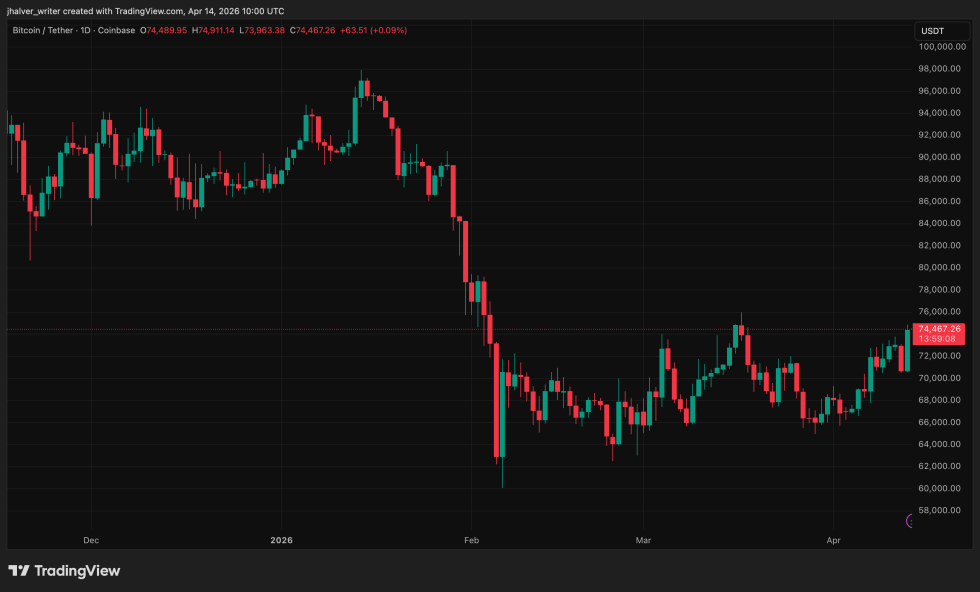
At the moment of writing, BTC trades for more than $74k on the daily chart. Source: BTCUSDT on Tradingview.

Cover image from Perplexity. BTCUSDT chart from Tradingview.

Domande pertinenti

QWhat is the main purpose of the upcoming 'compromise draft' in the CLARITY Act, according to Senator Thom Tillis?

AThe main purpose of the compromise draft is to break the stalemate over the stablecoin yield dispute between banks and crypto firms by clarifying whether crypto companies can pay interest on idle stablecoin holdings.

QWhy do traditional banks oppose yield-bearing stablecoins?

ABanks oppose them because they compete directly with traditional bank deposits by offering attractive returns on dollar-denominated assets that can move instantly on-chain. This could drain deposits that fund their lending and investment activities, especially from younger, digitally native customers.

QHow does the crypto industry view the ability to offer yield on stablecoins?

AThe crypto industry views yield on stablecoin balances as a fundamental feature. It is a primary way for exchanges and DeFi platforms to attract and retain users, turn idle cash into a revenue-generating product, differentiate from traditional banks, support token incentives, and deepen liquidity in various markets.

QWhat is the emerging policy direction for stablecoin yield as mentioned in the article?

AThe emerging policy direction seems to be against 'passive' yield for idle balances but allows for possible rewards that are tied to payments, transfers, and other forms of 'active use' of the stablecoins.

QWhat potential market impact could the CLARITY Act's final text have?

AThe final text will heavily influence stablecoin APY (Annual Percentage Yield), liquidity, and where serious traders park their capital. It could force U.S. exchanges to pivot to activity-based rewards and may lead yield-seeking capital to move to offshore platforms or impact competition with foreign CBDCs.

Letture associate

"Agents' Last Exam", Claude Fable 5 Actually Loses to GPT 5.5

Surprisingly, in the newly released "Agents' Last Exam" (ALE) benchmark from UC Berkeley, GPT-5.5 has outperformed the recently launched and highly-regarded Claude Fable 5. ALE tests AI agents on their ability to perform real-world tasks across 55 professional domains—such as 3D modeling in Siemens NX, creating game scenes in Unreal Engine, and visual effects work in Adobe After Effects—by granting them full GUI and command-line access. In the core task completion rate ranking, GPT-5.5 configurations secured the top two spots (24.0% and 23.0%), while Claude Fable 5 with Claude Code came in third (22.0%). Notably, the highest pass rate was only 24%, and the most difficult "Last-Exam" tier saw most top models, including GPT-5.5 and Fable 5, scoring zero. The benchmark also revealed significant cost and efficiency gaps: Fable 5 spent over four times more money than GPT-5.5's most expensive configuration for a slightly lower score, and was much slower. ALE differs from previous knowledge-based benchmarks by evaluating practical "ability to do" rather than static knowledge retrieval. Its tasks are derived from real expert projects, automatically scored, and designed to prevent cheating through a rotating pool of private challenges. The results suggest that high performance on traditional benchmarks does not necessarily translate to proficiency in complex, open-ended real-world work. The study also notes that agents often fail by prematurely declaring tasks complete without proper verification, and that no single model excels uniformly across all diverse domains.

marsbit5 min fa

"Agents' Last Exam", Claude Fable 5 Actually Loses to GPT 5.5

marsbit5 min fa

Retail Ecology Dwindles, ZKsync Bets on Bank Pilots for a Breakthrough

Amidst declining retail activity, ZKsync is pivoting to target institutional banking as its primary growth strategy. The article explores this shift, contrasting it with the competitive "survival of the fittest" narrative by highlighting a cooperative model inspired by naturalist Peter Kropotkin. ZKsync is developing infrastructure like its private, permissioned Prividium suite for banks (e.g., Deutsche Bank's use case via Memento), enabling private transactions with public verifiability via zero-knowledge proofs. This appeals to institutions needing privacy, compliance, and Ethereum-based settlement security, unlike fully private chains (e.g., JPMorgan's Kinaxis) or consortium models (e.g., R3 Corda). However, this strategic focus has coincided with a steep decline in its public DeFi ecosystem, evidenced by plunging TVL and the departure of major protocols like Aave due to low fees. The network's future now hinges on banking adoption, with upcoming pilots like the Cari Network involving regional banks holding over $600 billion in deposits. A significant challenge is balancing this institutional focus with ZKsync's decentralized governance. Banks must operate on a network where rules and fees (denominated in the volatile ZK token) can be changed via community vote, and where a Security Council holds emergency control—a stark contrast to the predictable, contract-bound environments of traditional finance. The coming 18 months will test whether ZKsync can successfully onboard traditional banks onto a dynamically governed public chain or if institutions will ultimately revert to proprietary solutions.

Foresight News47 min fa

Retail Ecology Dwindles, ZKsync Bets on Bank Pilots for a Breakthrough

Foresight News47 min fa

The Recursive AI Anthropic Warned About: Tian Yuandong's New Company Has Just Taken the "First Step"

Anthropic recently highlighted the rapid progress toward "recursive self-improvement," where AI systems autonomously design and train their successors. In response, Recursive Superintelligence, a new company co-founded by former Meta researcher Tian Yuan Dong, has publicly demonstrated its first step toward automating AI research. The company released a system designed to autonomously execute the full AI research cycle: generating ideas, implementing code, running experiments, and learning from results. It validated this approach by achieving state-of-the-art results on three diverse benchmarks: 1. **NanoChat Autoresearch:** Optimizing a small language model's validation loss under a fixed 5-minute GPU budget, improving upon the community's best result. 2. **NanoGPT Speedrun:** Reducing the time to train a GPT model to a specific loss on 8 H100 GPUs from 79.7 seconds to 77.5 seconds, beating a highly optimized, human-driven community effort. 3. **SOL-ExecBench:** Improving the overall score on NVIDIA's suite of 235 GPU kernel optimization tasks by 18%, closing the gap to the hardware limit. The system discovered novel optimizations in this highly specialized domain without direct human expertise. Recursive's system operates as a general framework, capable of parallel exploration and cross-task knowledge transfer while incorporating safeguards against reward hacking. The company, backed by $650M in funding and a star-studded team including Richard Socher and Alexey Dosovitskiy, aims to create AI that recursively enhances its own research capabilities. This development represents an early but concrete move toward a new paradigm where AI accelerates its own advancement. It occurs alongside Anthropic's warnings about the need for industry coordination and potential pauses when recursive self-improvement thresholds are reached, highlighting the dual trajectory of rapid technical progress and growing calls for careful stewardship.

marsbit54 min fa

The Recursive AI Anthropic Warned About: Tian Yuandong's New Company Has Just Taken the "First Step"

marsbit54 min fa

Trading

Spot
Futures
活动图片





