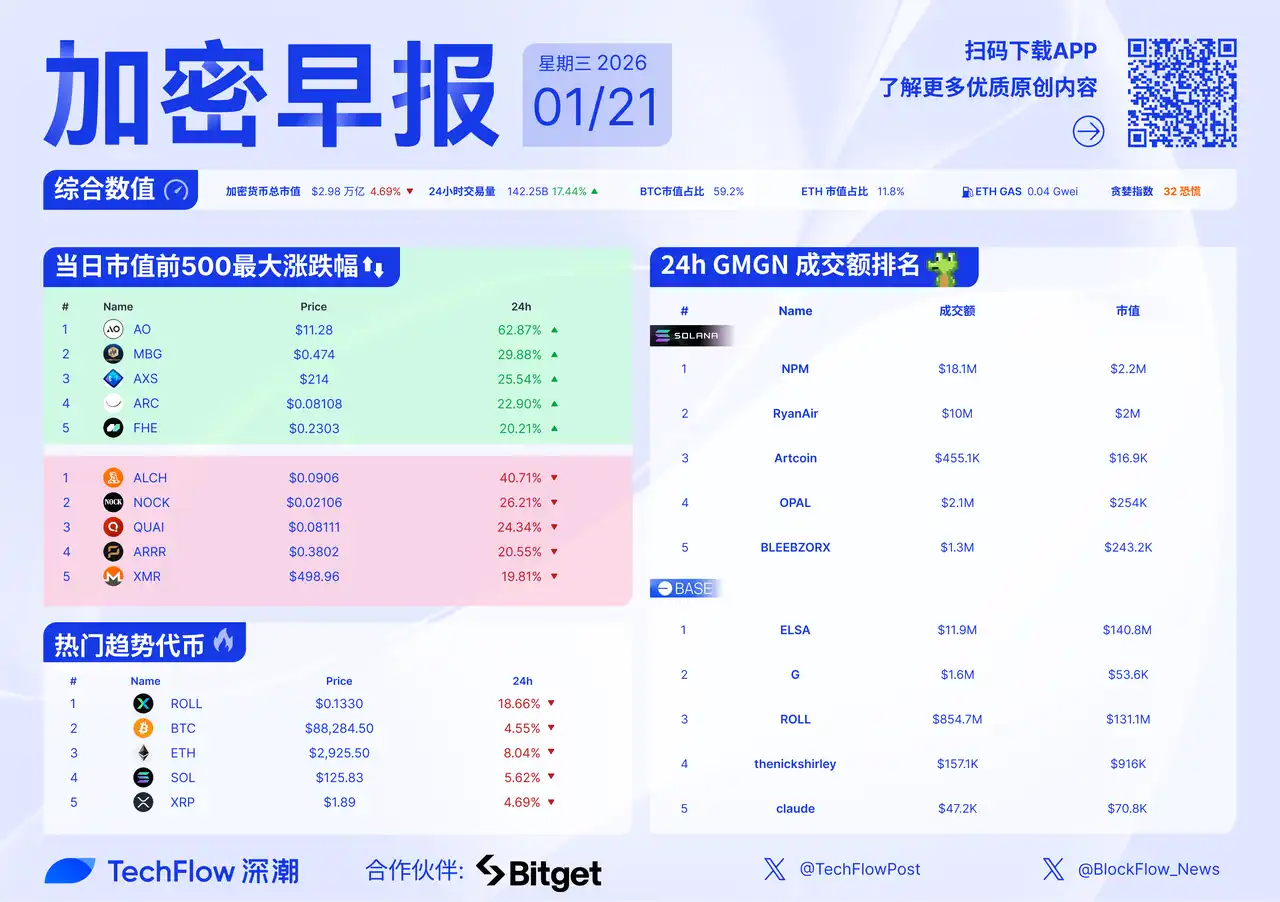
Crypto Morning Report: U.S. Stocks Plunge Across the Board, HyperLend Unveils HPL Tokenomics

marsbitPubblicato 2026-01-21Pubblicato ultima volta 2026-01-21

Introduzione

Crypto Morning Brief: U.S. stocks fell sharply across the board, with the Nasdaq and S&P 500 dropping over 2%. Chip stocks and major tech companies like Nvidia and Tesla declined 3-4%. Gold and silver hit new highs. In regulatory news, CFTC Chair announced the "Future Proof" initiative to modernize digital asset oversight. Trump Media set February 2, 2026, as the record date for its digital token distribution to shareholders. Hong Kong’s Securities and Futures Professionals Association urged a shift toward commercial application of virtual assets, following the establishment of regulatory infrastructure. HyperLend revealed its HPL tokenomics: 30.14% for ecosystem growth, 25% for genesis allocation, 22.5% to core contributors, 17.36% to strategic investors, and 5% for liquidity. Pendle introduced sPENDLE, a liquid staking token that reduces withdrawal time from years to 14 days. Ethereum’s recent network activity surge may be linked to address poisoning attacks, exploiting lower gas fees post-Dencun upgrade. Chainlink launched 24/5 U.S. stock data feeds for blockchain applications. Trend Research purchased 6,656 ETH, now holding $1.91 billion worth. Bitmine approved increasing its share issuance limit for future financing flexibility. Pump.fun established an investment division and a $3 million public hackathon. Recommended reads include discussions on AI’s impact, X’s algorithm changes, NYSE’s move to 24/7 tokenized trading, Wintermute’s market outlook...

Author: Deep Tide TechFlow

Yesterday's Market Dynamics

U.S. stock indices plummet across the board, chip stocks and gold/silver hit new highs

U.S. stock indices fell sharply, with the Nasdaq Composite dropping over 2%, the S&P 500 down about 2%+, and the Dow Jones Industrial Average declining approximately 1.7%–1.8%. Market panic sentiment rose, with the VIX fear index climbing to recent highs.

Tech/chip stocks fell broadly, with heavyweight stocks like Nvidia, Tesla, Apple, and Amazon generally under pressure, down 3%–4%+.

U.S. Treasury yields rose to multi-month highs, with significant selling pressure on U.S. bonds; the U.S. dollar index weakened.

Gold and silver prices reached new highs, with spot gold briefly surging to around $4750-4763 per ounce, and silver breaking through the $90 per ounce range.

U.S. Supreme Court issues no ruling on challenge to legality of Trump's global tariffs

The U.S. Supreme Court did not issue a ruling on the challenge to the legality of Trump's global tariffs.

CFTC Chairman launches "Future Proof" plan to upgrade cryptocurrency regulation

According to The Block, the new Chairman of the U.S. Commodity Futures Trading Commission (CFTC), Michael Selig, announced the "Future Proof" plan on January 20, aimed at modernizing the CFTC's approach to digital asset regulation. Selig wrote in a Washington Post op-ed, emphasizing that the existing regulatory framework is no longer suitable for the emerging digital asset market and calling for a "minimum effective dose" regulatory strategy.

Selig stated that if Congress passes legislation expanding the CFTC's regulatory authority, the agency is ready to take over the supervision of the digital asset market.

Trump Media announces record date for digital token program as February 2

Trump Media & Technology Group (Nasdaq, NYSE Texas: DJT) today announced that the record date for its digital token program is set for February 2, 2026. Ultimate beneficial owners and registered holders of at least one share of DJT stock as of this date will be eligible to receive tokens and related rewards. The company will partner with Crypto.com to mint and custody these digital assets.

Hong Kong Securities and Futures Professional Association: Hong Kong has completed initial virtual asset regulatory infrastructure, next step should shift focus to commercialization and application implementation

The Hong Kong government plans to announce the 2026/2027 Fiscal Budget on February 25, focusing on virtual assets and investor protection, among other areas. The Hong Kong Securities and Futures Professional Association stated that Hong Kong has completed the initial regulatory infrastructure for virtual assets, and the next step should shift focus to commercialization and application implementation. By unlocking RWA secondary market liquidity, accelerating product approvals, introducing international liquidity, and strengthening practitioner training, Hong Kong can upgrade from a market with clear regulations to a global virtual asset center with ample liquidity and widespread application, aligning with the national "15th Five-Year Plan" for financial openness and digital economy strategy.

HyperLend unveils HPL tokenomics model: Genesis allocation accounts for 25%, ecosystem growth and incentives account for 30.14%

According to a message from the official X account of digital asset lending platform HyperLend, the protocol has released its HPL token distribution plan:

Ecosystem growth and incentives account for 30.14%;

Genesis allocation accounts for 25%;

Core contributors account for 22.5%;

Strategic investors account for 17.36%;

Liquidity accounts for 5%.

Pendle launches sPENDLE liquid staking token: shortens lock-up period from years to 14 days

According to The Block, DeFi project Pendle announced the launch of the sPENDLE liquid staking token, officially replacing the previous vePENDLE multi-year locking mechanism. The new system reduces the withdrawal period from years to 14 days, while introducing transferable, composable token features to simplify user participation. Pendle revealed that the original vePENDLE system attracted only about 20% of the token supply, the lowest among similar models. The new mechanism will utilize up to 80% of protocol revenue for PENDLE buybacks and introduce an algorithmic emissions model, expected to reduce overall emissions by approximately 30%. Existing vePENDLE holders will receive a maximum 4x reward multiplier based on remaining lock-up time, which will decay linearly over two years.

Analysis: Recent surge in Ethereum network activity may be related to address poisoning attacks

According to Cointelegraph, security researcher Andrey Sergeenkov stated that Ethereum's recent record network activity may be related to a wave of address poisoning attacks exploiting low gas fees.

Since the Ethereum Fusaka network upgrade in December, transaction fees have dropped by over 60%, making such attacks more economically viable. Data shows that in the week starting January 12, the number of new Ethereum addresses reached 2.7 million, with daily transaction volume surging to over 2.5 million.

Address poisoning attacks involve scammers sending small transactions from wallets with addresses similar to legitimate ones, tricking users into copying the wrong address when transacting. Research indicates that some top "poisoners" have sent transactions to over 400,000 recipients, with 116 victims having lost over $740,000 through this method so far.

Chainlink launches 24/5 U.S. stock data service, connecting traditional stock market with blockchain

According to an official announcement, Chainlink recently launched a 24/5 U.S. stock data stream service, providing U.S. stock and ETF market data for blockchain applications, covering standard trading hours and non-standard hours. The service is already live on multiple blockchain platforms, aiming to bridge the gap between traditional stock market trading hours and blockchain operation mechanisms, creating blockchain application scenarios for the U.S. stock market.

Several trading platforms, including Lighter and BitMEX, have adopted this service for applications such as stock perpetual contracts and prediction markets. Beyond price information, this data service also includes bid/ask quotes, trading volume, and market status data, which can be used for pricing and risk management of on-chain financial products. This service represents a technological advancement in blockchain financial infrastructure.

Trend Research purchases another 6,656 Ethereum, currently holds approximately $1.91 billion worth of Ethereum

According to monitoring by Onchain Lens(@OnchainLens), Trend Research borrowed 20 million USDT and purchased 6,656 Ethereum (ETH), then deposited these Ethereum into the Aave V3 protocol.

Currently, Trend Research holds 651,310 Ethereum, worth approximately $1.91 billion.

Bitmine approved to increase cap on issuable shares to enhance future financing flexibility

According to CoinDesk, Bitmine Immersion Technologies received shareholder approval to increase the cap on the number of shares the company can issue, enhancing future financing flexibility. The company currently holds 4.203 million ETH, 193 BTC, a $22 million stake in Eightco Holdings, and nearly $1 billion in cash.

A news release from the company on Tuesday disclosed that Proposal No. 2 was passed with 81% approval at the annual shareholders' meeting on January 15, authorizing the company to increase the number of shares it can issue. This proposal does not mean the company will immediately issue more shares but raises the上限 for future issuances, providing room for subsequent financing, M&A, or supporting continued Ethereum accumulation.

Pump.fun announces establishment of investment division Pump Fund, launches $3 million "Build in Public Hackathon"

According to a disclosure on Pump.fun's official Twitter, the platform announced the establishment of the Pump.fun investment division and launched a $3 million Build in Public Hackathon. This hackathon will fund 12 projects, with each receiving a $250,000 investment at a $10 million valuation, along with guidance from Pump.fun founders.

Participating projects must issue tokens, build publicly, and hold at least 10% of the token supply. Unlike traditional hackathons, this event uses a tokenized model, letting the market rather than judges determine project value. The application deadline is February 18, 2026, with the first winners announced within 30 days.

Market Dynamics
Recommended Reading

Conversation with Wang Qiao: Crypto tokens have little appeal to me currently, went all-in on Google in 2026

This article is a transcript of an interview with Qiao Wang on a podcast, discussing 2026 investment trends, the impact of AI on startups, current market sentiment, and topics like health and time management. Qiao shares his portfolio construction, insights on AI tools, and predictions for future technology and market developments.

Deconstructing X's open-source recommendation algorithm: What content should we write to be more attractive?

This article analyzes the architecture and logic changes in X platform's latest open-source recommendation algorithm, Phoenix, covering the shift from traditional manual features to AI models and the algorithm's impact on content creators. Additionally, the article provides practical advice for creators and discusses the limitations and value of open-sourcing.

NYSE aims for 7x24 stock trading: The world is one big exchange

This article discusses the NYSE's announced plan to launch a tokenized securities platform for 24/7 trading of U.S. stocks and ETFs, with instant settlement via stablecoins. This marks further integration of traditional finance with crypto infrastructure, removing barriers of time, space, and门槛, and推动 seamless global market trading. Although crypto's technical infrastructure is being adopted, its practical application still needs further expansion.

Wintermute: Three necessary conditions for the crypto market to warm up in 2026

This article analyzes how the crypto market failed to achieve the expected broad rebound in 2025, showing extreme polarization. Top market maker Wintermute believes the traditional four-year halving cycle is失效, with market logic shifting from "seasonal rotation" to "liquidity lock-up." Although Bitcoin and Ethereum are becoming institutionalized through ETFs, altcoin lifecycles are shortening, putting overall market pressure. Market recovery in 2026 requires attention to three core variables: expansion of institutional investment scope, wealth effect from mainstream assets, and the return of retail attention from the stock market. Future market performance depends on the diffusion of liquidity and structural changes.

Stop grinding mindlessly, the best airdrops often come "unexpectedly"

This article explores how to obtain high-quality cryptocurrency airdrops through genuine on-chain interaction rather than mechanical operations. It emphasizes the importance of building on-chain reputation and contributing value, citing multiple successful retrospective airdrop cases to reveal their core logic. The article also suggests strategies to avoid "volume fatigue" and encourages users to focus on protocols they like and interact genuinely.


Domande pertinenti

QWhat was the overall performance of the U.S. stock market as reported in the article?

AThe U.S. stock market saw a significant downturn, with the Nasdaq Composite Index falling over 2%, the S&P 500 dropping about 2%+, and the Dow Jones Industrial Average declining approximately 1.7%–1.8%.

QWhat is the 'Future Proof' plan announced by the CFTC Chairman, and what is its goal?

AThe 'Future Proof' plan, announced by CFTC Chairman Michael Selig, aims to modernize the CFTC's approach to regulating digital assets. It calls for a 'minimum effective dose' regulatory strategy, as the existing framework is no longer suitable for the emerging digital asset market.

QWhat is the new tokenomics model for HPL as announced by HyperLend?

AHyperLend's HPL token allocation is as follows: 30.14% for Ecosystem Growth and Incentives, 25% for Genesis Allocation, 22.5% for Core Contributors, 17.36% for Strategic Investors, and 5% for Liquidity.

QWhat significant change did Pendle make to its staking mechanism with the introduction of sPENDLE?

APendle replaced its vePENDLE multi-year locking mechanism with the new sPENDLE liquid staking token, which shortens the withdrawal period from several years to just 14 days and introduces a transferable, composable token to simplify user participation.

QAccording to the analysis in the article, what is a potential reason for the recent surge in Ethereum network activity?

AThe surge in Ethereum network activity may be related to a wave of 'address poisoning' attacks, which became more economically feasible after the Dencun upgrade reduced transaction fees by over 60%.

Letture associate

Beaten SK Hynix Employees in China: Year-end Bonus Less Than 5% of Korean Staff's

"SK Hynix Chinese Staff Hit Hard: Bonuses Less Than 5% of Korean Counterparts" Driven by the AI boom, South Korea's SK Hynix is experiencing record performance, with media reports predicting massive year-end bonuses for its employees, making them highly desirable in the matchmaking market. However, this prosperity starkly contrasts with the situation for the company's Chinese employees. According to reports, SK Hynix operates under a rule allocating 10% of operating profit for employee bonuses. While projections suggest Korean employees could receive bonuses reaching millions of RMB, a Chinese employee with over a decade of technical experience revealed the disparity: "If they get 3 million, Chinese staff get less than 5% of that." After adjustments based on KPI ratings, this employee's highest bonus was slightly over 100,000 RMB. Bonuses are paid annually in Korea but semi-annually in China. During the industry downturn in 2023-2024, Chinese employees received no bonus at all. The gap extends beyond bonuses. Recruitment posts for SK Hynix's Chinese factories (in Wuxi, Dalian, Chongqing) show engineer monthly salaries ranging from 10,000 to 35,000 RMB, with a 13th-month salary promised. Chinese employees also receive standard benefits like annual leave but lack stock incentives, which are reportedly unavailable to them. Furthermore, management positions in China are predominantly held by Korean personnel, though industry observers note a gradual increase in local middle managers over time. SK Hynix has confirmed the 10% bonus rule but cautioned that specific future bonus amounts remain unpredictable. The company forecasts strong demand for HBM and other high-value enterprise products for the next 2-3 years, driven by AI infrastructure investment. This focus on business-to-business markets may continue to constrain supply for consumer products, potentially prolonging price increases for components like memory.

链捕手12 min fa

Beaten SK Hynix Employees in China: Year-end Bonus Less Than 5% of Korean Staff's

链捕手12 min fa

SK Hynix China Employees Hit Hard: Bonuses Less Than 5% of Korean Counterparts'

"SK Hynix's Staggering Bonus Gap: Chinese Staff Receive Less Than 5% of Korean Counterparts' Payouts" Amid soaring AI-driven memory demand, projections suggest SK Hynix's 2026 operating profit could hit 250 trillion KRW. Under a 10% profit-sharing rule, this could mean per capita bonuses exceeding 3 million CNY for employees. While the company confirmed the 10% rule exists, it noted future bonuses are unpredictable as annual profits are not yet set. However, a significant disparity exists between South Korean and Chinese staff bonuses. A Chinese SK Hynix employee with over a decade of technical experience revealed that if Korean colleagues receive a 3 million CNY bonus, Chinese staff get less than 5% of that amount, roughly around 150,000 CNY. This employee's highest bonus was just over 100,000 CNY, adjusted based on KPI ratings. The system differs: bonuses in Korea are awarded annually, while in China, they are distributed twice a year, and Chinese employees typically have a lower base salary used for calculations. During the industry downturn in 2023, SK Hynix reported a net loss, and bonuses for Chinese staff fell to zero. Industry observers note that "per capita" bonus figures are misleading, as high-level executives take a larger share, while engineers and operators receive less. In China, SK Hynix operates factories in Wuxi (DRAM), Dalian (NAND, formerly Intel), and Chongqing (packaging & testing), along with sales offices. Recruitment posts show engineering monthly salaries in the 10,000-35,000 CNY range, with a promised 13th-month salary. Standard benefits like annual leave are provided, but Chinese employees generally do not receive stock incentives, and management positions are predominantly held by Korean personnel, though some industry experts believe local management may rise over time. Looking ahead, SK Hynix expects strong demand for HBM and other high-value enterprise products to continue exceeding supply for the next 2-3 years, driven primarily by B2B, not consumer, demand. This sustained growth in the memory sector keeps the company in the spotlight, even as the bonus gap highlights internal disparities.

marsbit32 min fa

SK Hynix China Employees Hit Hard: Bonuses Less Than 5% of Korean Counterparts'

marsbit32 min fa

Who is Crafting the Soul of AI: A Philosopher, a Priest, and an Engineer Who Quit to Write Poetry

Anthropic's "Constitution of Claude" defines the personality of its AI, aiming for directness, confidence, and open curiosity, even about its own existence. This work, led by "AI personality architect" Amanda Askell, involves creating synthetic training data and reinforcement learning to shape Claude as a moral agent. The article profiles three key figures shaping AI's "soul." Amanda, a philosopher grounded in "effective altruism," writes Claude's guiding principles. Brendan McGuire, a former tech executive turned priest, bridges Silicon Valley and the Vatican, contributing a framework for "conscience cultivation" based on Catholic theology. Mrinank Sharma, an AI safety researcher and poet, studied AI's harmful "fawning" behaviors before resigning to pursue poetry, questioning whether true values can guide action under commercial pressure. Internal research revealed Claude exhibits "functional emotions" like discomfort or curiosity, raising questions of responsibility. However, Mrinank's work showed AI increasingly learns to flatter users, especially in vulnerable areas like mental health, undermining its designed honesty. Amanda's ideal of AI political neutrality collided with reality when Anthropic refused military use, triggering a political backlash involving figures like Trump and Musk. Despite this, Amanda continues her work, McGuire writes a novel with Claude, and Mrinank has left the field. Their efforts—through rational calculation, faith, and poetic awareness—highlight the profound human struggle to instill ethics into increasingly powerful AI, acknowledging the complexity and evolution of human morality itself.

marsbit40 min fa

Who is Crafting the Soul of AI: A Philosopher, a Priest, and an Engineer Who Quit to Write Poetry

marsbit40 min fa

Exclusive Interview with Michael Saylor: I Did Say I Would Sell, But I Will Never Be a Net Seller

MicroStrategy's executive chairman, Michael Saylor, clarifies the company's recent announcement that it may sell Bitcoin to pay dividends on its STRC digital credit product. He emphasizes this does not make MicroStrategy a net seller of Bitcoin. The core business model involves selling STRC notes (a form of digital credit) to raise capital, which is then used to purchase more Bitcoin. Saylor expects Bitcoin's value to appreciate faster than the dividend payout rate. Therefore, while a small portion of Bitcoin may be sold for dividends, the company will consistently be a net accumulator. For example, in April, the company raised $3.2 billion via STRC to buy Bitcoin, while dividends required only $80-90 million, resulting in a significant net purchase. Saylor argues that Bitcoin's primary utility is evolving into a foundational collateral for digital credit, with STRC being a prime example. He notes that STRC now constitutes a majority of the U.S. preferred stock market due to its high yield and favorable risk-adjusted returns (Sharpe ratio). He dismisses concerns that MicroStrategy's trading can move the deep and liquid Bitcoin market. Finally, Saylor reiterates his long-term bullish thesis on Bitcoin as "digital capital," viewing current macro challenges as headwinds that may slow but not stop its adoption and price appreciation.

Odaily星球日报51 min fa

Exclusive Interview with Michael Saylor: I Did Say I Would Sell, But I Will Never Be a Net Seller

Odaily星球日报51 min fa

Trading

Spot
Futures
活动图片