Crypto Morning Report: US December ADP Data Falls Short of Expectations, Solana Mobile Announces Launch of SKR Token

marsbitPubblicato 2026-01-08Pubblicato ultima volta 2026-01-08

Introduzione

Crypto Morning Brief: US December ADP employment data came in below expectations at 41K jobs, missing the forecast of 47K. Key regulatory developments include the US Senate preparing to review a crypto market structure bill, with increased industry lobbying efforts. The People's Bank of China continued to increase its gold reserves for the 14th consecutive month. In project news, Solana Mobile announced the official launch of its SKR token on January 21. Other notable updates: edgeX is transitioning from a Perp DEX to EDGE Chain, opBNB reduced its block time via a hard fork, and Rumble partnered with Tether to launch a non-custodial crypto wallet. Brazilian former central bank director Tony Volpon introduced a high-yield stablecoin, BRD, pegged to the Brazilian Real. Polymarket entered an exclusive data partnership with Dow Jones Media, and the Babylon protocol secured $15M in funding led by a16z Crypto.

Author: Deep Tide TechFlow

Yesterday's Market Dynamics

US December ADP Employment Change: 41K, Expected 47K

US December ADP employment change was 41,000, expected 47,000, previous value -32,000.

US Senate to Review Crypto Market Structure Bill Soon, Industry Ramps Up Lobbying Efforts

According to Crypto in America, the Senate Banking Committee plans to mark up the crypto market structure bill for discussion on January 15th. Currently, 13 pro-crypto senators are working to reach bipartisan consensus on issues such as ethics rules for public officials holding crypto and stablecoin yields. Simultaneously, the Senate Agriculture Committee is also preparing for a markup discussion next week. The crypto industry is intensifying its lobbying efforts, with representatives from over 40 companies set to hold an event on Capitol Hill this Thursday to discuss unresolved issues with senators.

China's Central Bank Increases Gold Holdings for the 14th Consecutive Month

People's Bank of China: China's gold reserves at the end of December stood at 74.15 million ounces (approx. 2,306.323 tons), an increase of 30,000 ounces (approx. 0.93 tons) month-on-month, marking the 14th consecutive month of increase.

WLFI Subsidiary Applies to OCC for US National Trust Bank Charter

According to the Wall Street Journal, World Liberty Financial stated that its subsidiary, World Liberty Trust, submitted a de novo application to the Office of the Comptroller of the Currency (OCC) on January 7th, seeking a US national trust bank charter to enable the direct issuance and custody of its dollar stablecoin, USD1. The company claimed that if approved, the trust bank would gradually launch crypto asset custody and stablecoin exchange services, primarily serving institutional clients.

Solana Mobile: SKR Token to Officially Launch on January 21st

Solana Mobile's official X account announced that the SKR token will officially launch on January 21st (UTC time).

Previous news indicated the token has a total supply of 10 billion. The token allocation includes: 30% for airdrops, 25% for growth and partnerships, 10% for liquidity, 10% for community treasury, 15% for Solana Mobile, and 10% for Solana Labs. The inflation mechanism follows a linear model, starting at 10% in the first year, decreasing by 25% annually, and eventually stabilizing at 2%. It is primarily targeted at Seeker device users and active dApp users.

edgeX Announces Transition from Perp DEX to EDGE Chain, Launches Pre TGE Season Event

edgeX officially announced it is transitioning from a Perpetual Contract Decentralized Exchange (Perp DEX) to EDGE Chain and is currently moving from a closed beta to an open beta. To support this transition, edgeX launched the Pre TGE Season event today, which will reward platform users for natural usage behavior through XP incentive units.

According to the official message, XP will be distributed weekly until the TGE (Token Generation Event) is completed, expected by or before March 31, 2026.

CZ: opBNB Has Completed Mainnet Hard Fork, Block Time Reduced from 500ms to 250ms

Binance founder CZ posted on social media, "opBNB just completed the mainnet hard fork about an hour ago. Block time reduced from 500ms to 250ms."

Listed Company Rumble Partners with Tether to Launch Crypto Wallet

Rumble Inc. (Nasdaq: RUM) and crypto giant Tether jointly announced on January 7, 2026, the launch of Rumble Wallet, a non-custodial crypto wallet directly into the Rumble platform.

According to the official press release, the wallet supports Tether (USDT), Tether Gold (XAUt), and Bitcoin (BTC), allowing viewers to tip creators directly with cryptocurrency, eliminating intermediaries like ad networks, banks, or payment processors.

MoonPay will provide on/off-ramp services for Rumble Wallet users, supporting conversions between traditional payment methods like credit cards, Apple Pay, PayPal, and Venmo and cryptocurrencies.

Former Brazilian Central Bank Official Launches High-Yield Stablecoin BRD, Pegged to the Real

According to CoinDesk, former Brazilian Central Bank director Tony Volpon announced the launch of an innovative stablecoin, BRD, pegged to the Brazilian Real and backed by Brazilian government bonds. BRD will offer holders a high yield share of up to 15%, significantly above the Fed's benchmark rate of 3.5%-3.75%.

Volpon stated on CNN Brazil's "Cripto na Real" program that BRD aims to make it easier for foreign investors to access Brazil's high-yield environment, while potentially supporting demand for Brazilian government bonds by broadening the investor base, thus reducing government borrowing costs.

Polymarket Enters Exclusive Partnership with Dow Jones Media

Prediction market platform Polymarket has entered an exclusive partnership with Dow Jones Media to provide prediction market data to media outlets including Barron's and The Wall Street Journal.

Decentralized Protocol Babylon Raises $15 Million in Round Led by a16z Crypto

According to Fortune magazine, the decentralized protocol Babylon, co-founded by Stanford professor David Tse, has raised $15 million. The round was led by Andreessen Horowitz's a16z Crypto, with the project's valuation undisclosed.

Market data shows BABY briefly surged over 15%, currently trading at $0.0209, with an FDV of approximately $200 million.

Market Dynamics
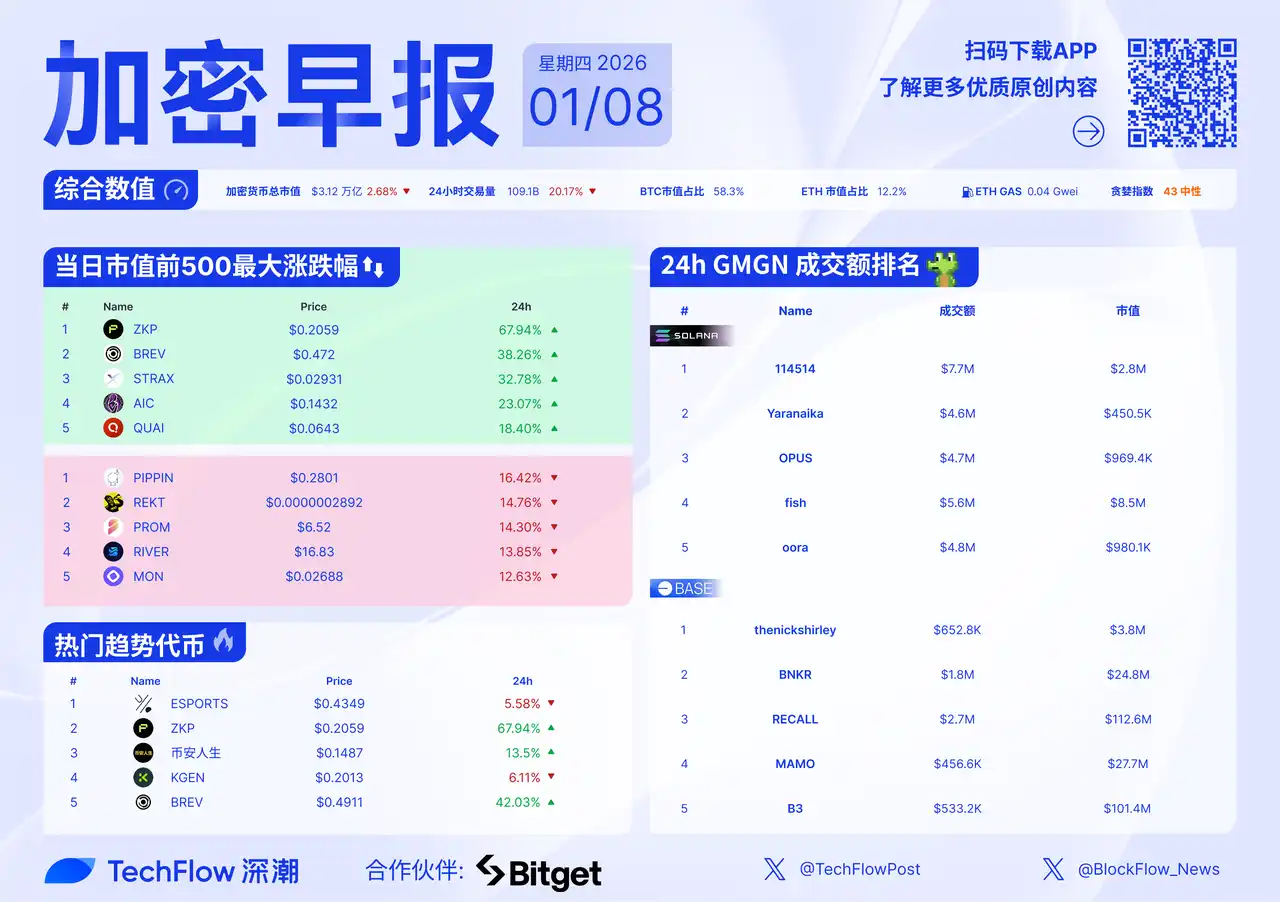
Recommended Reading

The People Need a Bad Capitalist, AI Created a Delivery Rumor

This article discusses a recent anonymous爆料 post on Reddit that sparked public outcry. The post accused food delivery platforms of using algorithms to exploit drivers, leading to heated discussions and emergency PR responses from two major delivery companies. However, it was later revealed that the爆料 post and its related "evidence" were generated by AI, highlighting the potential risks of AI technology in creating misinformation and reflecting public distrust towards platform companies.

Conversation with BNB Chain Growth Executive Director: Why Am I Bullish on BNB's Next Decade?

Through an interview with BNB Chain Growth Executive Director Nina Rong, this article explores the BNB Chain ecosystem, growth strategies, the significance of hackathon events, and Nina's advice for the Web3 industry. The article also covers BNB Chain's technical advantages, user base, infrastructure, and competitiveness against other public blockchains. Nina shares her career experience, industry insights, and advice for newcomers.

Conversation with Blockworks Co-founder: 27 Predictions for 2026 — Ethereum Revival, Solana Silence, Bitcoin Faces Quantum Shadow

This article is an in-depth discussion of 27 predictions for the crypto industry in 2026, covering development trends in major ecosystems like DeFi, Ethereum, Bitcoin, and Solana, as well as future prospects in areas such as quantum computing, enterprise chains, and venture capital trends. The author believes 2026 will be a crucial year for industry consolidation and fundamentals-driven development, emphasizing that builders need to focus on long-term value creation while pointing out potential challenges and opportunities.

OKX Ventures 2026 Investment Outlook: Asset On-Chaining, Intelligence and Privacy

This article details future trends in the crypto industry for 2026, including asset on-chaining, changes in entities and rules, and the deep integration of AI and crypto. It also discusses the trend of institutional adoption of crypto assets, the importance of privacy protection, and the development direction of DeFi active intelligent services and prediction markets.

Dragonfly Partner Review: The Three Strongest Figures in Crypto VC History

This article analyzes three of the most outstanding venture capitalists in the crypto space: Dan Robinson, Chris Dixon, and Kyle Samani. Their investment achievements and unique philosophies have secured their prominent positions in the industry. The article also touches upon the current state and future trends of the crypto venture capital industry, along with some hot crypto news.


Domande pertinenti

QWhat was the actual number for the US December ADP employment data and how did it compare to expectations?

AThe actual US December ADP employment number was 41,000, which was below the expected 47,000.

QWhat significant announcement did Solana Mobile make regarding the SKR token?

ASolana Mobile announced that the SKR token will officially launch on January 21st (UTC time).

QWhich company, in partnership with Tether, announced the launch of a non-custodial crypto wallet integrated into its platform?

ARumble Inc. (Nasdaq: RUM), in partnership with Tether, announced the launch of the Rumble Wallet.

QWhat is the unique feature of the new Brazilian Real-pegged stablecoin BRD, as introduced by a former central bank official?

AThe BRD stablecoin is unique because it is backed by Brazilian government bonds and offers holders a high yield share of up to 15%.

QWhich venture capital firm led the $15 million funding round for the decentralized protocol Babylon?

AAndreessen Horowitz's a16z Crypto led the $15 million funding round for Babylon.

Letture associate

From South Korea to the United States: Blue-Collar Jobs Are Becoming Increasingly Popular, Thanks to AI

AI is reshaping the labor market's value proposition. The traditional four-year college degree is losing its appeal as a guaranteed career path, while skilled blue-collar trades like electricians, welders, and plumbers are experiencing historic demand and wage premiums. This shift is driven by dual pressures: AI's displacement of certain white-collar roles and a booming need for physical infrastructure and data center construction. Data confirms the trend. In the U.S., vocational school revenue surged, and a significant portion of recent layoffs are AI-related. Surveys show a majority of Gen Z adults plan to pursue blue-collar work, citing better job security against AI automation. Vocational education interest has exploded recently. Experts cite a psychological shift as younger generations seek tangible, AI-resistant careers and avoid high student debt. In many cases, salaries for skilled trades now match or exceed those requiring a bachelor's degree. In South Korea, semiconductor vocational high schools boast near-total employment, with graduates securing high-paying roles at companies like Samsung. The shortage is structural, exacerbated by a retiring baby boomer workforce and massive infrastructure projects. Companies like JPMorgan Chase, Meta, and Lowe's are investing heavily in training programs. However, overcoming historical stigma and a "perception gap" around trade careers remains a key challenge to closing the talent gap.

marsbit47 min fa

From South Korea to the United States: Blue-Collar Jobs Are Becoming Increasingly Popular, Thanks to AI

marsbit47 min fa

Qualcomm: AI Hype Subsides, When Will Smartphones Emerge from the Gloom?

Qualcomm reported its Q3 FY2026 results (ending June 2026), with revenue of $9.95B, down 4% YoY but above expectations. Gross margin declined to 53.1%, pressured by rising costs across manufacturing and memory. Key business segments showed mixed performance: Handset revenue fell 19.6% YoY to $5.09B, dragged by an 11% decline in non-Apple Android shipments and weaker high-end mix. Conversely, Automotive revenue surged 61% to $1.59B, and IoT grew 9% to $1.83B. Core operating profit dropped 41% YoY due to margin compression and higher expenses. Management's Q4 FY2026 guidance projects revenue of $9.7B-$10.5B, in line with consensus, but Non-GAAP EPS guidance of $2.05-$2.25 fell short of expectations. Amidst persistent weakness in its core handset market, Qualcomm is pursuing growth in AI, focusing on Edge AI (smartphones, PCs, automotive) and Data Center AI. Its data center strategy includes four pillars: AI accelerators (e.g., AI200), commercial CPUs (Dragonfly C1000), custom silicon, and connectivity solutions. While these initiatives initially boosted its stock, concerns over AI capital expenditure sustainability have since erased those gains. The company targets $5B in data center revenue for FY2027 and $15B for FY2029. The report concludes that with the traditional handset business still under pressure, the data center opportunity is currently viewed as a longer-term option, and a more conservative valuation based on core operations may be warranted until AI contributions materialize.

marsbit52 min fa

Qualcomm: AI Hype Subsides, When Will Smartphones Emerge from the Gloom?

marsbit52 min fa

From TPU to Self-Evolving Agents: How Jeff Dean Predicts the Next Step in AI

At the 2026 YC Startup School, Jeff Dean outlined his vision for AI's next phase, shifting focus from simply scaling models to building intelligent, autonomous systems. He believes AI's progress is no longer just about creating smarter models, but about integrating them into systems capable of long-term, iterative work, automated experimentation, and continuous learning. This evolution moves the competition from "who has the bigger model" to "who can best organize intelligence." Dean suggests AI capabilities are now comparable to a junior engineer, enabling the automation of complex workflows. However, the true challenge and opportunity lie in managing these AI "workers" at scale. He emphasizes the importance of **context engineering**—structuring tools, memory, and feedback loops—over raw model power. For startups, this means building deep expertise in niche domains where general models currently fail (near 0-1% success rates), leveraging proprietary data, specialized tools, and domain-specific evaluators. A recurring theme is re-examining fundamental constraints. Dean's past work, like moving Google's search index to memory or creating the TPU, stemmed from questioning outdated assumptions about hardware and cost. He sees similar inflection points today, particularly in **specialized inference hardware** to drastically reduce latency and energy consumption for real-time Agent operation. Notably, he points out that in modern AI systems, the dominant cost is often not computation but **data movement**. Reliable, long-running Agents require robust system design, borrowing concepts from distributed computing like checkpointing, state management, and parallel exploration to handle failures and maintain progress over days or weeks. As AI automates execution, the scarcest human skills will shift to **defining clear specifications**, **judging what problems are worth solving** (taste), and designing effective feedback loops. Ultimately, Dean's framework prioritizes understanding the problem deeply, identifying the true bottlenecks, and systematically building closed-loop systems where AI can not only perform tasks but also improve AI itself.

marsbit52 min fa

From TPU to Self-Evolving Agents: How Jeff Dean Predicts the Next Step in AI

marsbit52 min fa

Trading

Spot
活动图片




