Crypto Morning Brief: Fed Cuts Rates by 25 Basis Points, Yi He Promises Compensation for Users Affected by WeChat Hack

深潮Pubblicato 2025-12-11Pubblicato ultima volta 2025-12-11

Introduzione

Fed cuts rates by 25 bps as expected; Binance's Yi He pledges BNB airdrop to users affected by hacked WeChat account. U.S. Senate may delay crypto market structure bill to 2026. OCC allows banks to intermediate crypto trades. Silk Road-linked wallets move $3.14M in dormant BTC. HashKey IPO heavily oversubscribed; Surf AI raises $15M. Market analysts debate crypto cycle shifts and regulatory outlook.

Author: Deep Tide TechFlow

Yesterday's Market Dynamics

The Federal Reserve cut the benchmark interest rate by 25 basis points to 3.50%-3.75% early this morning, in line with market expectations

According to Jinshi Data, the Federal Reserve cut the benchmark interest rate by 25 basis points to 3.50%-3.75%, marking the third consecutive meeting with a rate cut, in line with market expectations. The cumulative rate cut for the year has reached 75 basis points.

Key points from the Fed statement and Powell's press conference:

FOMC Statement:

  1. Statement Summary: Cut rates by 25 basis points to 3.50%-3.75%, the third consecutive meeting with a rate cut. Milan supported a 50 basis point cut, while Goolsbee and Schmid supported maintaining rates unchanged.

  2. Interest Rate Outlook: Will consider the extent and timing of further interest rate adjustments. The median dot plot is entirely consistent with September's, projecting one rate cut each in the next two years.

  3. Inflation Outlook: Inflation has risen since the beginning of the year and remains relatively high, consistent with previous statements. Lowered next year's inflation expectations in the SEP.

  4. Economic Outlook: Economic activity has been expanding at a moderate pace, and uncertainty about the outlook remains high, consistent with previous statements. Upwardly revised GDP growth forecasts for the next three years across the board.

  5. Labor Market: Removed the description of the unemployment rate as "low," believing that downside risks to employment have increased in recent months. The unemployment rate forecast for next year remains unchanged at 4.4%.

  6. Reserve Purchases: Will begin purchasing Treasury bills on December 12th, buying $40 billion in Treasury bills over the next 30 days. Removed operational limits on standing overnight repo operations.

Powell's Press Conference:

  1. Interest Rate Outlook: Can wait and observe how the economy develops. Currently at the upper end of the neutral range. No one currently has rate hikes as their baseline expectation. Long-term rates may rise due to expectations of faster economic growth.

  2. Inflation Outlook: Inflation risks are tilted to the upside. Peak inflation could be zero point something percent higher or lower than current levels. Current inflation overshoot is primarily driven by tariffs. If tariffs are removed, the inflation rate would be at the low end of the 2% range. The impact of tariffs is likely a one-time event.

  3. Economic Outlook: Does not believe the economy is overheating. The baseline outlook for next year is solid growth; can wait and observe developments.

  4. Employment Outlook: There are downside risks in the labor market. Job growth in recent months was overstated by 60,000 positions. The unemployment rate could rise by up to 0.1%-0.2%.

  5. Purchase Situation: Purchasing short-term Treasury bills is solely for reserve management purposes. The scale of purchases may remain high in the coming months before gradually decreasing.

  6. Latest Expectations: As of the time of writing, futures markets expect the Fed to cut rates by a cumulative 55 basis points next year, a slight increase from pre-meeting expectations. The probability of a 25 basis point cut in January next year is 24.4%.

  7. Market Reaction: From the release of the Fed statement through Powell's speech, gold and silver initially rose, then fell, before rising again, with silver hitting a new all-time high. U.S. Treasury yields fell by about 4 basis points. The U.S. dollar generally weakened, while non-USD currency pairs strengthened. U.S. stocks trended upward, with the Dow Jones rising over 1%. Trump criticized Powell after the meeting, saying the rate cut could have been larger.

U.S. Senate Banking Committee may delay consideration of the "Crypto Market Structure Bill" until 2026

Crypto journalist Eleanor Terrett posted on platform X that U.S. senators from both parties held another meeting today regarding the "Crypto Market Structure Bill." After the meeting, Senator Mark Warner revealed that it would be "very difficult" to consider the bill next week given its current state, a view shared by other senators. It now appears likely that the U.S. Senate Banking Committee will have to wait until the new year to consider the bill.

Bank of America approved to provide crypto trading intermediary services for clients

According to Dlnews, the U.S. Office of the Comptroller of the Currency (OCC) announced on Tuesday that Bank of America can act as an intermediary for cryptocurrency transactions, buying and selling digital assets on behalf of clients. This "riskless principal trading" model is the same way banks currently handle securities transactions for clients; the bank acts only as an intermediary and does not hold crypto assets in its own inventory.

Brevis partners with Aster to bring ZK security and privacy to on-chain transactions

According to an official announcement, ZK verifiable computing platform Brevis has now partnered with Aster. As a multi-chain DEX, Aster supports yield-generating collateral and hidden order functionality. This collaboration aims to address the three long-standing challenges faced by DEXs, achieving a true balance between speed, security, and privacy.

Brevis can migrate complex on-chain computations off-chain and generate efficient ZK proofs, enabling on-chain verification at a cost far lower than native on-chain execution. Through this partnership, the two will explore how to leverage these capabilities to achieve centralized exchange-level execution speed, cryptographically-secure verification, and protect user position data privacy without compromising overall market transparency.

Bitwise CEO: The four-year cycle is dead; it's actually been a bear market since February this year, a major rally is coming in 2026

Bitwise CEO Hunter Horsley expressed his views on social media, stating that the four-year cycle pattern for cryptocurrency has ended, and the market has changed and matured.

Hunter Horsley said that looking back at 2025, it will be clear that the market has actually been in a bear market since February, only masked by sustained buying from crypto treasury companies. He believes all factors are setting the stage for a massive rally in 2026.

Silk Road-linked wallets transfer $3.14 million in BTC to unknown address after a decade of dormancy

According to The Block, hundreds of cryptocurrency wallets linked to the dark web market Silk Road were reactivated on Tuesday after lying dormant for over a decade, transferring $3.14 million worth of BTC to an unknown address.

Data from Arkham Intelligence showed that approximately 312 wallets associated with the defunct dark web market Silk Road collectively moved BTC to the address "bc1q...ga54". The reason for the reactivation of these wallets is currently unclear. As of now, Silk Road-linked wallets still hold approximately $41.3 million in BTC. In January of this year, Coinbase director Conor Grogan stated on platform X that he had identified wallets linked to Silk Road founder Ross Ulbricht containing approximately $47 million worth of BTC.

Earlier this year, U.S. President Trump signed an executive order granting clemency to Ulbricht, who is currently serving a prison sentence.

Yi He: Will airdrop BNB to users who suffered losses due to WeChat hack

Binance co-founder Yi He's WeChat account was recently hacked, leading some users who trusted the information in her朋友圈 (Moments) to purchase a certain meme coin and suffer losses. Yi He has announced that she will personally provide a certain amount of BNB to compensate users who traded the meme coin on Binance's non-custodial wallet and Alpha platform during the account hack period and incurred losses. The airdrop will be completed within 24 hours.

Strategy responds to MSCI excluding DAT from index: Formally requests MSCI withdraw the proposal

Strategy has submitted a response to MSCI's consultation regarding Digital Asset Treasury companies. Index standards should remain neutral, consistent, and reflect global market trends. Therefore, they have formally requested MSCI withdraw the proposal, as it is arbitrary, discriminatory, unworkable, contrary to U.S. policy, and would stifle innovation. Digital Asset Treasury companies (DATs) are operating businesses, not investment funds.

HashKey Holdings IPO enters final stage, public offering nearly 149 times oversubscribed

HashKey Holdings (Stock Code: 03887), the parent company of Hong Kong licensed virtual asset exchange HashKey Exchange, which is soon to list on the Hong Kong Stock Exchange, continues to see active market subscription. It is reported that the international offering portion of the company has been oversubscribed, attracting long-term capital participation from international and Chinese institutions.

Meanwhile, its public offering portion has received a enthusiastic response. According to the latest data from several brokerages as of the time of writing, the total subscription funds lent through brokerage channels have climbed to approximately HK$24.898 billion. Based on the public offering fundraising amount of HK$167 million, it has initially recorded an oversubscription of about 148.91 times, indicating high investor participation.

HashKey Holdings' IPO subscription will close on December 12th.

Crypto AI platform Surf completes $15 million funding round led by Pantera Capital

According to Fortune, AI platform Surf announced the completion of a $15 million funding round led by Pantera Capital, with participation from Coinbase Ventures and Digital Currency Group.

Surf was founded by Ryan Li to address the "hallucination" issues mainstream AI platforms like ChatGPT have with cryptocurrency information. The platform launched in July this year on an invitation-only basis and opened to the public in September. It currently has over 300,000 users and has generated over 1 million search results.

Market Dynamics
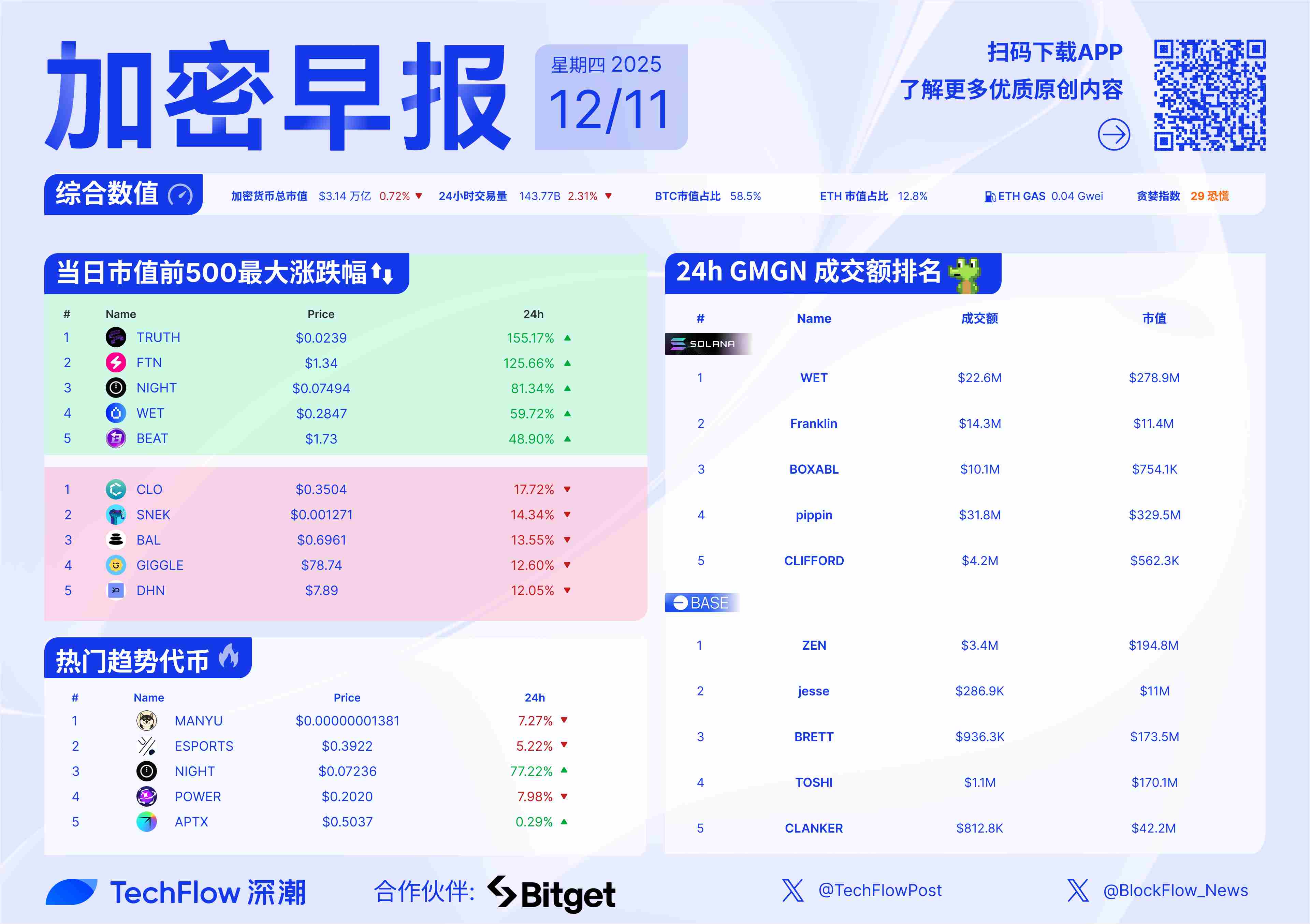
Recommended Reading

On the Eve of Do Kwon's Sentencing, $1.8 Billion is Betting on His Prison Term

This article describes the intense speculative gambling around LUNA tokens on the eve of Do Kwon's sentencing. Although LUNA's fundamentals have gone to zero, the market is leveraging the uncertainty surrounding Do Kwon's sentence to drive wild price fluctuations. The sentencing hearing on December 11th became a key market focus, expected to significantly impact LUNA token trading.

Crypto Analysts in Conversation: Bitcoin Bottom Taking Shape, Smart Money Starts Scooping Up in Anticipation of 2026 Market

This article delves into the current state and future trends of the Bitcoin and crypto markets, covering the formation of market bottoms, liquidity drivers, institutional capital deployment, and the potential of prediction markets, among other aspects. Through expert dialogue, it analyzes the impact of the macroeconomic environment on Bitcoin and altcoin markets and explores the shifting attitudes of sovereign wealth funds and financial institutions towards cryptocurrency.

30-Year Wall Street Veteran: Lessons from Horse Racing, Poker, and Investment Legends That Taught Me About Bitcoin

Through personal experience, this article explores how analytical methods used for horse racing odds can be applied to Bitcoin investment and other decisions. It emphasizes the importance of probabilistic thinking, independent evaluation, and position sizing, using Bitcoin as an example to analyze its potential value and risks as an investment.

The Person Who Made $69 Million from NFTs Four Years Ago is Still Making Money

This article tells the story of how, despite the NFT market no longer being glorious, artist Beeple and his team remain active in the NFT space. Beeple launched a series of NFT "Regular Animas" robotic dogs at Art Basel, which feature unique artistic expression and technological innovation and sold for high prices. Furthermore, the article mentions that Beeple never slowed down his creative pace due to success; he continues to drive NFT art development through his team and studio.

Regulatory Crossroads: The US, Europe, and the Future of Crypto Assets

This article analyzes the current state of the global cryptocurrency market and its regulatory trends, focusing on the different approaches to cryptocurrency regulation in regions like the US, Europe, and Switzerland. It points out that the US is actively promoting cryptocurrency normalization to attract capital and leveraging its fiscal advantages to push industry development; while the EU, due to overly cumbersome regulation, risks stifling innovation and becoming an obstacle to crypto industry growth; Switzerland, with its flexible and friendly regulatory environment, serves as a model for the crypto industry.


Crypto di tendenza

Domande pertinenti

QWhat was the outcome of the Federal Reserve's recent interest rate decision and how did it align with market expectations?

AThe Federal Reserve lowered the benchmark interest rate by 25 basis points to 3.50%-3.75%, marking the third consecutive meeting with a rate cut. This move was in line with market expectations, bringing the total rate reduction for the year to 75 basis points.

QWhat action did Binance co-founder Yi He take in response to users suffering losses from a meme coin purchase linked to her compromised WeChat account?

AYi He personally committed to airdropping a certain amount of BNB to users who incurred losses by trading the specific meme coin on Binance's non-custodial wallet and Alpha platform during the period her WeChat account was compromised. The airdrop was to be completed within 24 hours.

QAccording to Bitwise CEO Hunter Horsley, what is the state of the crypto market since February and what is his prediction for 2026?

AHunter Horsley stated that the crypto market has actually been in a bear market since February, a fact he believes was masked by continuous buying from crypto treasury companies. He predicts that all factors are setting the stage for a major market movement in 2026.

QWhat significant transaction occurred involving wallets linked to the Silk Road marketplace?

AHundreds of cryptocurrency wallets associated with the dark web marketplace Silk Road, which had been inactive for over a decade, were reactivated and transferred $3.14 million worth of Bitcoin to an unknown address.

QWhat was the result of HashKey Holdings' public offering ahead of its listing on the Hong Kong Stock Exchange?

AHashKey Holdings' public offering was nearly 149 times oversubscribed, with total borrowed subscription funds through broker channels reaching approximately HK$24.9 billion against a public offering fundraising target of HK$167 million.

Letture associate

Weekly Editor's Picks (0725-0731)

Weekly Editor's Picks (0725-0731) provides a curated selection of deep analysis, filtering out market noise. Key themes from this week include: **Macro & Policy:** The Federal Reserve's upcoming meeting is marked by high uncertainty, balancing cooling inflation data against persistent price pressures. Meanwhile, the U.S. crypto regulatory Clarity Act faces critical political hurdles, with its 2026 passage probability seen as low. **Investing & Crypto:** Analysis suggests long-term crypto success depends on conviction through volatile cycles, focusing on assets like Bitcoin and core smart contract platforms. A trend noted is the increasing similarity between global equity markets (especially tech) and crypto, driven by narrative and leverage. Several major crypto protocols show strong revenue growth, but this isn't always translating to token price appreciation due to sell pressure and structural factors. **AI & Semiconductors:** Nvidia's rising credit default swap rates signal market concern over AI infrastructure financing risks. The storage sector experienced volatility as markets began pricing in potential 2027 oversupply. Despite a record profitable quarter, SK Hynix's results were deemed "below expectations," reflecting heightened investor demands for future growth visibility. **Markets & DeFi:** TradeXYZ demonstrated remarkable accuracy in pre-market pricing for a major A股 listing. The token ONDO saw gains, linked to its growing role in the on-chain tokenized stock ecosystem. **Ethereum:** Post-Pectra upgrade, a major structural shift is underway as Lido begins migrating millions of ETH to new validator architectures designed for capital efficiency. **Also Highlighted:** Butian's bullish stock market move; OpenAI's Altman promising major advances; Samsung and SK Hynix securing large AI chip deals; Apple reaching a $5T market cap; and ongoing discussions around exchange security following Poolin's bankruptcy case.

marsbit15 min fa

Weekly Editor's Picks (0725-0731)

marsbit15 min fa

Low Investment Isn't Apple's Immunity Pass

While Meta and Google face investor scrutiny over ballooning AI capital expenditures, Apple's minimal AI investment has paradoxically become a strength. Its market cap recently reclaimed the global top spot, surpassing $5 trillion. The irony is deep: Apple's own AI efforts have lagged, with "Apple Intelligence" delayed and core talent lost, forcing reliance on partners like Google Gemini and Alibaba's Qianwen. Its Q3 FY2026 (Q2 CY) earnings initially seemed stellar. Revenue hit $109.4B (up 16% YoY), with iPhone and Mac sales, growing 22% and 29% respectively, driving most of the growth. However, the stock fell over 8% post-earnings. The primary concern was a weaker Q4 revenue growth forecast of 9-11%, below expectations, due to looming supply chain constraints. Apple is feeling the indirect cost of the AI boom. Soaring memory and chip prices, fueled by massive data center investments from Microsoft, Amazon, and others, are forcing Apple to raise Mac and iPad prices significantly. The upcoming iPhone launch is also expected to see substantial price hikes. Despite avoiding heavy AI infrastructure spending—its capital expenditures are actually down 28%—Apple cannot escape the industry-wide supply and cost pressures. While Apple's operating cash flow remains robust, its substantial R&D spending (up 32% YoY) has yet to yield major AI breakthroughs. As Tim Cook prepares to step down as CEO, Apple faces a challenging transition: balancing its premium hardware success against the strategic and cost pressures of the AI era it has so far cautiously navigated.

marsbit1 h fa

Low Investment Isn't Apple's Immunity Pass

marsbit1 h fa

PA Graphics Explanation | One Chart to Understand the Major Web3 Events in August 2026

**PANews Crypto Calendar: Key Web3 Events in August 2026** PANews introduces its revamped crypto calendar, featuring comprehensive coverage, flexible filtering, and easy export options. The market in August will be shaped by multiple key events across macroeconomics, regulation, tokenomics, and project developments: * **Macro & Policy:** Key US economic data releases (July Non-Farm Payrolls, CPI), the Federal Reserve meeting minutes, and the Jackson Hole Economic Symposium will be in focus. On the regulatory front, the US Senate plans to release a new draft of the *CLARITY Act*, while the EU's expanded crypto ban against Belarus comes into effect. * **Token Unlocks:** Significant token unlocks are scheduled for assets including ENA, AVAX, CONX, ZRO, and KAITO, which may influence market volatility. * **Project Updates & Shutdowns:** Several services, including Exchange Art, Ctrl Wallet, Zapper, NFTfi, and Summer.fi, are set to cease operations or undergo major adjustments. Users are advised to manage their assets accordingly. * **Corporate Activity:** Q2 earnings reports from companies like SpaceX, Circle, and Nvidia are due. Unitree Robotics will initiate its IPO subscription on the STAR Market, and Moonshot AI plans to begin a Pre-IPO financing round. * **Industry Events:** Major conferences such as Bitcoin Asia 2026 and the 2026 Digital Expo will take place. The overarching market narrative for August will revolve around macroeconomic expectations, regulatory developments, token unlock schedules, and ongoing industry consolidation.

marsbit1 h fa

PA Graphics Explanation | One Chart to Understand the Major Web3 Events in August 2026

marsbit1 h fa

Wall Street's Most Famous 'Cassandra' Now Has His Sights Set on Nvidia

Michael Burry, the famed "Big Short" investor, has once again captured Wall Street's attention with a series of short positions against major tech and semiconductor stocks, most notably Nvidia. In late June and July, through his "Cassandra Unchained" newsletter, Burry disclosed short bets against Nvidia, Tesla, Applied Materials, Caterpillar, the SOXX semiconductor ETF, and later, Micron Technology. His core thesis revolves around potential distortions in the AI infrastructure boom, specifically questioning whether extended depreciation schedules (e.g., 6 years vs. a realistic 2-3 years for AI chips) by cloud giants like Microsoft and Google artificially inflate profits. He also raises concerns about possible "off-balance-sheet circular financing," where chip demand might be propped up by vendor-backed funding to clients. Nvidia's stock experienced volatility following these disclosures, briefly dipping but largely holding near Burry's reported entry points, leaving his positions roughly flat or slightly underwater as of late July. This move is part of a pattern for Burry, whose track record since his legendary 2008 bet is mixed. He has faced notable losses, such as on Tesla in 2021, while scoring on broader market turns like the 2020 pandemic crash. His methodology focuses intensely on free cash flow and scrutinizing original financial documents to spot overvaluation and structural risks, but it often struggles with timing the market. The article contrasts Burry's stance with other prominent investors. Steve Eisman, another "Big Short" figure, is not shorting Nvidia, citing strong fundamentals but expressing nervousness about sustainability. Jim Chanos agrees with the broad "accounting mismatch" concern—comparing it to the dot-com bubble—but targets financial leverage in private equity firms rather than the chip stocks themselves. While Nvidia's short interest remains relatively low at 1.3-1.4% of float, the massive stock size means absolute short losses have been significant, exceeding $5 billion earlier this year. The piece concludes that for ordinary investors, the key takeaway is not replicating specific short bets but learning from the critical frameworks these investors use: questioning rosy accounting, identifying structural vulnerabilities, and maintaining skepticism during market euphoria, even if pinpointing the exact catalyst for a downturn remains elusive.

marsbit1 h fa

Wall Street's Most Famous 'Cassandra' Now Has His Sights Set on Nvidia

marsbit1 h fa

Weekly Selection丨Epic Stock Market Volatility, Changxin Tech's IPO Reshapes Storage Landscape, Saylor Aims to Re-Anchor STRC Around September 8th

PANews Weekly Digest: Market Turmoil, Tech Breakthroughs, and Crypto Developments. The week saw significant volatility across global markets. South Korea's KOSPI index experienced extreme turbulence, including multiple trading halts, largely driven by sharp declines in AI hardware stocks like SK Hynix. In contrast, China's Changxin Xinqiao (CXC) achieved a landmark IPO with a market cap surpassing 4 trillion yuan, marking a major success for the domestic DRAM industry after a decade of losses. In the crypto and Web3 space, several key narratives emerged. AI is driving demand for new infrastructure, with projects like AI agent wallets and programmable payments gaining traction, attracting interest from firms like Coinbase. The Bitcoin mining sector is pivoting, with companies like MARA focusing on energy management as electricity becomes a core AI-era asset. Meanwhile, the RWA (Real World Assets) sector faces a "utilization puzzle," with hundreds of billions in on-chain assets remaining dormant. Notable market movements included a historic single-day surge of over 17% for the KOSPI index and a significant migration of $16.5 billion in staked ETH within the Lido ecosystem. Michael Saylor announced a target to re-peg the STRC stablecoin around September 8th. Other highlights include discussions on Ethereum's ambitious 2030 roadmap for scaling and privacy, analysis showing high protocol revenues not always translating to token price gains, and warnings from Citi about potential extreme commodity price shocks by late 2026.

marsbit1 h fa

Weekly Selection丨Epic Stock Market Volatility, Changxin Tech's IPO Reshapes Storage Landscape, Saylor Aims to Re-Anchor STRC Around September 8th

marsbit1 h fa

Trading

Spot

Articoli Popolari

Cosa è $S$

Comprendere SPERO: Una Panoramica Completa Introduzione a SPERO Mentre il panorama dell'innovazione continua a evolversi, l'emergere delle tecnologie web3 e dei progetti di criptovaluta gioca un ruolo fondamentale nel plasmare il futuro digitale. Un progetto che ha attirato l'attenzione in questo campo dinamico è SPERO, denotato come SPERO,$$s$. Questo articolo mira a raccogliere e presentare informazioni dettagliate su SPERO, per aiutare gli appassionati e gli investitori a comprendere le sue basi, obiettivi e innovazioni nei domini web3 e crypto. Che cos'è SPERO,$$s$? SPERO,$$s$ è un progetto unico all'interno dello spazio crypto che cerca di sfruttare i principi della decentralizzazione e della tecnologia blockchain per creare un ecosistema che promuove l'impegno, l'utilità e l'inclusione finanziaria. Il progetto è progettato per facilitare interazioni peer-to-peer in modi nuovi, fornendo agli utenti soluzioni e servizi finanziari innovativi. Al suo interno, SPERO,$$s$ mira a responsabilizzare gli individui fornendo strumenti e piattaforme che migliorano l'esperienza dell'utente nello spazio delle criptovalute. Questo include la possibilità di metodi di transazione più flessibili, la promozione di iniziative guidate dalla comunità e la creazione di percorsi per opportunità finanziarie attraverso applicazioni decentralizzate (dApps). La visione sottostante di SPERO,$$s$ ruota attorno all'inclusività, cercando di colmare le lacune all'interno della finanza tradizionale mentre sfrutta i vantaggi della tecnologia blockchain. Chi è il Creatore di SPERO,$$s$? L'identità del creatore di SPERO,$$s$ rimane piuttosto oscura, poiché ci sono risorse pubblicamente disponibili limitate che forniscono informazioni dettagliate sul suo fondatore o fondatori. Questa mancanza di trasparenza può derivare dall'impegno del progetto per la decentralizzazione—un ethos che molti progetti web3 condividono, dando priorità ai contributi collettivi rispetto al riconoscimento individuale. Centrando le discussioni attorno alla comunità e ai suoi obiettivi collettivi, SPERO,$$s$ incarna l'essenza dell'empowerment senza mettere in evidenza individui specifici. Pertanto, comprendere l'etica e la missione di SPERO rimane più importante che identificare un creatore singolo. Chi sono gli Investitori di SPERO,$$s$? SPERO,$$s$ è supportato da una varietà di investitori che vanno dai capitalisti di rischio agli investitori angelici dedicati a promuovere l'innovazione nel settore crypto. Il focus di questi investitori generalmente si allinea con la missione di SPERO—dando priorità a progetti che promettono avanzamenti tecnologici sociali, inclusività finanziaria e governance decentralizzata. Queste fondazioni di investitori sono tipicamente interessate a progetti che non solo offrono prodotti innovativi, ma contribuiscono anche positivamente alla comunità blockchain e ai suoi ecosistemi. Il supporto di questi investitori rafforza SPERO,$$s$ come un concorrente degno di nota nel dominio in rapida evoluzione dei progetti crypto. Come Funziona SPERO,$$s$? SPERO,$$s$ impiega un framework multifunzionale che lo distingue dai progetti di criptovaluta convenzionali. Ecco alcune delle caratteristiche chiave che sottolineano la sua unicità e innovazione: Governance Decentralizzata: SPERO,$$s$ integra modelli di governance decentralizzati, responsabilizzando gli utenti a partecipare attivamente ai processi decisionali riguardanti il futuro del progetto. Questo approccio favorisce un senso di proprietà e responsabilità tra i membri della comunità. Utilità del Token: SPERO,$$s$ utilizza il proprio token di criptovaluta, progettato per servire varie funzioni all'interno dell'ecosistema. Questi token abilitano transazioni, premi e la facilitazione dei servizi offerti sulla piattaforma, migliorando l'impegno e l'utilità complessivi. Architettura Stratificata: L'architettura tecnica di SPERO,$$s$ supporta la modularità e la scalabilità, consentendo un'integrazione fluida di funzionalità e applicazioni aggiuntive man mano che il progetto evolve. Questa adattabilità è fondamentale per mantenere la rilevanza nel panorama crypto in continua evoluzione. Coinvolgimento della Comunità: Il progetto enfatizza iniziative guidate dalla comunità, impiegando meccanismi che incentivano la collaborazione e il feedback. Nutrendo una comunità forte, SPERO,$$s$ può affrontare meglio le esigenze degli utenti e adattarsi alle tendenze di mercato. Focus sull'Inclusione: Offrendo basse commissioni di transazione e interfacce user-friendly, SPERO,$$s$ mira ad attrarre una base utenti diversificata, inclusi individui che potrebbero non aver precedentemente interagito nello spazio crypto. Questo impegno per l'inclusione si allinea con la sua missione generale di empowerment attraverso l'accessibilità. Cronologia di SPERO,$$s$ Comprendere la storia di un progetto fornisce preziose intuizioni sulla sua traiettoria di sviluppo e sui traguardi. Di seguito è riportata una cronologia suggerita che mappa eventi significativi nell'evoluzione di SPERO,$$s$: Fase di Concettualizzazione e Ideazione: Le idee iniziali che formano la base di SPERO,$$s$ sono state concepite, allineandosi strettamente con i principi di decentralizzazione e focus sulla comunità all'interno dell'industria blockchain. Lancio del Whitepaper del Progetto: Dopo la fase concettuale, è stato rilasciato un whitepaper completo che dettaglia la visione, gli obiettivi e l'infrastruttura tecnologica di SPERO,$$s$ per suscitare interesse e feedback dalla comunità. Costruzione della Comunità e Prime Interazioni: Sono stati effettuati sforzi attivi di outreach per costruire una comunità di early adopters e potenziali investitori, facilitando discussioni attorno agli obiettivi del progetto e ottenendo supporto. Evento di Generazione del Token: SPERO,$$s$ ha condotto un evento di generazione del token (TGE) per distribuire i propri token nativi ai primi sostenitori e stabilire una liquidità iniziale all'interno dell'ecosistema. Lancio della Prima dApp: La prima applicazione decentralizzata (dApp) associata a SPERO,$$s$ è stata attivata, consentendo agli utenti di interagire con le funzionalità principali della piattaforma. Sviluppo Continuo e Partnership: Aggiornamenti e miglioramenti continui alle offerte del progetto, inclusi partnership strategiche con altri attori nello spazio blockchain, hanno plasmato SPERO,$$s$ in un concorrente competitivo e in evoluzione nel mercato crypto. Conclusione SPERO,$$s$ rappresenta una testimonianza del potenziale del web3 e delle criptovalute di rivoluzionare i sistemi finanziari e responsabilizzare gli individui. Con un impegno per la governance decentralizzata, il coinvolgimento della comunità e funzionalità progettate in modo innovativo, apre la strada verso un panorama finanziario più inclusivo. Come per qualsiasi investimento nello spazio crypto in rapida evoluzione, si incoraggiano potenziali investitori e utenti a ricercare approfonditamente e a impegnarsi in modo riflessivo con gli sviluppi in corso all'interno di SPERO,$$s$. Il progetto mostra lo spirito innovativo dell'industria crypto, invitando a ulteriori esplorazioni delle sue innumerevoli possibilità. Mentre il percorso di SPERO,$$s$ è ancora in fase di sviluppo, i suoi principi fondamentali potrebbero effettivamente influenzare il futuro di come interagiamo con la tecnologia, la finanza e tra di noi in ecosistemi digitali interconnessi.

174 Totale visualizzazioniPubblicato il 2024.12.17Aggiornato il 2024.12.17

Cosa è $S$

Cosa è AGENT S

Agent S: Il Futuro dell'Interazione Autonoma in Web3 Introduzione Nel panorama in continua evoluzione di Web3 e criptovalute, le innovazioni stanno costantemente ridefinendo il modo in cui gli individui interagiscono con le piattaforme digitali. Uno di questi progetti pionieristici, Agent S, promette di rivoluzionare l'interazione uomo-computer attraverso il suo framework agentico aperto. Aprendo la strada a interazioni autonome, Agent S mira a semplificare compiti complessi, offrendo applicazioni trasformative nell'intelligenza artificiale (AI). Questa esplorazione dettagliata approfondirà le complessità del progetto, le sue caratteristiche uniche e le implicazioni per il dominio delle criptovalute. Cos'è Agent S? Agent S si presenta come un innovativo framework agentico aperto, progettato specificamente per affrontare tre sfide fondamentali nell'automazione dei compiti informatici: Acquisizione di Conoscenze Specifiche del Dominio: Il framework apprende in modo intelligente da varie fonti di conoscenza esterne ed esperienze interne. Questo approccio duale gli consente di costruire un ricco repository di conoscenze specifiche del dominio, migliorando le sue prestazioni nell'esecuzione dei compiti. Pianificazione su Lungo Orizzonte di Compiti: Agent S impiega una pianificazione gerarchica potenziata dall'esperienza, un approccio strategico che facilita la suddivisione e l'esecuzione efficiente di compiti complessi. Questa caratteristica migliora significativamente la sua capacità di gestire più sottocompiti in modo efficiente ed efficace. Gestione di Interfacce Dinamiche e Non Uniformi: Il progetto introduce l'Interfaccia Agente-Computer (ACI), una soluzione innovativa che migliora l'interazione tra agenti e utenti. Utilizzando Modelli Linguistici Multimodali di Grandi Dimensioni (MLLM), Agent S può navigare e manipolare senza sforzo diverse interfacce grafiche utente. Attraverso queste caratteristiche pionieristiche, Agent S fornisce un framework robusto che affronta le complessità coinvolte nell'automazione dell'interazione umana con le macchine, preparando il terreno per innumerevoli applicazioni nell'AI e oltre. Chi è il Creatore di Agent S? Sebbene il concetto di Agent S sia fondamentalmente innovativo, informazioni specifiche sul suo creatore rimangono elusive. Il creatore è attualmente sconosciuto, il che evidenzia sia la fase embrionale del progetto sia la scelta strategica di mantenere i membri fondatori sotto anonimato. Indipendentemente dall'anonimato, l'attenzione rimane sulle capacità e sul potenziale del framework. Chi sono gli Investitori di Agent S? Poiché Agent S è relativamente nuovo nell'ecosistema crittografico, informazioni dettagliate riguardanti i suoi investitori e sostenitori finanziari non sono documentate esplicitamente. La mancanza di approfondimenti pubblicamente disponibili sulle fondazioni di investimento o sulle organizzazioni che supportano il progetto solleva interrogativi sulla sua struttura di finanziamento e sulla roadmap di sviluppo. Comprendere il supporto è cruciale per valutare la sostenibilità del progetto e il suo potenziale impatto sul mercato. Come Funziona Agent S? Al centro di Agent S si trova una tecnologia all'avanguardia che gli consente di funzionare efficacemente in contesti diversi. Il suo modello operativo è costruito attorno a diverse caratteristiche chiave: Interazione Uomo-Computer Simile a Quella Umana: Il framework offre una pianificazione AI avanzata, cercando di rendere le interazioni con i computer più intuitive. Mimando il comportamento umano nell'esecuzione dei compiti, promette di elevare le esperienze degli utenti. Memoria Narrativa: Utilizzata per sfruttare esperienze di alto livello, Agent S utilizza la memoria narrativa per tenere traccia delle storie dei compiti, migliorando così i suoi processi decisionali. Memoria Episodica: Questa caratteristica fornisce agli utenti una guida passo-passo, consentendo al framework di offrire supporto contestuale mentre i compiti si sviluppano. Supporto per OpenACI: Con la capacità di funzionare localmente, Agent S consente agli utenti di mantenere il controllo sulle proprie interazioni e flussi di lavoro, allineandosi con l'etica decentralizzata di Web3. Facile Integrazione con API Esterne: La sua versatilità e compatibilità con varie piattaforme AI garantiscono che Agent S possa adattarsi senza problemi agli ecosistemi tecnologici esistenti, rendendolo una scelta attraente per sviluppatori e organizzazioni. Queste funzionalità contribuiscono collettivamente alla posizione unica di Agent S all'interno dello spazio crittografico, poiché automatizza compiti complessi e multi-fase con un intervento umano minimo. Man mano che il progetto evolve, le sue potenziali applicazioni in Web3 potrebbero ridefinire il modo in cui si svolgono le interazioni digitali. Cronologia di Agent S Lo sviluppo e le tappe di Agent S possono essere riassunti in una cronologia che evidenzia i suoi eventi significativi: 27 Settembre 2024: Il concetto di Agent S è stato lanciato in un documento di ricerca completo intitolato “Un Framework Agentico Aperto che Usa i Computer Come un Umano”, mostrando le basi per il progetto. 10 Ottobre 2024: Il documento di ricerca è stato reso pubblicamente disponibile su arXiv, offrendo un'esplorazione approfondita del framework e della sua valutazione delle prestazioni basata sul benchmark OSWorld. 12 Ottobre 2024: È stata rilasciata una presentazione video, fornendo un'idea visiva delle capacità e delle caratteristiche di Agent S, coinvolgendo ulteriormente potenziali utenti e investitori. Questi indicatori nella cronologia non solo illustrano i progressi di Agent S, ma indicano anche il suo impegno per la trasparenza e il coinvolgimento della comunità. Punti Chiave su Agent S Man mano che il framework Agent S continua a evolversi, diversi attributi chiave si distinguono, sottolineando la sua natura innovativa e il potenziale: Framework Innovativo: Progettato per fornire un uso intuitivo dei computer simile all'interazione umana, Agent S porta un approccio nuovo all'automazione dei compiti. Interazione Autonoma: La capacità di interagire autonomamente con i computer attraverso GUI segna un passo avanti verso soluzioni informatiche più intelligenti ed efficienti. Automazione di Compiti Complessi: Con la sua metodologia robusta, può automatizzare compiti complessi e multi-fase, rendendo i processi più veloci e meno soggetti a errori. Miglioramento Continuo: I meccanismi di apprendimento consentono ad Agent S di migliorare dalle esperienze passate, migliorando continuamente le sue prestazioni e la sua efficacia. Versatilità: La sua adattabilità attraverso diversi ambienti operativi come OSWorld e WindowsAgentArena garantisce che possa servire un'ampia gamma di applicazioni. Man mano che Agent S si posiziona nel panorama di Web3 e delle criptovalute, il suo potenziale per migliorare le capacità di interazione e automatizzare i processi segna un significativo avanzamento nelle tecnologie AI. Attraverso il suo framework innovativo, Agent S esemplifica il futuro delle interazioni digitali, promettendo un'esperienza più fluida ed efficiente per gli utenti in vari settori. Conclusione Agent S rappresenta un audace passo avanti nell'unione tra AI e Web3, con la capacità di ridefinire il modo in cui interagiamo con la tecnologia. Sebbene sia ancora nelle sue fasi iniziali, le possibilità per la sua applicazione sono vaste e coinvolgenti. Attraverso il suo framework completo che affronta sfide critiche, Agent S mira a portare le interazioni autonome al centro dell'esperienza digitale. Man mano che ci addentriamo nei regni delle criptovalute e della decentralizzazione, progetti come Agent S giocheranno senza dubbio un ruolo cruciale nel plasmare il futuro della tecnologia e della collaborazione uomo-computer.

632 Totale visualizzazioniPubblicato il 2025.01.14Aggiornato il 2025.01.14

Cosa è AGENT S

Come comprare S

Benvenuto in HTX.com! Abbiamo reso l'acquisto di Sonic (S) semplice e conveniente. Segui la nostra guida passo passo per intraprendere il tuo viaggio nel mondo delle criptovalute.Step 1: Crea il tuo Account HTXUsa la tua email o numero di telefono per registrarti il tuo account gratuito su HTX. Vivi un'esperienza facile e sblocca tutte le funzionalità,Crea il mio accountStep 2: Vai in Acquista crypto e seleziona il tuo metodo di pagamentoCarta di credito/debito: utilizza la tua Visa o Mastercard per acquistare immediatamente SonicS.Bilancio: Usa i fondi dal bilancio del tuo account HTX per fare trading senza problemi.Terze parti: abbiamo aggiunto metodi di pagamento molto utilizzati come Google Pay e Apple Pay per maggiore comodità.P2P: Fai trading direttamente con altri utenti HTX.Over-the-Counter (OTC): Offriamo servizi su misura e tassi di cambio competitivi per i trader.Step 3: Conserva Sonic (S)Dopo aver acquistato Sonic (S), conserva nel tuo account HTX. In alternativa, puoi inviare tramite trasferimento blockchain o scambiare per altre criptovalute.Step 4: Scambia Sonic (S)Scambia facilmente Sonic (S) nel mercato spot di HTX. Accedi al tuo account, seleziona la tua coppia di trading, esegui le tue operazioni e monitora in tempo reale. Offriamo un'esperienza user-friendly sia per chi ha appena iniziato che per i trader più esperti.

1.3k Totale visualizzazioniPubblicato il 2025.01.15Aggiornato il 2026.06.02

Come comprare S

Discussioni

Benvenuto nella Community HTX. Qui puoi rimanere informato sugli ultimi sviluppi della piattaforma e accedere ad approfondimenti esperti sul mercato. Le opinioni degli utenti sul prezzo di S S sono presentate come di seguito.

活动图片