Author: Deep Tide TechFlow
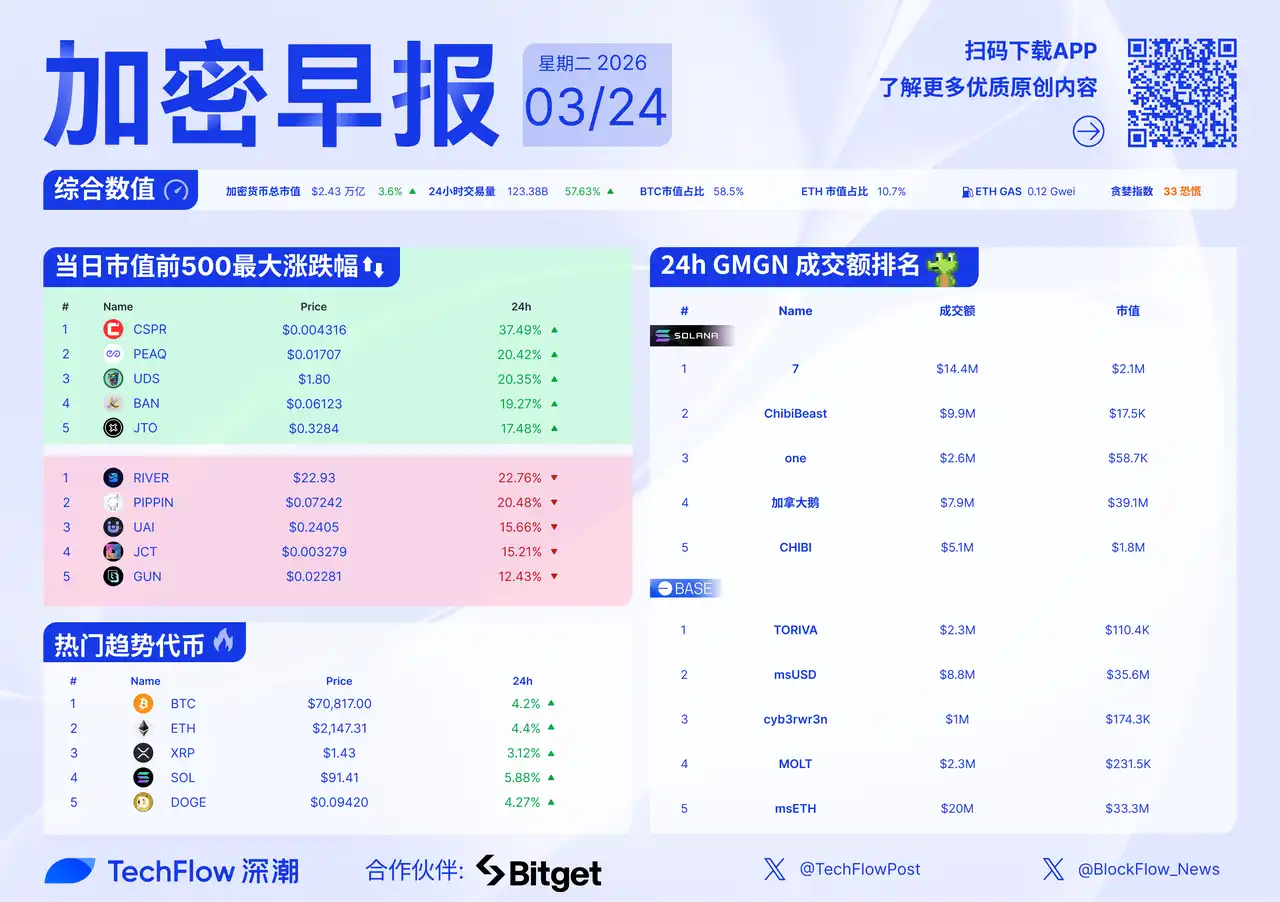
Yesterday's Market Dynamics
Israeli Media Reports US Sets April 9 as Target Date to End War, but as Strikes Continue, Iran Denies Negotiations
According to a report by Israeli media Ynetglobal, following a statement by President Trump, an Israeli official stated that Washington has set April 9 as the target date to end the war. The official mentioned that talks between Iran and the US are expected to take place later this week in Pakistan, adding that Washington has not yet informed Israel about the contact with Iranian Parliament Speaker Kalibaf. The official stated that ending the war by the target date would allow Trump to visit the country on Israel's Independence Day and accept the "Israel Prize." The official noted that Iran sometimes launches 12 to 15 missiles per day, while on other days, the number drops to about 7. However, they also pointed out that Iran has struggled to launch large-scale salvos, partly due to disruptions in its command and control systems. The US has set April 9 as the target date to end the war with Iran, but as strikes intensify, Tehran has denied any negotiations.
Latest Draft of Clarity Act: Prohibits Earnings Solely from Holding Stablecoins, Only Allows Earnings Based on User Activity
According to a CoinDesk report, the latest draft of the US Senate's "Digital Asset Market Clarity Act" has sparked dissatisfaction in the crypto industry due to its provisions on stablecoin earnings. Insiders revealed that the draft language is overly narrow and unclear.
Based on the latest revisions released by Senators Angela Alsobrooks and Thom Tillis last Friday, the draft explicitly prohibits users from earning returns solely for holding stablecoin balances, while also restricting any earnings schemes that resemble bank deposit interest in form. The draft only allows earnings programs based on user activity, but the specific determination mechanism remains unclear.
Crypto industry representatives attended a closed-door review session on Capitol Hill this Monday, marking their first exposure to the revised draft. The banking industry had previously insisted that stablecoin earnings must not compete with interest-bearing bank deposits, arguing that such products could weaken banks' lending capacity. This compromise was formed under this backdrop.
edgeX to Conduct TGE on March 31
Decentralized derivatives trading platform edgeX officially announced on platform X that it will conduct the EDGE token TGE and listing event on March 31.
Aave V4 Ethereum Mainnet Activation Proposal (ARFC) Passes Snapshot Vote
According to the Aave governance forum, the Aave V4 Ethereum mainnet activation proposal initiated by Aave Labs has passed the Snapshot vote. V4 adopts a modular Hub-and-Spoke architecture, with the Liquidity Hub managing shared liquidity and Spokes defining independent lending environments, supporting more granular risk pricing and credit expansion. The initial deployment will establish three major liquidity hubs: Core Hub, Prime Hub, and Plus Hub, covering mainstream assets such as wETH, wBTC, USDC, USDT, and GHO.
The deployment will start with conservative parameters, prioritizing security, with the DAO gradually adjusting limits, expanding assets, and configuring new Spokes thereafter. The security review for V4 lasted approximately 345 days, covering audits by Trail of Bits, Blackthorn, ChainSecurity, and other institutions, as well as public security competitions, with a security budget of $1.5 million. After launch, it will be deployed on the dedicated interface pro.aave.com, and the next step will involve submitting an AIP with complete risk parameters for formal activation.
Balancer Co-Founder Announces Closure of Balancer Labs and Transition to DAO Structure
Balancer protocol co-founder Fernando Martinelli announced the formal closure of Balancer Labs (BLabs). He stated that BLabs, as a corporate entity, has become a burden to the protocol's development and continues to face legal risks due to the v2 vulnerability incident on November 3, 2025. Coupled with a lack of sustainable revenue sources, the decision to close was inevitable.
Core team members of BLabs will be integrated into Balancer OpCo through a governance vote, with related proposals to be submitted by Marcus and Danko.
Fernando also stated that the protocol still holds practical operational value and will not cease operations entirely. He explicitly supports the currently proposed tokenomics restructuring plan, core elements of which include: reducing BAL emissions to zero, shutting down the veBAL mechanism, allocating 100% of protocol fees to the DAO treasury, reducing the v3 protocol share to 25% to attract organic liquidity, and providing a buyback exit channel for BAL holders.
SK Hynix Plans to Issue New Shares for US ADR Listing, Aims to Raise 10-15 Trillion Won
According to a report by the Korean Economic Daily, SK Hynix plans to issue new shares for a US ADR (American Depositary Receipt) listing, with an issuance scale of approximately 2.4% of the total shares. The raised funds will primarily be used to expand high-bandwidth memory (HBM) production capacity and advance the construction of the Yongin Semiconductor Cluster, consolidating its leading position in the global AI semiconductor market. SK Group Chairman Choi Tae-won had previously announced the ADR listing plan at Nvidia's GTC 2026 developer conference.
Strategy Announces Simultaneous Launch of Two $21 Billion ATM Offering Plans
According to an official announcement by Strategy, the company has announced the simultaneous launch of two large-scale financing plans: a new $21 billion STRC ATM offering and a $21 billion MSTR ATM offering, with a combined financing scale of $42 billion.
Strategy Adds Another 1,031 BTC Last Week, Now Holds 762,099 BTC in Total
According to an official announcement by Strategy, the company recently purchased an additional 1,031 BTC, spending approximately $76.6 million at an average price of about $74,326 per BTC. As of March 22, 2026, Strategy holds a cumulative total of 762,099 BTC, with a total acquisition cost of approximately $57.69 billion and an average purchase price of about $75,694 per BTC.
Bitmine Adds 65,341 ETH Last Week, Total Holdings Increase to Approximately 4.66 Million
According to a PRNewswire report, Ethereum treasury company Bitmine Immersion Technologies disclosed that it added 65,341 ETH last week. The company's current crypto asset holdings include 4,660,903 ETH, 196 BTC, $95 million worth of equity in Eightco Holdings, and $200 million worth of shares in Beast Industries. Additionally, the total amount of ETH staked by the company is 3,142,643 (valued at $6.5 billion based on $2,072 per ETH).
Early Kalshi Employees Establish Prediction Market VC Fund, Backed by Kalshi and Polymarket CEOs
According to a Fortune report, two early Kalshi employees, Adhi Rajaprabhakaran and Noah Zingler-Sternig, are raising up to $35 million for a newly established venture capital fund, 5c(c) Capital, focused on investing in startups in the prediction market sector. Kalshi CEO Tarek Mansour and Polymarket CEO Shayne Coplan have both committed capital. Other early backers include a16z co-founder Marc Andreessen, Ribbit Capital founder Micky Malka, and former Multicoin Capital managing partner Kyle Samani. The fund plans to invest in about 20 companies over the next two years, with the first close expected within a month.
Digital Asset Management Firm ParaFi Completes $125 Million Raise for New Fund
According to a Bloomberg report, New York-based digital asset management firm ParaFi completed fundraising for a new venture capital fund this month, raising $125 million. KKR & Co. co-founder Henry Kravis is among the firm's investors.
ParaFi also disclosed that since early 2025, it has raised an additional $325 million for its existing digital asset-related investment strategies. Combined with these fundraising efforts, ParaFi currently manages approximately $2 billion in assets.
Market Trends
Recommended Reading
Token Doesn't Need a Chinese Name, but the Business Behind It Does
This article discusses how, as Token gradually becomes a unit of billing for cloud services, a revenue source for large models, and a core metric for national AI industry statistics, its Chinese translation has garnered widespread attention. The translation of the term "Token" has sparked a naming battle, with different stakeholders proposing various translations such as "智元" (Zhi Yuan), "模元" (Mo Yuan), and "符元" (Fu Yuan). Each translation represents different industry narratives and interest distributions. Naming is not just a linguistic issue but also a matter of interest allocation. Different names may influence the归属 of industry discourse power and future business models and value distribution.
Gold Has Stabbed Everyone in the Back
This article analyzes the significant drop in gold prices against the backdrop of the Middle East war, exploring the failure of gold as a safe-haven asset and its potential future trends. The article points out that gold has gradually transformed from a traditional safe-haven asset into a risk asset, affected by both liquidity crises and high-leverage liquidations, leading to a continuous decline in gold prices. Meanwhile, factors such as war, inflation, and expectations of Fed rate hikes have further exacerbated instability in the gold market.
How to View the Divergence Between Gold and Oil Prices?
This article discusses the divergence in the trends of gold and oil prices since the outbreak of the Middle East war, with gold prices falling slightly while oil prices rose significantly, primarily due to the different safe-haven attributes and market expectations for gold and crude oil. Gold prices initially rose due to geopolitical safe-haven demand but subsequently plummeted as funds shifted from gold to oil, coupled with market concerns about potential Fed monetary tightening. The future trends of gold and oil prices will depend on the progress of the US-Iran conflict, particularly key events such as whether the Strait of Hormuz can be reopened.
Four-Stage Projection of the Iran War: 6 Weeks is the Turning Point, July is the Real Buying Opportunity
This article analyzes the impact of the Iran war on global markets, proposing a four-stage framework that details how the conflict could drive up energy prices, economic inflation, and the possibility of Fed policy adjustments. The article also explores the accelerated application of artificial intelligence in enterprises and its impact on the economy and employment.
AI Agent Outputting Garbage? The Problem is You're Reluctant to Burn Tokens
This article explores the relationship between the output quality of AI Agents and the number of Tokens invested, proposing two simple methods to improve Agent output quality. It analyzes the impact of Token quantity on solving complex problems while also pointing out the limitations of Tokens in addressing "novelty" issues.