Crypto market’s weekly winners and losers – PIPPIN, ZEC, MYX, APT

ambcryptoPubblicato 2026-02-15Pubblicato ultima volta 2026-02-15

Introduzione

Following weeks of significant losses, the cryptocurrency market showed signs of recovery, buoyed by a U.S. inflation report indicating a slowdown in price increases to 2.4% and a strong labor market, raising expectations of potential Federal Reserve interest rate cuts. While major cryptocurrencies like Bitcoin and Ethereum remained relatively stable, several smaller tokens experienced substantial price movements. Key weekly winners included PIPPIN, which surged over 280% from its accumulation zone to above $0.72, driven by strong buying activity and positive technical indicators. ZCash (ZEC) rallied 33% after Digital Currency Group CEO Barry Silbert suggested privacy coins could attract significant Bitcoin investment and praised ZEC's potential. Humanity Protocol (H) gained nearly 90%, reaching approximately $0.23, supported by its integration with Fireblocks, which provides access to over 2,000 financial institutions. Other notable gainers included Dogecoin (18%), Shiba Inu (12%), and Pi (30%). On the losing side, MYX Finance (MYX) fell nearly 70%, dropping from around $6.30 to below $2.00 due to sell pressure and negative capital flow. Memecore (M) declined over 10% to approximately $1.27 after failing to maintain earlier highs, reflecting weakened buyer confidence. Aptos (APT) slipped from about $1.10 to below $1.00, struggling to recover amid low buying volume. Other decliners included Story (IP, down 6%), Bitget Token (BGB, down 7%), and DoubleZero (2Z, down 13%). Th...

After weeks of heavy losses, the crypto market finally saw some light.

Bitcoin [BTC] and Ethereum [ETH] put up weak shows, but the overall mood was vastly improved. This came after a U.S. inflation report showed prices rising more slowly, with inflation falling to 2.4%.

The labor market also stayed strong, raising hopes that the Fed may cut interest rates soon. That often helps crypto.

While the biggest coins stayed quiet, several smaller tokens saw major gains… and losses. So, grab your coffees and teas! Here’s a quick look at this week’s biggest movers.

Weekly winners

Strong buying pushes pippin [PIPPIN] into a mammoth breakout

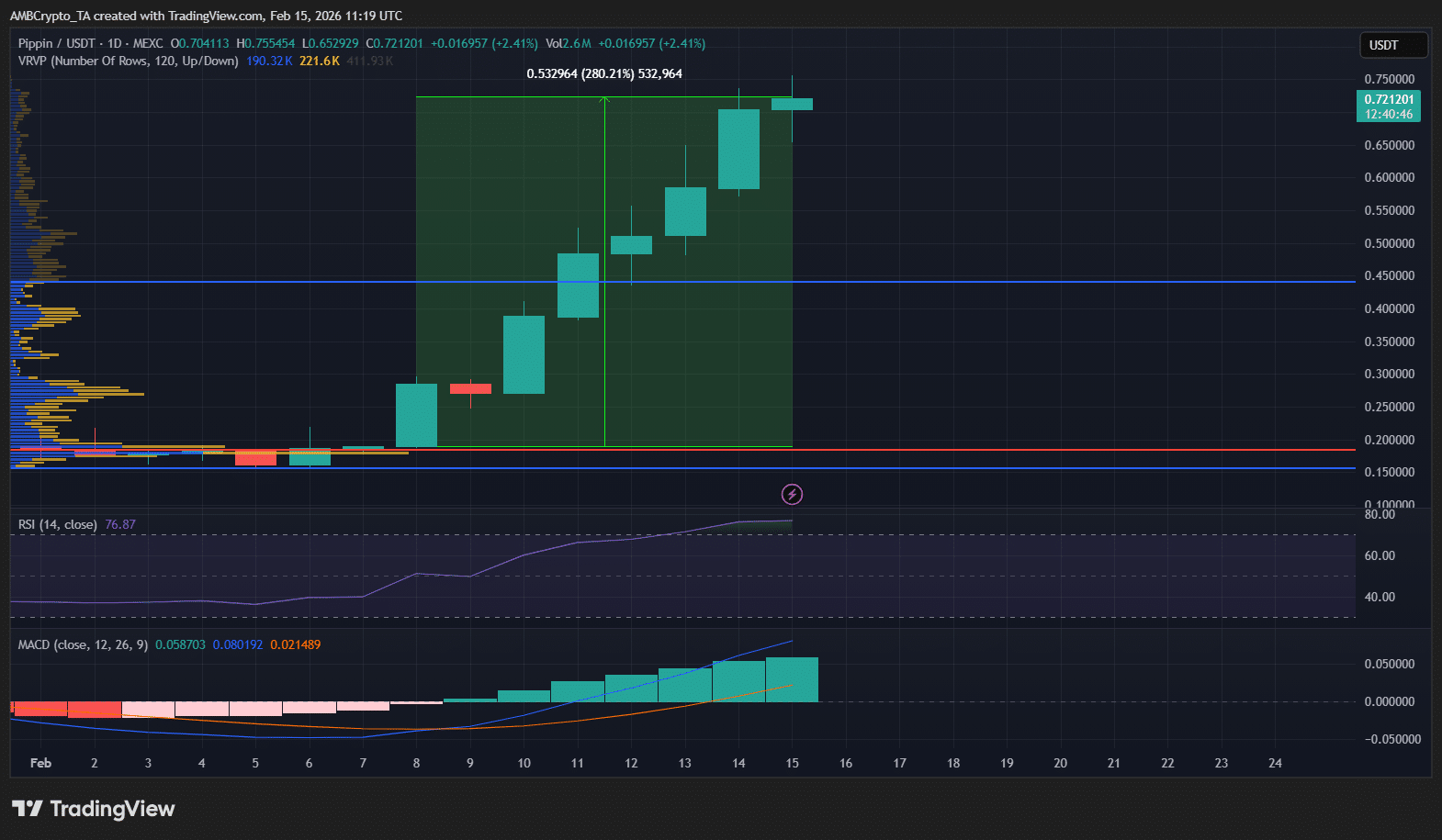
pippin [PIPPIN] has surged from the $0.16-$0.20 accumulation zone to above $0.72, a gain of over 280% in just over a week!

Most trading activity was concentrated near the lower range, which meant that buyers built strong positions before the breakout.

Once price moved above this high-volume area, resistance thinned, and upside movement happened quicker.

RSI showed demand but didn’t show any signs of a reversal. MACD was bullish as well.
Source: TradingView

With rising wallet counts and active incentives, PIPPIN’s rally was pushed by gradual buying. The trend may still have room to continue.

ZCash [ZEC] energized by DCG CEO claims

Zcash [ZEC] rallied 33% this week after Digital Currency Group CEO Barry Silbert said 5% to 10% of Bitcoin [BTC] investments could go into privacy coins in the coming years.

He also called Zcash a project capable of delivering 500x returns!

ZEC surged from around $230 to above $330 before settling at $307. This came after days of consolidation, so investors were buying before the move. RSI was at 51, recovering from weak levels.

Humanity Protocol [H] hits new highs

Humanity Protocol [H] traded near $0.23 after gaining nearly 90% from its recent base around $0.12. The steady series of higher highs and higher lows proves that the spike was supported by buying.

The RSI held above 70, while the MACD stayed bullish.

This growth came alongside Humanity Protocol’s integration with Fireblocks. This development opens access to more than 2,000 financial institutions, allowing professional investors to custody and interact with H.

At the same time, its privacy-focused mainnet and decentralized identity infrastructure are attracting interest.

Other notable winners

Dogecoin [DOGE] went up 18% at the time of writing. Shiba Inu [SHIB] followed with a 12% rise, supported by retail activity. Meanwhile, Pi [PI] led the group with a 30% rally!

Weekly losers

MYX Finance [MYX] drops with sell pressure

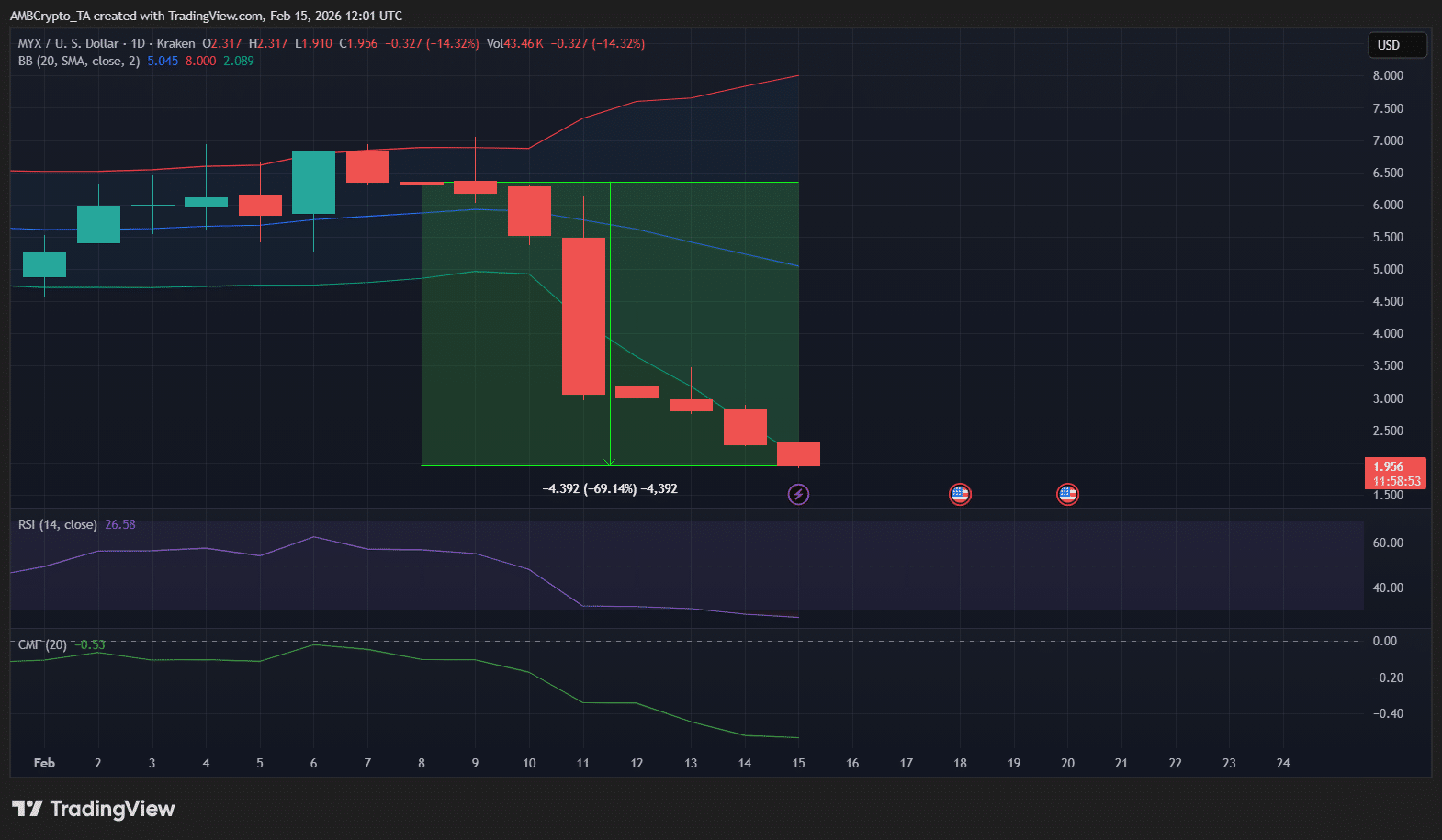
MYX Finance [MYX] fell nearly 70% from around $6.30 to below $2.00, according to the daily chart.

The decline followed a period of consolidation near the upper Bollinger Band, after which price broke down and continued forming lower lows.
Source: TradingView

The RSI dropped to 26, putting MYX deep in oversold territory. At the same time, the CMF was negative, so capital has been exiting.

Unless buyers step in to defend current levels, MYX may continue facing downward pressure in the near term.

Memecore [M] weakens with fading pace

Memecore [M] has come under pressure after failing to hold its early February highs near $1.85. There was a rejection followed by a steady decline, with the price at around $1.27 at press time.

That’s a drop of over 10% in recent sessions.

The token attempted to stabilize between $1.30 and $1.45, but repeated lower highs proved the lack of buyer confidence. RSI slipped to 41.

The earlier rally was met with strong selling at higher levels, forcing M into a consolidation phase.

Aptos [APT] loses its footing

Aptos [APT] slipped from around $1.10 to below $1.00, a steady downtrend before finding weak support near $0.90. While there’s been a small bounce since then, the recovery hasn’t been strong enough to flip the board.

RSI was close to oversold territory at 29. Meanwhile, the OBV was low, so buyers hadn’t returned in full force.

APT is trying to stabilize, but confidence still looks shaky. Unless it can reclaim the $1.00-$1.10 range convincingly, the token may be stuck in a fragile recovery phase.

Other notable losers

Story [IP] fell 6%, while Bitget Token [BGB] dropped 7% with a fading pace. Meanwhile, DoubleZero [2Z] saw the worst decline among the group, sliding 13% as sellers took control.

And that’s the week in crypto!

If there’s always one takeaway, it’s this. Things can flip fast; today’s top gainer can easily become next week’s biggest loser. So, stay curious, stay cautious, and always DYOR before chasing the hype.

We’ll be watching the charts, and we’ll see you next week!


Final Summary

  • PIPPIN jumped 280%, Humanity Protocol rose 90%, and Zcash gained 33%.
  • Market momentum is way beyond major coins.
Next: BONK jumps 11% after channel breakout: Reversal or short squeeze setup?
Share
  • Share
  • Tweet

Crypto di tendenza

Domande pertinenti

QWhat was the main reason for the improved mood in the crypto market this week?

AThe improved mood was due to a U.S. inflation report showing prices rising more slowly, with inflation falling to 2.4%, and a strong labor market raising hopes that the Fed may cut interest rates soon.

QWhich token had the largest percentage gain this week and what was the gain?

APIPPIN had the largest percentage gain, surging over 280% from the $0.16-$0.20 accumulation zone to above $0.72.

QWhat news event catalyzed the 33% rally for ZCash (ZEC)?

AZCash rallied after Digital Currency Group CEO Barry Silbert said 5% to 10% of Bitcoin investments could go into privacy coins in the coming years and called Zcash a project capable of delivering 500x returns.

QWhich token was the biggest loser this week and what was its percentage decline?

AMYX Finance (MYX) was the biggest loser, falling nearly 70% from around $6.30 to below $2.00.

QWhat development contributed to the growth of Humanity Protocol (H) alongside its price increase?

AIts growth came alongside Humanity Protocol's integration with Fireblocks, which opens access to over 2,000 financial institutions, allowing professional investors to custody and interact with H.

Letture associate

From South Korea to the United States: Blue-Collar Jobs Are Becoming Increasingly Popular, Thanks to AI

AI is reshaping the labor market's value proposition. The traditional four-year college degree is losing its appeal as a guaranteed career path, while skilled blue-collar trades like electricians, welders, and plumbers are experiencing historic demand and wage premiums. This shift is driven by dual pressures: AI's displacement of certain white-collar roles and a booming need for physical infrastructure and data center construction. Data confirms the trend. In the U.S., vocational school revenue surged, and a significant portion of recent layoffs are AI-related. Surveys show a majority of Gen Z adults plan to pursue blue-collar work, citing better job security against AI automation. Vocational education interest has exploded recently. Experts cite a psychological shift as younger generations seek tangible, AI-resistant careers and avoid high student debt. In many cases, salaries for skilled trades now match or exceed those requiring a bachelor's degree. In South Korea, semiconductor vocational high schools boast near-total employment, with graduates securing high-paying roles at companies like Samsung. The shortage is structural, exacerbated by a retiring baby boomer workforce and massive infrastructure projects. Companies like JPMorgan Chase, Meta, and Lowe's are investing heavily in training programs. However, overcoming historical stigma and a "perception gap" around trade careers remains a key challenge to closing the talent gap.

marsbit1 h fa

From South Korea to the United States: Blue-Collar Jobs Are Becoming Increasingly Popular, Thanks to AI

marsbit1 h fa

Qualcomm: AI Hype Subsides, When Will Smartphones Emerge from the Gloom?

Qualcomm reported its Q3 FY2026 results (ending June 2026), with revenue of $9.95B, down 4% YoY but above expectations. Gross margin declined to 53.1%, pressured by rising costs across manufacturing and memory. Key business segments showed mixed performance: Handset revenue fell 19.6% YoY to $5.09B, dragged by an 11% decline in non-Apple Android shipments and weaker high-end mix. Conversely, Automotive revenue surged 61% to $1.59B, and IoT grew 9% to $1.83B. Core operating profit dropped 41% YoY due to margin compression and higher expenses. Management's Q4 FY2026 guidance projects revenue of $9.7B-$10.5B, in line with consensus, but Non-GAAP EPS guidance of $2.05-$2.25 fell short of expectations. Amidst persistent weakness in its core handset market, Qualcomm is pursuing growth in AI, focusing on Edge AI (smartphones, PCs, automotive) and Data Center AI. Its data center strategy includes four pillars: AI accelerators (e.g., AI200), commercial CPUs (Dragonfly C1000), custom silicon, and connectivity solutions. While these initiatives initially boosted its stock, concerns over AI capital expenditure sustainability have since erased those gains. The company targets $5B in data center revenue for FY2027 and $15B for FY2029. The report concludes that with the traditional handset business still under pressure, the data center opportunity is currently viewed as a longer-term option, and a more conservative valuation based on core operations may be warranted until AI contributions materialize.

marsbit1 h fa

Qualcomm: AI Hype Subsides, When Will Smartphones Emerge from the Gloom?

marsbit1 h fa

From TPU to Self-Evolving Agents: How Jeff Dean Predicts the Next Step in AI

At the 2026 YC Startup School, Jeff Dean outlined his vision for AI's next phase, shifting focus from simply scaling models to building intelligent, autonomous systems. He believes AI's progress is no longer just about creating smarter models, but about integrating them into systems capable of long-term, iterative work, automated experimentation, and continuous learning. This evolution moves the competition from "who has the bigger model" to "who can best organize intelligence." Dean suggests AI capabilities are now comparable to a junior engineer, enabling the automation of complex workflows. However, the true challenge and opportunity lie in managing these AI "workers" at scale. He emphasizes the importance of **context engineering**—structuring tools, memory, and feedback loops—over raw model power. For startups, this means building deep expertise in niche domains where general models currently fail (near 0-1% success rates), leveraging proprietary data, specialized tools, and domain-specific evaluators. A recurring theme is re-examining fundamental constraints. Dean's past work, like moving Google's search index to memory or creating the TPU, stemmed from questioning outdated assumptions about hardware and cost. He sees similar inflection points today, particularly in **specialized inference hardware** to drastically reduce latency and energy consumption for real-time Agent operation. Notably, he points out that in modern AI systems, the dominant cost is often not computation but **data movement**. Reliable, long-running Agents require robust system design, borrowing concepts from distributed computing like checkpointing, state management, and parallel exploration to handle failures and maintain progress over days or weeks. As AI automates execution, the scarcest human skills will shift to **defining clear specifications**, **judging what problems are worth solving** (taste), and designing effective feedback loops. Ultimately, Dean's framework prioritizes understanding the problem deeply, identifying the true bottlenecks, and systematically building closed-loop systems where AI can not only perform tasks but also improve AI itself.

marsbit1 h fa

From TPU to Self-Evolving Agents: How Jeff Dean Predicts the Next Step in AI

marsbit1 h fa

Trading

Spot

Articoli Popolari

Come comprare ZEC

Benvenuto in HTX.com! Abbiamo reso l'acquisto di Zcash (ZEC) semplice e conveniente. Segui la nostra guida passo passo per intraprendere il tuo viaggio nel mondo delle criptovalute.Step 1: Crea il tuo Account HTXUsa la tua email o numero di telefono per registrarti il tuo account gratuito su HTX. Vivi un'esperienza facile e sblocca tutte le funzionalità,Crea il mio accountStep 2: Vai in Acquista crypto e seleziona il tuo metodo di pagamentoCarta di credito/debito: utilizza la tua Visa o Mastercard per acquistare immediatamente ZcashZEC.Bilancio: Usa i fondi dal bilancio del tuo account HTX per fare trading senza problemi.Terze parti: abbiamo aggiunto metodi di pagamento molto utilizzati come Google Pay e Apple Pay per maggiore comodità.P2P: Fai trading direttamente con altri utenti HTX.Over-the-Counter (OTC): Offriamo servizi su misura e tassi di cambio competitivi per i trader.Step 3: Conserva Zcash (ZEC)Dopo aver acquistato Zcash (ZEC), conserva nel tuo account HTX. In alternativa, puoi inviare tramite trasferimento blockchain o scambiare per altre criptovalute.Step 4: Scambia Zcash (ZEC)Scambia facilmente Zcash (ZEC) nel mercato spot di HTX. Accedi al tuo account, seleziona la tua coppia di trading, esegui le tue operazioni e monitora in tempo reale. Offriamo un'esperienza user-friendly sia per chi ha appena iniziato che per i trader più esperti.

344 Totale visualizzazioniPubblicato il 2024.12.12Aggiornato il 2026.06.02

Come comprare ZEC

Discussioni

Benvenuto nella Community HTX. Qui puoi rimanere informato sugli ultimi sviluppi della piattaforma e accedere ad approfondimenti esperti sul mercato. Le opinioni degli utenti sul prezzo di ZEC ZEC sono presentate come di seguito.

活动图片













