Crypto Markets Catch A Breather As Outflows Begin To Slow: Analysts

bitcoinistPubblicato 2026-02-10Pubblicato ultima volta 2026-02-10

Introduzione

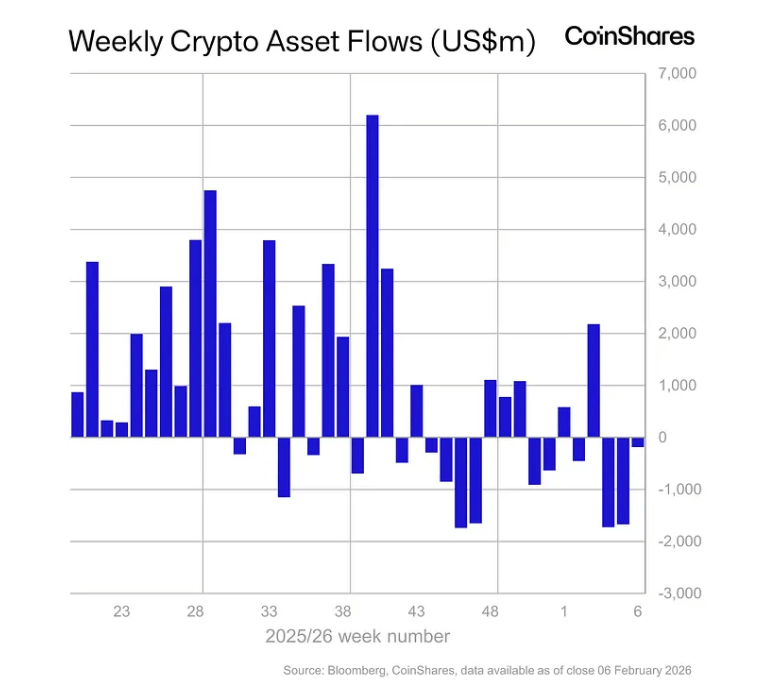
Crypto investment products experienced another week of net outflows, though the pace of withdrawals slowed significantly as prices stabilized. Trading activity reached a record high, with volumes exceeding $63 billion. Bitcoin-focused funds bore the brunt of the outflows, with approximately $264 million withdrawn. Meanwhile, some altcoins like XRP attracted fresh capital, suggesting a partial rotation by investors. Global crypto ETP assets declined to around $130 billion, the lowest since March 2025. Despite the downturn, new product filings, such as 21Shares' ETF application for Ondo, indicate continued industry development amid ongoing political and regulatory influences.

Crypto investment products saw another week of net withdrawals, but the rush out the door slowed sharply as prices found firmer footing. Trading activity stayed heavy, and a handful of altcoins drew fresh interest even while Bitcoin-focused funds lost ground.

Record Trading Activity

According to CoinShares, exchange-traded products logged a record week of trading, with volumes topping $63 billion. That was higher than the prior high set last October.

High turnover was mixed with net selling. James Butterfill, head of research at CoinShares, said a change in the speed of withdrawals can be more revealing than the raw outflows themselves.

Market watchers took that as a hint that investor mood might be shifting after several rough weeks.

Source: CoinShares
Bitcoin Takes The Brunt

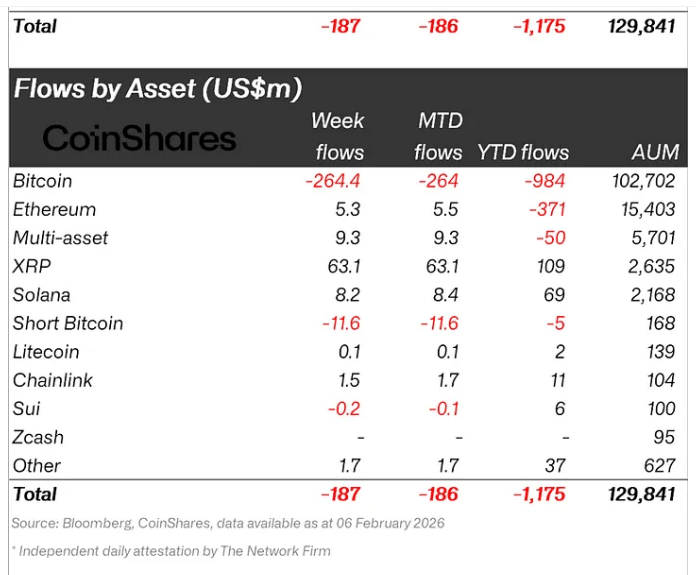
Bitcoin-linked ETPs were the main source of outflows. Reports say Bitcoin funds saw withdrawals around $264 million while spot Bitcoin ETFs accounted for about $318 million of that move, based on SoSoValue data.

The token’s price briefly touched $60,000 last Thursday on Coinbase, marking its lowest point since November 2024. That drop clearly weighed on funds tied directly to Bitcoin exposure.
Source: CoinShares

Altcoins Attract Some Fresh Capital

XRP led the inflows, drawing $63 million. Ether and Solana-linked products picked up smaller amounts, attracting $5.3 million and $8.2 million, respectively.

The flow mix suggests some investors are trimming big Bitcoin positions and shifting small slices into other tokens. That behavior was visible even as overall assets under management slid.

BTCUSD trading at $69,061 on the 24-hour chart: TradingView

Crypto AUM And Year-To-Date Flows

Global crypto ETP assets fell to close to $130 billion by week’s end, the lowest since March 2025. Bitcoin ETP AUM stood at about $102.7 billion, while ETF totals fell below $90 billion.

After three consecutive weeks of withdrawals, crypto ETPs have shed roughly $1.2 billion year-to-date, compared with almost $2 billion pulled from Bitcoin ETFs over the same span.

Industry Moves Continue

Beyond flows and prices, the market kept adding new product filings. Reports note that 21Shares filed with the US Securities and Exchange Commission for an ETF tied to Ondo. That kind of filing shows issuers still see demand for more varied crypto tools even in a cooling period.

Political signals have also been part of the backdrop. Markets remain sensitive to comments from US political figures, including US President Donald Trump, and to US regulatory talk that can shape investor appetite.

Featured image from TalkShop, chart from TradingView

Domande pertinenti

QWhat was the main reason analysts suggested a potential shift in investor sentiment despite continued outflows from crypto investment products?

AAnalysts pointed to the sharp slowdown in the speed of withdrawals as a more revealing indicator than the raw outflow numbers, hinting that investor mood might be shifting after several rough weeks as prices found firmer footing.

QWhich cryptocurrency's investment products were the primary source of outflows, and what was the approximate amount withdrawn from its ETFs according to SoSoValue data?

ABitcoin-linked ETPs were the main source of outflows. Spot Bitcoin ETFs accounted for approximately $318 million in withdrawals.

QWhich altcoin led the inflows for the week, and how much capital did it attract?

AXRP led the inflows for the week, attracting $63 million in fresh capital.

QWhat was the total value of assets under management (AUM) for global crypto ETPs by the end of the week, and what was significant about this level?

AGlobal crypto ETP assets fell to close to $130 billion by week’s end, which was the lowest level since March 2025.

QBeyond market flows, what action did 21Shares take that indicates continued issuer interest in new crypto products?

A21Shares filed with the US Securities and Exchange Commission for an ETF tied to Ondo, showing that issuers still see demand for more varied crypto tools even during a cooling period.

Letture associate

Behind Musk and Huang Jen-hsun's 'AI Factories', an Unseen Battle for Freshwater Has Begun

Behind the "AI factories" of Elon Musk and Jensen Huang lies a hidden battle for a critical resource: fresh water. As AI models like ChatGPT and Claude process billions of prompts daily, they consume vast amounts of water for cooling. By 2030, global AI infrastructure is projected to use 9.3 trillion liters annually—enough to meet the basic needs of 1.3 billion people. This "water grab" stems from the massive heat generated by high-powered GPUs. Over 70% of data centers use evaporative cooling systems, where water absorbs heat and evaporates into the atmosphere, depleting local groundwater. Training models like GPT-4 can consume over 600 million liters of water. Tech giants like Google and Microsoft report skyrocketing water usage, sparking conflicts with local communities over resources. A flashpoint occurred in Memphis, Tennessee, where Musk's xAI built the Colossus supercomputer. It draws nearly 3.8 million liters of drinking water daily from local aquifers, leading to public outrage and legal action. In response, xAI is building an $80 million water recycling plant to use treated wastewater instead. Facing pressure, companies like Microsoft promote "waterless" closed-loop cooling systems. However, these systems increase electricity consumption by 20-30%, shifting the water burden to power plants, which require immense cooling water themselves—a case of indirect water footprint transfer. For China's AI industry, this crisis offers a strategic warning and opportunity. Instead of replicating the West's resource-intensive model, China can leverage its "East Data, West Computing" policy to locate data centers in cooler, water-rich regions like Guizhou. Furthermore, developing lightweight edge computing for smart homes and embodied AI robots can drastically reduce the need for constant cloud queries, cutting both water and energy consumption at the source. The freshwater war underscores a fundamental question: Will AI be a tool for human advancement or a silicon-based monster competing for our planet's last drops of clean water? The answer is becoming clearer as the water vapor rises.

marsbit21 min fa

Behind Musk and Huang Jen-hsun's 'AI Factories', an Unseen Battle for Freshwater Has Begun

marsbit21 min fa

AGI is Just One Step Away

The article discusses Anthropic's release of the Fable 5 model, a heavily restricted version of its powerful Mythos model. Initially unveiled in April, Mythos reportedly identified over 10,000 high-risk vulnerabilities for 50 enterprise clients, causing significant concern. Due to its dangerous capabilities in areas like autonomous cyber-attacks and biochemical weapons design guidance (classified as CB-1 level), the unaltered Mythos 5 remains limited to about 200 vetted entities like government agencies. Fable 5, released with a safety classifier, demonstrates extraordinary performance, leading benchmarks in coding (SWE-Bench Pro), software engineering, and research. It exhibits true "long-horizon agency," autonomously planning and executing complex, multi-step tasks like migrating 50 million lines of code in a day, moving beyond simple question-answering. The article positions Fable 5 at OpenAI's Level 3 ("Agent") and progressing toward Level 4 ("Innovator"), suggesting AGI (Artificial General Intelligence) is within reach, potentially 18-24 months away. To mitigate risks, Anthropic implemented a two-layer safety "cage": a silent routing system that redirects dangerous queries to a weaker model, and a mandatory 30-day data retention policy for all Mythos traffic to detect patterns of malicious use. Despite its high cost ($10/$50 per million input/output tokens), the model targets the enterprise market, where its unparalleled productivity and defensive capabilities against AI-powered cyber threats justify the premium. This signals a market maturation where top-tier AI becomes a strategic, high-value tool for businesses, potentially widening the gap with consumer-focused models and accelerating the rise of "one-person companies" while disrupting labor markets.

marsbit33 min fa

AGI is Just One Step Away

marsbit33 min fa

AI Investors' 2026 Anxiety: When Models Devour Everything, What Moat Is Left for Startups?

In 2026, a wave of investor anxiety questions the defensibility of AI startups as models improve, fearing that most companies are just "thin wrappers" destined to be absorbed by foundation models or chipmakers. The author argues against this despair, positing that true moats lie not in benchmark performance but in areas models cannot easily reach. The logic of despair is that if models excel at all measurable tasks, only compute and cutting-edge model weights hold lasting value. However, the essay contends that the most valuable work is inherently "untrainable." Benchmarks measure what can be measured and thus optimized for, but real-world correctness often resides in private, complex systems. Examples include legacy codebases, intricate legal transactions, or hospital workflows. This kind of correctness is proprietary, costly to establish, and cannot be validated quickly—it requires time and trust within an organization. As models commodify visible, measurable tasks from both above (labs absorbing scaffolding) and below (saturation by cheaper models), value shifts to "untrainable ground." This encompasses work where correctness is a private truth, locked behind integration barriers, licenses, liability frameworks, and entrenched user habits. Trust and adoption are slow, human-centric processes that smarter models cannot accelerate. Successful companies defend their position by embedding deeply into client operations, owning the definition of "good" within a specific domain (e.g., Harvey in law, OpenEvidence in medicine), and pricing on outcomes rather than tokens. While labs compete fiercely, they are incentivized to keep the application layer vibrant. The future belongs not to those competing on generic benchmarks but to those navigating unscoreable terrain, doing the "unsexy work" of translation between models and messy human realities. The most cited benchmark scores are thus maps of territory about to become worthless, signaling who will lose the right to define what counts as good.

marsbit2 h fa

AI Investors' 2026 Anxiety: When Models Devour Everything, What Moat Is Left for Startups?

marsbit2 h fa

Trading

Spot
Futures
活动图片





