Crypto Market Infrastructure Is Unprecedentedly Perfect, So Why Has the Investment Environment Hit Rock Bottom?

比推Pubblicato 2026-01-28Pubblicato ultima volta 2026-01-28

Introduzione

The crypto market infrastructure and regulatory environment are more robust than ever, yet the investment climate is arguably at its worst. Arca CIO Jeff Dorman critiques the industry's failed attempt to position cryptocurrencies as broad macro trading tools, which has led to extreme correlation among all crypto assets, eroding differentiation. While assets like gold and silver have recently outperformed Bitcoin, the industry continues to neglect token subtypes that function like equities—such as DePIN, DeFi, and CeFi tokens—which generate actual cash flows and could appeal to traditional investors managing over $600 trillion in assets. Dorman calls for a return to fundamental analysis, emphasizing that tokens are merely a "wrapper" and that their underlying value drivers, sectors, and economic models should be the focus, rather than treating all cryptocurrencies as a single asset class. The current high correlation and lack of dispersion in returns have made the investment landscape dull compared to the healthier, more nuanced market of 2020-2021.

Author: Jeff Dorman (Arca CIO)

Compiled by: Deep Tide TechFlow

Original title: The Crypto Market Five Years Ago Was Actually Healthier Than Now


Deep Tide Introduction:

Is the crypto market becoming increasingly dull? Arca Chief Investment Officer Jeff Dorman writes that although infrastructure and regulatory environments have never been stronger, the current investment environment is the "worst in history."

He sharply criticizes industry leaders' failed attempts to forcibly transform cryptocurrencies into "macro trading tools," leading to extreme convergence in correlations among various assets. Dorman calls for a return to the essence of "tokens as securities packaging," focusing on equity-like assets such as DePIN and DeFi that have cash flow generation capabilities.

At a time when gold is surging while Bitcoin is relatively weak, this in-depth reflective article provides an important perspective for re-examining Web3 investment logic.

Full text below:

Bitcoin is facing an unfortunate situation

Most investment debates exist because people are on different time horizons, so they often "talk past each other," even though technically both sides are correct. Take the debate between gold and Bitcoin as an example: Bitcoin enthusiasts tend to say that Bitcoin is the best investment because its performance over the past 10 years has far exceeded that of gold.
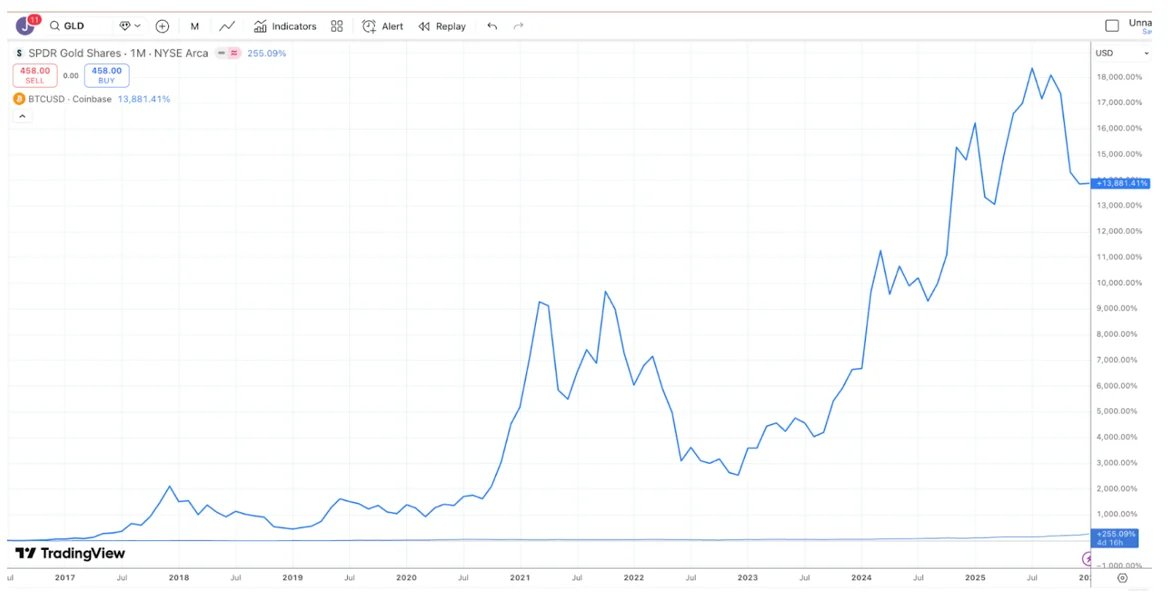
Caption: Source TradingView, comparison of Bitcoin (BTC) vs. gold (GLD) returns over the past 10 years

Gold investors, on the other hand, tend to believe that gold is the best investment and have recently been "mocking" Bitcoin's weakness, as gold has significantly outperformed Bitcoin over the past year (the same goes for silver and copper).
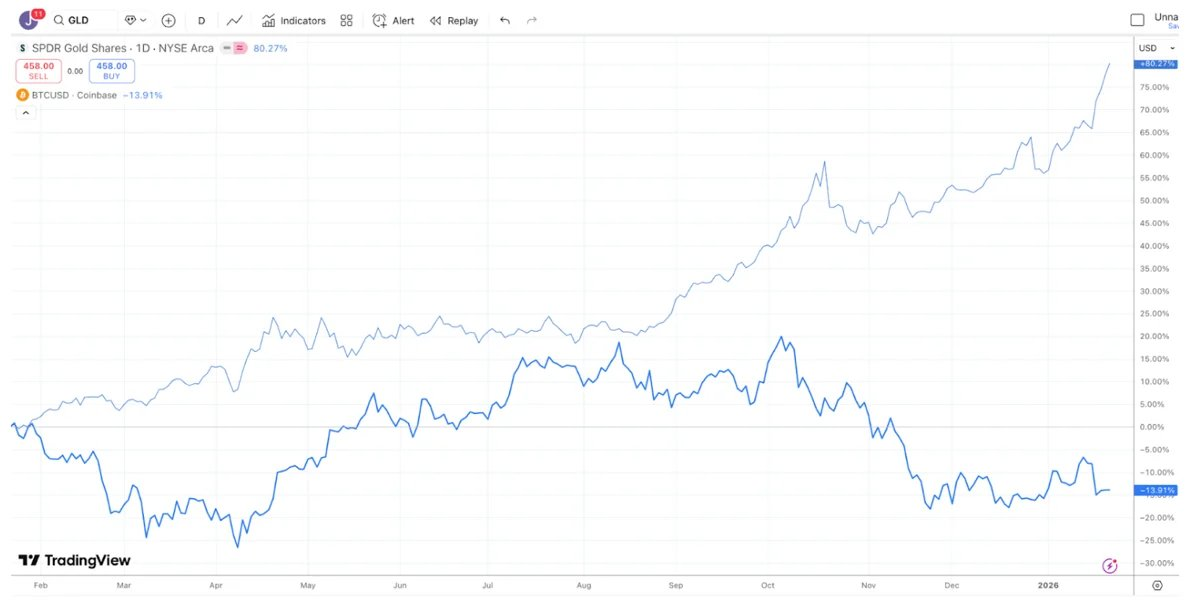
Caption: Source TradingView, comparison of Bitcoin (BTC) vs. gold (GLD) returns over the past 1 year

Meanwhile, over the past 5 years, the returns of gold and Bitcoin have been almost identical. Gold tends to do nothing for long periods, then skyrocket when central banks and trend followers buy; Bitcoin tends to have sharp rallies followed by significant crashes but ultimately moves higher.
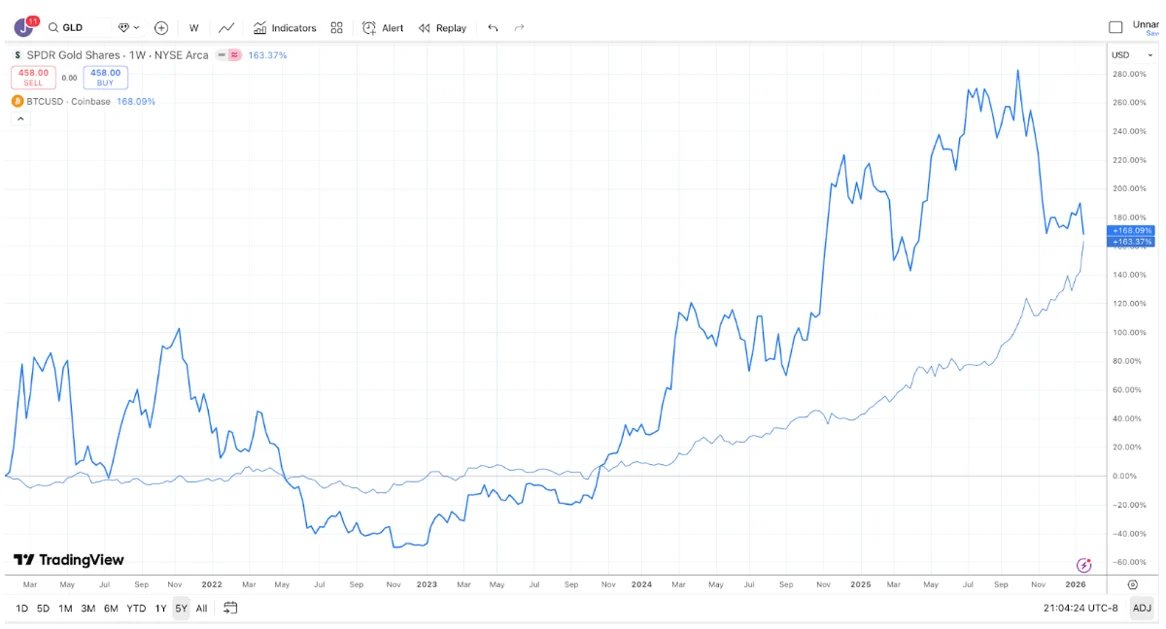
Caption: Source TradingView, comparison of Bitcoin (BTC) vs. gold (GLD) returns over the past 5 years

Therefore, depending on your investment horizon, you can almost win or lose any argument about Bitcoin vs. gold.

Even so, it's undeniable that recently gold (and silver) have shown strength relative to Bitcoin. To some extent, this is somewhat ironic (or pathetic). The largest companies in the crypto industry have spent the past 10 years trying to cater to macro investors rather than true fundamental investors, and now these macro investors are saying, "Never mind, we'll just buy gold, silver, and copper instead." We have long called for a shift in the industry's thinking. There are over $600 trillion in entrusted assets, and the buyers of these assets are a much stickier investor base. There are many digital assets that look more like bonds and stocks, issued by companies that generate revenue and conduct token buybacks, yet market leaders have, for some reason, decided to ignore this token sub-sector.

Perhaps Bitcoin's recent poor performance relative to precious metals will be enough for large brokers, exchanges, asset managers, and other crypto leaders to realize that their attempt to turn cryptocurrencies into an all-encompassing macro trading tool has failed. Instead, they might start focusing on and educating that $600 trillion pool of investors who prefer to buy cash-flow generating assets. It's not too late for the industry to start paying attention to those quasi-equity tokens that carry cash-flow generating tech businesses (like various DePIN, CeFi, DeFi, and token issuance platform companies).

Then again, if you just keep moving the "finish line," Bitcoin is still king. So, more likely than not, nothing will change.

Asset Differentiation

The "good old days" of crypto investing seem like a thing of the past. Back in 2020 and 2021, it seemed like every month brought a new narrative, sector, use case, and new type of token, with positive returns coming from all corners of the market. Although the growth engines of blockchain have never been stronger (thanks to legislative progress in Washington, stablecoin growth, DeFi, and RWA tokenization), the investment environment has never been worse.

A sign of market health is dispersion and low cross-market correlation. You want healthcare and defense stocks to move differently from tech and AI stocks; you want emerging market stocks to move independently of developed markets. Dispersion is generally seen as a good thing.

2020 and 2021 are largely remembered as "everything goes up" markets, but that wasn't entirely true. It was rare to see the entire market move in lockstep. More commonly, one sector would rise while another fell. Gaming surged while DeFi might have been falling; DeFi surged while "Dino" L1 tokens fell; Layer-1s surged while the Web3 sector fell. A diversified crypto portfolio actually smoothed returns and often lowered the overall portfolio's beta and correlation. Liquidity came and went as interest and demand shifted, but performance was diverse. This was very exciting. The massive inflow into crypto hedge funds in 2020 and 2021 made sense because the investable universe was expanding and returns were differentiated.

Fast forward to today, and the returns of all "crypto-wrapped" assets look identical. Since the flash crash on October 10th, the declines across sectors are almost indistinguishable. No matter what you hold, or how the token captures economic value, or what the project's trajectory is... the returns are largely the same. This is very frustrating.
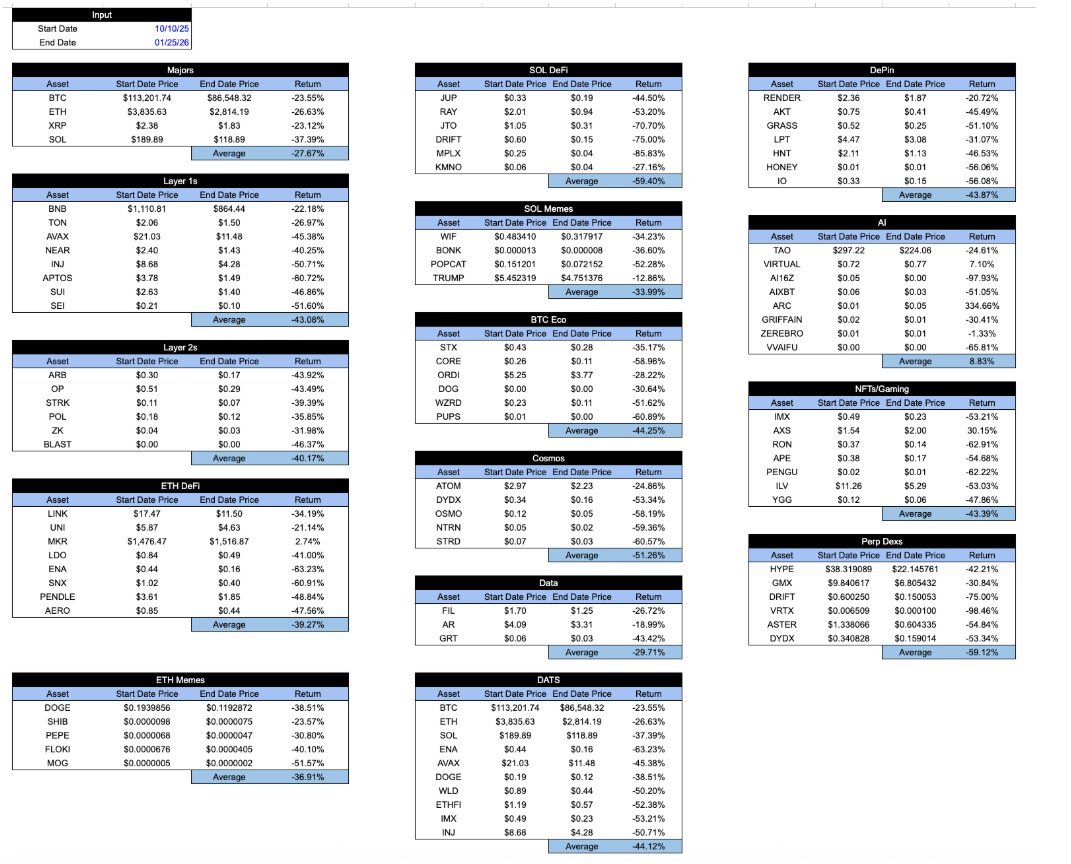
Caption: Arca internal calculations and CoinGecko API data for a sample of representative crypto assets

During market booms, this table looks slightly more encouraging. "Good" tokens tend to outperform "bad" tokens. But a healthy system should actually be the opposite: you want good tokens to perform better during bad times, not just during good times. Here is the same table from the low on April 7th to the high on September 15th.
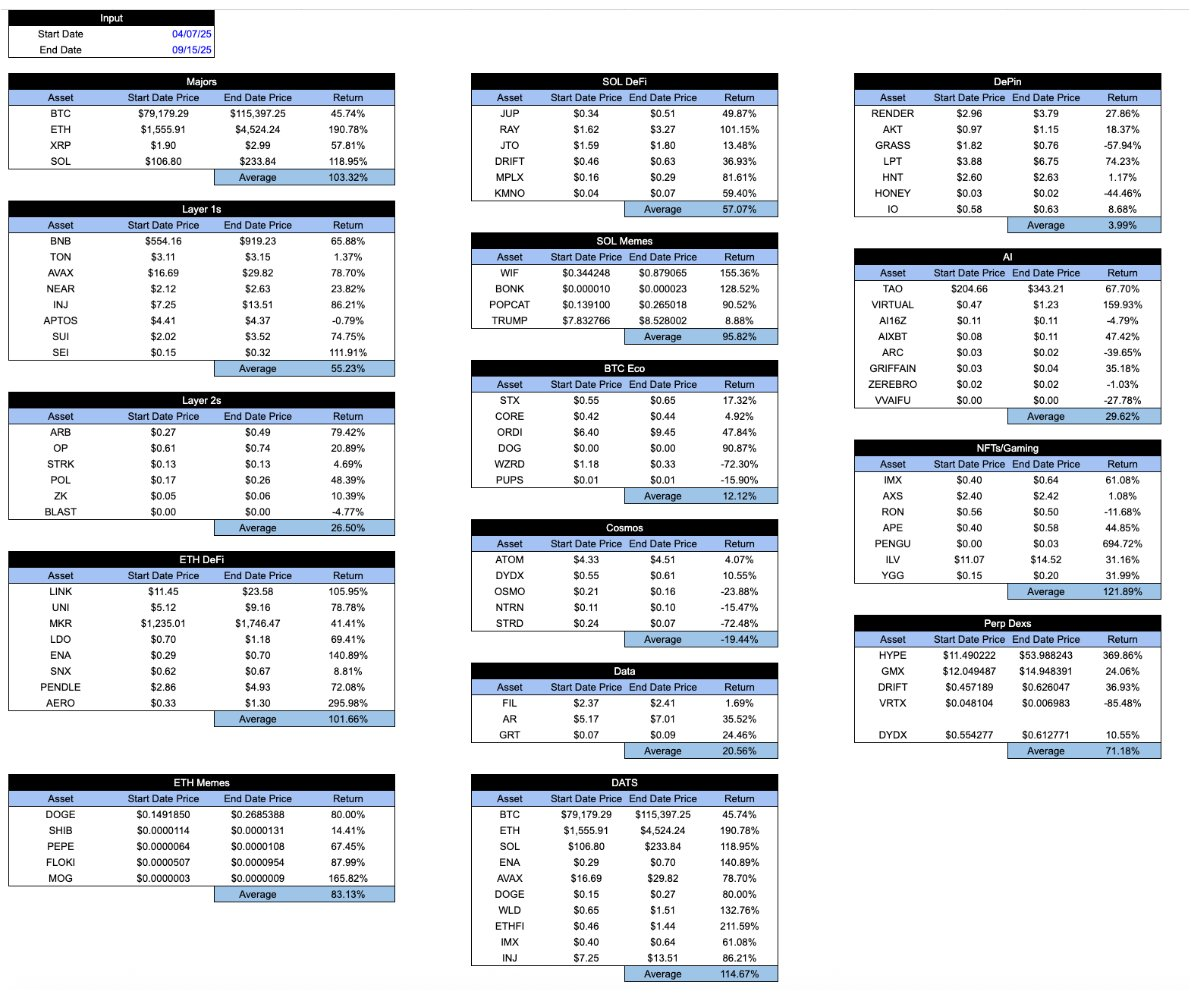
Caption: Arca internal calculations and CoinGecko API data for a sample of representative crypto assets

Interestingly, when the crypto industry was in its infancy, market participants worked very hard to differentiate between different types of crypto assets. For example, I published an article in 2018 where I categorized crypto assets into 4 types:

  1. Cryptocurrencies/money

  2. Decentralized protocols/platforms

  3. Asset-backed tokens

  4. Pass-through securities

At the time, this classification method was quite unique and attracted many investors. Importantly, crypto assets were evolving, from just Bitcoin, to smart contract protocols, asset-backed stablecoins, to equity-like pass-through securities. Researching different growth areas was a major source of alpha, and investors wanted to understand the various valuation techniques required to assess different asset types. Most crypto investors back then didn't even know when unemployment data was released or when FOMC meetings were held, and rarely looked to macro data for signals.

After the 2022 crash, these different types of assets still exist. Nothing has fundamentally changed. But there has been a huge change in how the industry markets itself. The "gatekeepers" decided that Bitcoin and stablecoins were the only things that mattered; the media decided they didn't want to write about anything except TRUMP tokens and other memecoins. Over the past few years, not only has Bitcoin outperformed most other crypto assets, but many investors have even forgotten these other asset types (and sectors) exist. The business models of the underlying companies and protocols haven't become less relevant, but the assets themselves have become more correlated due to investor flight and market makers dominating price action.

This is why Matt Levine's recent article about tokens was so surprising and well-received. In just 4 short paragraphs, Levine accurately described the differences and nuances between various tokens. It gives me some hope that this kind of analysis is still possible.
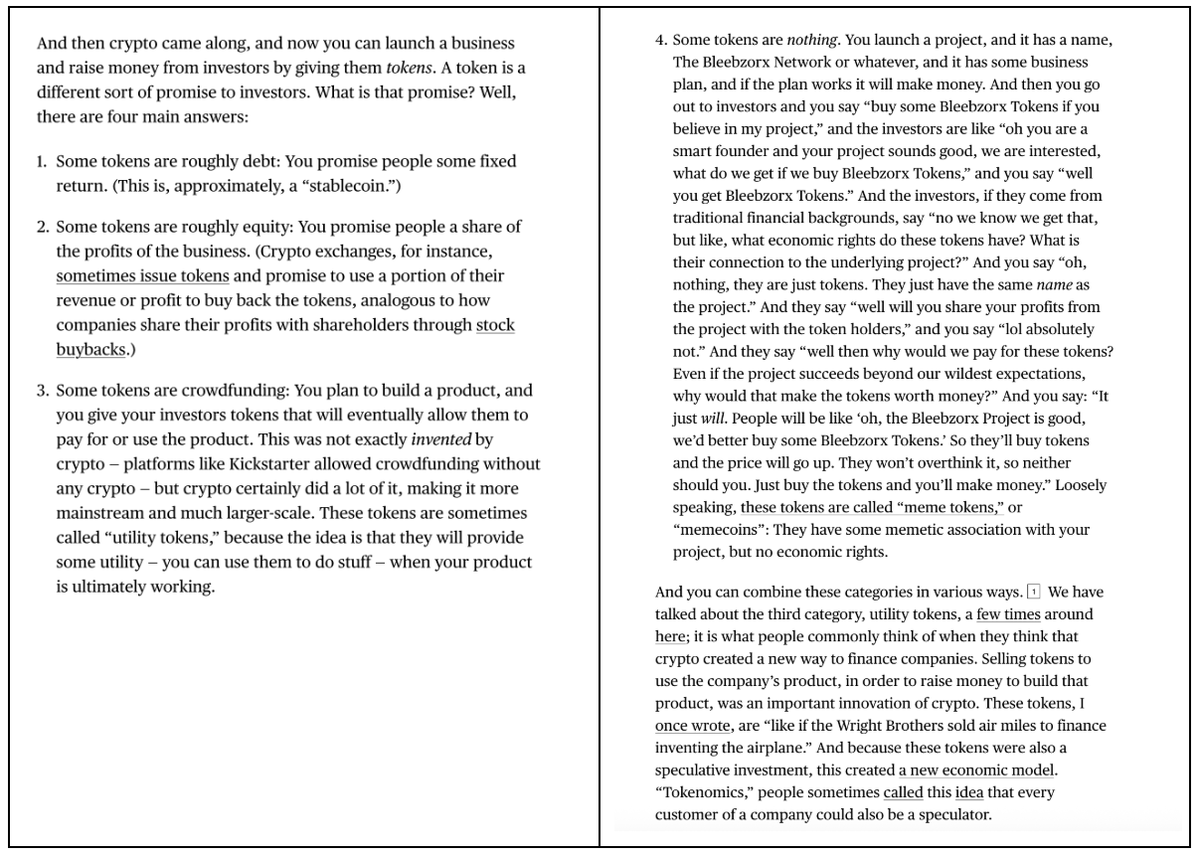
The leading crypto exchanges, asset managers, market makers, OTC desks, and pricing services still call everything besides Bitcoin an "altcoin" and seem to only write macro research, bundling all "cryptocurrencies" together as one giant asset. Take Coinbase, for example – they seem to have only a very small research team led by one primary analyst (David Duong) whose focus is primarily on macro research. I have nothing against Mr. Bitcoin (Mr. Duong) – his analysis is excellent. But who goes to Coinbase specifically for macro analysis?

Imagine if leading ETF providers and exchanges only wrote generically about ETFs, saying things like "ETFs are down today!" or "ETFs react negatively to inflation data." They would be laughed out of business. Not all ETFs are the same just because they use the same "wrapper," and those selling and promoting ETFs understand this. What's inside the ETF matters most, and investors seem to be able to intelligently differentiate between ETFs, mainly because industry leaders help their clients understand this.

Similarly, a token is just a "wrapper." As Matt Levine eloquently described, what's inside the token matters. The type of token matters, the sector matters, its properties (inflationary or amortizing) matter.

Perhaps Levine isn't the only one who understands this. But he does a better job explaining the industry than those who actually profit from it.


Twitter:https://twitter.com/BitpushNewsCN

Bitpush TG Discussion Group:https://t.me/BitPushCommunity

Bitpush TG Subscription: https://t.me/bitpush

Original link:https://www.bitpush.news/articles/7606655

Domande pertinenti

QWhy does the author believe the current crypto investment environment is the 'worst ever' despite strong infrastructure and regulation?

AThe author believes the investment environment is poor because all crypto assets have become highly correlated and move in lockstep, eliminating dispersion and differentiation. Market leaders have focused excessively on marketing crypto as a macro tool rather than educating investors about fundamental differences between asset types, causing a loss of alpha opportunities and making diversified portfolios ineffective.

QWhat is the main criticism the author has against crypto industry's attempt to appeal to macro investors?

AThe main criticism is that the industry's attempt to position crypto as a broad macro trading tool has failed, as macro investors are instead choosing traditional assets like gold and silver. The author argues the industry should instead focus on educating the massive $600 trillion pool of investors who prefer cash-flow generating, quasi-equity tokens that resemble stocks and bonds.

QHow does the author contrast the market behavior of 2020-2021 with the current market?

AIn 2020-2021, the market had healthy dispersion where different sectors (e.g., Gaming, DeFi, Layer-1s) moved independently, allowing for diversified portfolios to smooth returns. Today, all crypto assets are highly correlated and move uniformly, regardless of their fundamentals or value capture mechanisms, making the market monotonous and frustrating for investors.

QWhat does the author suggest is the key to improving the investment landscape for crypto assets?

AThe author suggests returning to the essence of tokens as 'securities wrappers' and focusing on fundamental analysis of what is inside the token—such as cash-flow generating businesses in DePIN, DeFi, or token issuance platforms—rather than treating all crypto as a homogeneous macro asset. Industry leaders should educate investors on these nuances.

QWhy does the author reference Matt Levine's article on tokens?

AThe author references Matt Levine's article because it accurately describes the differences and nuances between various token types in just a few paragraphs, highlighting that what matters is the content inside the token wrapper. This gives hope that nuanced analysis is still possible and needed, contrasting with the industry's current homogenized approach.

Letture associate

Has the 'Digital Gold' Narrative for BTC Failed?

**Title: Has the "Digital Gold" Narrative for Bitcoin Failed?** The article argues that Bitcoin's "digital gold" narrative remains valid despite a recent sharp price decline (from a peak near $126k in Oct 2025 to briefly under $61k in Feb 2026). It presents a long-term investment framework based on three core points: **1. Viewing Bitcoin as an Asset:** Bitcoin is presented as a superior potential store of value compared to gold. Key arguments are its absolute scarcity (21 million cap), superior portability, and transparent auditability via its public ledger. While acknowledging its current use in early, volatile stages (~3-4% global adoption), the author draws parallels to the early, disruptive phases of the internet and e-commerce. **2. Understanding the Recent Downturn:** The current ~50% correction is framed as a predictable, consensus-driven cycle following its post-halving peak (the 2024 halving preceded the Oct 2025 high). A crucial factor is a historic "changing of hands": the influx of new institutional buyers via ETFs allowed early, low-cost holders (miners, OG believers) to take profits. The author notes that while severe, Bitcoin's historical drawdowns (e.g., 93% in 2011, 77% in 2021-22) have been progressively smaller, suggesting maturing holder structure and decreasing volatility over time. **3. The Long-Term Perspective:** The long-term thesis hinges on Bitcoin capturing a portion of gold's market value. With Bitcoin's market cap at ~$1.4 trillion (at $70k) versus gold's ~$20 trillion, significant upside potential exists if the "digital gold" narrative is partially realized. However, the author strongly cautions that short-term risks remain, the bottom is unpredictable, and high volatility is inherent. The real risk is not Bitcoin failing but poor personal position management (over-leverage, wrong capital) and a lack of deep understanding, which can force investors out during severe downturns. The conclusion uses Amazon's 95% crash post-2000 dot-com bubble and subsequent 42x recovery as an analogy. The ultimate question is not if Bitcoin's price will rise, but if an investor's strategy and conviction can withstand the volatility to see the long-term play out. The recent divergence (gold up, Bitcoin down) is posed not as a narrative failure, but as potential evidence of this ongoing, painful transition from a speculative asset to a mainstream allocation.

marsbit6 h fa

Has the 'Digital Gold' Narrative for BTC Failed?

marsbit6 h fa

Has BTC's 'Digital Gold' Narrative Failed?

The article discusses Bitcoin's "digital gold" narrative, its recent price drop, and long-term outlook through the perspective of "Jason". It argues the narrative is not a failure but that Bitcoin represents a superior, new asset class due to its fixed supply (21 million), portability, and auditability. The piece compares its current ~3-4% global adoption rate to early internet/e-commerce, suggesting significant growth potential. Regarding the 2025-2026 price decline (from ~$126k to briefly under $61k), the author views it as a predictable, consensus-driven sell-off within Bitcoin's ~4-year cycle post-halving, exacerbated by a major "handover" from early, low-cost holders to new institutional buyers via ETFs. A key observation is that historical peak-to-trough drawdowns have lessened over time (e.g., 93% in 2011 to ~50% in 2026), indicating maturing volatility as holder structure changes. For the long term, the author uses a simple framework: Bitcoin's total market cap (~$1.4T at $70k) is only about 7% of gold's (~$20T). Even capturing 30-50% of gold's value would imply substantial upside. However, the article strongly cautions against viewing this as investment advice, emphasizing extreme volatility and the critical importance of risk management, position sizing, and deep fundamental understanding to survive severe drawdowns. It concludes by drawing a parallel to Amazon's 95% crash in 2000 and subsequent 42x recovery, stressing that the key is surviving market cycles to realize long-term potential.

链捕手6 h fa

Has BTC's 'Digital Gold' Narrative Failed?

链捕手6 h fa

From Code to Cognition: A Ten-Thousand-Word Guide to the Evolution of the Robot Brain

"From Code to Cognition: The Evolution of Robot Brains" The journey of robotic intelligence has shifted dramatically from manually coded systems to AI-driven brains. For decades, robots relied on layered software stacks—perception, state estimation, planning, control—each handcrafted. While predictable, they lacked adaptability. The 2010s saw deep learning revolutionize perception (e.g., object detection) and control (via reinforcement learning), but learned skills remained narrow. The arrival of Large Language Models (LLMs) marked a turning point. LLMs acted as high-level planners, interpreting natural language instructions and generating sequences of actions for traditional robotic systems to execute. However, true integration came with Visual-Language-Action (VLA) models, which fused vision, language, and motion prediction into a single network. Pioneered by models like RT-2 and open-source projects like OpenVLA, VLAs enable robots to reason and act directly from visual input and commands. The most advanced humanoid robots now employ a "dual-brain" architecture: a slow-thinking, large VLA (System 2) for reasoning and planning, and a fast-reacting, small network (System 1) for high-frequency motion control, sometimes with an even lower-level System 0 for balance. This split balances cognition with the physics of real-time movement. Computation is split between onboard hardware (e.g., NVIDIA Jetson) for safety-critical control loops and cloud/edge servers for non-critical tasks like learning and interfaces. A crucial driver is the open-source ecosystem—models like GR00T and OpenVLA allow startups to build upon pre-trained brains and fine-tune them with their own data, accelerating development. Despite progress, current systems struggle with recovery from errors, sample inefficiency, and long-horizon tasks. This has spurred the rise of **World Models**—neural networks that predict the consequences of actions. By simulating possible futures before acting (like NVIDIA Cosmos or Meta V-JEPA), robots can plan, recover, and generalize better. This represents the next frontier: shifting intelligence from learned reactions to an internal model of physics and cause-and-effect. The field is rapidly evolving. While not yet at its "ChatGPT moment," the convergence of cheaper hardware, scalable simulation, and world models points toward robots that are increasingly capable, adaptive, and useful. The question is shifting from "what can robots do?" to "what *should* they do?"

marsbit7 h fa

From Code to Cognition: A Ten-Thousand-Word Guide to the Evolution of the Robot Brain

marsbit7 h fa

Trading

Spot
Futures

Articoli Popolari

Come comprare ROCK

Benvenuto in HTX.com! Abbiamo reso l'acquisto di Rock Dao (ROCK) semplice e conveniente. Segui la nostra guida passo passo per intraprendere il tuo viaggio nel mondo delle criptovalute.Step 1: Crea il tuo Account HTXUsa la tua email o numero di telefono per registrarti il tuo account gratuito su HTX. Vivi un'esperienza facile e sblocca tutte le funzionalità,Crea il mio accountStep 2: Vai in Acquista crypto e seleziona il tuo metodo di pagamentoCarta di credito/debito: utilizza la tua Visa o Mastercard per acquistare immediatamente Rock DaoROCK.Bilancio: Usa i fondi dal bilancio del tuo account HTX per fare trading senza problemi.Terze parti: abbiamo aggiunto metodi di pagamento molto utilizzati come Google Pay e Apple Pay per maggiore comodità.P2P: Fai trading direttamente con altri utenti HTX.Over-the-Counter (OTC): Offriamo servizi su misura e tassi di cambio competitivi per i trader.Step 3: Conserva Rock Dao (ROCK)Dopo aver acquistato Rock Dao (ROCK), conserva nel tuo account HTX. In alternativa, puoi inviare tramite trasferimento blockchain o scambiare per altre criptovalute.Step 4: Scambia Rock Dao (ROCK)Scambia facilmente Rock Dao (ROCK) nel mercato spot di HTX. Accedi al tuo account, seleziona la tua coppia di trading, esegui le tue operazioni e monitora in tempo reale. Offriamo un'esperienza user-friendly sia per chi ha appena iniziato che per i trader più esperti.

158 Totale visualizzazioniPubblicato il 2024.12.13Aggiornato il 2026.06.02

Come comprare ROCK

Discussioni

Benvenuto nella Community HTX. Qui puoi rimanere informato sugli ultimi sviluppi della piattaforma e accedere ad approfondimenti esperti sul mercato. Le opinioni degli utenti sul prezzo di ROCK ROCK sono presentate come di seguito.

活动图片