Crypto 'Guardian' Rings the Bell at the New York Stock Exchange

比推Pubblicato 2026-01-22Pubblicato ultima volta 2026-01-22

Introduzione

BitGo ($BTGO), a leading cryptocurrency custody provider, went public on the New York Stock Exchange on January 22, pricing its IPO at $18 per share. The stock opened at $22.43, rising about 25% on its first day, giving the company a valuation of approximately $2 billion. Founded in 2013 by Mike Belshe, BitGo pioneered multi-signature wallet technology and later became a regulated trust company, positioning itself as a key infrastructure provider for institutional investors. Its core business revolves around custody services, staking, trading, and stablecoin-as-a-service offerings. In 2025, BitGo generated an estimated $195.9 million in core economic revenue, with nearly half coming from high-margin subscription services. The company serves over 4,900 institutional clients and has become a critical backend provider for major Bitcoin and Ethereum ETFs. Notably, BitGo tokenized its stock on the same day as its IPO through a partnership with Ondo Finance, enabling trading on Ethereum, Solana, and BNB Chain and bridging traditional finance with DeFi. The successful IPO reflects growing investor confidence in crypto infrastructure companies with sustainable business models and regulatory compliance, signaling continued maturation in the digital asset industry.

Crypto custody firm BitGo ($BTGO) officially rang the opening bell at the New York Stock Exchange on January 22nd, Eastern Time.

This company, seen as the "lifeline of crypto asset infrastructure," completed its IPO at $18 per share, opening at $22.43 and surging approximately 25% on its first day, firing the starting gun for the 2026 wave of crypto company listings.
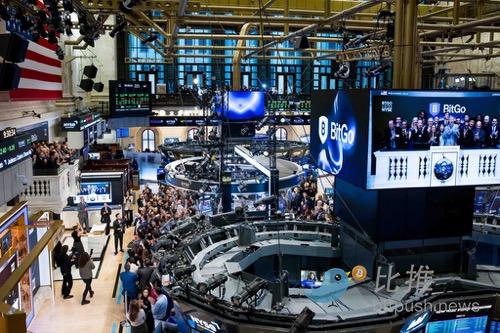
Calculated at the IPO price, BitGo's valuation is approximately $2 billion. Although this figure is far below the nearly $7 billion valuation of stablecoin issuer Circle ($CRCL) which went public last year, as one of the first major crypto companies to list this year, BitGo's performance is considered steady.

Ten Years in the Making: From Multi-Sig Pioneer to Institutional Guardian

BitGo is the latest native crypto company attempting to enter the public markets, following the successful listings of several crypto firms in 2025.

Its story begins in 2013, when the crypto world was still in its "wild west" era, with frequent hacker attacks and private key management being a nightmare. Founders Mike Belshe and Ben Davenport keenly observed that if institutional investors were to enter, what they needed was not fancy trading software, but a sense of "security".
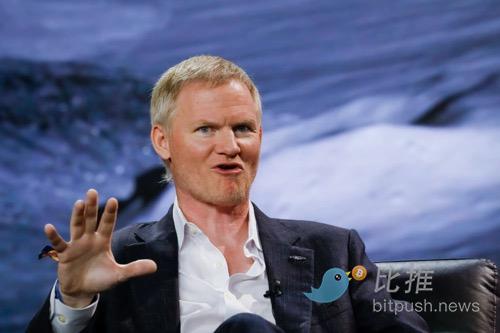
BitGo founder Mike Belshe

Standing on the podium at the NYSE, Mike Belshe might recall that afternoon over a decade ago.

As one of the first ten employees of the Google Chrome team and a foundational figure behind the modern web acceleration protocol HTTP/2, Mike was initially skeptical of cryptocurrency, even suspecting it was a scam. But he used the most "programmer" way to debunk it: "I tried to hack Bitcoin, and I failed."

This failure instantly turned him from a skeptic into a hardcore believer. To find a safer place for the old laptop full of Bitcoin under his sofa, he decided to personally dig a set of "trenches" for this wild market.

The early BitGo office was more like a laboratory. While contemporaries like Coinbase were busy acquiring users and boosting retail trading volume, Mike's team was researching the commercial potential of multi-signature (Multi-sig) technology. Despite his close personal ties with Netscape's founding bigwigs and a16z's head honcho Ben Horowitz, he did not choose the fast track of "VC acceleration," but instead took the slowest and steadiest path.

BitGo pioneered multi-signature (Multi-sig) wallet technology, which later became an industry standard. However, BitGo did not stop at selling software; it made a crucial strategic choice: to transform into a "licensed financial institution".

By obtaining trust charters in South Dakota and New York, BitGo successfully became a "qualified custodian." This status played a stabilizing role in the wave of crypto ETFs in 2024 and 2025. When asset management giants like BlackRock launched Bitcoin and Ethereum spot ETFs, it was underlying service providers like BitGo that were responsible for safeguarding the assets and handling the settlement processes.

Unlike Coinbase and other exchanges, BitGo built a solid "institutional flywheel": first, lock in assets (AUM) with极致ly compliant custody, then衍生出 (derive) staking, clearing, and prime brokerage services around these deposited assets.

This "infrastructure first" logic has given BitGo remarkable resilience amidst market volatility. After all, regardless of bull or bear markets, as long as the assets remain in the "vault," BitGo's business continues.

10x Price-to-Sales Ratio, What's the Basis?

Looking at the financial data disclosed in BitGo's prospectus, the numbers appear quite 'intimidating'.

Due to US GAAP (Generally Accepted Accounting Principles) requirements, BitGo must record the full principal of transactions as revenue. This led to a staggering "digital asset sales" gross revenue of approximately $10 billion in the first three quarters of 2025. But in the eyes of mature investors, these figures are merely "pass-through money" and do not reflect true profitability.

What truly supports its $2 billion valuation is the "Subscription & Services" business segment.
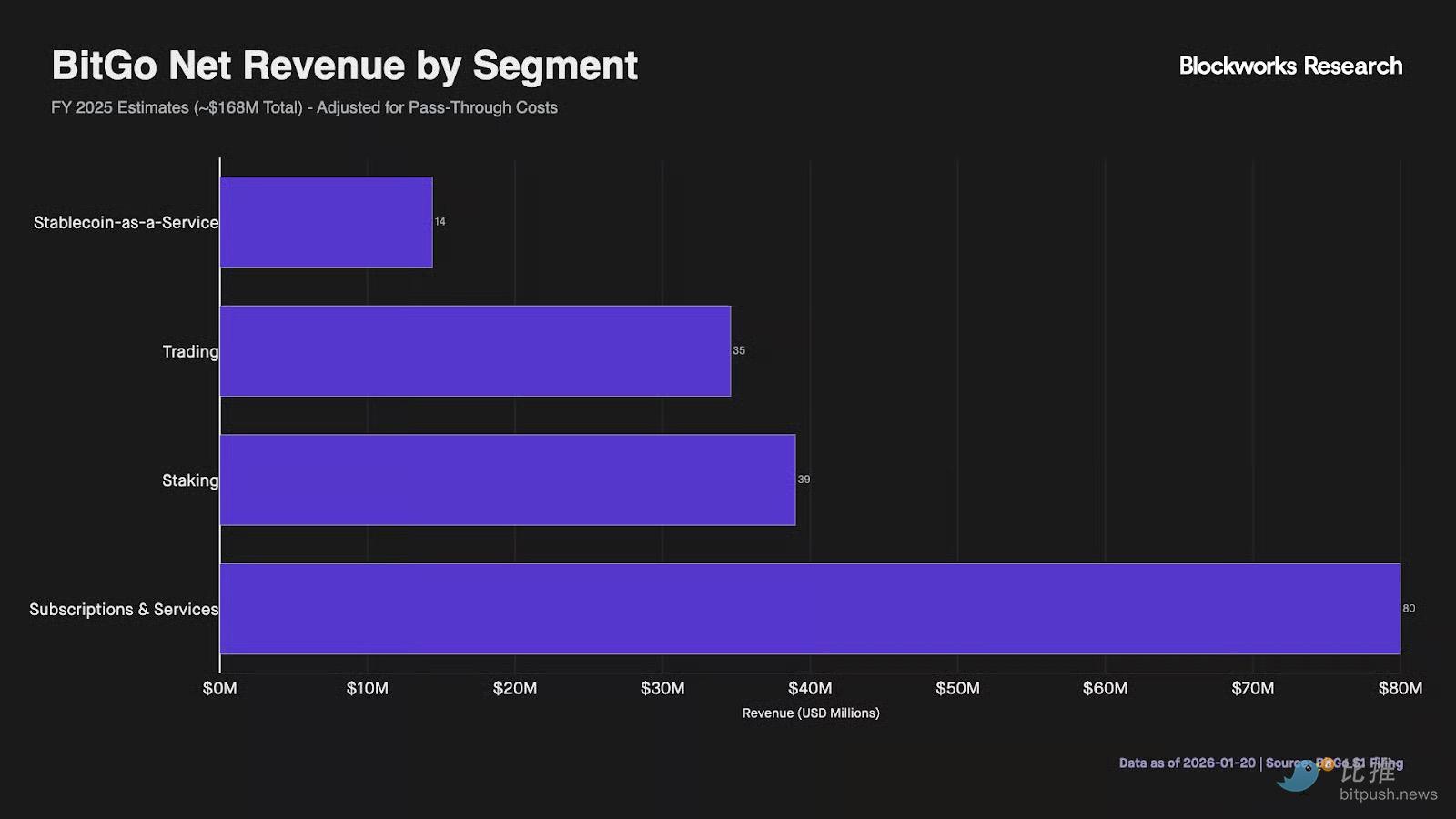
According to chart data from Blockworks Research, BitGo's core economic revenue (excluding pass-through fees and costs) is estimated to be approximately $195.9 million for the 2025 fiscal year. Subscription business contributes the vast majority of high-margin recurring revenue, with $80 million contributing nearly 48% of the total net revenue. This revenue primarily comes from recurring fees charged to over 4,900 institutional clients.

Furthermore, staking business became an unexpected growth driver. Staking revenue reached $39 million, ranking second. This reflects that BitGo is no longer just a simple "vault"; by providing value-added returns on top of custodial assets, it significantly improves capital efficiency.

Looking at the trading and stablecoin business, although trading volume accounts for the highest proportion of total revenue, it only constitutes $35 million in adjusted net revenue.

The newly launched "Stablecoin-as-a-Service" contributed $14 million. Although it's just starting, it has already demonstrated certain market penetration.
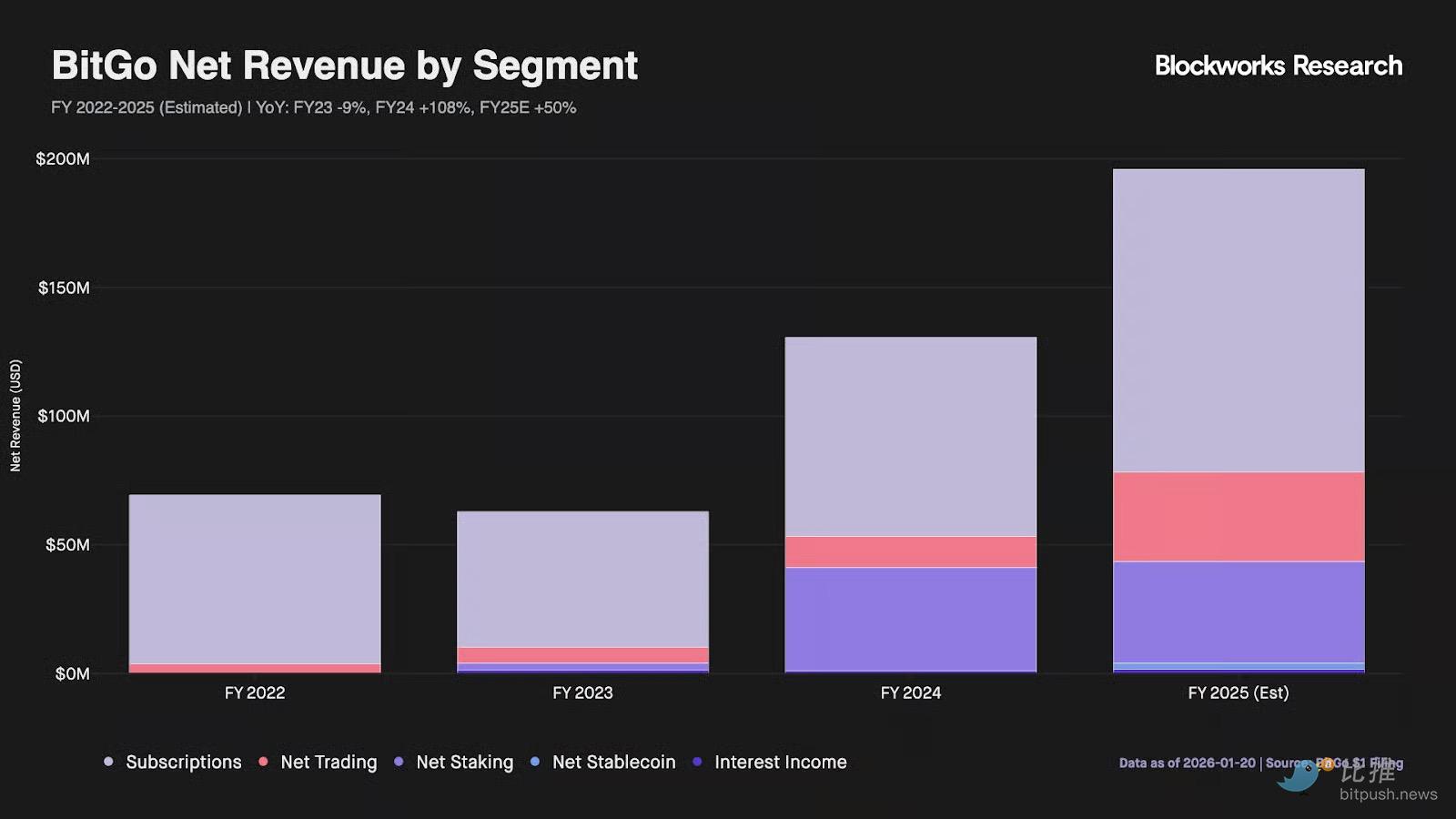
To understand BitGo's true valuation, its paper financial metrics need adjustment. If calculated based on its roughly $16 billion GAAP revenue, its valuation seems very low (P/S ratio ~0.1x). But after剔除 (removing) pass-through trading costs, staking sharing, and payments from stablecoin issuers and other non-core items, the moat of its core business is deep:

2025 Fiscal Year Core Economic Revenue (Est.): ~$195.9 million

Implied Valuation Multiple: Enterprise Value / Core Revenue ≈ 10x

This 10x valuation multiple places it above wallet-focused peers reliant on retail business. The premium部分 (partially) reflects its regulatory moat as a "qualified custodian." Simply put, at a $1.96 billion valuation level, the market is willing to pay a premium for the subscription business, with the low-margin trading and staking businesses being just the icing on the cake.

VanEck Research Director Matthew Sigel believes that BitGo's equity assets are superior to the vast majority of crypto tokens with a market cap exceeding $2 billion, as the latter have mostly never generated any net profit for their holders. BitGo's business is essentially "selling shovels." As long as institutions are trading, ETFs are running, and assets need storing, BitGo earns fees. This model might not be as flashy as some altcoins in a bull market, but in volatile and bear markets, it's an "iron rice bowl".

Stock Tokenization on IPO's First Day

Unlike other crypto company IPOs, BitGo adopted a more "crypto-native" approach: by partnering with Ondo Finance, it synchronized its shares on-chain on the very first day of listing.

The tokenized BTGO shares will circulate on Ethereum, Solana, and BNB Chain, allowing global investors to接入 (access) this newly listed custody机构几乎瞬时地 (almost instantly). Tokenized BTGO stock may in the future be used as collateral directly in DeFi lending protocols, bridging TradFi (Traditional Finance) and DeFi.

Summary
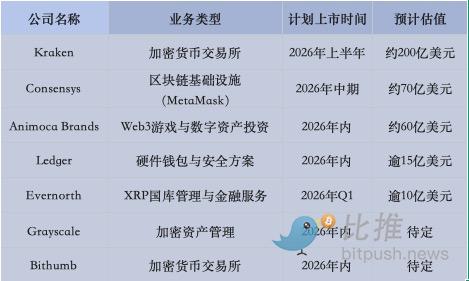
BitGo's IPO attempt continues the warming trend of the crypto equity financing market since 2025. Against the backdrop of Bitcoin spot ETF approvals and gradually clearer regulatory frameworks, institutional service providers are becoming important targets for public market investors looking to allocate crypto assets.
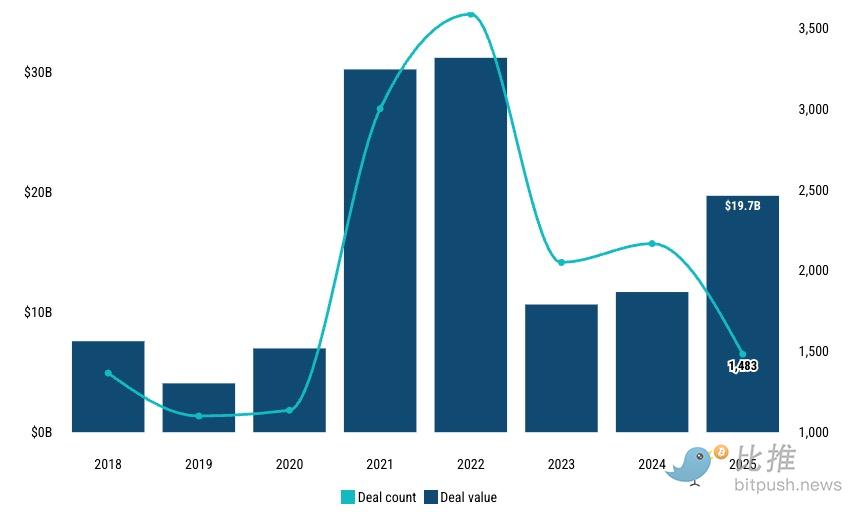
Source: PitchBook

Looking back at 2025, crypto venture capital (VC) deal value surged to $19.7 billion. As PwC IPO expert Mike Bellin stated, 2025 completed the "professionalization transformation" of cryptocurrency, and 2026 will be the year of彻底爆发 (complete) liquidity explosion.

Following the successful上岸 (landing) of pioneers like Bullish, Circle, and Gemini in 2025, crypto company listings have shown dual characteristic of "infrastructuralization" and "giantization." Currently, Kraken has submitted a confidential application to the SEC, aiming for the largest crypto exchange IPO of the year; Consensys is working closely with J.P. Morgan seeking capital influence in the Ethereum ecosystem; and Ledger, amidst the wave of self-custody demand explosion, has also targeted the New York Stock Exchange.

Of course, the market has never shaken off macro fluctuations, and memories of some companies falling below their IPO price immediately after listing in 2025 are still fresh. But this恰恰说明 (precisely indicates) the industry is maturing; capital is no longer paying for every good story but is starting to scrutinize financial health, compliance frameworks, and sustainable business models.

Author: Bootly


Twitter:https://twitter.com/BitpushNewsCN

Bitpush TG Discussion Group:https://t.me/BitPushCommunity

Bitpush TG Subscription: https://t.me/bitpush

Original link:https://www.bitpush.news/articles/7605298

Domande pertinenti

QWhat was the IPO price and opening day performance of BitGo ($BTGO) on the New York Stock Exchange?

ABitGo went public at $18 per share. It opened at $22.43, surging approximately 25% on its first day of trading.

QWhat core technology did BitGo pioneer that became an industry standard for securing crypto assets?

ABitGo pioneered the commercialization of multi-signature (Multi-sig) wallet technology, which became an industry standard for securing crypto assets.

QAccording to its adjusted financials, what was the estimated core economic revenue for BitGo in the 2025 fiscal year, and what was its implied valuation multiple?

ABitGo's estimated core economic revenue for the 2025 fiscal year was approximately $195.9 million. Its implied valuation multiple was about 10x (Enterprise Value / Core Revenue).

QHow did BitGo make its stock available to the crypto-native community on its first day of trading, differentiating it from other IPOs?

ABitGo partnered with Ondo Finance to tokenize its shares on the first day of trading, making the BTGO stock available on blockchains like Ethereum, Solana, and BNB Chain for near-instant global access.

QWhat key strategic shift did BitGo make by obtaining trust charters, and how did this position it for the later ETF boom?

ABitGo obtained trust charters in South Dakota and New York, transforming into a 'qualified custodian.' This status was crucial during the 2024-2025 crypto ETF wave, as major asset managers like BlackRock relied on such custodians to safeguard the underlying assets for their Bitcoin and Ethereum spot ETFs.

Letture associate

Hardcore First Look | Ocean Embodied Intelligence Company 'Shihang Intelligence' Secures Record-Breaking 1 Billion in Funding, Zhu Xiaohu, Temasek Place Bets

Breaking News | Ocean Embodied Intelligence company "Shihang Intelligent" secures a record-breaking 1 billion RMB (approximately 10 billion yuan) in Series A financing, with investment from Zhu Xiaohu and Temasek. Author: Qiu Xiaofen | Editor: Yuan Silai Ocean Embodied Intelligence company "Shihang Intelligent" has completed its Series A funding round, raising over 1 billion RMB. This marks the largest single funding round in the global marine robotics field to date. Investors include upstream momentum funds from chip companies "Moore Thread" and "Kunlunxin," Singapore's state-owned investment platform Vertex Growth, and listed company Dyneo, among others. Existing investors like GSR Ventures (whose founder Zhu Xiaohu has invested for the fifth time), Vertex Ventures China, Hua Ying Capital, and Long Capital also significantly increased their investments. Founder and CEO Chen Xiaobo, a 1989-born alumnus of Harbin Engineering University, is a long-time expert in underwater robotics. He received the National Defense Science and Technology Progress Award at age 28 (the youngest recipient) and led the development of China's first commercial underwater cleaning robot. The funds will be used for core technology R&D, global market expansion, and building the industry chain ecosystem to scale the application of marine robots in complex underwater scenarios. The ocean is considered one of the most challenging environments for robotics due to low light, high turbidity, complex currents, limited communication, high pressure, and corrosion. "Shihang Intelligent" focuses on developing core underlying technologies for marine robots, covering six key systems: power, control, sensing, navigation, sealing, and deployment. Its robots are capable of operating at depths from 0 to 10,000 meters with full degrees of freedom, performing complex maneuvers, autonomous navigation, and multi-robot collaboration. Applications include ship cleaning, underwater security, offshore wind power, marine ranching, and seabed inspection. The company's order value for the first half of 2026 alone has exceeded 1 billion RMB. Its "Orca Robot" is used by major shipping companies and has performed maintenance on over a thousand large vessels. In April of this year, the company launched its ocean embodied large model "Cangqiong CEORION." Unlike traditional remote-controlled or pre-programmed robots, this model integrates environmental perception, task understanding, and action generation into a single end-to-end architecture. Trained on millions of hours of commercial operation data and simulation data, it covers 12 major underwater operation scenarios. In simulations, it achieved over 90% task success rate and over 70% zero-shot adaptation capability to unseen environments. A built-in physics reasoning module reduces collision risk by 80%, enabling autonomous operation even with weak or no communication. Recently, "Shihang Intelligent" was selected as a core technology partner for Singapore's Maritime and Port Authority national hull inspection and cleaning program. These advancements indicate marine robotics is moving from pilot projects to scaled applications, with real-world operations generating valuable data to continuously improve robot capabilities. CEO Chen Xiaobo stated the company will continue investing in core marine robotics technology, the embodied intelligence model, and global application scenarios to expand into more high-risk, high-difficulty, and high-value underwater operations.

marsbit19 min fa

Hardcore First Look | Ocean Embodied Intelligence Company 'Shihang Intelligence' Secures Record-Breaking 1 Billion in Funding, Zhu Xiaohu, Temasek Place Bets

marsbit19 min fa

Three Months, 35 Billion Yuan: Investors Rush to Grab the OpenAI of the Physical World

Investors flock to a physical AI startup as the race for the "OpenAI of the physical world" heats up. Ji Jia Shi Jie (GigaWorld), a company dedicated to developing Artificial General Intelligence (AGI) for the physical world, has raised 3.5 billion RMB (approximately $490 million) in just three months, according to a report from investment media outlet Touzijie. The latest B2 funding round of 1 billion RMB attracted a wide range of top-tier investors, including sovereign wealth funds, industrial capital, and financial institutions. This brings the total funding for the young company, now valued over 10 billion RMB, to 3.5 billion RMB across three recent rounds. The company is led by Huang Guan, a post-90s Tsinghua University PhD with extensive experience in AI, autonomous driving, and entrepreneurship. Its core innovation is a "dual-pyramid" system comprising a five-layer data pyramid (from internet videos to real-world robot data) and a three-layer algorithm pyramid focused on world simulation, action alignment, and reinforcement learning. This system underpins its key models: the "World Action Model" (e.g., GigaBrain series for robot control) and the "World Generation Model" (e.g., GigaWorld series for simulating and understanding the physical world). Its models have reportedly achieved top rankings in global robotics benchmarks. Ji Jia Shi Jie argues that while current digital AGI excels in information processing, the next frontier is physical AGI—systems that can understand and interact with the real world. The company believes the field is approaching its "GPT-3 moment," a key inflection point in capability scaling. To achieve this, the company is pursuing a dual-market strategy. For the consumer (C) market, it launched the "SeeLight" brand and its S1 general-purpose humanoid robot, which has secured initial orders for deployment in real homes. For the business (B) market, it focuses on industrial automation with its Maker series robots, having signed agreements for large-scale deployment in factories, and its DriveDreamer world model for autonomous driving, which is already in use with over 30 automakers and tech companies. The report concludes that by bridging the gap between digital intelligence and physical action, Ji Jia Shi Jie aims to unlock a new wave of productivity, ultimately bringing physical AGI into everyday life.

marsbit47 min fa

Three Months, 35 Billion Yuan: Investors Rush to Grab the OpenAI of the Physical World

marsbit47 min fa

What's the Connection Between Pinduoduo's Huang Zheng and Blockchain?

This text explores the unexpected connection between Pinduoduo founder Colin Huang and blockchain, as suggested in his article *Turning Capitalism Upside Down*. Huang argues Pinduoduo's core business is about managing "uncertainty." He posits that wealth flows to the rich because they absorb life's uncertainties (e.g., illness, job loss) that devastate the poor, who pay a premium for certainty through insurance or stable prices. Pinduoduo's model attempts a "reverse insurance": by aggregating consumer demand via group-buying and flash sales, it creates a large, predictable order for manufacturers. This certainty allows factories to remove risk premiums, passing savings back as lower prices, thus partially reversing the wealth flow. The key obstacle, Huang notes, is that an individual's buying intent is an unreliable promise. He then asks if blockchain is the natural solution for this "reverse insurance." The text elaborates that blockchain, through smart contracts with binding deposits, could transform casual intent into a costly-to-break, enforceable commitment. This replaces interpersonal trust with coded rules, making promises credible, pricable, and resistant to fraud. Finally, the author draws a parallel to Bitcoin, framing two paths to creating certainty: the "Pinduoduo path" of aggregating decentralized will into scale, and the "Bitcoin path" of locking rules into immutable code. Both sacrifice something—personal freedom or system flexibility—to manufacture trust and predictability.

链捕手2 h fa

What's the Connection Between Pinduoduo's Huang Zheng and Blockchain?

链捕手2 h fa

The Storage Magnate Who Conquered a Trillion-Dollar Kingdom, Yet Ultimately Could Not Become the Richest

**Summary:** "The Memory Magnate Who Built a Trillion-Dollar Empire, Yet Never Became the Richest" explores the journey of Zhu Yiming, founder of GigaDevice (603986) and co-founder of the soon-to-IPO ChangXin Memory Technologies (CXMT). The article positions GigaDevice, a fabless chip designer now valued at ~¥340 billion, as a prequel to the massive IDM (Integrated Device Manufacturer) venture, CXMT. Starting in 2005 with minimal capital, Zhu strategically "picked up the pieces" by focusing on niche markets like NOR Flash and microcontrollers (MCUs), areas major players were exiting. This allowed GigaDevice to grow into a diversified semiconductor company, maintaining robust profitability even during industry downturns by controlling costs. However, the piece argues that in the highly cyclical and capital-intensive memory chip industry, the fabless model has limits. True resilience and scale require the ability for "counter-cyclical expansion" – investing heavily during downturns – a tactic only possible for IDMs like Samsung or SK Hynix. This insight led Zhu to partner with the Hefei city government in 2016 to establish CXMT, an IDM focused on DRAM. Zhu's symbolic moves, like forfeiting salary and diluting his equity, were crucial in securing the massive state and bank funding needed. CXMT's equipment base is now valued even higher than that of BYD's vast auto manufacturing empire. Despite the potential for CXMT to reach a market cap of ¥1-2 trillion upon its IPO, Zhu's indirect stake in both companies is estimated below 3%, placing his personal wealth far below that of China's top billionaires. The article concludes that his strategic vision built a trillion-yuan memory landscape, but the capital structure necessary to achieve it precluded a personal fortune of similar scale.

marsbit2 h fa

The Storage Magnate Who Conquered a Trillion-Dollar Kingdom, Yet Ultimately Could Not Become the Richest

marsbit2 h fa

Trading

Spot
Futures
活动图片