Crypto activity in Brazil rises 43% with average investment surpassing $1,000: Report

cointelegraphPubblicato 2025-12-21Pubblicato ultima volta 2025-12-21

Introduzione

Cryptocurrency activity in Brazil surged by 43% in 2025, with the average investment per user exceeding $1,000 (around 5,700 BRL), according to a Mercado Bitcoin report. The market is shifting from speculation to structured investing, with 18% of users diversifying across multiple assets. Bitcoin remained the most-traded asset, followed by USDT, ETH, and SOL. Stablecoins saw triple the previous year’s transactions as investors sought lower volatility. Lower-risk digital fixed-income products grew 108%, with $325 million distributed to investors. Younger investors (under 24) increased by 56%, and participation expanded beyond major cities. Itaú Asset Management recommended a 1–3% Bitcoin allocation due to geopolitical and monetary risks.

Crypto activity in Brazil expanded sharply in 2025, with total transaction volume climbing 43% year over year as average investment per user crossed the $1,000 mark, according to a new report from crypto platform Mercado Bitcoin.

The report, titled “Raio-X do Investidor em Ativos Digitais 2025,” claimed that the Brazilian crypto market is no longer driven purely by speculation but increasingly shaped by structured investing and portfolio planning. The data was based on activity across Mercado Bitcoin’s platform, the largest digital asset exchange in Latin America.

Per the report, the average amount invested per person reached roughly 5,700 Brazilian reais, equivalent to more than $1,000. At the same time, 18% of investors allocated funds across more than one crypto asset, indicating a gradual shift toward diversification rather than single-asset bets.

Bitcoin (BTC) remained the most traded asset, followed by the US dollar-pegged stablecoin USDt (USDT), Ether (ETH) and Solana (SOL), the report showed. Stablecoins also stood out as a key on-ramp for new and existing investors, accounting for roughly three times more transactions than in the prior year, as users sought lower volatility amid uncertain macro conditions.
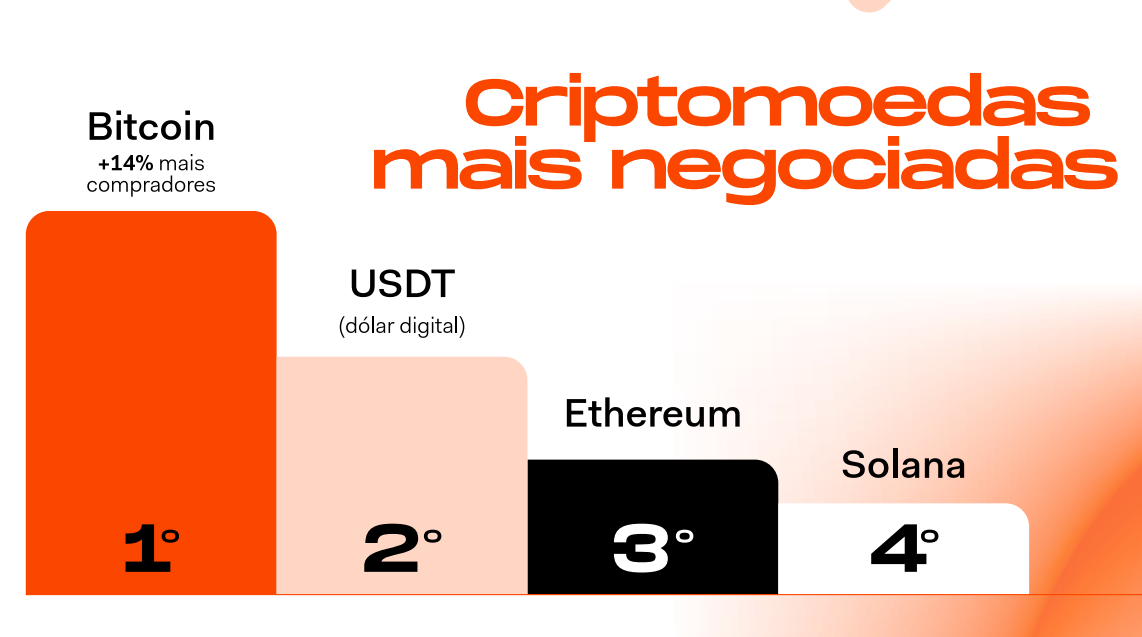
Bitcoin remains most-traded asset in Brazil. Source: Mercado Bitcoin

Related: Brazilian stock exchange to launch tokenization platform and stablecoin

Brazil’s low-risk crypto products see 108% growth

The report revealed that lower-risk crypto products gained momentum in 2025. Digital fixed-income offerings, known locally as Renda Fixa Digital (RFD), recorded a 108% increase in investment volume, with Mercado Bitcoin distributing about $325 million to investors in 2025.

Demographics also shifted. Investors aged 24 and under posted a 56% increase year over year. However, Mercado Bitcoin noted that demand expanded across all age groups, including high-net-worth and institutional profiles.

Regionally, Brazil’s Southeast and South remained dominant by transaction volume, led by São Paulo and Rio de Janeiro, while states in the Central-West and Northeast gained visibility as crypto participation spread geographically.

Related: Solana enters Brazil’s main exchange as Valour expands regulated crypto access

Itaú Asset advises 1%–3% Bitcoin allocation

As Cointelegraph reported, Itaú Asset Management has recommended that investors allocate between 1% and 3% of their portfolios to Bitcoin, citing rising geopolitical risks, shifting monetary policy and ongoing currency volatility.

In a research note, strategist Renato Eid described Bitcoin as a distinct asset with its own return profile and a potential hedging role due to its global and decentralized nature, despite sharp price swings throughout 2025.

Magazine: 2026 is the year of pragmatic privacy in crypto — Canton, Zcash and more

Domande pertinenti

QWhat was the percentage increase in crypto transaction volume in Brazil in 2025, according to the Mercado Bitcoin report?

ACrypto transaction volume in Brazil increased by 43% year over year in 2025.

QWhat was the average amount invested per person in Brazilian reais, and what was its approximate equivalent in US dollars?

AThe average amount invested per person was roughly 5,700 Brazilian reais, which is equivalent to more than $1,000.

QWhich four crypto assets were reported as the most traded in Brazil, listed in order?

AThe most traded assets were Bitcoin (BTC), followed by the stablecoin USDt (USDT), Ether (ETH), and Solana (SOL).

QWhat was the reported growth percentage for lower-risk crypto products like Digital Fixed-Income (RFD) in 2025?

ALower-risk crypto products, specifically Digital Fixed-Income offerings (RFD), recorded a 108% increase in investment volume.

QWhat Bitcoin allocation range did Itaú Asset Management recommend for investors' portfolios and what reasons did they cite?

AItaú Asset Management recommended an allocation of between 1% and 3% to Bitcoin, citing rising geopolitical risks, shifting monetary policy, and ongoing currency volatility.

Letture associate

Anthropic Starts Poaching Scientists? $27K Weekly Onsite Stipend to Fix Claude's Expert-Level Errors

Anthropic has launched a new STEM Fellow program, offering $3,800 per week for a three-month, in-person residency in San Francisco. The role targets experts from science, technology, engineering, and mathematics (STEM) fields—machine learning experience is helpful but not required. Instead, Anthropic values scientific judgment and a willingness to learn quickly. Fellows will work with Claude models and internal tools under the guidance of an Anthropic researcher. Example projects include a materials scientist identifying errors in Claude’s reasoning or a climate scientist integrating atmospheric modeling software with Claude. The goal is to have experts "tell Claude where it's wrong" and improve its scientific capabilities. This initiative is part of Anthropic’s broader strategy to strengthen its scientific ecosystem, following earlier programs like the AI Safety Fellows and AI for Science programs. The company acknowledges that current AI models, while powerful, still produce high-confidence errors and lack end-to-end research autonomy. The program aims to embed domain expertise directly into model development, turning scientists into "high-level reviewers" for AI. Anthropic CEO Dario Amodei has previously emphasized AI’s potential to accelerate scientific breakthroughs, particularly in biology and healthcare. The company believes that the next phase of AI competition will depend not on scaling parameters, but on integrating human expertise to refine model accuracy and reliability.

marsbit31 min fa

Anthropic Starts Poaching Scientists? $27K Weekly Onsite Stipend to Fix Claude's Expert-Level Errors

marsbit31 min fa

On the Eve of X Money's Launch, Musk Dismantles the Referee First

"X Money Launches After Dismantling Regulator: Musk's 9-Day Power Play" In February 2025, a team from the "Department of Government Efficiency" (DOGE), led by Elon Musk, entered the Consumer Financial Protection Bureau (CFPB) headquarters. Shortly after, the CFPB was effectively dismantled—its funding frozen, activities suspended, and nearly 90% of staff laid off. This move came just nine days after X announced a partnership with Visa and as X Money prepared to launch. The article contrasts this with the decade-long regulatory battles faced by companies like Coinbase and PayPal. Coinbase spent over $75 million in political contributions and endured a major SEC lawsuit to operate legally. PayPal complied with strict state and federal rules for its stablecoin PYUSD, including 100% reserve requirements and monthly audits. However, Musk’s approach was different. After the CFPB introduced a rule placing large digital payment apps under federal oversight, Musk tweeted "Delete CFPB." Within months, the rule was revoked by Congress. Meanwhile, DOGE operatives gained "god-tier" access to CFPB databases, potentially obtaining sensitive competitive information from rivals like Apple, Google, and PayPal. The article also highlights a "suspicious exemption clause" in the GENIUS Act, which allows private companies like X to issue stablecoins with fewer restrictions. Senator Elizabeth Warren questioned whether Musk, who was a senior presidential advisor during the Act’s drafting, influenced this clause. X Money offers a 6% APY on deposits, despite FDIC warnings that stablecoin users are not insured. As X Money launches to 600 million monthly users, the article questions the fairness of a system where Musk can bypass regulations that others spent years and millions to comply with. The dismantling of the CFPB and the alleged regulatory advantages raise concerns about the future of equitable rule-making in the U.S. financial system.

marsbit40 min fa

On the Eve of X Money's Launch, Musk Dismantles the Referee First

marsbit40 min fa

Trading

Spot
Futures
活动图片