Confirmed: GPT-5.5 "Brain Drain" Exposed, OpenAI's Own Documentation Admits It

marsbitPubblicato 2026-05-27Pubblicato ultima volta 2026-05-27

Introduzione

Summary: Evidence emerges that OpenAI's GPT-5.5 may be "silently" switching to a less capable model during use. Users report that after roughly two hours, the GPT-5.5 Extended Thinking model begins responding instantly with significantly degraded output quality, while the interface continues to display the premium model's label. Complaints on developer forums describe a loss of instruction-following ability and poor code quality, with even the highest "xhigh" tier affected. This is corroborated by an OpenAI help document stating that after Plus users exceed 160 messages per 3 hours, the system "silently" switches to a "mini" model without any user notification. Pro users also report "heavy thinking" modes being throttled during high server loads. Trace commands from earlier incidents have shown users requesting GPT-5.3 Codex but receiving GPT-5.2 outputs. OpenAI acknowledged performance degradation in mid-May, marking it resolved, but user reports surged again in late May. The pattern mirrors past controversies with GPT-5, 5.2, 5.3, and 5.4 releases, where each update was followed by user complaints of reduced capability. The article suggests cost-cutting on compute may be a factor, noting that while GPT-5.5 users struggle, GPT-5.6 is already being tested internally.

[Introduction] GPT-5.5 exposed for "fake thinking," secretly switched to 'mini' after two hours of use. $200 monthly fee buys you a "Schrödinger's brain." Trace command provides concrete evidence, official documentation personally acknowledges. Users are flocking to complain: OpenAI, who are you trying to fool?

ChatGPT has been caught "dumbing down" again!

Just in the last couple of days, it blew up on X first.

User Lisan al Gaib discovered that after using GPT-5.5 for an hour or two, it suddenly became stupid, with every request answered instantly and quality plummeting off a cliff.

Yet the interface still displayed "GPT-5.5 Extended Thinking."

In other words, the thinking label was still there, but the thinking itself had vanished.
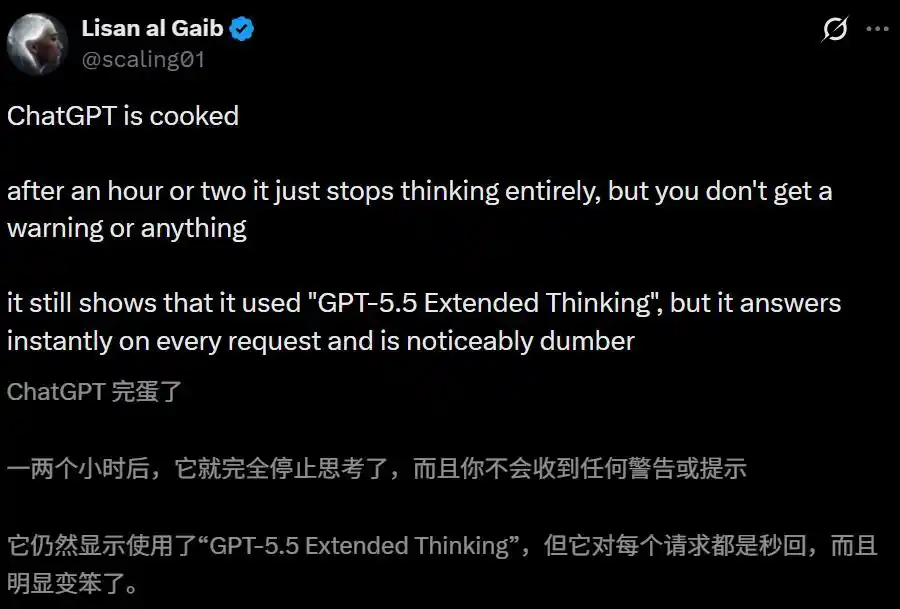
$200/month for a "Schrödinger's Model"

On the OpenAI developer forum, a complaint post blew up simultaneously.

Agentify.sh stated that GPT-5.5 would suddenly lose its ability to follow instructions during use.

Watching it excitedly announce it was "fixed," only to produce code so poor it triggered a mass rollback.

UI tasks that the previous 5.5-med could handle easily now couldn't even manage the simplest changes.

Upgrading to 5.5-high didn't work. Upgrading again to xhigh, still no luck.

And xhigh, which used to run for several hours, now clearly lasted a shorter time.
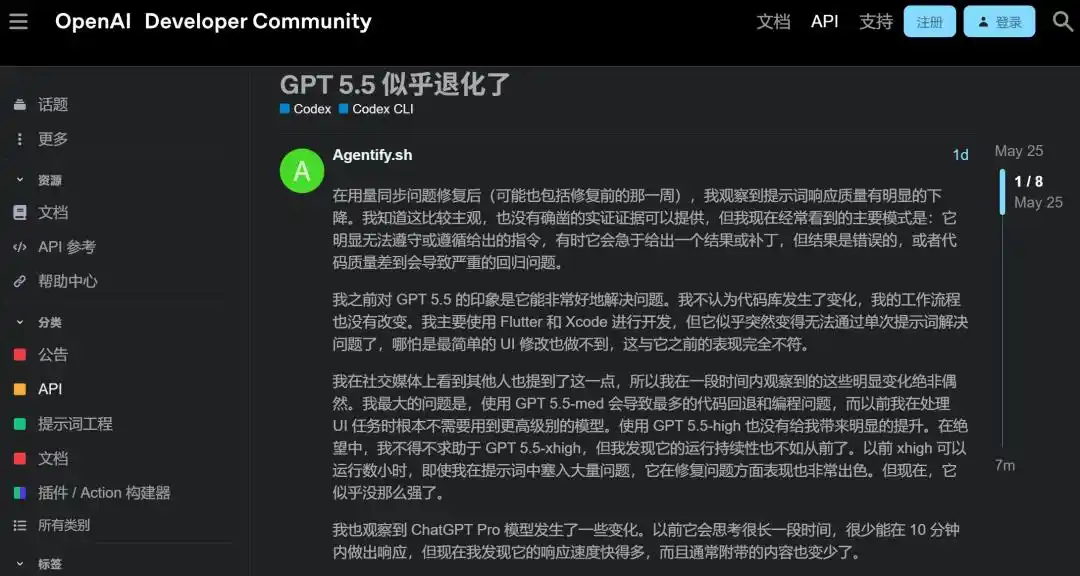
As soon as the post went up, the replies exploded.

Some directly reverted to 5.4.

One used the highest tier, xhigh, but found it "clearly worse than last week, frequent errors on long tasks, not following the workflow at all."

One reported an even more bizarre situation: "Simple queries also take ages to process, and if you interrupt to correct its direction, it completely ignores you and continues with its previous incorrect plan."

That's right, everyone was describing the same phenomenon—GPT's brain had been swapped out at some unknown point.

GPT-5.5's current performance is on par with 5.3, no exaggeration. It was amazing the first few days, but now you can't find a trace of that original model.

Not an illusion, OpenAI spells it out in black and white

To verify, Lisan al Gaib conducted a comparative test.

Same account, Extended Thinking on the ChatGPT side produced garbage, but switching to xhigh on the Codex side immediately restored normal performance.

In his own words, Codex was "literally 4 billion times smarter than this thing."

Developer Andrew Curran came up with a clever trick—directly asking the model, "What is the cutoff date for your training data?"

The model answered: August 2025.

The problem? The cutoff date for GPT-5.5 Thinking is December. August is the cutoff date for the Instant version!

In other words, he selected Thinking, but the system actually ran Instant for him.

Not a single word of the model label on the interface changed, but the model behind it had been secretly swapped......

The funny thing is, this time OpenAI itself nailed the coffin shut for users in its own help documentation.

According to the official explanation in the OpenAI Help Center, Plus users can send a maximum of 160 GPT-5.5 messages every 3 hours.

After that quota is used up, the system will silently switch to the mini model until the quota resets.

Note the word "silently."

No pop-up notification, no change in the model label, no visual feedback whatsoever.

You still think you're using the flagship model, while on the other end it has quietly been replaced with mini.

Pro users, don't celebrate too soon either.

Heavy thinking mode, the top reasoning tier exclusive to Pro users, is also subject to capacity throttling when server load is high. Again, without any warning.

In other words, a $200/month Pro subscription buys you a service that can be "switched out" at any moment.
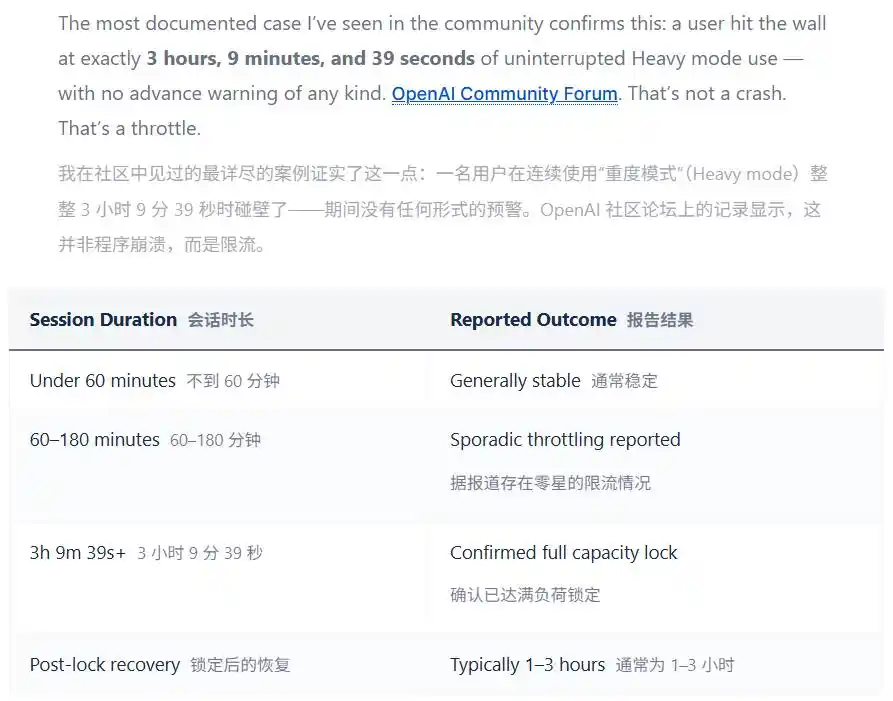
This kind of "label unchanged, brain swapped" operation was caught even earlier on the Codex side.

In February this year, an issue appeared on GitHub where a Pro user used a trace command to discover that they were requesting GPT-5.3 Codex, but the actual model returned was GPT-5.2.

Not even 5.2 Codex, but the lower-tier base 5.2.
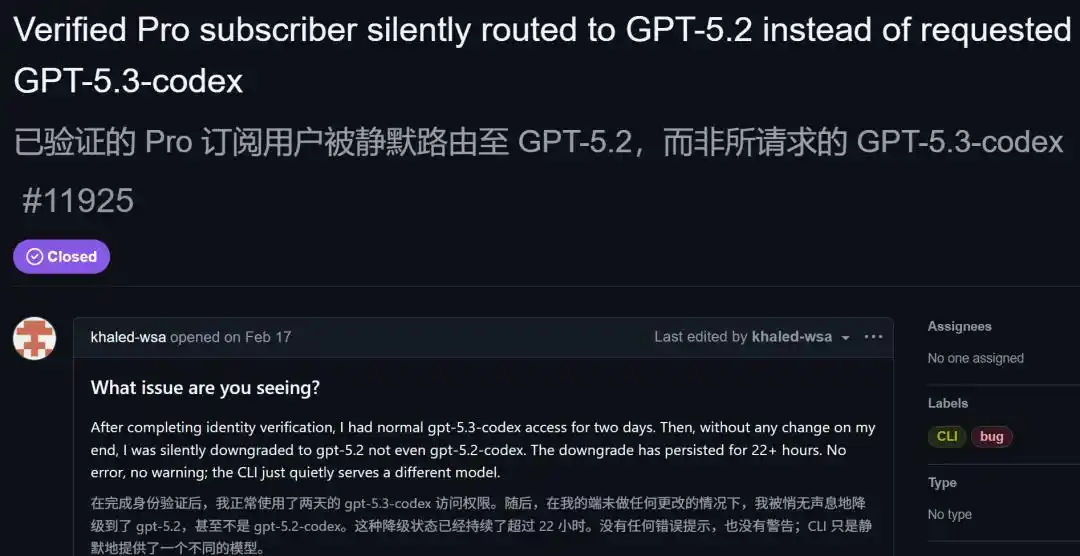
He posted the reproduction command:

  • RUST_LOG='codex_api::sse::responses=trace' codex exec --skip-git-repo-check -s read-only -m 'gpt-5.3-codex' 'hi' 2>&1 >/dev/null | rg -o --replace '$1' '"model":"([^"]+)"' | head -n1
  • Output: gpt-5.2-2025-12-11
  • Expected: gpt-5.3-codex

Multiple Pro users confirmed the same downgrade under the same issue.

And this kind of downgrade is "sticky," it doesn't revert on its own, and there's no explanation.

Even on the day GPT-5.5 was released in April, there were user reports that the speed of Fast mode was similar to Standard, but billing was still at the Fast rate.

A simple task took 7 minutes and 49 seconds, when normally it should be 5-6 minutes.

OpenAI admitted it, and then... nothing

On May 15, a record appeared on OpenAI's status page.

GPT5.5 Performance Degradation, We are investigating reports of performance degradation for GPT-5.5 from some users.

On May 17, the status was updated to "Resolved."

But judging from the timeline of forum posts, complaints about "brain drain" from May 24-26 were even more intense than the wave on May 15.

Either the "resolved" problem came back, or it was never truly solved in the first place.

Every upgrade comes with a "brain drain controversy"

While all companies face complaints about their models "getting dumber," OpenAI hasn't missed a single one with every update from GPT-5 to GPT-5.5.

Every time OpenAI says it's investigating, every time it says it's resolved, and then continues with the next version.

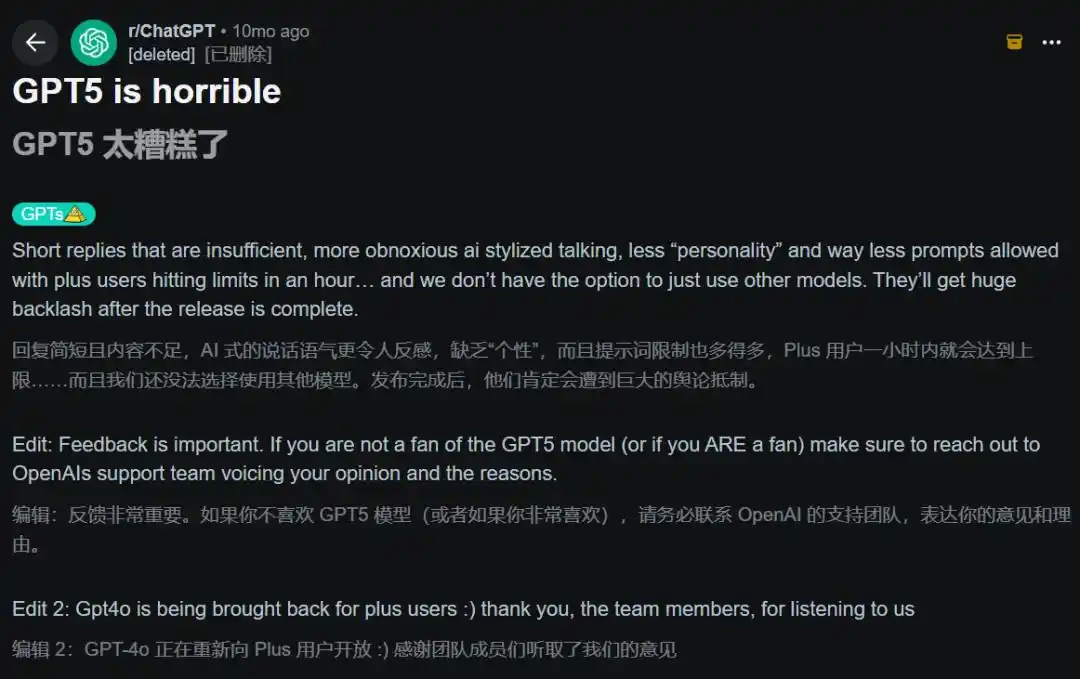
August 2025, GPT-5's debut. The hot post on Reddit was titled directly "GPT-5 is so bad." Users complained about short replies, more refusals, less personality.

OpenAI was forced to urgently restore the GPT-4o option. Altman personally admitted in a Reddit AMA, "bumpier than we expected."
December 2025, GPT-5.2. Translation quality regressed, fabricated non-existent APIs, refused to execute style instructions that 5.1 could easily handle.

February 2026, GPT-5.3-Codex. Pro users silently downgraded to 5.2, trace command confirmed.

March 2026, GPT-5.4. A post titled "GPT-5.4 has clearly regressed in Codex" appeared on the OpenAI community forum, with all replies confirming.

Early May 2026, GPT-5.5 Instant launched. Reply length shortened by 30%, emojis almost disappeared. User summary: Accuracy improved, but warmth vanished.
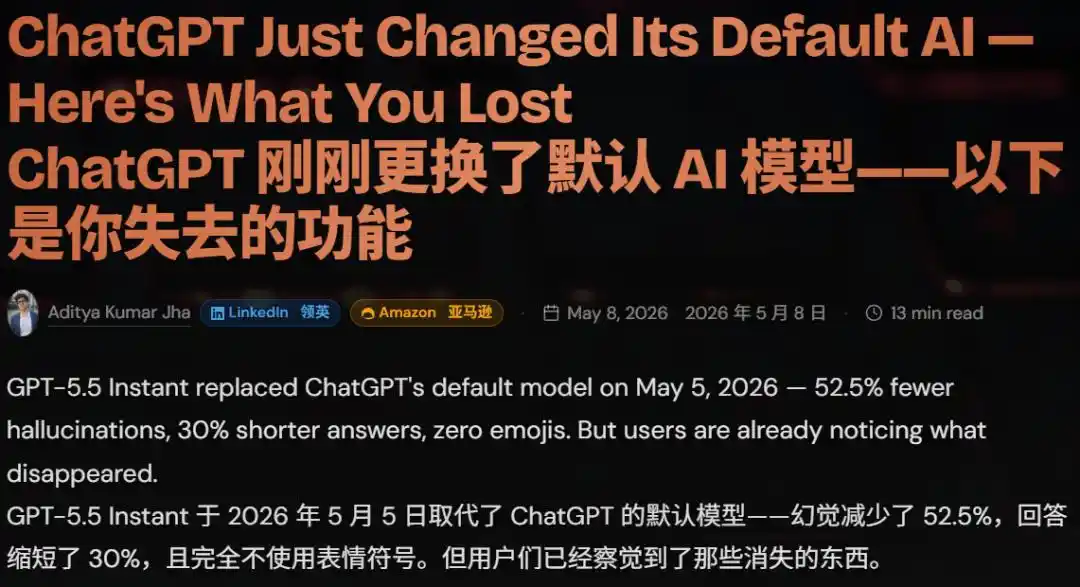
Late May 2026, now. Complaints about Thinking mode "brain drain" erupted again.

Lisan al Gaib revealed that since he led the fight for ChatGPT Plus quotas during GPT-5's release, "I receive DMs like this every week."

The latest one was someone asking him to help get their xhigh/heavy thinking back.

The day it benchmarks strongest is launch day

chatgptdisaster.com compiled 1087 verified user complaints, one frequently mentioned scenario is "routing layer failure," where the UI shows GPT-5.5 Pro, but the output is completely from another tier.

Users describe a reproducible pattern: after a long session, the model starts "completely ignoring what you say," but the top-tier label is still hanging on the model selector.
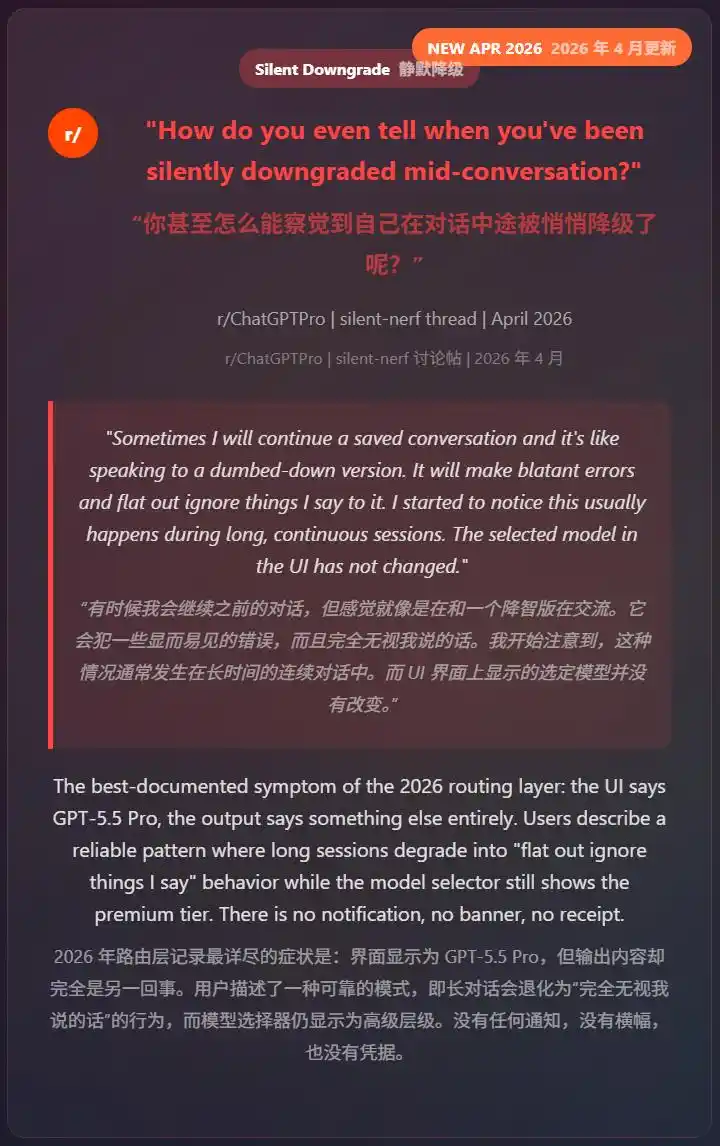
The most absurd footnote is that the mechanism for Plus users automatically switching to mini after using 160 messages/3 hours is described as a "feature" in OpenAI's official documentation.

Why is this happening? Lisan al Gaib's analysis suggests the answer is two words: cost-saving.

The crunch on compute power and profitability is affecting everyone. Cutting corners everywhere, not missing any opportunity to save a buck.

Yet, in the same week GPT-5.5 users were collectively complaining, traces of GPT-5.6 had already appeared in Codex backend logs.

Internal codename iris-alpha, 1.5 million token context, Polymarket gave an over 85% probability for a June release.

On one side, 5.5 users can't even secure a basic experience; on the other, 5.6 is already quietly running real traffic in the background.

This is the 2026 ASI race.

The speed of creating new models is getting faster and faster, but making an old model run a single session properly is getting harder and harder.

The day it benchmarks strongest is always launch day, and every day after is Schrödinger's GPT.

Reference: https://x.com/scaling01/status/2058643470357590058?s=20

This article is from the WeChat public account "AI Era," author: ASI Apocalypse; Editor: Moses

Domande pertinenti

QWhat is the main issue reported by users regarding GPT-5.5?

AUsers report that after using GPT-5.5 for a short period, its performance degrades significantly, with responses becoming instant and of much lower quality, while the interface still shows the 'GPT-5.5 Extended Thinking' label, indicating a silent model switch.

QAccording to the article, what does OpenAI's official documentation reveal about user limits?

AOpenAI's official Help Center documentation states that Plus users are limited to 160 GPT-5.5 messages every 3 hours. Once this limit is reached, the system silently switches to a mini model until the quota resets, with no visual indication to the user.

QHow did developers verify that they were receiving a different model than selected?

ADevelopers used methods like comparing outputs between ChatGPT and Codex endpoints, asking the model for its training data cutoff date (which revealed an instant model date when thinking was selected), and using trace commands that showed the actual model returned was a lower-tier version than requested.

QWhat pattern does the article describe regarding OpenAI's model updates?

AThe article describes a recurring pattern where each major model update (GPT-5, 5.2, 5.3, 5.4, 5.5) is followed by widespread user complaints about performance degradation. OpenAI typically acknowledges and investigates the issue, but complaints resurface with subsequent releases.

QWhat reason does the article suggest is behind these performance issues and silent model switches?

AThe article suggests the primary reason is cost-saving. It cites an analysis stating that 'compute and profitability constraints are affecting everyone,' leading OpenAI to silently downgrade models to manage costs, even for users paying high subscription fees.

Letture associate

A 134% Surge, 75 P/E Ratio: Why Is the Market Paying Up for Murata's 'Zero Growth'?

Murata Manufacturing, the world's largest passive components maker, saw its stock price surge 134% over the past year and hit a record high on May 28th, despite reporting nearly zero growth in operating profit for its latest fiscal year. This has pushed its valuation to a P/E ratio of approximately 75x. The disconnect is driven by a fundamental market re-rating. The catalyst was a late-May meeting where management upgraded the AI investment cycle outlook to "lasting until around 2030" and noted that demand for its components is roughly double its supply capacity, with customers prioritizing securing volume over price. While Murata's revenue grew only 5.0% and operating profit stagnated at ¥281.8 billion for the fiscal year ending March 2026, its guidance for the current fiscal year projects a 34.8% jump in operating profit to ¥380 billion. This sharp growth is underpinned by expectations that its AI/data center-related revenue will nearly double from ¥170 billion to ¥325 billion, becoming a key pillar of its business. Analysts highlight that this growth stems not from broad price hikes but from a shift towards higher-value, cutting-edge MLCCs for AI servers, where Murata holds over 70% market share. The market is now pricing Murata not as a cyclical component maker but as a critical "AI pick-and-shovel" supplier with structural pricing power. However, the high valuation also carries risk if future AI demand or quarterly guidance falls short of the elevated expectations.

marsbit7 min fa

A 134% Surge, 75 P/E Ratio: Why Is the Market Paying Up for Murata's 'Zero Growth'?

marsbit7 min fa

a16z: Why Do Prediction Markets Matter?

Prediction markets, which allow users to trade on the outcome of future events, have gained significant traction, especially in the U.S. At their core, these markets function like any other market by aggregating information from all participants and translating it into a price signal—in this case, the perceived probability of a specific event occurring. Unlike polls or surveys that offer static snapshots, prediction markets provide dynamic, quantifiable probability estimates that update in real-time as new information and participants enter. A key advantage is the incentive structure: participants risk their own capital, which encourages serious research and trading based on genuine knowledge. This can surface information that traditional methods might miss. Furthermore, prediction markets can be created for a vast array of specialized questions—from geopolitical events to AI model performance—that aren't covered by traditional financial markets. However, several challenges remain. Infrastructure issues include reliably determining event outcomes and resolving disputes. Market design must ensure participation from well-informed individuals while preventing manipulation, such as insider trading or attempts to sway public perception by artificially moving prices. Addressing these concerns around rules, participation, and contract design is crucial. If these hurdles are overcome, prediction markets could evolve into a powerful, widely-used tool for forecasting and navigating uncertainty.

marsbit17 min fa

a16z: Why Do Prediction Markets Matter?

marsbit17 min fa

Interview with 7 Ordinary Professionals: After AI Arrived, How Are You Doing?

This article interviews seven professionals from diverse fields like Web3, bulk chemical trading, digital agriculture, and traditional wholesale to examine the impact of AI on their work. Key themes emerge from the discussions. AI has become integral to their workflows, primarily for increasing efficiency in tasks such as coding, content creation, research, and data analysis. Individuals across roles, from developers to managers, report that AI tools like ChatGPT and Claude have significantly reduced workloads and accelerated learning, creating opportunities for "super individuals" or one-person teams. However, this efficiency comes with a double-edged sword. It intensifies competition, pushing professionals to constantly learn new tools and adapt, leading to widespread anxiety about job security and a heightened pressure to keep pace. Interviewees anticipate significant job reductions in roles like administrative support, finance, HR, customer service, and some creative fields. A recurring view is that AI acts as a "great equalizer," amplifying the capabilities of those who use it effectively while leaving others behind, potentially deepening polarization. Despite AI's capabilities, interviewees identify enduring human strengths. AI struggles with tasks requiring deep contextual understanding, complex judgment in areas like risk assessment and system stability (especially in finance/Web3), nuanced human communication, and handling exceptions in logistics and manufacturing. These areas remain firmly in the human domain. Consequently, many professionals are refocusing their career strategies. They plan to evolve from task executors into "complex system owners," "super coordinators" managing AI agents, or specialists in high-level areas like business context, risk control, product design, and personal branding. In summary, the article portrays AI not as an optional tool but as a transformative force reshaping job demands. While it automates routine work, it also creates new forms of pressure and competition. The future, as seen by these professionals, belongs to those who can strategically integrate AI to augment uniquely human skills like judgment, responsibility, and strategic oversight.

marsbit33 min fa

Interview with 7 Ordinary Professionals: After AI Arrived, How Are You Doing?

marsbit33 min fa

Satoshi Nakamoto Sued? $83.7 Billion Worth of BTC Up for 'Legal Claim'

An anonymous individual known as Noah Doe, along with two Wyoming LLCs, has filed a lawsuit in the New York Supreme Court. They are attempting to use New York's "lost and found" laws to claim legal ownership of approximately 837 billion USD worth of Bitcoin held in 39,069 dormant addresses. Crucially, this list includes addresses believed to belong to Bitcoin's creator, Satoshi Nakamoto (holding around 837 billion USD), alongside other long-inactive addresses from Mt. Gox and early Bitcoin holders. The plaintiff's legal strategy hinges on classifying these public Bitcoin addresses as "lost property." They submitted a USB drive containing only the public addresses to the New York Police Department, sent OP_RETURN notifications on the Bitcoin blockchain, and issued press releases. Their argument is that after these efforts and a waiting period, they should be granted ownership. A key, and highly controversial, claim is an unnamed "independent expert" valuing each address at under 10 USD, allowing for a faster legal process. Analysts from Galaxy point out major flaws in the case. The plaintiff never physically possessed the Bitcoin or private keys. The "under 10 USD" valuation is considered unrealistic, and allowing anonymous companies to claim such vast assets is highly unusual. Even if the plaintiff wins, they would only receive a court declaration of ownership, not the actual private keys to move the Bitcoin. The real danger lies in this court document acting as a "cloud on title." If any of these Bitcoins are later transferred to a regulated exchange or custodian, the plaintiff could present the judgment to freeze the assets, forcing the true owner into lengthy and de-anonymizing litigation to prove ownership. The outcome is uncertain, but the case highlights potential legal risks for dormant cryptocurrency holdings.

marsbit38 min fa

Satoshi Nakamoto Sued? $83.7 Billion Worth of BTC Up for 'Legal Claim'

marsbit38 min fa

Trading

Spot
Futures
活动图片





