Coinbase Targets Crypto Crime, Freezing $3M Linked To Scam Operations

bitcoinistPubblicato 2026-06-05Pubblicato ultima volta 2026-06-05

Introduzione

Coinbase froze over $3 million in cryptocurrency linked to Southeast Asian scam networks as part of a multi-agency "Disruption Week" campaign. The operation, coordinated by the DOJ's Scam Center Strike Force, involved companies like Meta, Microsoft, and Starlink, and disrupted over 1.4 million scam accounts. The DOJ noted that investment fraud, including "pig butchering" scams, is among the fastest-growing threats, with crypto-related scams causing billions in losses. This action follows other recent crackdowns targeting scam infrastructure globally. Coinbase highlighted that blockchain provides a permanent transaction record, aiding investigations and countering the narrative that crypto is solely a tool for crime.

Coinbase moved to freeze more than $3 million in crypto linked to scam networks operating across Southeast Asia, a move that came as US authorities and private firms widened a joint campaign against fraud rings that have drained billions from Americans. The freeze was announced during Disruption Week, a coordinated push led by the DOJ’s Scam Center Strike Force.

Multi-Agency Push

According to Coinbase, the effort pulled in government agencies and private companies to hit the fraud chain at several points at once, from online accounts to money flows and physical sites. The exchange said no single company or agency could stop the crews on its own.

The company said the work involved social platforms, financial institutions, connectivity providers, and law enforcement working together, while the Justice Department framed the action as part of a broader strike against Southeast Asian criminal organizations. Officials said those groups have defrauded Americans of billions of dollars.
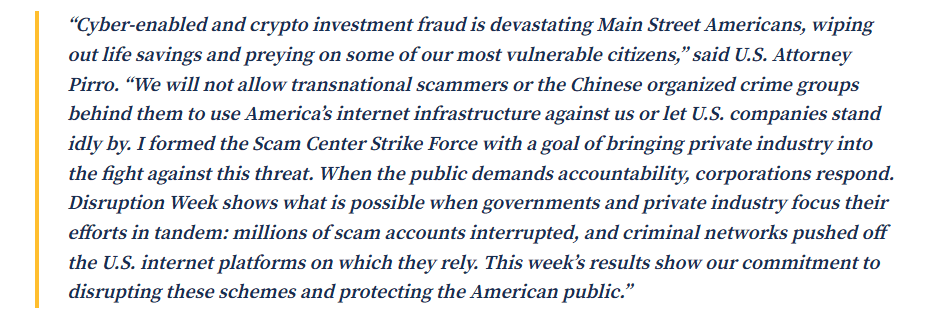
Source: US DOJ

Accounts, Servers, And Arrests

Meta, Microsoft, and Starlink were among the private firms named in the operation, helping take down servers and other hosting tools linked to the scam networks. Authorities also said more than 1.4 million social media and email accounts were disrupted, and the Royal Thai Police Anti-Cyber Scam Center made arrests tied to the effort.

The scam pattern is familiar, but the scale keeps climbing. The DOJ said investment fraud and pig butchering remain among the fastest-growing and most damaging scams aimed at Americans, and the FBI reported earlier this month that losses from crypto- and AI-related scams in 2025 topped $11 billion, with investment scams causing the most damage.

Total crypto market cap currently at $2.15 trillion. Chart: TradingView

Another part of the same push came in April, when the Scam Center Strike Force and its partners restrained more than $701 million in crypto tied to investment scams. Authorities have also carried out other crackdowns this year, including actions in Dubai and Albania, as pressure on scam infrastructure spread beyond Southeast Asia.

Crypto’s Place In The Crackdown

Coinbase also argued that blockchain gives investigators a permanent record of transactions, a point it used to push back on the idea that crypto is only a tool for crime. The coalition behind the operation included the FBI, the US Secret Service, and law enforcement partners in the UK, Australia, Canada, New Zealand, and Thailand.

The latest freeze fits a pattern of steady pressure on scam centers rather than one-off arrests. Officials have kept aiming at websites, messaging channels, servers, and the money trail itself, hoping to cut off the machinery that lets these fraud rings keep running.

Featured image from Unsplash, chart from TradingView

Domande pertinenti

QAccording to the article, how much cryptocurrency did Coinbase freeze that was linked to Southeast Asian scam networks?

ACoinbase moved to freeze more than $3 million in crypto linked to scam networks operating across Southeast Asia.

QWhat was the name of the coordinated law enforcement push during which this crypto freeze was announced?

AThe freeze was announced during Disruption Week, a coordinated push led by the DOJ's Scam Center Strike Force.

QWhich private companies were named as helping to take down servers linked to the scam networks?

AMeta, Microsoft, and Starlink were among the private firms named in the operation, helping take down servers and other hosting tools linked to the scam networks.

QWhat does the FBI report say about total losses from crypto- and AI-related scams in 2025?

AThe FBI reported earlier this month that losses from crypto- and AI-related scams in 2025 topped $11 billion, with investment scams causing the most damage.

QHow does Coinbase argue that blockchain technology can assist in fighting crime, according to the article?

ACoinbase argued that blockchain gives investigators a permanent record of transactions, pushing back on the idea that crypto is only a tool for crime.

Letture associate

Bitcoin's 'Rally Ends,' Officially Entering the Later Stage of a Bear Market?

Bitcoin prices declined 13% this week, reversing the recent rebound and signaling a likely transition into the later stages of a bear market. Key on-chain metrics deteriorated, with the short-term holder cost basis falling below the Realized Price—a pattern last seen in early 2022, characteristic of bear market maturity. The rally to ~$82k proved to be a bear market bounce, as evidenced by the 90-day realized profit/loss ratio failing to sustain above the bullish threshold of 2. Daily realized losses surged to $1.35B, including significant selling from long-term holders who accumulated near cycle tops, indicating ongoing supply redistribution. Price was rejected almost precisely at the aggregate US spot ETF cost basis of ~$83k, turning that level into resistance and leaving the average ETF investor underwater again. Spot market selling pressure intensified, with the 7-day volume delta turning significantly negative to its weakest level since February. While a major long liquidation event cleared over $400M in leverage, spot demand has not yet stepped in to absorb the resulting supply. Options markets continue pricing in higher future volatility (elevated volatility risk premium) and maintain a skew toward put options, reflecting persistent demand for downside protection, though not yet panic. Overall, market structure remains fragile. Sustained recovery likely requires a reclaim of the ETF cost basis, a shift back to positive spot demand, and a slowdown in realized loss-taking. Until then, the market risks further downside or extended consolidation within the broader bear trend.

Foresight News1 h fa

Bitcoin's 'Rally Ends,' Officially Entering the Later Stage of a Bear Market?

Foresight News1 h fa

How Risky is the "Death Spiral" of MSTR and STRC?

Summary: This article explores the perceived "death spiral" risk between MicroStrategy (MSTR), its Bitcoin holdings, and its perpetual preferred stock (STRC), drawing comparisons to the LUNA-UST collapse. While both systems feature price anchors, high yields for holders, and potential feedback loops, their core mechanisms differ fundamentally. The MSTR-STRC structure relies on continuous financing to sustain its high dividend payouts, primarily through stock ATM offerings. A negative feedback cycle could occur: falling MSTR stock price makes raising equity capital harder, increasing pressure to sell Bitcoin, which undermines STRC confidence and further depresses MSTR. However, unlike LUNA-UST's automated, direct linkage, the MSTR-STRC loop is weaker and has brakes: STRC dividends can be deferred or rates lowered, and STRC holders have a $100/share liquidation preference in bankruptcy, providing a price floor. The company's sustainability hinges on its ability to continue financing. Its current ~$900 million USD reserves cover only about 6.3 months of its ~$1.71 billion annual interest/dividend burden. The next six months are critical, aligning with both the potential bottom in Bitcoin's four-year cycle and the depletion timeline of its reserves. While a LUNA-style catastrophic collapse is deemed highly unlikely due to structural differences, the key question is whether MicroStrategy can navigate this period through healthy deleveraging to restart its capital engine.

Foresight News1 h fa

How Risky is the "Death Spiral" of MSTR and STRC?

Foresight News1 h fa

Trading

Spot
Futures
活动图片





