Coinbase Launches Prediction Market Across US as SUBBD Explodes

bitcoinistPubblicato 2026-02-04Pubblicato ultima volta 2026-02-04

Introduzione

Coinbase has launched a U.S.-regulated prediction market platform, entering a space dominated by players like Polymarket and Kalshi. This move signals growing regulatory acceptance for event-based trading contracts. Meanwhile, attention is shifting toward utility-driven crypto projects like SUBBD Token ($SUBBD), which aims to decentralize the $85 billion content creator economy. SUBBD uses AI tools and Web3 payments to help creators monetize content more efficiently, bypassing high fees and restrictions from centralized platforms. Its ongoing presale has raised over $1.4 million, offering staking rewards and exclusive content access to token holders.

Coinbase just walked into the prediction market arena. By launching a U.S.-regulated platform for trading event contracts, the American crypto giant is taking a swing at emerging heavyweights like Polymarket and Kalshi.

This isn’t just about competition; it’s a signal. By running these contracts through its CFTC-regulated arm, Coinbase is essentially legitimizing a sector that’s spent years operating in DeFi’s gray zones.

It’s a bold move. Prediction markets used to be a niche curiosity, but recent volume on decentralized platforms proves there’s a massive appetite for betting on real-world outcomes, everything from Fed rates to election results.

Coinbase’s entry suggests infrastructure providers are finally comfortable with the regulatory landscape surrounding these ‘binary options.’ We aren’t just looking at asset speculation anymore; we’re moving toward functional markets where information, probability, and capital actually intersect.

But the democratization of markets isn’t stopping at financial derivatives. While Coinbase tackles the prediction vertical, a different shift is hitting the creator economy. Smart money is rotating into utility-driven protocols that solve actual headaches for non-financial users.

As the hype around prediction markets builds, liquidity is quietly flowing into projects that redefine content monetization. That’s where SUBBD Token ($SUBBD) steps in, a protocol aiming to dismantle the centralized monopolies choking the $85 billion content industry.

Check out the $SUBBD presale here.

SUBBD Token ($SUBBD) Redefining the $85 Billion Creator Economy

The digital content sector is facing a serious centralization problem. Platforms like OnlyFans and Patreon often take a 30% cut of earnings and hold the power to deplatform users on a whim. SUBBD Token ($SUBBD) uses a decentralized architecture to fix these inefficiencies, but it’s not just about lower fees.

By merging Web3 payments with advanced AI tools, the project offers a technological leap rather than just a financial band-aid.

The real differentiator here is the AI integration. According to the project’s whitepaper, SUBBD equips creators with an AI Personal Assistant for automated interactions and proprietary AI Voice Cloning tech.
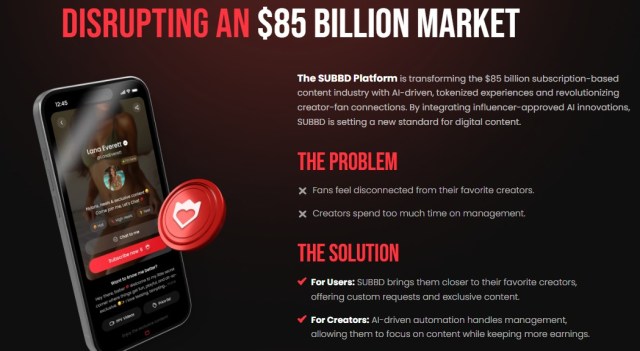
This allows for ‘AI Influencers’, autonomous personas that generate revenue 24/7. That matters. It shifts the creator economy from a labor-intensive grind to a scalable, asset-based model. Plus, by tokenizing access via Ethereum smart contracts, SUBBD ensures creators keep their data and revenue, not the platform.

The logic is simple: legacy platforms are struggling with payment restrictions and bloated fees, while decentralized alternatives offer better margins. SUBBD supports subscriptions, pay-per-view (PPV), and NFT sales, all governed by the token.

It’s a circular setup where the asset is needed for governance, staking, and premium features, theoretically driving demand as the user base grows.

Visit the $SUBBD presale.

Presale Surges Past $1.4M As Investors Seek Yield

You can see this rotation into utility tokens in the fundraising data. $SUBBD has raised over $1.4M in its ongoing presale, a figure that suggests serious conviction from early backers. With tokens currently priced at $0.05749, the entry point is still accessible relative to the roadmap.
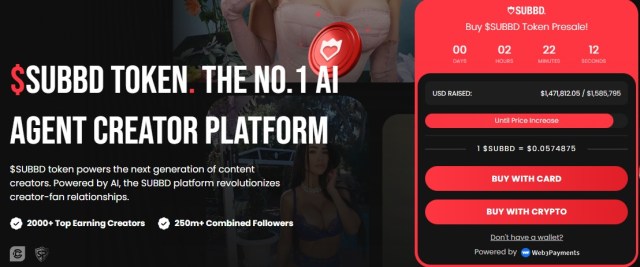
This steady inflow during a choppy market suggests investors are hedging against pure speculation by backing infrastructure plays with clear revenue models.

Staking incentives are also driving retention. SUBBD offers a fixed 20% APY for the first year to users who lock their tokens. That high-yield strategy does two things: rewards early adopters and takes supply off the table during the launch phase.

After that initial period, the model shifts to ‘platform benefit staking.’ Holding tokens then grants access to exclusive livestreams, ‘behind-the-scenes’ drops, and XP multipliers.

This structure makes the ecosystem sticky for active users. Unlike governance tokens that often lack immediate utility, $SUBBD functions as a license to operate within this new creator economy. As Coinbase validates decentralized prediction markets, projects like SUBBD are doing the same for content.

It points to a broader trend: blockchain tech finally replacing middleman-heavy industries.

Buy $SUBBD here.

Disclaimer: The content of this article is for informational purposes only and does not constitute financial advice. Cryptocurrency investments carry inherent risks, and you should perform your own due diligence before making any investment decisions.


Domande pertinenti

QWhat is the significance of Coinbase launching a U.S.-regulated prediction market platform?

ACoinbase's launch of a U.S.-regulated prediction market platform legitimizes a sector that has operated in DeFi's gray zones and signals that infrastructure providers are becoming comfortable with the regulatory landscape for binary options.

QHow does SUBBD Token ($SUBBD) aim to address problems in the content creator economy?

ASUBBD Token uses a decentralized architecture to reduce platform fees, prevent deplatforming risks, and integrates AI tools like an AI Personal Assistant and Voice Cloning to enable scalable, asset-based revenue models for creators.

QWhat fundraising milestone has the $SUBBD presale achieved, and what does it indicate?

AThe $SUBBD presale has raised over $1.4 million, indicating strong investor conviction in utility-driven protocols with clear revenue models during a volatile market.

QWhat staking incentives does SUBBD offer to its early adopters?

ASUBBD offers a fixed 20% APY for the first year to users who lock their tokens, rewarding early adopters and reducing supply during launch, followed by platform benefit staking for exclusive content access.

QHow does the integration of AI technology differentiate SUBBD from traditional content platforms?

ASUBBD's AI integration enables features like AI Influencers and automated interactions, shifting the creator economy from a labor-intensive model to a scalable, autonomous revenue-generating system.

Letture associate

In-depth: The Foreign Guest Genspark

The article "The Foreign Guest: Genspark" investigates the identity and business practices of AI startup Genspark, which presents itself as a Palo Alto-based "AI Costco" offering a subscription bundle of over 70 models and numerous AI agent tools. Despite its official Silicon Valley narrative, Genspark's founding team has deep roots in Chinese tech giant Baidu, a history systematically downplayed in its branding. The company actively cultivates an image as an elite US firm, heavily publicizing partnerships and endorsements from OpenAI, Anthropic, and Microsoft, while distancing itself from the Chinese AI community and obscuring its connections to Chinese investors and open-weight models (like those from DeepSeek, Moonshot AI, and MiniMax) that power its services. Genspark's core strategy involves rapidly cloning and integrating successful AI product concepts (e.g., from Perplexity, Manus, Plaud) into its unified platform, supported by aggressive marketing, including Super Bowl ads and paid native content in publications like The Wall Street Journal. Critically, the article suggests a significant portion of its engineering and product development is conducted by a team in Beijing, operating outside its official US corporate structure. This duality allows Genspark to leverage Chinese talent and models for efficiency and cost reduction while constructing a public facade as a purely American success story. The piece concludes that Genspark's most effective agent is its own corporate identity, meticulously engineered to obscure its Chinese underpinnings and be perceived solely as a Silicon Valley company.

marsbit40 min fa

In-depth: The Foreign Guest Genspark

marsbit40 min fa

Debate: Korean Workers Fear Unemployment, While Musk Envisions a Society 'Without Work'?

While South Korean auto workers fear job losses from robotics, Elon Musk envisions a future where AI and robots render most work optional. This article explores the growing tension between immediate anxieties over automation and long-term visions of a post-work society. The piece begins with recent strikes at Hyundai's Korean plants, where unions, amid standard wage negotiations, also sought job guarantees against advancing robotics—specifically mentioning Boston Dynamics' Atlas. This reflects how anxiety about technological displacement is emerging even before robots are fully capable of replacing skilled labor on assembly lines. The author argues that while current robotics still struggle with the nuanced, experiential knowledge of veteran workers, the *perception* of imminent replacement is fueling social conflict prematurely. This modern "Luddite" sentiment is compared to the 19th-century English textile workers who smashed machines. Historically, Luddites weren't simply anti-technology; they were protesting the rapid devaluation of their skills and the unequal distribution of productivity gains. Similarly, today's workers ask who will bear the cost of transition and share in the new wealth created by machines. In contrast, figures like Elon Musk propose an optimistic endpoint: with AI and robotics driving extreme abundance, the link between work and survival could break. He suggests concepts like "Universal High Income" could allow society to share the technological bounty, transforming work from a necessity into a choice. The core challenge, however, lies in the transition. The author notes that technology's benefits diffuse slowly, while its disruptive costs—job losses, skill obsolescence—can be concentrated and immediate. The risk is a painful interim period where productivity gains are captured by a few before new social contracts, safety nets, and retraining systems are established. The conclusion calls for proactive governance. Just as past industrial revolutions gave rise to labor standards and social safety nets, the robotics era needs its own frameworks. These should address job transition support, distribution of productivity gains, safety liability, and ethical deployment. Embracing such "constraints" is not opposition to progress but a necessary step to ensure technology benefits society broadly. The discussion sparked by Hyundai's workers, therefore, is not premature but essential.

marsbit53 min fa

Debate: Korean Workers Fear Unemployment, While Musk Envisions a Society 'Without Work'?

marsbit53 min fa

Trading

Spot
活动图片