Coinbase + Glassnode: Charting Crypto Q2 2026

insights.glassnodePubblicato 2026-06-03Pubblicato ultima volta 2026-06-03

Introduzione

Amid geopolitical uncertainty overshadowing crypto-native drivers, Q2 2026 market analysis reveals capital rotation within crypto rather than full exit. While the total crypto market cap (ex-stablecoins) fell ~18% in Q1, stablecoin supply grew, indicating investors are de-risking into cash-like instruments while staying engaged. Bitcoin sentiment reset to 'Fear' with supply tightening as speculative capital diminished. Ethereum shows capital concentrating at its base layer for utility-driven use cases like stablecoins and tokenized assets, despite softening broader activity. Most surveyed institutions (82%) now view the market in a bear or late-bear phase, though derivatives markets show rebuilding risk appetite. Historical cycle analogs are becoming less reliable for timing inflection points.

Geopolitical events in recent months have introduced persistent uncertainty for investors, making it challenging to take short-term positions with conviction. Macro developments now overshadow crypto-native drivers in shaping near-term price action.

Produced in collaboration with Coinbase Institutional, the latest Charting Crypto report distills the key market and on-chain trends impacting institutional crypto strategy this quarter. From investor sentiment and stablecoin liquidity to Bitcoin accumulation signals and Ethereum’s evolving market structure, the report offers a data-driven view of a market waiting for clearer direction.

Some of the many highlights in this edition:

  • Liquidity is rotating into stablecoins rather than exiting the asset class, as total crypto market cap (excluding stablecoins) fell by ~18% in Q1, while stablecoin supply increased from $308B to $318B
  • Past cycle analogues are becoming less useful for timing market inflection points as both Bitcoin and Ethereum cycles continue to diverge from historical patterns
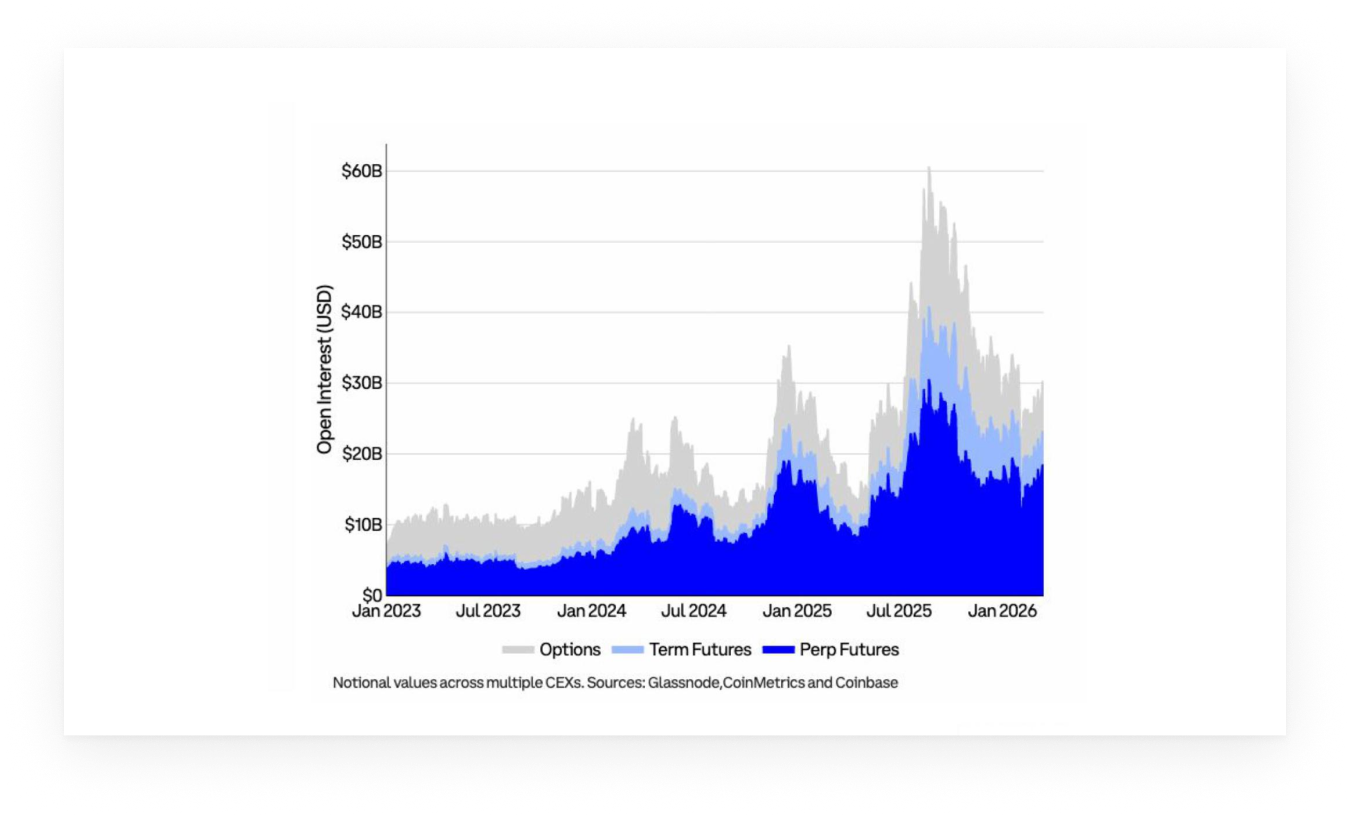
  • Market structure shows signs of normalization, with BTC derivatives open interest recovering (particularly in perpetuals), indicating a rebuilding of risk appetite in leveraged markets
  • 82% of surveyed institutions now place the market in a bear or late-bear phase (up from 31% in December)
  • Ethereum’s ecosystem is becoming more differentiated: Capital concentrates in base-layer use cases as broader activity softens, highlighting a shift toward utility-driven demand over speculative flows.
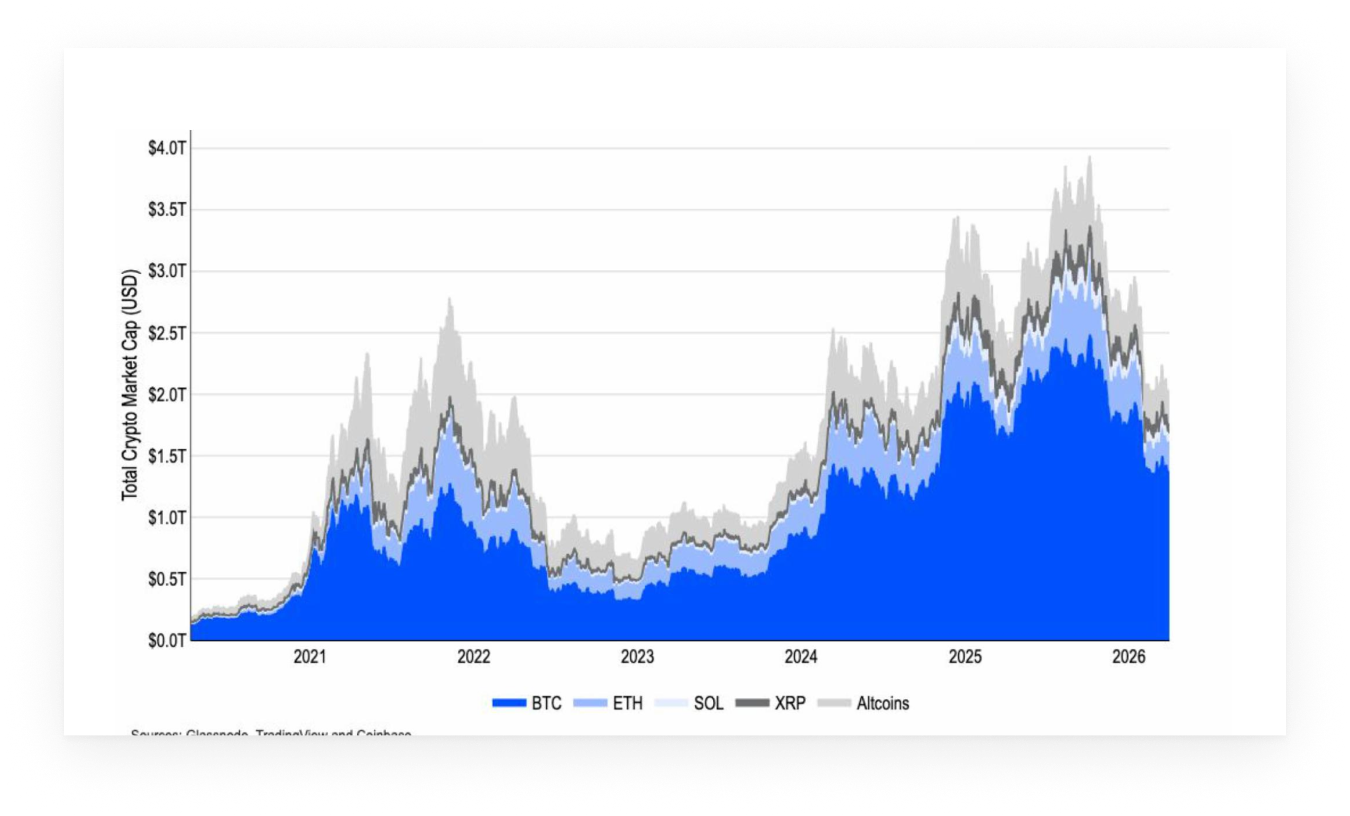
Liquidity Remains Inside the System

Despite the broad risk-off move in Q1, liquidity dynamics tell a more nuanced story. Total crypto market capitalization (excluding stablecoins) declined by roughly 18%, yet stablecoin supply increased over the same period.

This divergence suggests that capital is not fully leaving crypto markets, but rather rotating into cash-like instruments while awaiting clearer signals. In effect, investors are de-risking without disengaging, preserving optionality for re-entry.
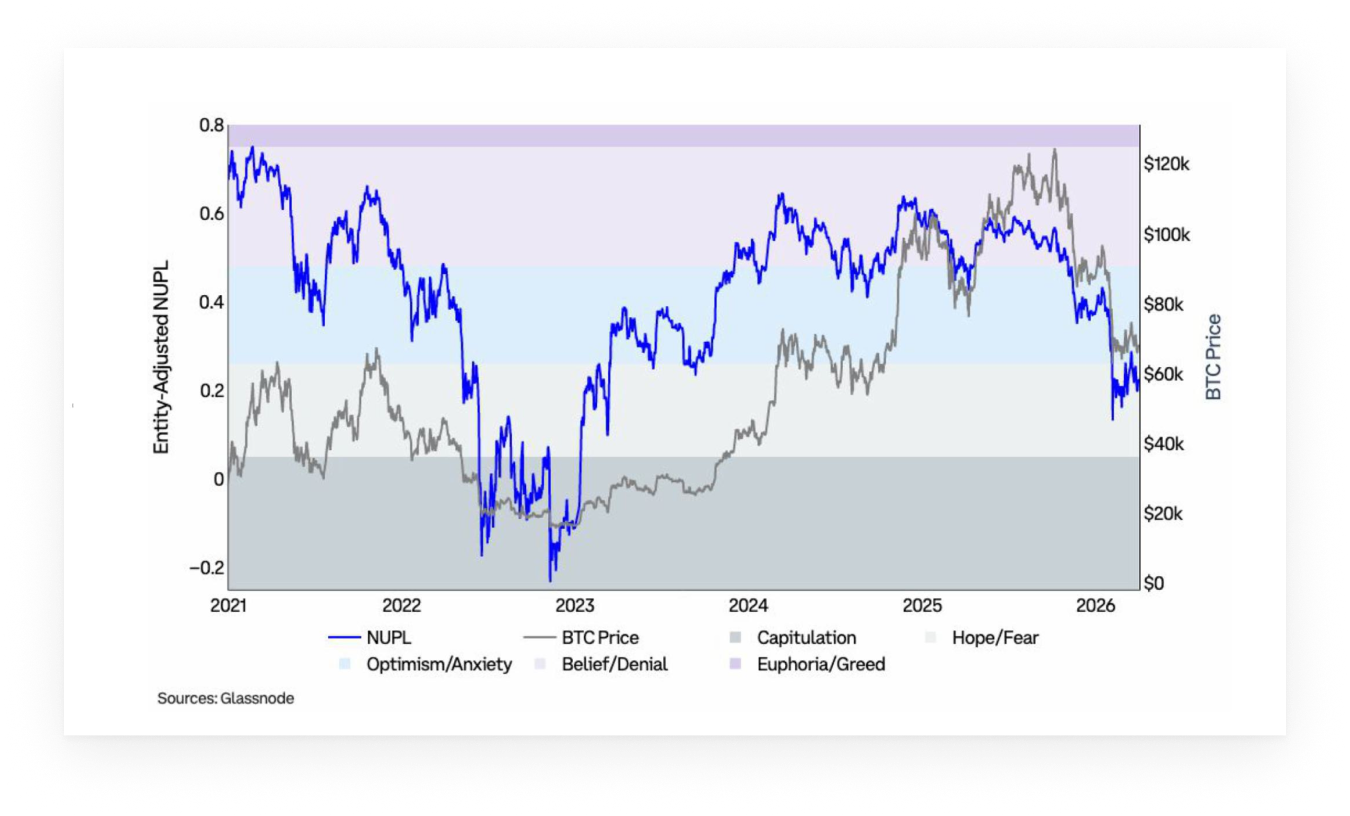
Bitcoin: Sentiment Reset, Supply Tightens

Bitcoin’s February drawdown was reflected in a deterioration in investor sentiment, with Net Unrealized Profit/Loss (NUPL) moving from Anxiety into Fear for the rest of Q1. While sentiment has started to show early signs of improvement in April, it remains closely tied to external developments, suggesting conviction is still fragile.

At the same time, onchain supply dynamics indicate a transfer of coins away from more reactive participants. The contraction in recently active supply, alongside a modest increase in long-term held coins, implies that shorter-term, speculative capital has been reduced.
Ethereum: Capital Concentration at the Base Layer

Ethereum data points to a divergence between activity and capital allocation. Short-term participation declined throughout the first quarter, as reflected in a sharp drop in recently active supply and a prolonged period of depressed sentiment. However, capital flows have remained concentrated on the base layer.

Stablecoin supply on Ethereum continues to expand with positive momentum, and tokenized real-world assets have reached new highs, indicating sustained demand for settlement and collateral use cases. At the same time, ETH has outperformed major L2 tokens since late 2025, suggesting that capital is consolidating at the base layer rather than rotating further out on the risk curve.
To help you navigate the current challenging crypto environment, check out the full insights and data in the Glassnode x Coinbase report: download the report here.


Domande pertinenti

QAccording to the Coinbase and Glassnode report, what does the increase in stablecoin supply alongside a decrease in the total crypto market cap (excluding stablecoins) suggest about capital movement in Q1 2026?

AIt suggests that capital is not fully exiting the crypto market, but rather rotating into stablecoins (cash-like instruments) while awaiting clearer signals. Investors are de-risking without disengaging, preserving optionality for re-entry.

QHow has institutional sentiment shifted regarding the market phase from December to the time of the report, and what does this indicate?

A82% of surveyed institutions now place the market in a bear or late-bear phase, a significant increase from 31% in December. This indicates a dramatic deterioration in institutional sentiment and conviction in the market over that period.

QWhat key trend does the report highlight regarding Bitcoin's on-chain supply dynamics and investor behavior in Q1 2026?

AThe report highlights a transfer of Bitcoin away from more reactive participants. The contraction in recently active supply and a modest increase in long-term held coins imply that shorter-term, speculative capital has been reduced, tightening available supply.

QWhat evidence does the report provide for Ethereum's capital concentrating at its base layer despite broader activity softening?

AThe evidence includes: continued expansion of stablecoin supply on Ethereum with positive momentum, tokenized real-world assets (RWAs) reaching new highs, and ETH outperforming major Layer 2 tokens since late 2025. This suggests sustained demand for settlement/collateral use cases and capital consolidation on the base chain.

QWhat does the recovery in Bitcoin derivatives open interest, particularly in perpetuals, signal about the market according to the report?

AIt indicates a normalization of market structure and a rebuilding of risk appetite within leveraged markets, as open interest recovers from previous declines.

Letture associate

The Once-Niche Field of Philosophy Becomes a Hot Topic in "Governing" AI

"Cold" Philosophy Becomes Hot in Taming AI This article explores the rising prominence of philosophical inquiry at the World Artificial Intelligence Conference (WAIC), highlighting a shift from purely technical discussions to deeper questions about AI's nature and impact. A key theme is the foundational question of intelligence itself. Philosopher Sun Ning argued that true, grounded intelligence requires embodiment, environment, interaction with others, and historical context, summarized as "Before intelligence, there is a world. Before mind, there is relationship." The forum then examined AI's expanding role in science. Researchers presented AI systems that can autonomously generate scientific papers and mathematical proofs, raising critical questions about evaluation, attribution of discovery, and potential misuse. The proposed solution is a collaborative framework: AI expands the search space, humans define value and provide rigorous constraints, and machines handle verification. As AI models begin to simulate human societies and behaviors for research, new risks emerge. Simulations can inherit and amplify societal biases from their training data, and their outputs risk being mistaken for genuine social signals. This necessitates robust governance focused on auditability, bias correction, and clear human oversight—ensuring people retain intervention, correction, and explanation rights ("human-in-the-loop"). The discussion extended to industry, where AI integrates with wet labs for bio-manufacturing. Here, challenges involve bridging the digital-physical gap and adapting regulatory and business models from process-based to outcome-based partnerships, fundamentally altering production relationships. The convergence of philosophers, scientists, and entrepreneurs at WAIC signals a broader trend: as AI permeates knowledge creation and social systems, technical progress is increasingly intertwined with urgent questions of ethics, governance, economic distribution, and public policy. The core challenge becomes not just what AI *can* do, but what we *should* ask it, trust from it, and guide it towards.

marsbit46 min fa

The Once-Niche Field of Philosophy Becomes a Hot Topic in "Governing" AI

marsbit46 min fa

After six years of pie-in-the-sky fundraising, 90% of funds used to replenish cash flow: The illusion and reality of L'CI Technology's silicon carbide "industrialization"|TMTPost Deep Dive

After six years and raising approximately 3.2 billion yuan through two private placements, Luxshare Technology has officially terminated its two major SiC wafer projects. Only about 7.75% of the raised funds were actually invested in SiC construction and R&D, with the remaining 90% redirected to replenish working capital and repay loans. Despite previous ambitious plans for a 10-billion-yuan SiC industrial park and public assurances of progress, the company's actual SiC capacity remains unclear, with its subsidiary recording significant losses. The article details a pattern of chasing market trends, from electric vehicles and photovoltaics to the current focus on SiC. However, its SiC entry was late; while peers like Tianke Heda and Tianyue Advanced have moved from mass-producing 6-inch to 8-inch and even 12-inch wafers, Luxshare is still struggling with its 6-inch plans and now promises to develop larger sizes with its own funds. Key concerns include unclear disclosures about the status of its chief scientist, Chen Zhizhan, and significantly lower R&D investment compared to competitors. Financially, since its 2011 IPO, the company has raised over 7 billion yuan but generated only 221 million yuan in cumulative net profit. Meanwhile, the controlling shareholder family has cashed out nearly 2 billion yuan since 2018. The article positions Luxshare as a case study of a listed company focused more on financing and capital operation around hot topics than on substantive industrial development.

marsbit1 h fa

After six years of pie-in-the-sky fundraising, 90% of funds used to replenish cash flow: The illusion and reality of L'CI Technology's silicon carbide "industrialization"|TMTPost Deep Dive

marsbit1 h fa

ChatGPT Finally Can 'Search Itself': Nearly Four Years of Conversations, Retrieved with One Click

ChatGPT, nearly four years old, has long lacked a functional way for users to search their own accumulated history. This changed on July 14th, when OpenAI launched a comprehensive "Unified Search" feature across all platforms and plans. This new search allows users to find and instantly access past conversations, uploaded documents, generated images, and projects within their own ChatGPT account, all from a single sidebar entry. This update signifies a major shift in ChatGPT's role, transforming it from a transient chat tool into a personal knowledge base or "file system" for users' AI-generated content. It completes a critical missing piece as OpenAI expands ChatGPT's capabilities with features like Projects, Memory, Work, and Sites, aiming to make it a central hub for work and creativity. The ability to easily retrieve years of personal data makes that data more valuable as a unique, irreplaceable asset in the AI era. However, it also highlights the increasing weight and potential sensitivity of this data, given default settings that allow conversations to be used for model training and legal precedents involving user logs. While a significant improvement over the previous ineffective search, this move is seen as addressing an industry-wide oversight. As the competition between AI assistants (ChatGPT, Gemini, Claude) moves beyond raw model power, the new battleground is becoming which platform can best organize, retain, and leverage the valuable data co-created by users and AI.

marsbit1 h fa

ChatGPT Finally Can 'Search Itself': Nearly Four Years of Conversations, Retrieved with One Click

marsbit1 h fa

Trading

Spot
活动图片