The Once-Niche Field of Philosophy Becomes a Hot Topic in "Governing" AI

marsbitPubblicato 2026-07-20Pubblicato ultima volta 2026-07-20

Introduzione

"Cold" Philosophy Becomes Hot in Taming AI This article explores the rising prominence of philosophical inquiry at the World Artificial Intelligence Conference (WAIC), highlighting a shift from purely technical discussions to deeper questions about AI's nature and impact. A key theme is the foundational question of intelligence itself. Philosopher Sun Ning argued that true, grounded intelligence requires embodiment, environment, interaction with others, and historical context, summarized as "Before intelligence, there is a world. Before mind, there is relationship." The forum then examined AI's expanding role in science. Researchers presented AI systems that can autonomously generate scientific papers and mathematical proofs, raising critical questions about evaluation, attribution of discovery, and potential misuse. The proposed solution is a collaborative framework: AI expands the search space, humans define value and provide rigorous constraints, and machines handle verification. As AI models begin to simulate human societies and behaviors for research, new risks emerge. Simulations can inherit and amplify societal biases from their training data, and their outputs risk being mistaken for genuine social signals. This necessitates robust governance focused on auditability, bias correction, and clear human oversight—ensuring people retain intervention, correction, and explanation rights ("human-in-the-loop"). The discussion extended to industry, where AI integrates with...

Who would have thought that philosophy, a once niche major, would become a hot topic in the current AI scene.

This was our unexpected discovery while browsing WAIC this year – the philosophical content was surprisingly high.

For example, at the parallel session “Mind and Intelligence · Youth Ecology Forum” of the WAIC Scientific Intelligence Open Forum, the first speaker was Sun Ning, a professor from the School of Philosophy at Fudan University. In the main forum discussion “Original Innovation in the AI-Native Era,” Sun Xiangchen, another professor from the School of Philosophy at Fudan University, also joined the panel for a summit dialogue.

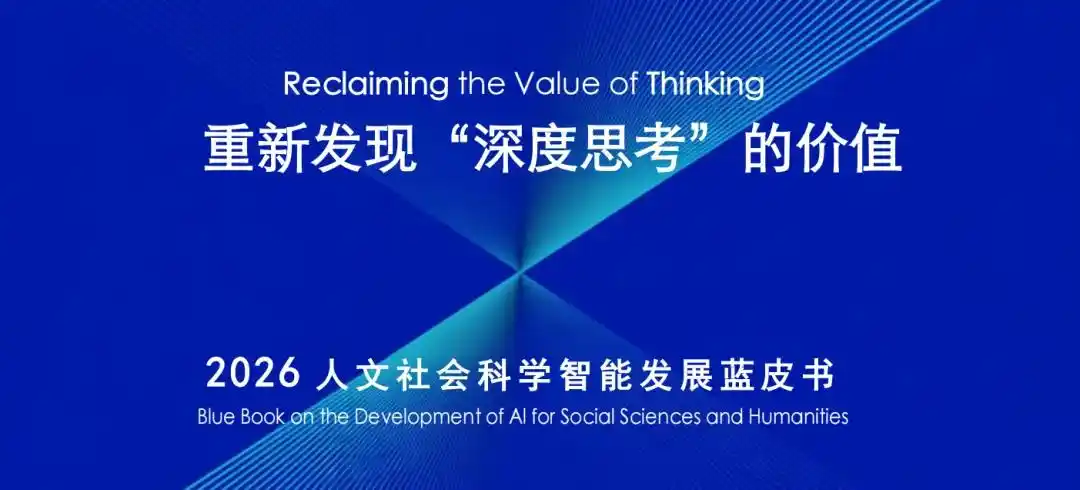
Coincidentally, during WAIC, the “2026 Blue Book on Intelligent Development in Humanities and Social Sciences” released by the National Development and Intelligent Governance Comprehensive Laboratory of Fudan University brought deep thinking, research credibility, and AI governance into the spotlight.

But to be fair, this seemingly sudden wave of philosophical interest actually has a clear trajectory.

A few years ago at AI conferences, people mostly talked about parameters, computing power, and leaderboards. Now, AI can write papers, perform mathematical proofs, generate protein conformations, and simulate societies with a group of agents.

While AI capabilities are advancing triumphantly, the ensuing problems are becoming increasingly philosophical:

  • Does a model's ability to answer questions fluently mean it truly understands?
  • If AI can autonomously discover knowledge, does it count as a new scientist?
  • If AI discovers laws that humans cannot explain but can be verified experimentally, should we believe them?

In his speech titled “Before Intelligence, There is a World,” Sun Ning brought the questions back to the source.

As early as the 1990s, cognitive scientist Stevan Harnad proposed the Symbol Grounding Problem, questioning how a symbol system acquires true meaning through perception and interaction. Around the same time, robotics engineer Rodney Brooks proposed the Physical Grounding Hypothesis, leaving behind an influential statement—the world is its own best model.
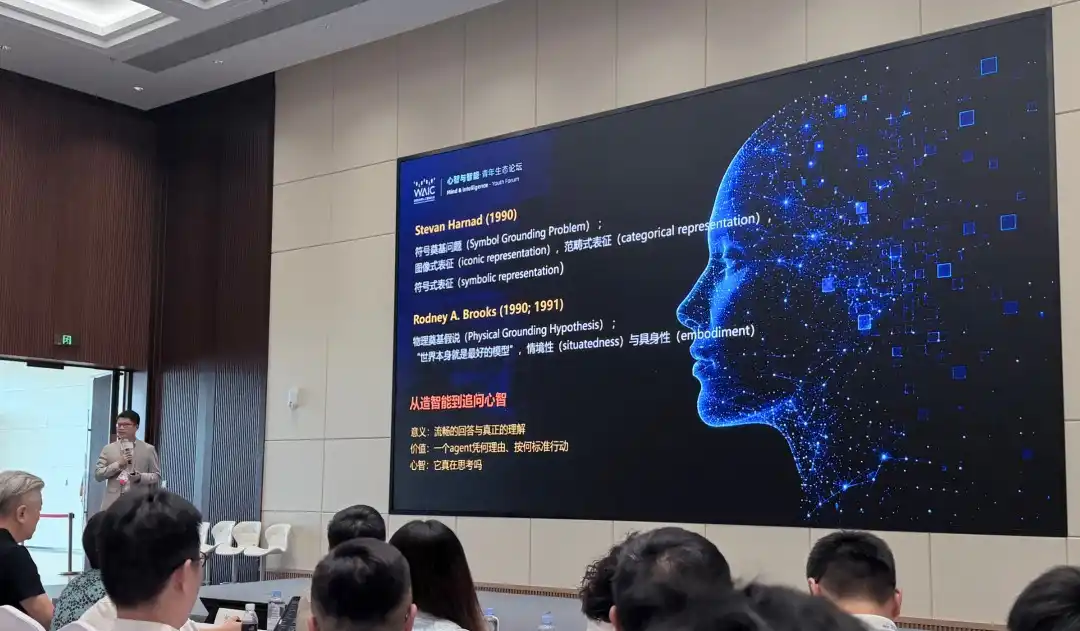
Following this line of thought, Sun Ning proposed that a kind of intelligence deeply rooted in the world requires at least a body, an environment, others, and history. The body gives action a cost, the environment provides feedback, others bring norms, and history allows failures to accumulate into experience.

He summarized it in two sentences:

Before intelligence, there is a world. Before mind, there is relationship.

This also set the tone for the day's discussions.

This Youth Forum was jointly organized by the National Development and Intelligent Governance Comprehensive Laboratory of Fudan University, Shanghai AI Lab, the School of Philosophy at Fudan University, Qingpu Fudan Future Technology Research Institute, and Datawhale.

The stage featured young scientists, philosophers, social scientists, and entrepreneurs. Conversations ranged from self-evolving models to mathematical proofs, from protein dynamics to social simulations, and finally settled on governance and industry.

Issues seemingly scattered across different disciplines were thus strung together.

AI Starts Doing Science Itself

Just after philosophers questioned “what is intelligence,” Chen Yongchao, founder of Chaoyan Intelligence, raised a more specific question—Can AI become a new scientist?
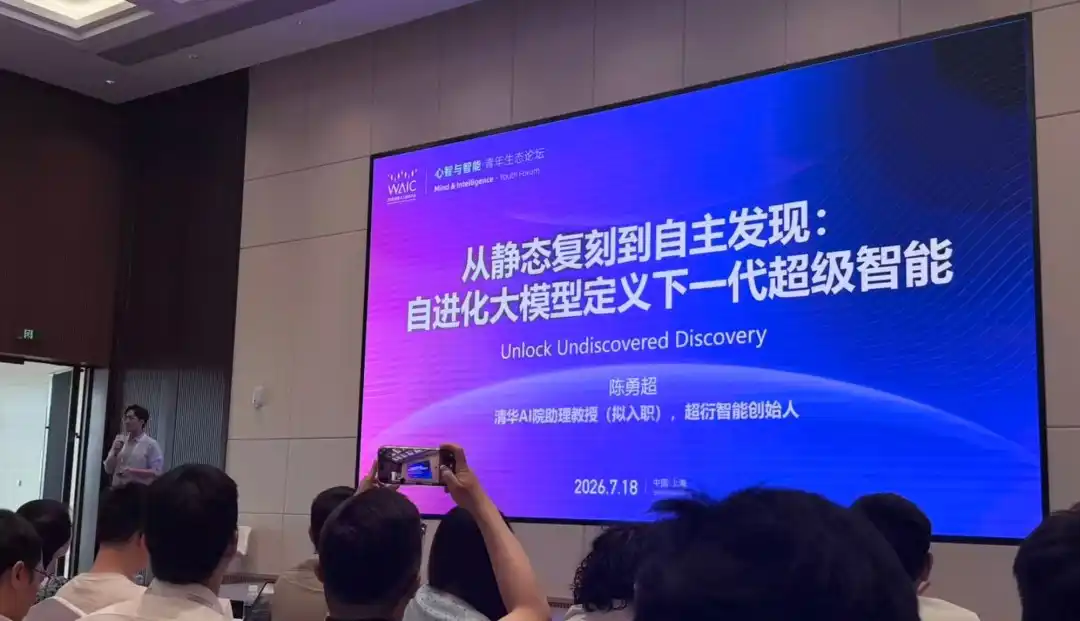
Past large models mainly learned existing human knowledge from internet data. The self-evolving models Chen Yongchao described aim to engage in real-world tasks and continuously learn from the research process and environmental feedback.

Specifically, the model can generate its own ideas, write code, run experiments, analyze data, and then incorporate the trajectories of successes and failures to adjust data, the model, and the Harness.

Chen Yongchao also showcased some eye-catching results.

The Apex Search developed by his team generated 34 papers, submitted to academic peer-review systems like ACL and ARR. According to results disclosed on-site, about 10 had the chance to enter Findings or the main conference, with two papers scoring 3.67, higher than about 95% of human submissions.
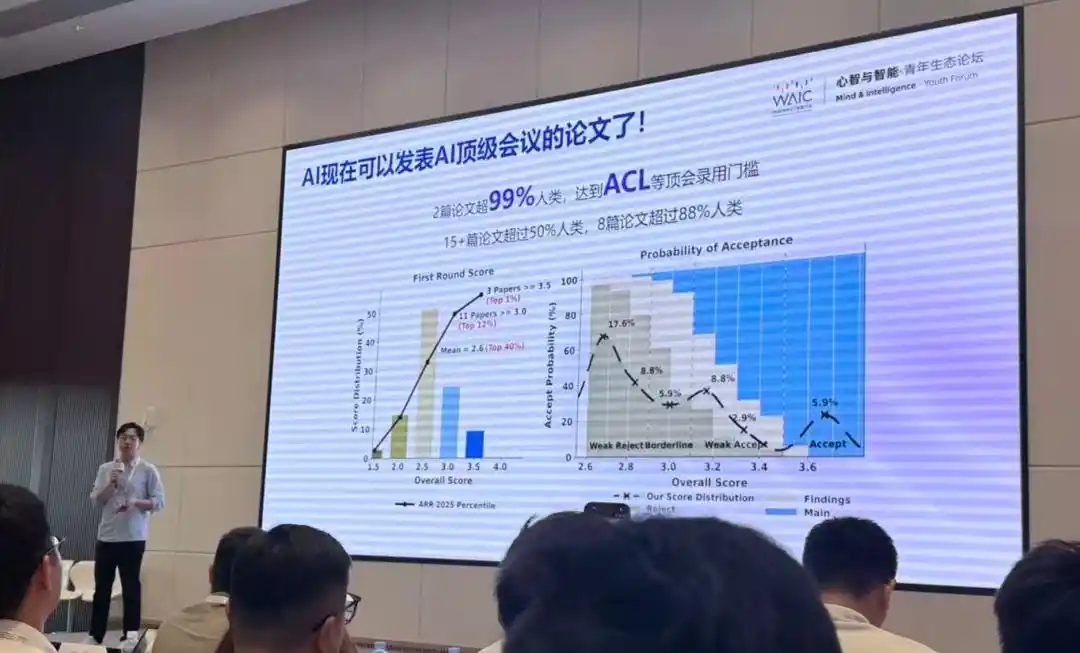
Some peer reviews even gave comments like “the first study in the field,” “rigorous experiments,” and “addresses key issues.”

In other words, AI-generated research results could already pass the first round of scrutiny by human reviewers.

But problems followed.

In the later “Changes in Society” panel, Wei Zhongyu, a professor at the School of Data Science, Fudan University, raised the question: if AI generates and submits dozens of papers at once, and a few receive high scores, how should we judge its research capabilities? Does this mean the system's research ability has reached top conference publication level, or has it merely found weak points in the existing peer-review mechanism?
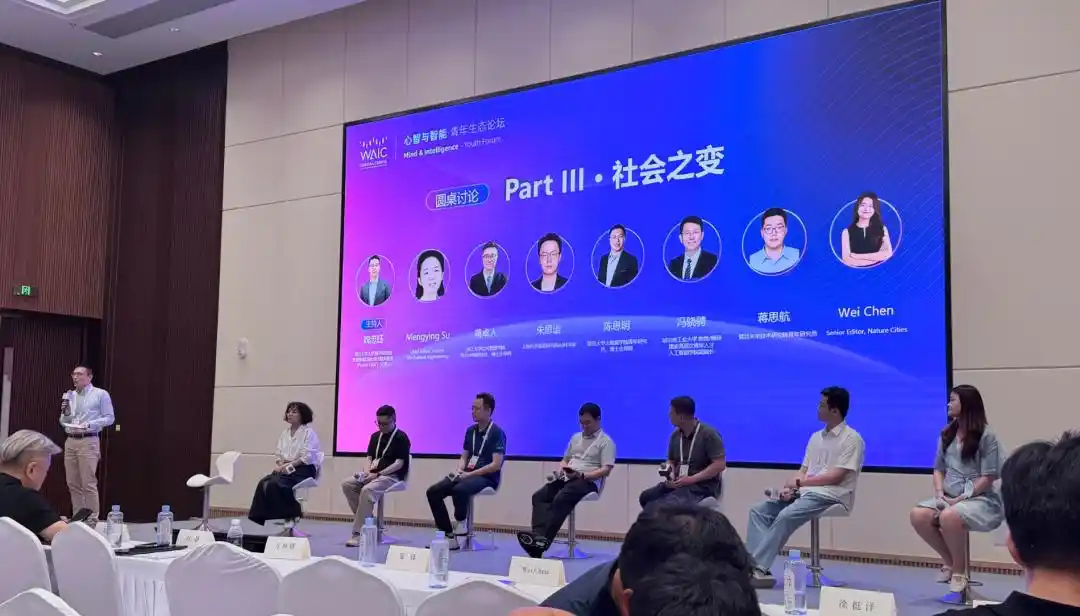
As papers are generated faster and faster, evaluation may become more difficult than generation itself.

Chen Yongchao himself left a series of questions. Can AI produce a breakthrough like Transformer? How to evaluate massive scientific discoveries? Who owns AI research outcomes? If the system is used for harmful research, how should responsibility be allocated?

Next on stage, Wang Tiandong, a tenure-track associate professor at the Shanghai Center for Mathematical Sciences, Fudan University, offered a clearer division of labor between humans and machines.
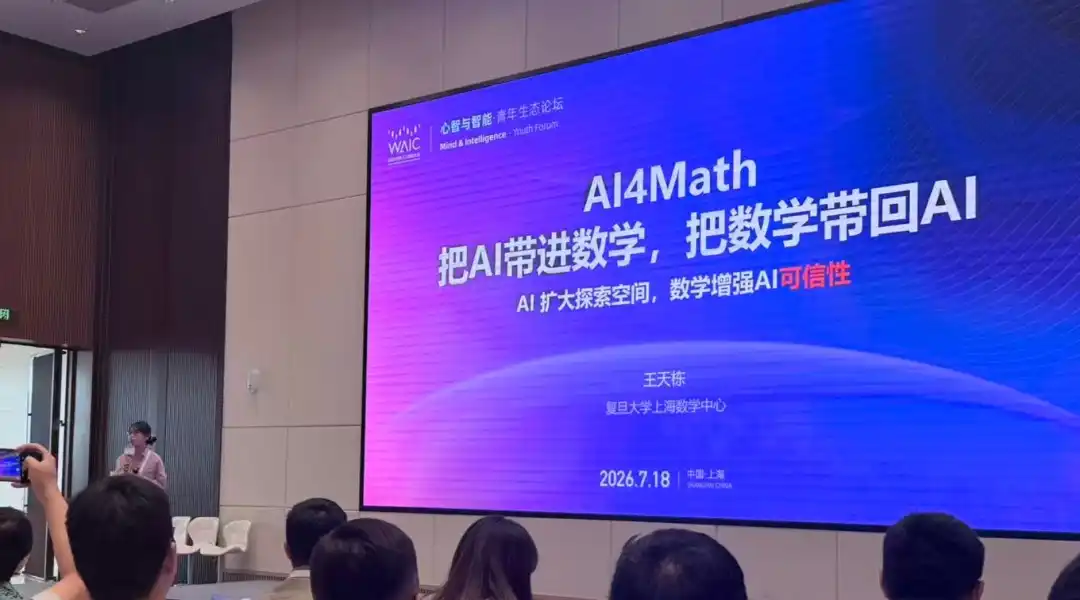
AI excels at retrieval, summarization, finding special and counterexamples, and generating dozens of candidate proof paths simultaneously. Mathematicians are responsible for judging the importance of problems, whether conjectures are worth studying, and applying rigorous concepts and structures to constrain results. Finally, machine verification is added to check for missing steps in reasoning or errors in calculations.

Simply put:

AI expands the search space, humans define value, and machines are responsible for verification.

In this process, mathematics can provide structural constraints, formal verification, error analysis, and applicability boundaries for AI. Trustworthiness does not mean never making mistakes; a more realistic standard is that errors can be discovered, risks can be defined, and conclusions can withstand review.

Subsequently, Yang Zixiong, an AI scientist at the Shanghai Institute for Science and Technology Artificial Intelligence, brought the trustworthiness issue into the more complex world of life.
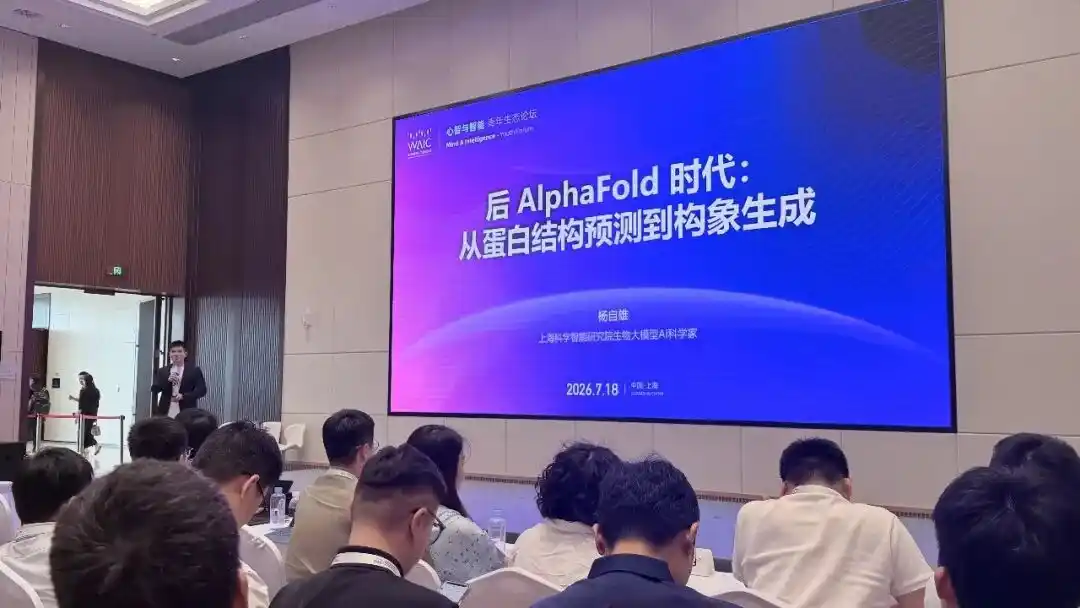
AlphaFold's core solution infers highly probable static structures from sequences. But biological molecules like proteins and RNA are always in motion, with many functions dependent on conformational distributions, state transitions, and timescales.

Therefore, the research goal in the post-AlphaFold era has shifted from “predicting a structure” to “generating a dynamic trajectory.”

This means the model must cover rare but important conformations, maintain structural stability over long generation times, and satisfy thermodynamics, kinetics, and physical laws. While static structures have accumulated vast data, dynamic molecular data is very limited, and related evaluation systems still need improvement.

From mathematical proofs to protein dynamics, AI can indeed explore faster and more broadly. But once it comes to effective scientific discovery, evidence, experiments, and real-world feedback are all indispensable.

If mathematics and life sciences have relatively clear verification paths, things get more complicated when AI starts simulating humans and society.

When Intelligence Enters Society, Governance Can’t Lag Behind

Qu Jingjing, a young scientist at the Shanghai AI Lab, researches precisely the intersection of AI and social sciences.
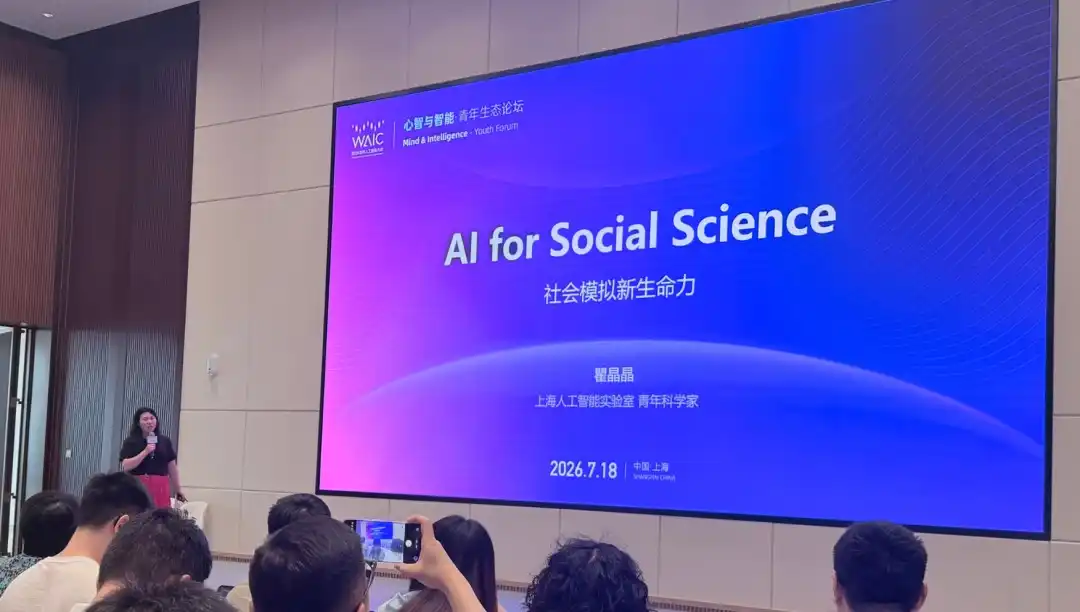
In her view, social sciences are a core foundation for AI development. Alan Turing's research on “whether machines can think” was published in the philosophy journal Mind. Herbert A. Simon proposed the theory of bounded rationality, co-founded the physical symbol system hypothesis with Allen Newell, initiating symbolic AI. Geoffrey Hinton combined psychology and cognitive science to develop neural networks simulating the human brain, paving the way for today's large models.

Now, this relationship is running in reverse, with AI bringing new experimental methods to the social sciences. However, as AGI develops socially and at scale, a core challenge remains: in large-scale, complex social evolutionary games, it's difficult to balance logical consistency with the credibility of experimental results.

Qu Jingjing showcased the social simulation platform Epitome. In terms of high-throughput efficiency, the platform can simulate thousands of virtual samples with one click, compressing a decade of social evolution into 14 hours. Researchers can freely adjust variables like intervention policies and group relationships to quickly observe their long-term social impacts.

This method is particularly suitable for experiments that are difficult to conduct directly in the real world.

For example, how to simulate a child growing from third to fifth grade? The model must reflect knowledge changes and simulate psychological, behavioral, and social relationships. Researchers also want to test different education policies in this virtual environment to observe which methods benefit child development.

While the idea is attractive, risks are also embedded.

After all, a large model can simulate an expert but may not accurately simulate a child in a specific family, region, and social context. Do the attitudes displayed by virtual roles come from real social patterns or stereotypes in the training data?

In the “Changes in Society” panel, Jiang Zhuoren, a Hundred-Talent-Plan researcher and doctoral supervisor at the School of Public Administration, Zhejiang University, shared a set of more cautionary data.

In a cross-national trust study, the correlation coefficient of data generated by large models at the national mean level could reach over 90%. But when entering regression analysis, the significance coverage dropped to 34%–37%; when researchers tried to recover country types using this data, the results were close to random.

In other words, the model looks very much like real society at a macro level, but once entering specific populations and causal relationships, biases are exposed.

More troublesome, social data can form a loop.

Real-world biases enter training data, models then participate in recruitment, education, content distribution, and public decision-making, and new results become materials for the next training round. Without auditing and correction, original biases may be continuously amplified in the loop.

Thus, a straightforward reminder appeared on the panel:

Large models can be used to simulate society, but don't take simulation results as the voice of real society.

Once AI enters society, governance cannot remain at the level of “is the model accurate.”

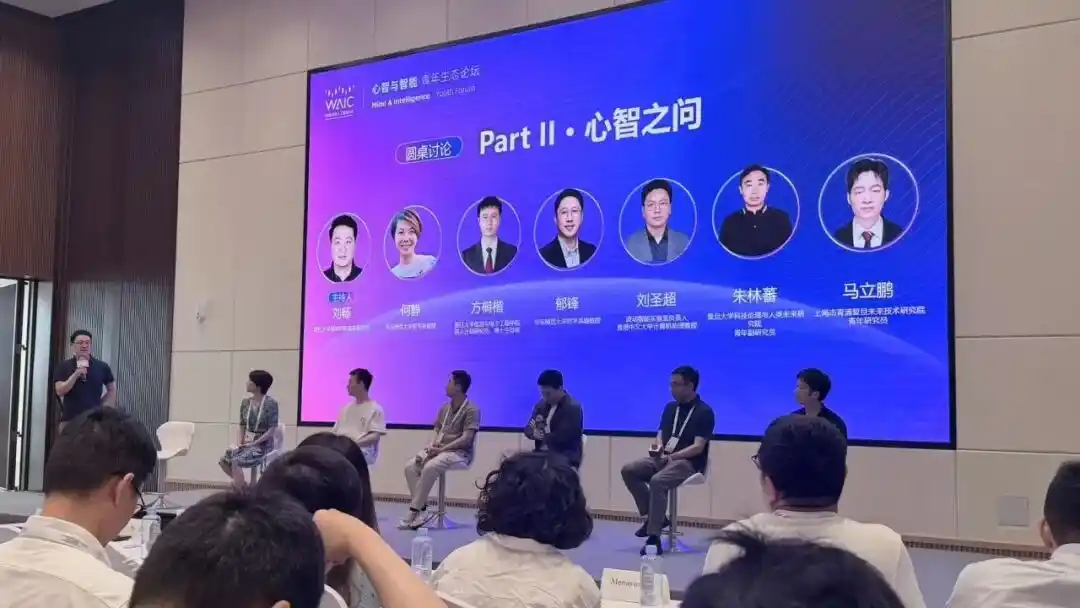
The “Questions of Mind” panel discussed risks like attacks, harmful biological research, and psychological dependence. Zhu Linfan, a young associate researcher at the Institute for Science, Technology and Human Future Ethics, Fudan University, also mentioned that current AI governance generally faces the dilemma of “over-regulation stifles, under-regulation leads to chaos,” requiring technology, policy, ethics, and international cooperation to find more nuanced solutions.

Ma Lipeng, a young researcher at the Qingpu Fudan Future Technology Research Institute, added a technical layer. Today's AI can answer almost anything but lacks the meta-cognitive ability to “know what it doesn't know.” Only by first helping AI recognize its own capabilities and boundaries can subsequent evaluation and governance have better handles. This also requires participation from different disciplines like philosophy, education, and computer science.
The responsibility issue is also becoming more complex.

When AI agents possess stronger initiative, can they become legal or moral actors? If they cannot bear responsibility independently, how should responsibility be divided among developers, deployers, users, and final decision-makers?

Given this, it's not hard to understand why the National Development and Intelligent Governance Comprehensive Laboratory of Fudan University appeared as an organizer of this Scientific Intelligence Forum.

This laboratory's research spans artificial intelligence, big data, humanities and social sciences, public governance, etc., and is one of the first Ministry of Education key laboratories for philosophy and social sciences. An important task it undertakes is observing technological changes within real social and institutional environments and then bridging academic research with policy needs.

The “2026 Blue Book on Intelligent Development in Humanities and Social Sciences,” compiled by the Fudan AI+New Liberal Arts ecosystem led by the lab, in collaboration with the Shanghai AI Lab, bringing together over 40 experts from nearly 20 disciplines, attempts to transform many seemingly abstract governance principles into actionable research and institutional processes.
For example, when AI enters research, the final output cannot just be a fluently written paper. The research question, data dictionary, analysis scripts, execution records, review comments, and human adjudication should also be preserved, allowing others to follow the evidence chain.

The STRIDES framework proposed in the Blue Book sets checkpoints at theory, method, data, execution, and review stages. Which hypotheses need to be stated, which evidence needs to be located, which low-confidence conclusions need to be referred back to human judgment—all are incorporated into the process.

In the field of public governance, the questions are more direct.

The Blue Book distinguishes between agentic and auxiliary AI embedding modes. The former allows the algorithm to participate all the way to the output decision, with humans often only appearing in case of system failure or appeal. The latter mode assigns AI tasks like retrieval, calculation, risk prompts, and solution generation, with the final decision still made by humans.

And so-called “human-in-the-loop” cannot just be a confirmation button. Humans need rights to intervene, correct, and explain.

From this perspective, governance is more like building roads for technology. Which scenarios can accelerate, which places need guardrails, who reviews, who explains, and who takes responsibility when problems arise must all be written into the rules beforehand.

Additionally, the 2026 Blue Book constructs the “Chinese Universities AI4SSH Index,” observing the integration level of AI and humanities/social sciences in universities from dimensions like core research capability, innovative development potential, and social dissemination capability.

The judgment it conveys is clear. For a field to develop long-term capacity, a few papers and models are not enough. Data, computing power, toolchains, talent cultivation, organizational collaboration, and evaluation systems all need to keep up.

This is the significance of the National Development and Intelligent Governance Comprehensive Laboratory connecting academia and policy. Technology provides new possibilities, social sciences explain impacts, economics studies incentives and distribution, and governance research transforms these understandings into procedures and institutions.

In Shanghai, Academia, Policy, and Industry Are Connected

Following governance issues further down, one eventually encounters industry.

Luo Xiaozhou, a researcher at the Shenzhen Institute of Advanced Technology, Chinese Academy of Sciences, and founder of SynbioTech, vividly described a key difference on-site.
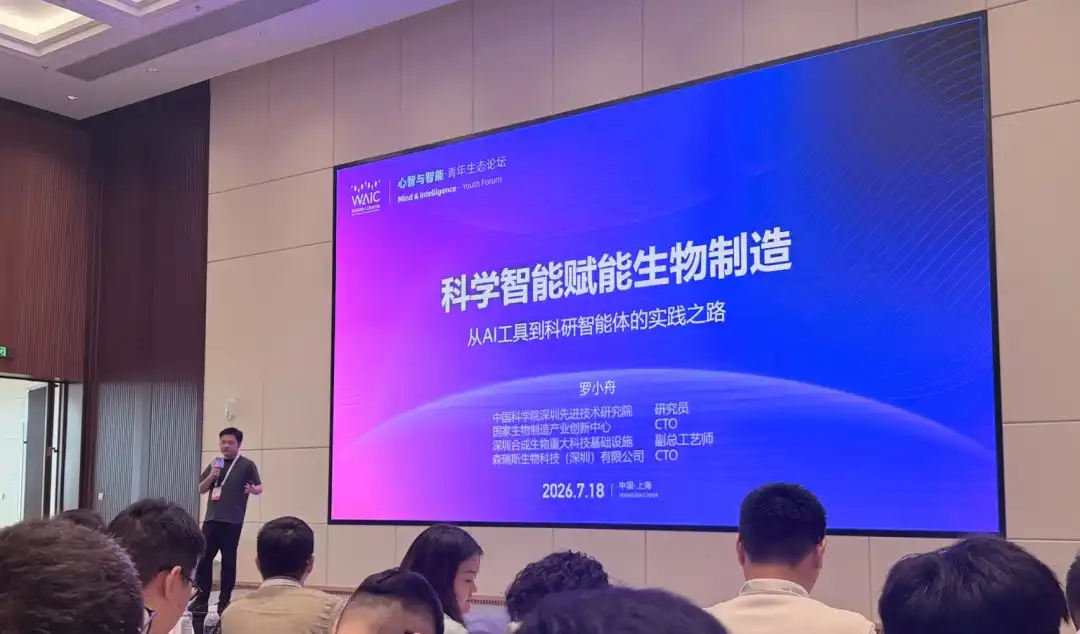
When AI writes code or does math, many processes can form closed loops within computers. But bio-manufacturing must cross the chasm between the digital and physical worlds.

After the model proposes a scientific hypothesis, experimental equipment must physically realize it, then feed the detection results back to the model. If any single link is broken, self-evolution stops.

Relying on the Shenzhen Synthetic Biology Major Science Facility with over 2 billion RMB investment, Luo Xiaozhou's team uses automated equipment as the “body and hands,” letting AI handle experimental design and decision-making. They hope that upon inputting a demand, the system can automatically design experiments, write scripts, execute operations, collect data, and proceed to the next round of optimization.

Related technologies have been used in R&D and production of products like squalene and squalane. Among them, squalene products have entered Merck's supply chain, and squalane has entered cosmetic supply chains.

But deep integration of research and industry involves more than just the model.

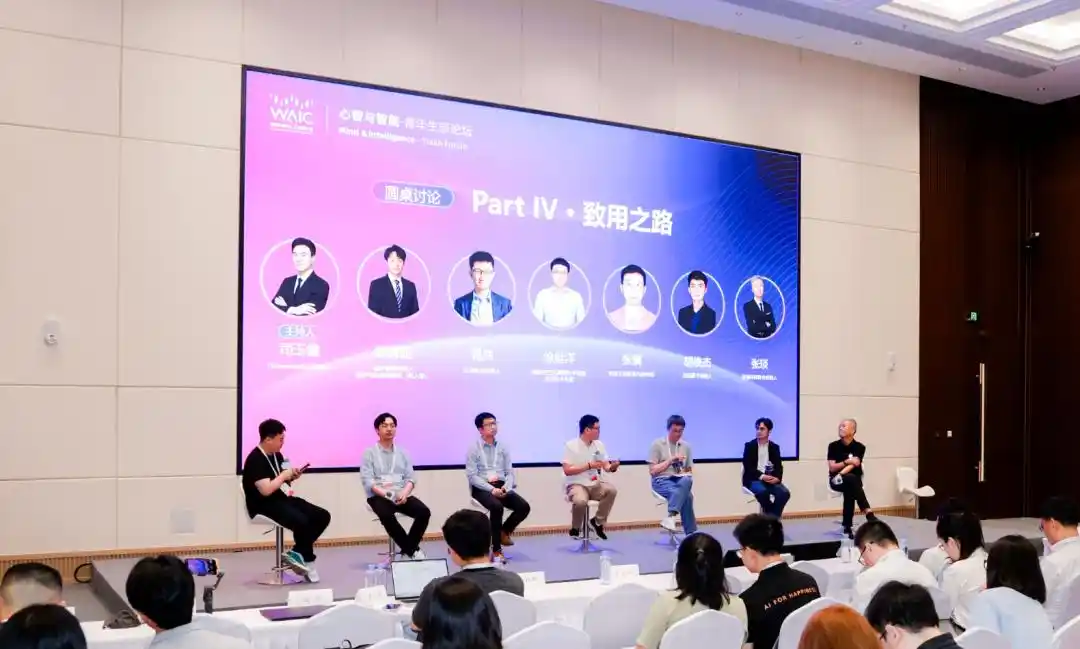
The “Path to Application” panel was quite candid. AI can accelerate antibody design, protein optimization, and strain engineering, but there are still wet lab experiments, clinical trials, approvals, process development, production, and markets.

Zhang Yan, co-founder and senior vice president of MGI Tech, summarized the difficulty as the “last mile” for AI landing in the physical world. In his view, lab automation and robotics technologies are relatively mature; the harder part is truly integrating AI, software systems, instruments, and specific disciplinary needs. To this end, MGI Tech attempts to control lab instruments and robots like computer peripherals, then connect models, automated experiments, and data feedback into a closed loop.
Upstream shortens R&D time, but bottlenecks may quickly shift to the next link. If regulatory systems, industry inertia, and organizational processes don't change simultaneously, the acceleration brought by technology is hard to pass along the value chain.

Of course, the money issue is also unavoidable.

When data providers, model developers, automation platforms, and industry clients jointly create a result, how should they charge, and how should revenue be distributed? Zhang Yan was also direct: new productivity changes production relations; besides “how to make money,” one must figure out “how to share the money” among parties in the chain.

It sounds down-to-earth but touches on deep changes as AI enters industry.

In the past, parties charged based on work stages; now, AI pushes industries from process delivery to outcome delivery, with participants beginning to share responsibility for the final result.

New productivity is also giving birth to new production relations.

This also falls within the scope of AI governance. Besides safety, ethics, and rights, how technological dividends are distributed, how industry rules adjust, and how traditional regulation adapts to new research speeds all require study.

Looking back, the composition of guests at this Youth Forum was actually quite interesting.

Some study self-evolving models, some build trustworthy boundaries for AI, some explore protein dynamics and social simulations, journal editors question what real problems AI research solves from an academic evaluation perspective; others move from labs to startups, advancing research results to automated experiments and industrial production.

They come from different specialties and institutions but gathered together in Shanghai.

That same afternoon, the main Scientific Intelligence Open Forum unfolded along the themes of “Path of Discovery, Foundation of Closed Loop, Road to Implementation,” with guests like Nobel laureate Arieh Warshel and Turing Award winner Gilles Brassard discussing scientific intelligence and original innovation.

The Youth Forum turned the lens towards research credibility, social governance, and industry chains.

One side discusses how far scientific intelligence can go, the other continues to ask how it can steadily enter reality.

Behind this lies a Youth Scientific Intelligence Ecosystem taking shape in Shanghai.

Shanghai provides universities, research institutions, industry resources, and policy research platforms, while young people cross disciplinary boundaries here, placing models, society, and industry within the same set of questions.

Therefore, philosophy heating up again in AI circles is just the visible part of this change.

Deeper down, AI has entered knowledge production and social operation, and technical issues have begun intertwining with governance, economics, ethics, and public policy.

The better AI answers, the more seriously humans must decide what to ask, what to believe, and where to steer the technology.

This article comes from the WeChat public account “QbitAI” (ID: QbitAI), author: Jin Lei.

Crypto di tendenza

Domande pertinenti

QWhat is the core philosophical concept proposed by Professor Sun Ning regarding the development of true intelligence?

AThe core concept proposed by Professor Sun Ning is summarized as: 'Intelligence exists only after there is a world. Mind exists only after there are relationships.' He argues that a truly grounded intelligence requires embodiment (a body that incurs action costs), an environment (providing feedback), other agents (introducing norms), and history (where failures become experience).

QWhat are the main concerns raised about AI systems that autonomously conduct scientific research and generate papers?

AThe main concerns are: 1) How to accurately evaluate an AI's true research capability versus its ability to exploit weaknesses in peer review systems. 2) Ownership and attribution of AI-generated scientific discoveries. 3) Responsibility and liability if the AI system is used for harmful research. 4) The risk of generating papers faster than they can be properly assessed, making evaluation more difficult than generation.

QAccording to the article, what are the key limitations or risks when using large language models to simulate human society?

AKey limitations and risks include: 1) Models may replicate stereotypes and biases from training data rather than capturing real social dynamics. 2) While macro-level simulated data may correlate highly with real-world data, it often breaks down in specific causal relationships or population-level analyses. 3) A dangerous feedback loop can form where real-world biases in data train models, which then influence decisions (e.g., in hiring, education), and those outcomes become new training data, amplifying the biases. The article cautions against treating simulation results as the voice of real society.

QWhat is the STRIDES framework proposed in the '2026 Humanities and Social Sciences Intelligent Development Bluebook', and what is its purpose?

AThe STRIDES framework is a proposed system that sets checkpoints at various stages of AI-assisted research, including Theory, Method, Data, Execution, and Scrutiny. Its purpose is to translate abstract governance principles into actionable research and institutional workflows. It ensures that AI-driven research leaves behind not just a fluent paper, but a verifiable evidence chain including research questions, data dictionaries, analysis scripts, execution records, review comments, and human adjudication, allowing others to retrace the steps.

QHow is AI's integration into industries like biomanufacturing challenging traditional models of work and payment, according to the discussion in the 'Road to Application' roundtable?

AAI integration is shifting the industry from process-based delivery to outcome-based delivery. Traditionally, different parties were paid for their specific work环节 (process). Now, with AI driving towards a final result (e.g., a new molecule or manufacturing process), participants including data providers, model developers, automation platforms, and industrial clients are becoming jointly responsible for the final outcome. This new productivity is催生 new production relationships, forcing a re-evaluation of not just 'how to make money' but 'how to distribute the profits' across the entire value chain.

Letture associate

Who Captures Value in Web 2.5?

Title: Who Captures Value in Web 2.5? Summary: For most of financial history, moving money was difficult and slow. Cryptocurrencies and stablecoins promised faster, cheaper transfers. However, their true potential is realized not by replacing traditional finance but by acting as an efficient, invisible settlement layer beneath it—a hybrid model called "Web 2.5." This fusion combines the regulation and familiar interfaces of traditional finance with the low-cost, programmable, always-on settlement of crypto. The critical question is: where does value accumulate in this new system? The answer lies in the coordination or "translation" layer that bridges the two financial worlds. History shows that the middleman connecting systems often captures immense value, as seen with Visa or SWIFT. This layer controls the flow of funds and can extract fees, collect float interest, and wield significant power (e.g., sanctions). Now, four main models are competing to become this dominant translation layer: protocols (like Chainlink), market utilities, banking cooperatives, and central bank clubs. For instance, Chainlink, in partnership with a consortium of banks, is piloting real-time FX settlement. SWIFT is building its own blockchain-based ledger layer. The Bank for International Settlements is testing tokenized central bank reserves. Ultimately, Web 2.5 is more promising than a purely decentralized utopia because it doesn't require abandoning existing systems. Instead, crypto becomes a commoditized, hidden infrastructure enabling faster, cheaper transactions within the traditional financial framework. The winning coordination layer will hold the power and capture the economic value in this new landscape.

链捕手4 h fa

Who Captures Value in Web 2.5?

链捕手4 h fa

Trading

Spot

Articoli Popolari

Cosa è GROK AI

Grok AI: Rivoluzionare la Tecnologia Conversazionale nell'Era Web3 Introduzione Nel panorama in rapida evoluzione dell'intelligenza artificiale, Grok AI si distingue come un progetto notevole che collega i domini della tecnologia avanzata e dell'interazione con l'utente. Sviluppato da xAI, un'azienda guidata dal rinomato imprenditore Elon Musk, Grok AI cerca di ridefinire il modo in cui interagiamo con l'intelligenza artificiale. Mentre il movimento Web3 continua a prosperare, Grok AI mira a sfruttare il potere dell'IA conversazionale per rispondere a query complesse, offrendo agli utenti un'esperienza che è non solo informativa ma anche divertente. Cos'è Grok AI? Grok AI è un sofisticato chatbot di intelligenza artificiale conversazionale progettato per interagire dinamicamente con gli utenti. A differenza di molti sistemi di intelligenza artificiale tradizionali, Grok AI abbraccia un'ampia gamma di domande, comprese quelle tipicamente considerate inappropriate o al di fuori delle risposte standard. Gli obiettivi principali del progetto includono: Ragionamento Affidabile: Grok AI enfatizza il ragionamento di buon senso per fornire risposte logiche basate sulla comprensione contestuale. Supervisione Scalabile: L'integrazione dell'assistenza degli strumenti garantisce che le interazioni degli utenti siano sia monitorate che ottimizzate per la qualità. Verifica Formale: La sicurezza è fondamentale; Grok AI incorpora metodi di verifica formale per migliorare l'affidabilità delle sue uscite. Comprensione del Lungo Contesto: Il modello di IA eccelle nel trattenere e richiamare una vasta storia di conversazione, facilitando discussioni significative e consapevoli del contesto. Robustezza Adversariale: Concentrandosi sul miglioramento delle sue difese contro input manipolati o malevoli, Grok AI mira a mantenere l'integrità delle interazioni degli utenti. In sostanza, Grok AI non è solo un dispositivo di recupero informazioni; è un partner conversazionale immersivo che incoraggia un dialogo dinamico. Creatore di Grok AI Il cervello dietro Grok AI non è altri che Elon Musk, un individuo sinonimo di innovazione in vari campi, tra cui automotive, viaggi spaziali e tecnologia. Sotto l'egida di xAI, un'azienda focalizzata sull'avanzamento della tecnologia AI in modi benefici, la visione di Musk mira a rimodellare la comprensione delle interazioni con l'IA. La leadership e l'etica fondamentale sono profondamente influenzate dall'impegno di Musk nel superare i confini tecnologici. Investitori di Grok AI Sebbene i dettagli specifici riguardanti gli investitori che sostengono Grok AI rimangano limitati, è pubblicamente riconosciuto che xAI, l'incubatore del progetto, è fondato e supportato principalmente dallo stesso Elon Musk. Le precedenti imprese e partecipazioni di Musk forniscono un robusto sostegno, rafforzando ulteriormente la credibilità e il potenziale di crescita di Grok AI. Tuttavia, al momento, le informazioni riguardanti ulteriori fondazioni di investimento o organizzazioni che supportano Grok AI non sono facilmente accessibili, segnando un'area per potenziali esplorazioni future. Come Funziona Grok AI? Le meccaniche operative di Grok AI sono innovative quanto il suo framework concettuale. Il progetto integra diverse tecnologie all'avanguardia che facilitano le sue funzionalità uniche: Infrastruttura Robusta: Grok AI è costruito utilizzando Kubernetes per l'orchestrazione dei container, Rust per prestazioni e sicurezza, e JAX per il calcolo numerico ad alte prestazioni. Questo trio garantisce che il chatbot operi in modo efficiente, si scaldi efficacemente e serva gli utenti prontamente. Accesso alla Conoscenza in Tempo Reale: Una delle caratteristiche distintive di Grok AI è la sua capacità di attingere a dati in tempo reale attraverso la piattaforma X—precedentemente nota come Twitter. Questa capacità consente all'IA di accedere alle informazioni più recenti, permettendole di fornire risposte e raccomandazioni tempestive che altri modelli di IA potrebbero perdere. Due Modalità di Interazione: Grok AI offre agli utenti la scelta tra “Modalità Divertente” e “Modalità Normale”. La Modalità Divertente consente uno stile di interazione più giocoso e umoristico, mentre la Modalità Normale si concentra sulla fornitura di risposte precise e accurate. Questa versatilità garantisce un'esperienza su misura che soddisfa varie preferenze degli utenti. In sostanza, Grok AI sposa prestazioni con coinvolgimento, creando un'esperienza che è sia arricchente che divertente. Cronologia di Grok AI Il viaggio di Grok AI è segnato da traguardi fondamentali che riflettono le sue fasi di sviluppo e distribuzione: Sviluppo Iniziale: La fase fondamentale di Grok AI si è svolta in circa due mesi, durante i quali sono stati condotti l'addestramento iniziale e il perfezionamento del modello. Rilascio Beta di Grok-2: In un significativo avanzamento, è stata annunciata la beta di Grok-2. Questo rilascio ha introdotto due versioni del chatbot—Grok-2 e Grok-2 mini—ognuna dotata delle capacità per chattare, programmare e ragionare. Accesso Pubblico: Dopo lo sviluppo beta, Grok AI è diventato disponibile per gli utenti della piattaforma X. Coloro che hanno account verificati tramite un numero di telefono e attivi per almeno sette giorni possono accedere a una versione limitata, rendendo la tecnologia disponibile a un pubblico più ampio. Questa cronologia racchiude la crescita sistematica di Grok AI dall'inizio all'impegno pubblico, enfatizzando il suo impegno per il miglioramento continuo e l'interazione con gli utenti. Caratteristiche Chiave di Grok AI Grok AI comprende diverse caratteristiche chiave che contribuiscono alla sua identità innovativa: Integrazione della Conoscenza in Tempo Reale: L'accesso a informazioni attuali e rilevanti differenzia Grok AI da molti modelli statici, consentendo un'esperienza utente coinvolgente e accurata. Stili di Interazione Versatili: Offrendo modalità di interazione distinte, Grok AI soddisfa varie preferenze degli utenti, invitando alla creatività e alla personalizzazione nella conversazione con l'IA. Avanzata Struttura Tecnologica: L'utilizzo di Kubernetes, Rust e JAX fornisce al progetto un solido framework per garantire affidabilità e prestazioni ottimali. Considerazione del Discorso Etico: L'inclusione di una funzione di generazione di immagini mette in mostra lo spirito innovativo del progetto. Tuttavia, solleva anche considerazioni etiche riguardanti il copyright e la rappresentazione rispettosa di figure riconoscibili—una discussione in corso all'interno della comunità AI. Conclusione Come entità pionieristica nel campo dell'IA conversazionale, Grok AI incarna il potenziale per esperienze utente trasformative nell'era digitale. Sviluppato da xAI e guidato dall'approccio visionario di Elon Musk, Grok AI integra conoscenze in tempo reale con capacità di interazione avanzate. Si sforza di spingere i confini di ciò che l'intelligenza artificiale può realizzare, mantenendo un focus su considerazioni etiche e sicurezza degli utenti. Grok AI non solo incarna il progresso tecnologico, ma rappresenta anche un nuovo paradigma conversazionale nel panorama Web3, promettendo di coinvolgere gli utenti con sia conoscenze esperte che interazioni giocose. Man mano che il progetto continua a evolversi, si erge come testimonianza di ciò che l'incrocio tra tecnologia, creatività e interazione simile a quella umana può realizzare.

521 Totale visualizzazioniPubblicato il 2024.12.26Aggiornato il 2024.12.26

Cosa è GROK AI

Cosa è ERC AI

Euruka Tech: Una Panoramica di $erc ai e delle sue Ambizioni in Web3 Introduzione Nel panorama in rapida evoluzione della tecnologia blockchain e delle applicazioni decentralizzate, nuovi progetti emergono frequentemente, ciascuno con obiettivi e metodologie uniche. Uno di questi progetti è Euruka Tech, che opera nel vasto dominio delle criptovalute e del Web3. L'obiettivo principale di Euruka Tech, in particolare del suo token $erc ai, è presentare soluzioni innovative progettate per sfruttare le crescenti capacità della tecnologia decentralizzata. Questo articolo si propone di fornire una panoramica completa di Euruka Tech, un'esplorazione dei suoi obiettivi, della funzionalità, dell'identità del suo creatore, dei potenziali investitori e della sua importanza nel contesto più ampio del Web3. Cos'è Euruka Tech, $erc ai? Euruka Tech è caratterizzato come un progetto che sfrutta gli strumenti e le funzionalità offerte dall'ambiente Web3, concentrandosi sull'integrazione dell'intelligenza artificiale nelle sue operazioni. Sebbene i dettagli specifici sul framework del progetto siano piuttosto sfuggenti, è progettato per migliorare l'engagement degli utenti e automatizzare i processi nello spazio crypto. Il progetto mira a creare un ecosistema decentralizzato che non solo faciliti le transazioni, ma incorpori anche funzionalità predittive attraverso l'intelligenza artificiale, da cui il nome del suo token, $erc ai. L'obiettivo è fornire una piattaforma intuitiva che faciliti interazioni più intelligenti e un'elaborazione delle transazioni più efficiente all'interno della crescente sfera del Web3. Chi è il Creatore di Euruka Tech, $erc ai? Attualmente, le informazioni riguardanti il creatore o il team fondatore di Euruka Tech rimangono non specificate e piuttosto opache. Questa assenza di dati solleva preoccupazioni, poiché la conoscenza del background del team è spesso essenziale per stabilire credibilità nel settore blockchain. Pertanto, abbiamo classificato queste informazioni come sconosciute fino a quando dettagli concreti non saranno resi disponibili nel dominio pubblico. Chi sono gli Investitori di Euruka Tech, $erc ai? Allo stesso modo, l'identificazione degli investitori o delle organizzazioni di supporto per il progetto Euruka Tech non è prontamente fornita attraverso la ricerca disponibile. Un aspetto cruciale per i potenziali stakeholder o utenti che considerano di impegnarsi con Euruka Tech è la garanzia che deriva da partnership finanziarie consolidate o dal supporto di società di investimento rispettabili. Senza divulgazioni sulle affiliazioni di investimento, è difficile trarre conclusioni complete sulla sicurezza finanziaria o sulla longevità del progetto. In linea con le informazioni trovate, anche questa sezione rimane allo stato di sconosciuto. Come funziona Euruka Tech, $erc ai? Nonostante la mancanza di specifiche tecniche dettagliate per Euruka Tech, è essenziale considerare le sue ambizioni innovative. Il progetto cerca di sfruttare la potenza computazionale dell'intelligenza artificiale per automatizzare e migliorare l'esperienza dell'utente all'interno dell'ambiente delle criptovalute. Integrando l'IA con la tecnologia blockchain, Euruka Tech mira a fornire funzionalità come operazioni automatizzate, valutazioni del rischio e interfacce utente personalizzate. L'essenza innovativa di Euruka Tech risiede nel suo obiettivo di creare una connessione fluida tra gli utenti e le vaste possibilità presentate dalle reti decentralizzate. Attraverso l'utilizzo di algoritmi di apprendimento automatico e IA, mira a ridurre le sfide degli utenti alle prime armi e semplificare le esperienze transazionali all'interno del framework Web3. Questa simbiosi tra IA e blockchain sottolinea l'importanza del token $erc ai, fungendo da ponte tra le interfacce utente tradizionali e le avanzate capacità delle tecnologie decentralizzate. Cronologia di Euruka Tech, $erc ai Sfortunatamente, a causa delle limitate informazioni disponibili riguardo a Euruka Tech, non siamo in grado di presentare una cronologia dettagliata dei principali sviluppi o traguardi nel percorso del progetto. Questa cronologia, tipicamente preziosa per tracciare l'evoluzione di un progetto e comprendere la sua traiettoria di crescita, non è attualmente disponibile. Man mano che le informazioni su eventi notevoli, partnership o aggiunte funzionali diventano evidenti, gli aggiornamenti miglioreranno sicuramente la visibilità di Euruka Tech nella sfera crypto. Chiarimento su Altri Progetti “Eureka” È importante sottolineare che più progetti e aziende condividono una nomenclatura simile con “Eureka.” La ricerca ha identificato iniziative come un agente IA della NVIDIA Research, che si concentra sull'insegnamento ai robot di compiti complessi utilizzando metodi generativi, così come Eureka Labs ed Eureka AI, che migliorano l'esperienza utente nell'istruzione e nell'analisi del servizio clienti, rispettivamente. Tuttavia, questi progetti sono distinti da Euruka Tech e non dovrebbero essere confusi con i suoi obiettivi o funzionalità. Conclusione Euruka Tech, insieme al suo token $erc ai, rappresenta un attore promettente ma attualmente oscuro nel panorama del Web3. Sebbene i dettagli sul suo creatore e sugli investitori rimangano non divulgati, l'ambizione centrale di combinare intelligenza artificiale e tecnologia blockchain si erge come un punto focale di interesse. Gli approcci unici del progetto nel promuovere l'engagement degli utenti attraverso l'automazione avanzata potrebbero distinguerlo mentre l'ecosistema Web3 progredisce. Con l'evoluzione continua del mercato crypto, gli stakeholder dovrebbero tenere d'occhio gli sviluppi riguardanti Euruka Tech, poiché lo sviluppo di innovazioni documentate, partnership o una roadmap definita potrebbe presentare opportunità significative nel prossimo futuro. Così com'è, attendiamo ulteriori approfondimenti sostanziali che potrebbero svelare il potenziale di Euruka Tech e la sua posizione nel competitivo panorama crypto.

551 Totale visualizzazioniPubblicato il 2025.01.02Aggiornato il 2025.01.02

Cosa è ERC AI

Cosa è DUOLINGO AI

DUOLINGO AI: Integrare l'apprendimento delle lingue con Web3 e innovazione AI In un'era in cui la tecnologia rimodella l'istruzione, l'integrazione dell'intelligenza artificiale (AI) e delle reti blockchain annuncia una nuova frontiera per l'apprendimento delle lingue. Entra in scena DUOLINGO AI e la sua criptovaluta associata, $DUOLINGO AI. Questo progetto aspira a fondere la potenza educativa delle principali piattaforme di apprendimento delle lingue con i benefici della tecnologia decentralizzata Web3. Questo articolo esplora gli aspetti chiave di DUOLINGO AI, esaminando i suoi obiettivi, il framework tecnologico, lo sviluppo storico e il potenziale futuro, mantenendo chiarezza tra la risorsa educativa originale e questa iniziativa indipendente di criptovaluta. Panoramica di DUOLINGO AI Alla sua base, DUOLINGO AI cerca di stabilire un ambiente decentralizzato in cui gli studenti possono guadagnare ricompense crittografiche per il raggiungimento di traguardi educativi nella competenza linguistica. Applicando smart contracts, il progetto mira ad automatizzare i processi di verifica delle competenze e le allocazioni di token, aderendo ai principi di Web3 che enfatizzano la trasparenza e la proprietà da parte degli utenti. Il modello si discosta dagli approcci tradizionali all'acquisizione linguistica, facendo forte affidamento su una struttura di governance guidata dalla comunità, che consente ai detentori di token di suggerire miglioramenti ai contenuti dei corsi e alle distribuzioni delle ricompense. Alcuni degli obiettivi notevoli di DUOLINGO AI includono: Apprendimento Gamificato: Il progetto integra traguardi blockchain e token non fungibili (NFT) per rappresentare i livelli di competenza linguistica, promuovendo la motivazione attraverso ricompense digitali coinvolgenti. Creazione di Contenuti Decentralizzati: Apre opportunità per educatori e appassionati di lingue di contribuire con i propri corsi, facilitando un modello di condivisione dei ricavi che beneficia tutti i collaboratori. Personalizzazione Guidata dall'AI: Utilizzando modelli avanzati di machine learning, DUOLINGO AI personalizza le lezioni per adattarsi ai progressi individuali, simile alle funzionalità adattive presenti nelle piattaforme consolidate. Creatori del Progetto e Governance A partire da aprile 2025, il team dietro $DUOLINGO AI rimane pseudonimo, una pratica comune nel panorama decentralizzato delle criptovalute. Questa anonimato è inteso a promuovere la crescita collettiva e il coinvolgimento degli stakeholder piuttosto che concentrarsi su sviluppatori individuali. Lo smart contract distribuito sulla blockchain di Solana annota l'indirizzo del wallet dello sviluppatore, che segna l'impegno verso la trasparenza riguardo alle transazioni, nonostante l'identità dei creatori sia sconosciuta. Secondo la sua roadmap, DUOLINGO AI mira a evolversi in un'Organizzazione Autonoma Decentralizzata (DAO). Questa struttura di governance consente ai detentori di token di votare su questioni critiche come l'implementazione di funzionalità e le allocazioni del tesoro. Questo modello si allinea con l'etica dell'empowerment della comunità presente in varie applicazioni decentralizzate, enfatizzando l'importanza del processo decisionale collettivo. Investitori e Partnership Strategiche Attualmente, non ci sono investitori istituzionali o capitalisti di rischio identificabili pubblicamente legati a $DUOLINGO AI. Invece, la liquidità del progetto proviene principalmente da scambi decentralizzati (DEX), segnando un netto contrasto con le strategie di finanziamento delle aziende tradizionali di tecnologia educativa. Questo modello di base indica un approccio guidato dalla comunità, riflettendo l'impegno del progetto verso la decentralizzazione. Nel suo whitepaper, DUOLINGO AI menziona la formazione di collaborazioni con “piattaforme educative blockchain” non specificate, mirate ad arricchire la sua offerta di corsi. Sebbene partnership specifiche non siano ancora state divulgate, questi sforzi collaborativi suggeriscono una strategia per mescolare innovazione blockchain con iniziative educative, ampliando l'accesso e il coinvolgimento degli utenti attraverso diverse vie di apprendimento. Architettura Tecnologica Integrazione AI DUOLINGO AI incorpora due componenti principali guidate dall'AI per migliorare la sua offerta educativa: Motore di Apprendimento Adattivo: Questo sofisticato motore apprende dalle interazioni degli utenti, simile ai modelli proprietari delle principali piattaforme educative. Regola dinamicamente la difficoltà delle lezioni per affrontare le sfide specifiche degli studenti, rinforzando le aree deboli attraverso esercizi mirati. Agenti Conversazionali: Utilizzando chatbot alimentati da GPT-4, DUOLINGO AI offre una piattaforma per gli utenti per impegnarsi in conversazioni simulate, promuovendo un'esperienza di apprendimento linguistico più interattiva e pratica. Infrastruttura Blockchain Costruito sulla blockchain di Solana, $DUOLINGO AI utilizza un framework tecnologico completo che include: Smart Contracts per la Verifica delle Competenze: Questa funzionalità assegna automaticamente token agli utenti che superano con successo i test di competenza, rinforzando la struttura di incentivi per risultati di apprendimento genuini. Badge NFT: Questi token digitali significano vari traguardi che gli studenti raggiungono, come completare una sezione del loro corso o padroneggiare competenze specifiche, consentendo loro di scambiare o mostrare digitalmente i loro successi. Governance DAO: I membri della comunità dotati di token possono partecipare alla governance votando su proposte chiave, facilitando una cultura partecipativa che incoraggia l'innovazione nell'offerta di corsi e nelle funzionalità della piattaforma. Cronologia Storica 2022–2023: Concettualizzazione I lavori per DUOLINGO AI iniziano con la creazione di un whitepaper, evidenziando la sinergia tra i progressi dell'AI nell'apprendimento delle lingue e il potenziale decentralizzato della tecnologia blockchain. 2024: Lancio Beta Un lancio beta limitato introduce offerte in lingue popolari, premiando i primi utenti con incentivi in token come parte della strategia di coinvolgimento della comunità del progetto. 2025: Transizione DAO Ad aprile, avviene un lancio completo della mainnet con la circolazione di token, stimolando discussioni nella comunità riguardo a possibili espansioni nelle lingue asiatiche e ad altri sviluppi dei corsi. Sfide e Direzioni Future Ostacoli Tecnici Nonostante i suoi obiettivi ambiziosi, DUOLINGO AI affronta sfide significative. La scalabilità rimane una preoccupazione costante, in particolare nel bilanciare i costi associati all'elaborazione dell'AI e nel mantenere una rete decentralizzata reattiva. Inoltre, garantire la creazione e la moderazione di contenuti di qualità in un'offerta decentralizzata presenta complessità nel mantenere standard educativi. Opportunità Strategiche Guardando al futuro, DUOLINGO AI ha il potenziale per sfruttare partnership di micro-credentialing con istituzioni accademiche, fornendo validazioni verificate dalla blockchain delle competenze linguistiche. Inoltre, l'espansione cross-chain potrebbe consentire al progetto di attingere a basi utenti più ampie e a ulteriori ecosistemi blockchain, migliorando la sua interoperabilità e portata. Conclusione DUOLINGO AI rappresenta una fusione innovativa di intelligenza artificiale e tecnologia blockchain, presentando un'alternativa focalizzata sulla comunità ai sistemi tradizionali di apprendimento delle lingue. Sebbene il suo sviluppo pseudonimo e il modello economico emergente comportino alcuni rischi, l'impegno del progetto verso l'apprendimento gamificato, l'istruzione personalizzata e la governance decentralizzata illumina un percorso per la tecnologia educativa nel regno di Web3. Man mano che l'AI continua a progredire e l'ecosistema blockchain evolve, iniziative come DUOLINGO AI potrebbero ridefinire il modo in cui gli utenti interagiscono con l'istruzione linguistica, potenziando le comunità e premiando il coinvolgimento attraverso meccanismi di apprendimento innovativi.

503 Totale visualizzazioniPubblicato il 2025.04.11Aggiornato il 2025.04.11

Cosa è DUOLINGO AI

Discussioni

Benvenuto nella Community HTX. Qui puoi rimanere informato sugli ultimi sviluppi della piattaforma e accedere ad approfondimenti esperti sul mercato. Le opinioni degli utenti sul prezzo di AI AI sono presentate come di seguito.

活动图片