Claude Designer Lags Behind Engineers, Fires Back by Creating a Million-User Tool

marsbitPubblicato 2026-07-28Pubblicato ultima volta 2026-07-28

Introduzione

The article tells the story of Nate Parrott, a designer at Anthropic who created Claude Design as a side project to keep pace with his engineering teammates. When Anthropic released Opus 4.5 in November 2025, the two engineers on Parrott's Claude Code team significantly increased their output using the new AI capabilities. Parrott, the sole designer, found himself struggling to match their speed, becoming a bottleneck in the workflow. To catch up, he began experimenting in his spare time. He initially tried prompting Claude to generate designs from text descriptions and screenshots, with limited success. His breakthrough came when he shifted focus from asking Claude to "design" to asking it to generate HTML. He realized HTML could be a rich visual canvas for creating everything from slides and interactive prototypes to full web pages. He built a simple interface with a chat panel on the left and a live HTML preview on the right. The key to making the output useful was incorporating Anthropic's brand system—fonts, colors, assets, and design principles—into the prompts. This ensured generated designs were immediately on-brand. He shared an internal prototype with his team, and other product designers quickly adopted it for creating clickable prototypes, a task traditionally requiring manually drawing every state. The project's "official" turning point came during an Anthropic Labs offsite, where Parrott noticed many attendees were using his tool to build presentation slides...

Claude Design was actually a 'side project' born out of intense competition.

Behind it lies a story involving two engineers and one designer.

The story begins with the release of Opus 4.5 in November 2025.

At that time, Nate Parrott was the sole designer in the Claude Code VS Code project, working alongside two engineers.
Anthropic product designer Nate Parrott recounts the entire birth process of Claude Design in the first person on the official blog.

The three of them worked together on one thing: transforming Claude Code, which could only be operated via command line in a terminal, into an interface that ordinary people could understand and use smoothly.

By the end of September, the product entered beta, everything was normal; then in November, Opus 4.5 was released. Parrott described the subsequent scene as follows:

The two engineers suddenly started delivering work frantically, producing much more than before, while he remained at his original speed.

Soon, he fell behind.

"I need to find a way to catch up," Parrott thought.

So, he tinkered with a small tool in his spare time, specifically to help himself keep up with the engineering pace.

And this 'side project' later became Claude Design, used by over a million people in its first week after launch.

Engineering Takes Off First, Design Gets Left Behind

The heart-wrenching part of this story is that AI didn't uniformly increase everyone's speed; instead, it first sent engineering into overdrive.

Consequently, Parrott's design work quickly became the slowest link in the entire workflow chain.

The turning point was November 24, 2025, the day Opus 4.5 was released.

According to Parrott's recollection, the delivery pace of the entire Claude Code team noticeably accelerated after that. The output of the two engineers increased significantly, while his design output remained at the original speed.

This forced him to find a way to catch up.

This also exposes the most easily overlooked side of the AI wave: its initial impact is often not about whether a certain job will disappear, but about disrupting the previously matched rhythms between different workflows.

For example, once engineering accelerates, any环节 like design, product, or marketing that cannot keep up will instantly become a new bottleneck.

A One-Month Side Experiment, From 'AI Writing Design' to 'AI Writing HTML'

Parrott's initial idea was straightforward.

Claude Code was a purely text-based terminal tool. He initially followed this line of thinking, treating design as a text-based task:

Bundle the terminal output, a few interface screenshots, and a one-sentence requirement and throw it to Claude, saying "This is the feature we want to add, design it."

The results, however, were not ideal.

For about a month, he treated this as a side project: not officially approved, just advancing it bit by bit in his spare time.

Gradually, he stumbled upon the real solution: Claude is particularly good at writing HTML.

We're accustomed to thinking of HTML as something for making web pages.

But Parrott's epiphany was that HTML is actually a very rich interactive visual medium: slideshows, video files, PDFs... anything they can do, you can do with a webpage.

So he stopped asking Claude to "draw designs," and instead had it "produce HTML," then wrapped it in an interface: chat on the left, real-time preview on the right. You say something, and the right side changes accordingly.

The breakthrough Parrott found wasn't in "making AI draw pictures," but in "using HTML as a unified visual canvas": slideshows, interactive prototypes, animations, web pages could now enter the same generation and editing pipeline.
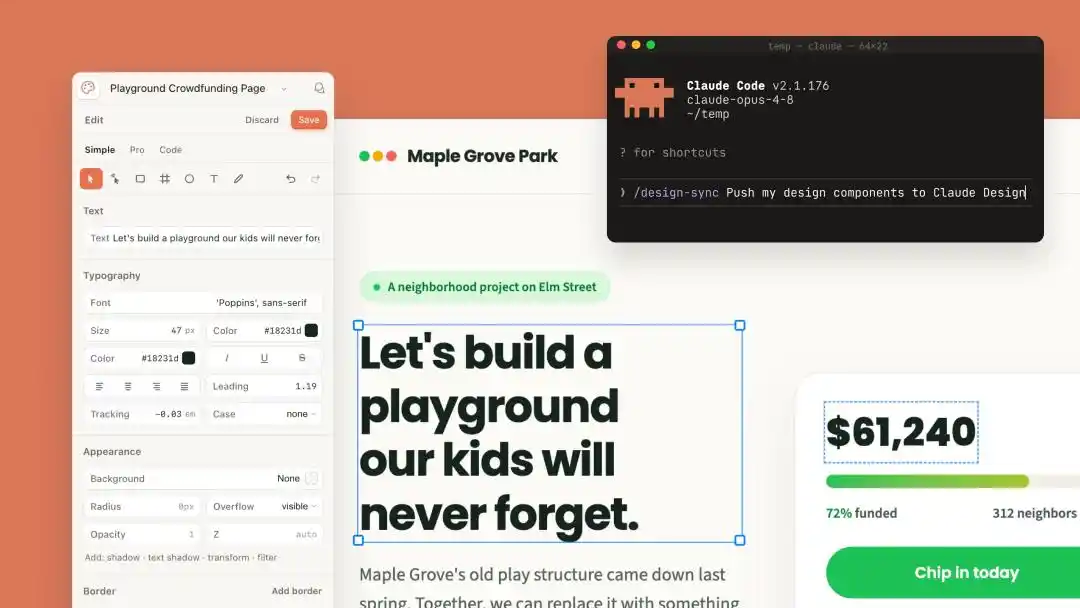
The Claude Design workspace: conversation on the left, canvas on the right, mirroring Parrott's original prototype idea.

HTML Alone Isn't Enough, the Brand System is the Key

Just being able to write HTML is still far from "usable."

In Parrott's view, the core of product design is translating your understanding of the product and brand into every specific design action.

So he spent considerable time distilling the essence of the Anthropic brand—fonts, color schemes, assets, and design principles—into the prompts.

This way, when he inputs requirements into the AI, the generated designs are naturally closer to Anthropic's standards.

He packed this whole system into a small internal prototype and shared it with the team. Product designers immediately started using it to create interactive prototypes.

Making a clickable prototype in traditional design tools means you have to draw out every state of every interface and manually link them one by one.

In Claude Design, you just throw the materials at Claude, say "make it run," and what it produces comes with a link that you can directly share with colleagues like a document.

This later became the core capability of the entire product.

Today, when you start using Claude Design, during the first configuration, it reads your code repository and design files, automatically assembling a design system for the team.

Every subsequent project automatically applies your colors, fonts, and components. Larger teams can assign an administrator to lock down a standard system that no one can alter arbitrarily.

An Offsite Meeting Turns a Side Project into a Main Project

What truly made Parrott feel "this is it" was during an idea pitch session at an Anthropic Labs team offsite.

He found that almost everyone there was using this tool to cobble together slides. Many were even doing it on the fly, right before their turn to speak during the meeting.

It was this scene that convinced the Labs team to officially allocate resources to the project. From that moment, a side project became a real product.

Anthropic had already validated this path with Claude Design once before.

On January 13, 2026, Anthropic announced the expansion of Labs, bringing in Instagram co-founder Mike Krieger and Ben Mann to lead it, positioning it as an incubator for experimental products at the forefront of Claude's capabilities.

Claude Code started from a research preview and grew into a billion-dollar product in six months.

Claude Design followed the same path: one person's private experiment, to internal designers voluntarily adopting it, to colleagues "voting with their feet" during idea pitches, and finally Labs allocating resources, releasing a public research preview, and transitioning to beta.

Not a single step in this chain was planned top-down.

AI-native products are often not designed; they are 'used' into existence internally.

Value Shifts Forward, Designers Are No Longer Just 'Outputting Mockups'

Once Claude Design became an official product, its positioning quickly changed.

They stopped seeing it as just a tool for creating interface mockups.

Slideshows, landing pages, printable single-page PDFs, emails, animations, social media graphics—any task involving visual communication, it can handle.

Parrott's own description is that it operates "one level above product design": what you and Claude are refining together are those visual materials primarily used for communication and ideation.

The division of labor is clear: Claude Design handles the early stages—rapid exploration, comparing directions, building consensus; Claude Code handles the later stages—actual production development.

The two can also interconnect: use /design-sync to pull in the design system, use /design to make changes directly in the terminal, with MCP bridging the middle.
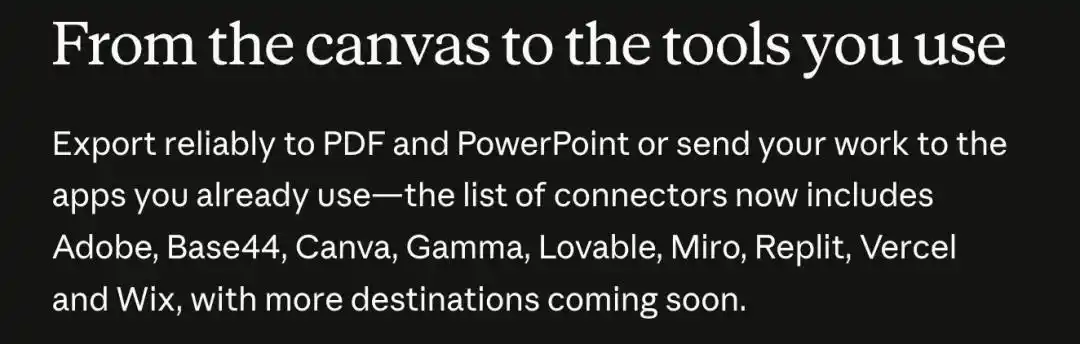
Claude Design can export to PDF, PPTX, HTML, and integrates with tools like Canva, Adobe, Gamma, Miro, Replit, Vercel, Wix.

Finished work can be exported to PDF, PPTX, HTML, and sent with one click to tools like Canva, Adobe, Gamma, Miro, Replit, Vercel, Wix for further work.

However, Claude Design is not an image generation model. Parrott admits: It's not suitable for making logos. Your existing logos, images, and brand assets need to be imported yourself.

For actually writing production software ready for launch, Anthropic still recommends using Claude Code diligently.

Ultimately, Claude Design is an early-stage tool, not a mature production development platform.

The more models can handle writing code, the more valuable work shifts forward. The value of designers turns towards choosing directions, building systems, judging quality, and driving consensus.

Back to the initial scenario.

When the two engineers beside him suddenly accelerated, Parrott, the sole designer in the group, was left behind. He didn't just wait; he took matters into his own hands and built a tool to catch up.

Who would have thought this tool would later be used by millions.

So, when your work is impacted by AI and you feel anxious, perhaps learn from Parrott's move: use AI to build yourself a new tool, or find such a tool, and open up a new situation.

References:

https://claude.com/blog/how-the-product-designer-who-built-claude-design-uses-it-to-explore-ideas-before-building-them?utm_source=chatgpt.com

https://www.anthropic.com/news/claude-design-anthropic-labs?utm_source=chatgpt.com

This article is from the WeChat public account "New Zhiyuan", author: ASI启示录

Domande pertinenti

QWhat is the origin story behind Claude Design, according to the article?

AClaude Design originated as a side project by Anthropic product designer Nate Parrott. He built it in his spare time to help himself catch up after being outpaced by two engineers on his team when their productivity surged following the release of Opus 4.5 in November 2025.

QWhat key insight did Nate Parrott have that led to the development of Claude Design?

AParrott's key insight was not to have AI generate designs directly, but to have it generate HTML. He realized HTML is a rich interactive and visual medium that could serve as a unified 'canvas' for creating prototypes, slides, animations, and web pages within a single generation and editing pipeline.

QWhat specific problem does Claude Design aim to solve for designers and teams?

AClaude Design aims to solve the bottleneck created when engineering speeds up with AI, leaving design behind. It helps designers rapidly create interactive prototypes, presentations (like slides for a meeting), landing pages, and other visual communication materials to explore ideas, compare directions, and build consensus in the early stages of a project.

QHow does Claude Design ensure generated designs align with a company's brand identity?

AClaude Design allows users to distill their brand system—including fonts, color palettes, assets, and design principles—into its prompts. For teams, it can automatically read a codebase and design files to build a design system, ensuring all generated materials consistently use the team's colors, fonts, and components.

QHow did Claude Design transition from a side project to an official product at Anthropic?

AClaude Design transitioned after being widely adopted internally. During an Anthropic Labs offsite, Parrott observed many colleagues using his tool to create presentation slides on the fly. This 'vote with their feet' demonstration of its utility convinced the Labs team to officially staff the project, turning it from a side project into a real product, following a similar path as Claude Code.

Letture associate

The 800x Golden Dog, "Gacha" Saves NFT Trading

Title: 800x Golden Dog: How 'Gacha' Mechanics Are Rescuing NFT Trading In the past month, the on-chain TCG (Trading Card Game) narrative, centered around "gacha" or loot box mechanics, has emerged as a major crypto-native revenue generator, second only to platforms like Hyperliquid and pump.fun. Recently, this trend hit Ethereum with Fake World Assets (FWA). Within just over a week, FWA generated approximately $1.3 million in revenue, ranking 15th in the past week's crypto app earnings. Its token, $FWA, surged from an initial market cap of ~$47,550 to a peak of ~$38.8 million—an 800x gain. Meanwhile, Collector Cards' token $CARDS declined significantly from its previous highs. FWA, developed by the team behind "PunkStrategy," operates as an NFT gacha system with a built-in token flywheel. Users deposit NFTs paired with ETH as liquidity into pools. Each deposit creates a personal pool; more ETH deposited lowers the chance of the NFT being "won" in a draw. Players spend ETH to "draw" (gacha). If they get an undesirable NFT, they can instantly sell it back to the original depositor at an 85% discount, generating income for the depositor. A 1% fee is taken on each draw and on depositor earnings when an NFT is kept. The key to FWA's momentum is its token $FWA. It cannot be bought directly externally. The primary way to acquire it is by playing the gacha and choosing to receive $FWA (instead of ETH) when selling back an unwanted NFT. This mechanism creates constant buy pressure for $FWA as players engage, especially during its price ascent. Early participants who held $FWA benefited massively from subsequent inflows. This contrasts with projects like Collector Cards, which, despite strong revenues, suffer from perceived low token utility beyond buybacks. In conclusion, while FWA's flywheel design—linking speculative token gains directly to NFT trading activity—has driven rapid growth, its sustainability is questionable. The model relies heavily on continuous $FWA price appreciation to offset the inherent negative expectancy of each draw. When price momentum stalls, activity will likely decline. The case highlights that in crypto markets, pure profitability narratives can be fleeting; understanding the relationship between attention, token buy pressure, and sustainable mechanics is crucial to avoid speculative pitfalls.

marsbit19 min fa

The 800x Golden Dog, "Gacha" Saves NFT Trading

marsbit19 min fa

The Quantum Computing Threat Approaches, Cryptocurrency May Be Exposed to Risks Before Banks

Quantum computing poses a significant threat to all cryptographic systems, including banks and governments, but decentralized cryptocurrencies with public ledgers like Bitcoin are likely the first practical target. Experts warn that a cryptographically relevant quantum computer (CRQC), capable of running Shor's algorithm to break the elliptic curve cryptography securing most crypto wallets, could emerge around 2029. Recent research shows the required quantum resources for such attacks are shrinking dramatically, potentially enabling key extraction in minutes. The core vulnerability for cryptocurrencies is not the cryptography itself—post-quantum standards are being developed—but the slow, decentralized governance required to implement upgrades. Unlike centralized banks that can swiftly transition, Bitcoin needs near-unanimous consensus among its global network, a historically difficult process as seen in past upgrades. Estimates suggest migrating all vulnerable Bitcoin funds could take at least 76 days of dedicated network time, and it must be completed before a CRQC exists to prevent "now-or-never" attacks on exposed keys. The threat is not binary; it begins when a quantum computer can decrypt data before it loses value, not necessarily in real-time. A significant portion of Bitcoin (estimated at millions of coins) already has public keys permanently exposed on-chain, making them vulnerable to eventual "static attacks." While technical solutions exist, the race is against time for decentralized networks to coordinate a defensive transition, serving as an early warning for the broader financial system.

marsbit30 min fa

The Quantum Computing Threat Approaches, Cryptocurrency May Be Exposed to Risks Before Banks

marsbit30 min fa

On the First Day of Listing, Changxin Technology's Market Value Exceeds 3 Trillion Yuan, Which Securities Firm Has the Largest Floating Profit?

On July 27th, Changxin Technology, the largest-ever IPO on China's STAR Market, debuted with its share price soaring 465.82% to close at 49 yuan. Its market capitalization reached 3.28 trillion yuan, instantly making it the most valuable A-share company. The stellar performance delivered substantial gains for involved securities firms, primarily through equity investments rather than underwriting fees. China Merchants Securities emerged as the biggest winner. Its direct investment subsidiary, Zhaozheng Investment, alone holds a 0.54% pre-issue stake, translating to a paper profit exceeding 155 billion yuan based on the first-day closing price—surpassing the firm's entire 2025 net profit of 123.5 billion yuan. Other major beneficiaries include Huaan Securities, with an estimated profit of around 123 billion yuan from its 0.44% stake, and the lead underwriters, CICC and CITIC Securities, which each gained approximately 46 billion yuan from mandatory follow-on investments. Firms like Founder Securities, Haitong Securities, and GF Securities also reported significant holdings valued in the billions. Despite these paper gains, shares of some brokerages like Huaan and China Merchants fell on the listing day, reflecting broader market pressures. Analysts remain bullish on Changxin's long-term prospects, citing the AI-driven demand surge for DRAM (Dynamic Random-Access Memory) and a supportive supply-demand dynamic with projected shortages through 2028. As China's largest and most advanced integrated DRAM designer and manufacturer, Changxin is poised to capture growth from domestic substitution and global market shifts, potentially challenging the current "big three" oligopoly (Samsung, SK Hynix, Micron). The IPO proceeds, focused on capacity upgrades and R&D, are expected to accelerate China's semiconductor self-sufficiency.

marsbit1 h fa

On the First Day of Listing, Changxin Technology's Market Value Exceeds 3 Trillion Yuan, Which Securities Firm Has the Largest Floating Profit?

marsbit1 h fa

Will Changxin Technology Continue to Rise Today?

Changxin Technology made a historic debut on the stock market, with its share price soaring 465.82% to close at 49 yuan. Its market capitalization reached 3.28 trillion yuan, surpassing Industrial and Commercial Bank of China to become the largest company by market cap on the A-share market. Daily trading volume exceeded 140 billion yuan, a first in A-share history. This created a moment of realization for 7.7 million investors who won the lottery for its shares. On the first day, investor strategies varied: some sold immediately and later regretted missing intraday highs, others secured profits to avoid future volatility, while a third group held or even bought more shares, betting on long-term growth. The staggering IPO, massive public enthusiasm, and debut during a peak industry cycle led some to compare Changxin to PetroChina's 2007 listing, which was followed by a long decline. Key similarities noted include comparable fundraising scales (approx. 666 billion yuan for Changxin vs. 668 billion for PetroChina) and both companies listing at a perceived high point in their respective commodity cycles (oil then, memory chips now). However, analysts caution against over-simplifying the comparison. They highlight core differences: Changxin operates in the high-growth semiconductor sector with strong "domestic substitution" tailwinds. Brokerages like Huaxi Securities project significant revenue and profit growth from 2026 to 2028, driven by DDR5 adoption, product mix optimization, and economies of scale. Nomura Securities issued a "buy" rating with a 116 yuan target price, citing AI-driven demand for DRAM, tight supply as major players shift to HBM production, and Changxin's vast room for market share growth. Some analysts position the current memory cycle, fueled by AI, as just beginning, contrasting with the mature energy cycle PetroChina entered. The article concludes that for investors, monitoring the memory cycle's progression and Changxin's breakthroughs in high-end technologies like HBM will be crucial, rather than relying on superficial historical parallels.

marsbit1 h fa

Will Changxin Technology Continue to Rise Today?

marsbit1 h fa

Trading

Spot
活动图片