CLARITY Act edges closer – But ONE disagreement is holding everything up

ambcryptoPubblicato 2026-03-18Pubblicato ultima volta 2026-03-18

Introduzione

The CLARITY Act, a key piece of U.S. crypto market structure legislation, is advancing but remains stalled due to a major disagreement over interest-bearing stablecoins. While the crypto industry supports such products, traditional banks oppose them, fearing capital flight from deposits. Despite this impasse, political pressure is mounting, notably from President Donald Trump, who publicly demanded the bill's swift passage to maintain U.S. financial leadership and prevent innovation from moving abroad. The crypto community expresses growing confidence in the bill's eventual success, with Polymarket bettors assigning a 62% probability of it passing in 2026. The legislation aims to provide regulatory clarity and unlock institutional investment, but disagreements continue to delay progress.

The GENIUS Act, passed in 2025, created a regulatory framework for U.S. stablecoins. However, clear rules for the rest of the crypto market are still missing.

That may soon change, as the recent data from Santiment suggested the Digital Asset Market CLARITY Act is moving closer to the final stage of the legislative process.

If passed, the bill could mark a turning point for institutional investment in crypto, providing clearer regulatory guidance for large investors.
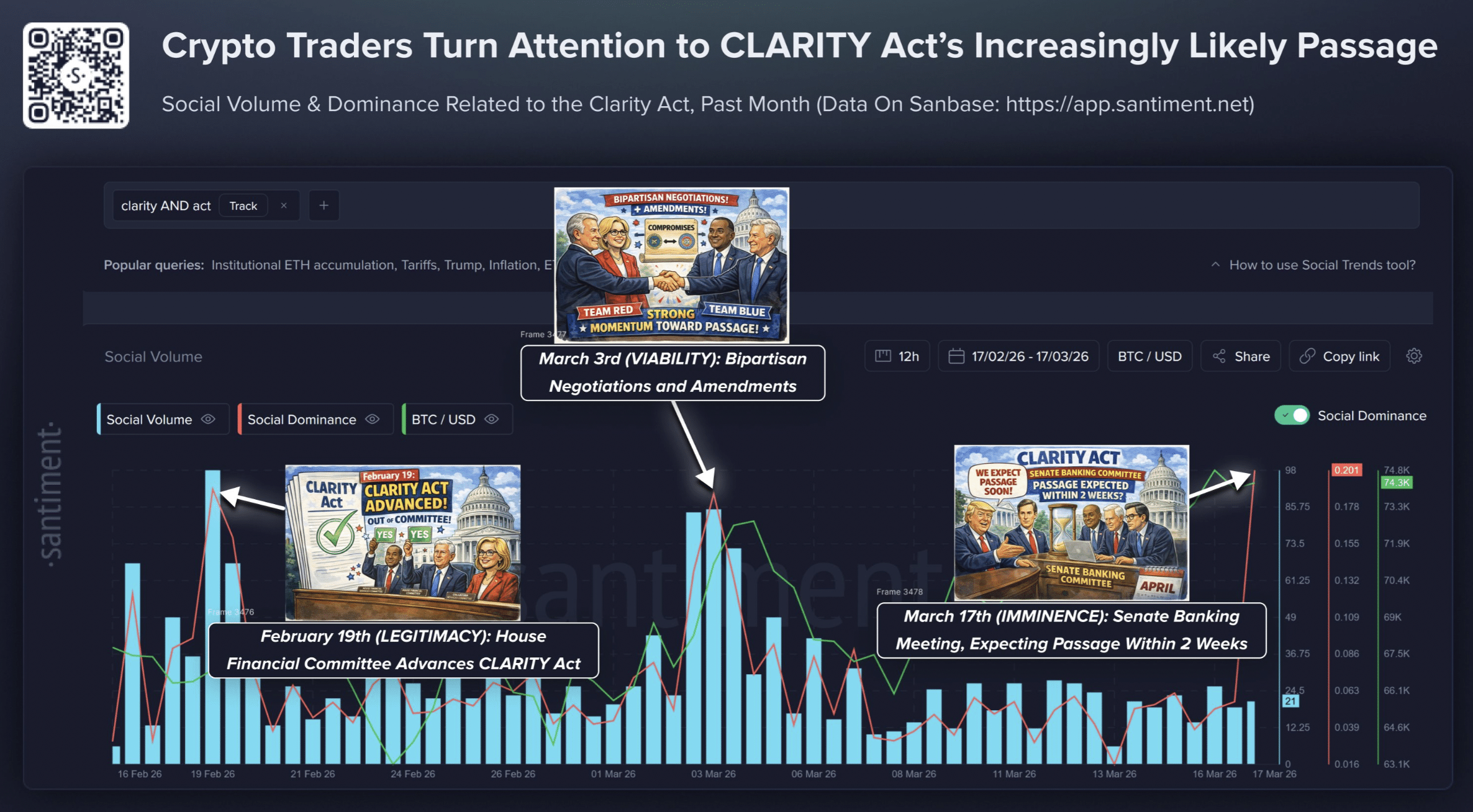
Source: Santiment/X

CLARITY Act talks continue

Talking about the same at the DC Blockchain Summit on the 17th of March, Senate Banking Committee Chair Tim Scott said the bill is still delayed due to a disagreement over interest-bearing stablecoins.

While the crypto industry supports such products, banks fear they could pull large amounts of money away from traditional deposits.

That said, Senators Thom Tillis and Angela Alsobrooks are currently reviewing these concerns and pushing for stronger safeguards if crypto products function like bank services.

This cautious approach has slowed the bill’s progress. Meanwhile, political pressure is growing, especially after U.S. President Donald Trump urged lawmakers to pass the Act quickly.

President Trump demands CLARITY Act passage

On the 4th of March, U.S. President Donald Trump wrote in a post on Truth Social,

The Genius Act is being threatened and undermined by the Banks, and that is unacceptable — We are not going to allow it. The U.S. needs to get Market Structure done, ASAP.

Donald Trump’s statement has shifted the debate around the CLARITY Act from a technical policy issue to a broader economic and strategic concern.

He argues that without clear crypto regulations, capital and innovation could move to countries like China, making the bill important for maintaining U.S. financial leadership.

Trump also criticized major banks for resisting crypto reforms, despite reporting record profits, suggesting they are prioritizing their own interests.

By linking the CLARITY Act to his goal of making the U.S. the global crypto capital, he has increased pressure on lawmakers to move the legislation forward.

Crypto community stands confident

The confidence was also reflected in the crypto community, as noted by Senator Kevin Cramer when he said,

I think we have to make this a committee priority for some time just before Easter or shortly after.

Echoing similar sentiments, Dan Spuller, EVP of Industry Affairs at Blockchain Association, added,

I’m now increasingly confident we’re going to get CLARITY through, and we’re not going to let the banks rig the outcome.

Polymarket odds and other hiccups

Additionally, Polymarket bettors have also pushed the odds of the CLARITY Act passing in 2026 to a commanding 62%.
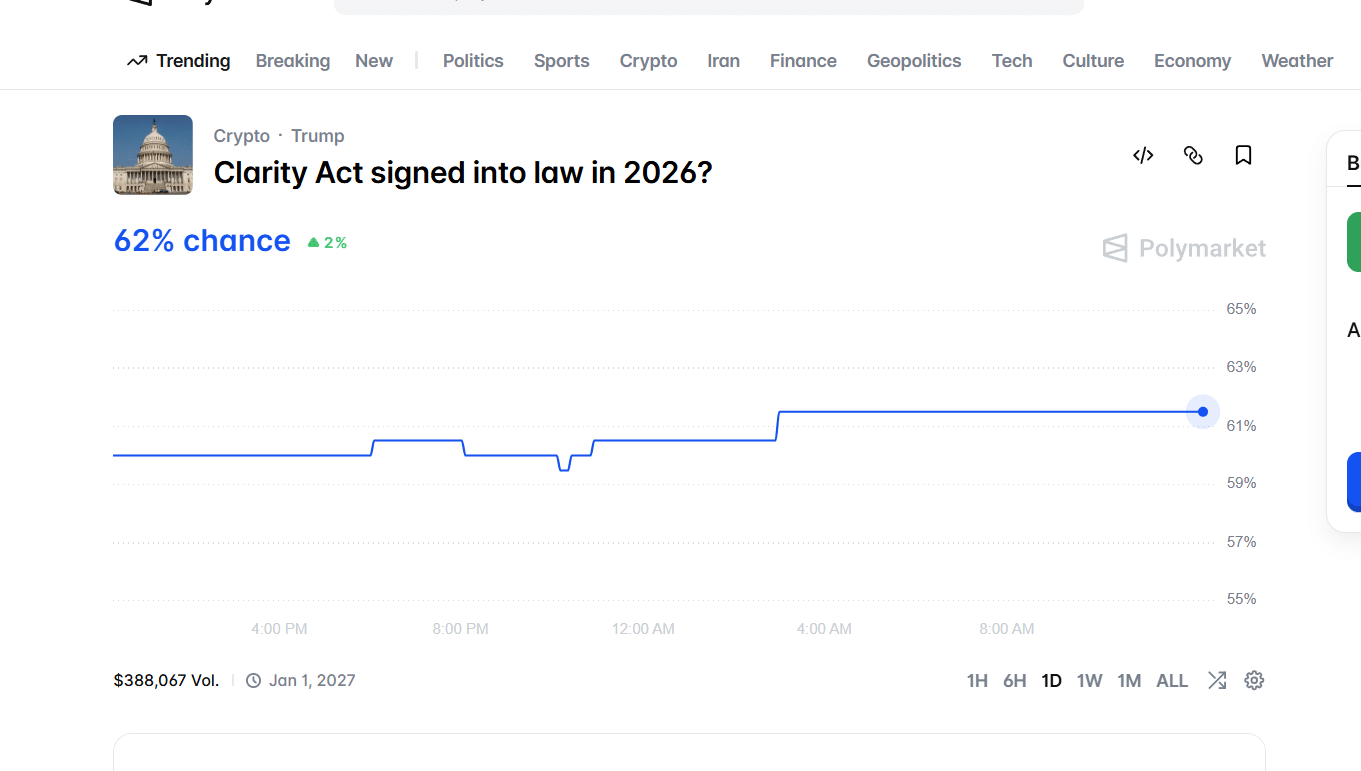
Source: Polymarket

Needless to say, the bill has now become the center of a growing clash between the U.S. government and traditional banks.

This disagreement has stalled the bill since early 2026. Thus, as expected, Trump’s crypto advisor, Patrick Witt, had put it best when he said,

The CLARITY Act must remain a pro-innovation piece of legislation. Attempts to hijack the legislative process and turn it into an anti-competition bill are shameful.


Final Summary

  • Clear rules could unlock large institutional capital that has remained cautious due to regulatory uncertainty.
  • However, a key disagreement over interest-bearing stablecoins continues to slow progress.

Domande pertinenti

QWhat is the main disagreement holding up the CLARITY Act according to the article?

AThe main disagreement is over interest-bearing stablecoins, with the crypto industry supporting such products while banks fear they could pull large amounts of money away from traditional deposits.

QWhat did U.S. President Donald Trump say about the CLARITY Act and the banks?

APresident Trump stated that the 'Genius Act' (referring to the CLARITY Act) is being 'threatened and undermined by the Banks' and that this is unacceptable. He argued that the U.S. needs to get Market Structure done ASAP and criticized major banks for resisting crypto reforms despite reporting record profits.

QAccording to the article, what is the predicted probability of the CLARITY Act passing in 2026 on Polymarket?

APolymarket bettors have pushed the odds of the CLARITY Act passing in 2026 to 62%.

QHow did Trump's advisor, Patrick Witt, characterize attempts to change the CLARITY Act?

APatrick Witt characterized attempts to hijack the legislative process and turn the CLARITY Act into an anti-competition bill as 'shameful,' stating that the act must remain a pro-innovation piece of legislation.

QWhat previous legislation created a regulatory framework for U.S. stablecoins, as mentioned in the article?

AThe GENIUS Act, passed in 2025, created a regulatory framework for U.S. stablecoins.

Letture associate

Crypto Market Makers Are Collectively Seeking Change as Money Becomes Harder to Earn

**Summary: Crypto Market Makers Adapt as Margins Shrink** Leading crypto market maker GSR exemplifies a broader industry shift, moving beyond traditional market-making to become a full-service "Web3 investment bank." Its recent strategic acquisitions—including an SEC-registered broker-dealer, rebranded as GSR Securities—and purchases of token advisory firms aim to create an integrated platform covering token design, fundraising, listing, liquidity provision, and asset management. This includes launching an ETF and investing in tokenization platforms like Libeara, backed by a strategic investment from Standard Chartered's SC Ventures. This transformation is not unique to GSR. Other major players like Keyrock, B2C2, Wintermute, and DWF Labs are also expanding geographically, pursuing regulatory licenses (especially under frameworks like MiCA in the EU), and diversifying into over-the-counter (OTC) trading, asset management, and real-world asset tokenization. The driving force behind this collective pivot is a rapidly changing market. Profits from traditional altcoin market-making are declining due to fewer viable projects, reduced client budgets, increased competition, and smarter, more demanding clients. Simultaneously, regulatory pressures are mounting, making compliance a baseline cost. Extreme market events further expose teams lacking robust risk controls. Consequently, the crypto market-making business model is evolving from one reliant on information asymmetry and volatility to a more institutionalized, regulated, and service-diverse industry. Survival now depends on building systemic capabilities beyond mere liquidity provision.

marsbit1 h fa

Crypto Market Makers Are Collectively Seeking Change as Money Becomes Harder to Earn

marsbit1 h fa

Market Adjusts Following Google's $84.7 Billion Fundraising, AI Valuations Now Focus on Payback Speed

After Alphabet's announcement of an $84.75 billion equity financing round, market focus for AI investment is shifting from pure growth narratives to capital efficiency and payback periods. The core argument is that AI is being re-priced from a software-like growth story into a heavy-asset infrastructure cycle, requiring massive capital expenditure (CapEx) on chips, data centers, and power grids. While Alphabet's financing itself is not a distress signal—part of it is for administrative purposes like tax obligations on stock compensation—it highlights the enormous capital demands of AI infrastructure. This demand extends beyond tech giants to pure-play AI model companies (like OpenAI, Anthropic), data center REITs, and utilities. Major tech firms are projected to spend heavily on AI data centers in 2026, signaling a broad-based capital cycle the market must absorb. Consequently, valuation logic is changing. Investors are moving away from questions about who has the strongest AI narrative and are now prioritizing clear visibility into orders, stable cash flows, and the cost of capital. This has led to recent pressure on high-multiple AI software and semiconductor stocks, while "picks-and-shovels" hardware, data center, and power assets with firmer near-term demand may see relative support. The key going forward will be monitoring whether rising CapEx guidance across companies is matched by a timely monetization of AI investments into revenue and cash flow. The market's tolerance for high spending depends on demonstrable returns. While the long-term AI thesis remains intact, the valuation framework has fundamentally shifted to emphasize capital discipline and payback speed.

marsbit1 h fa

Market Adjusts Following Google's $84.7 Billion Fundraising, AI Valuations Now Focus on Payback Speed

marsbit1 h fa

Trading

Spot
Futures

Articoli Popolari

Come comprare ONE

Benvenuto in HTX.com! Abbiamo reso l'acquisto di Harmony (ONE) semplice e conveniente. Segui la nostra guida passo passo per intraprendere il tuo viaggio nel mondo delle criptovalute.Step 1: Crea il tuo Account HTXUsa la tua email o numero di telefono per registrarti il tuo account gratuito su HTX. Vivi un'esperienza facile e sblocca tutte le funzionalità,Crea il mio accountStep 2: Vai in Acquista crypto e seleziona il tuo metodo di pagamentoCarta di credito/debito: utilizza la tua Visa o Mastercard per acquistare immediatamente HarmonyONE.Bilancio: Usa i fondi dal bilancio del tuo account HTX per fare trading senza problemi.Terze parti: abbiamo aggiunto metodi di pagamento molto utilizzati come Google Pay e Apple Pay per maggiore comodità.P2P: Fai trading direttamente con altri utenti HTX.Over-the-Counter (OTC): Offriamo servizi su misura e tassi di cambio competitivi per i trader.Step 3: Conserva Harmony (ONE)Dopo aver acquistato Harmony (ONE), conserva nel tuo account HTX. In alternativa, puoi inviare tramite trasferimento blockchain o scambiare per altre criptovalute.Step 4: Scambia Harmony (ONE)Scambia facilmente Harmony (ONE) nel mercato spot di HTX. Accedi al tuo account, seleziona la tua coppia di trading, esegui le tue operazioni e monitora in tempo reale. Offriamo un'esperienza user-friendly sia per chi ha appena iniziato che per i trader più esperti.

320 Totale visualizzazioniPubblicato il 2024.12.12Aggiornato il 2026.06.02

Come comprare ONE

Discussioni

Benvenuto nella Community HTX. Qui puoi rimanere informato sugli ultimi sviluppi della piattaforma e accedere ad approfondimenti esperti sul mercato. Le opinioni degli utenti sul prezzo di ONE ONE sono presentate come di seguito.

活动图片













