Circle gets Abu Dhabi greenlight amid UAE stablecoin and crypto push

cointelegraphPubblicato 2025-12-09Pubblicato ultima volta 2025-12-09

Introduzione

Circle has received regulatory approval from the Abu Dhabi Global Market (ADGM) to operate as a licensed Money Services Provider, expanding its presence in the UAE. The company also appointed Saeeda Jaffar as managing director for the Middle East and Africa. This move is part of a broader trend of crypto firms, including Tether, Ripple, and Binance, gaining regulatory clearance in Abu Dhabi. The UAE has been advancing its crypto regulatory framework, introducing rules for DeFi and Web3, while also enforcing stricter oversight on unlicensed crypto operations.

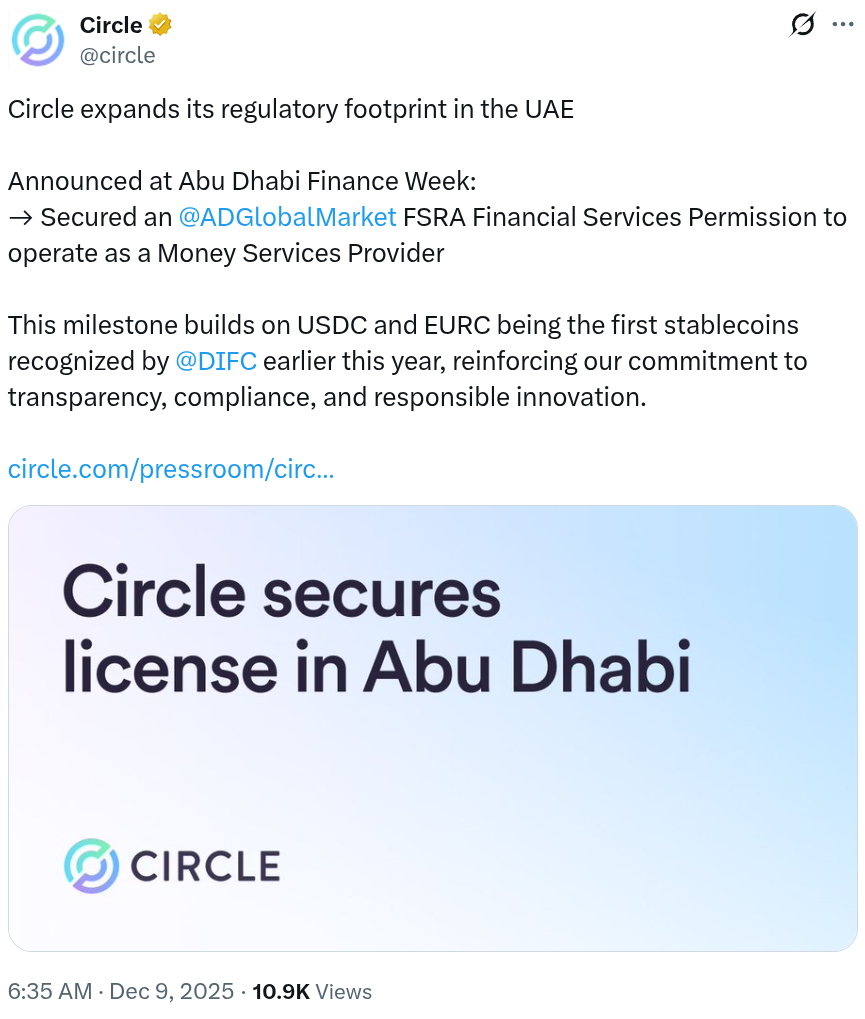
Stablecoin issuer Circle has secured regulatory approval to operate as a financial service provider in the Abu Dhabi International Financial Center, deepening its push into the United Arab Emirates.

In an announcement Tuesday, Circle Internet Group said it received a Financial Services Permission license from the Financial Services Regulatory Authority of the Abu Dhabi Global Market (ADGM), the International Financial Centre of Abu Dhabi. This allows the stablecoin issuer to operate as a Money Services Provider in the IFC.

The USDC (USDC) issuer also appointed Saeeda Jaffar as its managing director for Circle Middle East and Africa. The new executive also serves as a senior vice president and group country manager for the Gulf Operation Council at Visa and will be tasked with developing the stablecoin issuer’s regional strategy and partnerships.

Circle co-founder, chairman and CEO Jeremy Allaire said that the relevant regulatory framework “sets a high bar for transparency, risk management, and consumer protection,” adding that those standards are needed if “trusted stablecoins” are going to support payments and finance at scale.
Source: Circle

Related: Abu Dhabi Investment Council triples stake in Bitcoin ETF in Q3: Report

Abu Dhabi awards a wave of licenses

The ADGM has recently awarded licenses for financial operations to a wave of crypto companies. Earlier this week, Tether’s USDt (USDT) — the largest stablecoin by circulation and Circle’s top competitor — secured a regulatory milestone in Abu Dhabi’s international financial center, as did Ripple’s dollar-pegged stablecoin Ripple USD at the end of November.

On Monday, crypto exchange Binance was granted three separate licenses from Abu Dhabi’s financial regulator, allowing it to operate its exchange, clearing house and broker-dealer services. This followed its competitor Bybit receiving regulatory approval in the UAE in early October.

Related: HSBC to bring tokenized deposits to US and UAE as stablecoin race heats up

UAE bets on crypto

The Central Bank of the UAE has been actively reviewing its cryptocurrency regulations. In November, it introduced rules for decentralized finance (DeFi) and the broader Web3 industry.

The newly-introduced Federal Decree Law No. 6 of 2025 brings DeFi platforms, related services and infrastructure providers under the scope of regulations if they enable payments, exchange, lending, custody, or investment services, with licenses now required. Local crypto lawyer Irina Heaver said that “DeFi projects can no longer avoid regulation by claiming they are just code.”

Heaver told Cointelegraph at the end of 2024 that during that year the country cemented its status as a global crypto hub.

In October 2024, the UAE exempted cryptocurrency transfers and conversions from value-added tax, just a month after Dubai’s digital asset regulator announced stricter rules on crypto marketing. Around the same time, local free economic zone Ras Al Khaimah Digital Assets Oasis was also working to introduce a legal framework for decentralized autonomous organizations.

Local regulators were also not shy about enforcing the rules, with Dubai’s Virtual Assets Regulatory Authority cracking down on seven unlicensed crypto businesses, issuing fines and cease-and-desist orders.

Magazine: Review: The Devil Takes Bitcoin, a wild history of Mt. Gox and Silk Road

Letture associate

Ten-Thousand-Word Analysis: From $10 to $290, MRVL Wins the Entire AI Era by 'Not Making GPUs'

Marvell Technology's stock price surged from under $10 in 2016 to a record $290 in June 2026, fueled not by making GPUs, but by dominating AI infrastructure connectivity. This analysis argues the market misvalues MRVL as merely a smaller Broadcom in custom AI chips, overlooking its true, unique position. Marvell's core strength lies in enabling high-speed data flow for AI clusters through three interconnected businesses. First, it holds a commanding ~70% market share in high-speed optical DSPs (essential for data center light modules), a deep-moat business with accelerating growth. Second, its custom AI chip design business serves hyperscalers like AWS, Microsoft, and Google, with a significant revenue pipeline despite lower margins. Third, stable cash flows come from Ethernet switch chips and enterprise storage controllers. Together, they form a full-stack "AI data movement" platform. CEO Matt Murphy's transformative leadership since 2016, involving strategic divestments, key acquisitions (like Inphi for optical DSPs), and securing long-term agreements with major cloud providers, repositioned the company. A pivotal $2 billion strategic investment from NVIDIA in 2026 underscored Marvell's critical role in the AI ecosystem, particularly through collaborations like NVLink Fusion. While Marvell faces risks—including client concentration (losing the Amazon Trainium3 design), lower-margin business mix, competitive threats, insider selling, and complex supply chains—its fundamentals remain strong. The optical interconnect moat is widening with the acquisition of Celestial AI (photonics fabric), and financial metrics show accelerating revenue growth and operating leverage. With a PEG ratio suggesting undervaluation relative to its growth, the thesis is that the market undervalues Marvell's monopolistic position in AI "plumbing" while overemphasizing its competitive custom chip segment. The story transcends investing, symbolizing how in any complex system—from the internet to AI—the value of "connection" ultimately surpasses that of individual "nodes."

marsbit16 min fa

Ten-Thousand-Word Analysis: From $10 to $290, MRVL Wins the Entire AI Era by 'Not Making GPUs'

marsbit16 min fa

AI Relay Stations Spark Heated Debate on Zhihu: Behind Cheap Tokens, What Are Users Really Worried About?

A discussion on Zhihu about "AI relay stations" shifted the niche developer topic of "cheap tokens" into broader user awareness. Users moved beyond simply questioning the legitimacy of these services to focus on practical concerns: Where do cheap tokens truly come from? Is the model being accessed the real one? Can relay stations see prompts, code, and API keys? For occasional users, are the risks worth it? The core debate centered less on price and more on trust. A primary worry is model authenticity—the risk of "model swapping," where users paying for a premium model might be routed to a cheaper one, creating an information asymmetry. Others argued that cost comparisons matter; while cheaper than official pay-as-you-go APIs, relay stations may not be the lowest-cost option versus subscriptions, domestic models, or free tiers, making user needs assessment crucial. Speculation about token sources ranged from legitimate bulk discounts to gray-area methods like account sharing or exploiting regional pricing. This opacity makes risk assessment difficult for users. Data security emerged as a critical concern, especially for enterprise use. When processing sensitive information like code, contracts, or client data, the inability to verify a relay station's data handling, retention, or access policies poses significant compliance and confidentiality risks. The evolving consensus suggests relay stations can be used cautiously for low-sensitivity, disposable tasks (e.g., summarizing public info, simple translation). However, they should not be the default for sensitive, professional, or production workflows involving proprietary data, Agents, or automated systems. Recommendations include avoiding large prepayments, not relying on a single service, using test prompts to monitor quality, anonymizing data where possible, and keeping official channels as backups. Ultimately, the discussion framed tokens not just as a billing unit but as a measure of real cost encompassing price, model integrity, data security, and service stability. The popularity of relay stations highlights user demand for affordable access, but the debate underscores a key trade-off: the savings from cheap tokens may come at the price of trust, transparency, and control over one's data and AI experience.

marsbit45 min fa

AI Relay Stations Spark Heated Debate on Zhihu: Behind Cheap Tokens, What Are Users Really Worried About?

marsbit45 min fa

In-Depth Research Report on TradFi: The Convergence Wave of Crypto and Traditional Finance

In 2026, the crypto industry is undergoing a profound infrastructure-level transformation—TradFi assets are migrating on-chain at an unprecedented pace. According to CoinGecko's Q1 2026 report, the total value locked (TVL) of tokenized real-world assets (RWA) has surpassed $31 billion, a nearly 4x increase from $7.8 billion at the beginning of 2025, with the sector’s aggregate market capitalization reaching $19.3 billion. Among these, the market cap of tokenized stocks surged from $2 million to $486 million, with Q1 spot trading volume reaching $15.1 billion—a single quarter already surpassing the entire second half of 2025. RWA perpetual contract Q1 trading volume reached a staggering $524.8 billion, far exceeding the $313 billion for all of 2025. Meanwhile, BlackRock's BUIDL fund has reached $2.3 billion in scale and has filed for two new tokenized funds, signaling that the world's largest asset manager's tokenization strategy is evolving from pilot to product suite expansion. HTX, as a core participant in the crypto exchange sector, officially launched TradFi perpetual futures products including NVDA, AAPL, MSFT, META, and SPY in 2026, enabling crypto users to gain 24/7 trading access to core U.S. equities. Boston Consulting Group predicts that global tokenized asset scale could reach $16 trillion by 2030, while McKinsey offers a conservative estimate of approximately $2 trillion. The on-chain migration of TradFi assets is no longer a "future narrative" but a structural transformation unfolding in real time, as crypto exchanges evolve from single crypto asset trading platforms toward "multi-asset-class trading infrastructure."

HTX Learn48 min fa

In-Depth Research Report on TradFi: The Convergence Wave of Crypto and Traditional Finance

HTX Learn48 min fa

Trading

Spot
Futures

Articoli Popolari

Come comprare PUSH

Benvenuto in HTX.com! Abbiamo reso l'acquisto di Push Protocol (PUSH) semplice e conveniente. Segui la nostra guida passo passo per intraprendere il tuo viaggio nel mondo delle criptovalute.Step 1: Crea il tuo Account HTXUsa la tua email o numero di telefono per registrarti il tuo account gratuito su HTX. Vivi un'esperienza facile e sblocca tutte le funzionalità,Crea il mio accountStep 2: Vai in Acquista crypto e seleziona il tuo metodo di pagamentoCarta di credito/debito: utilizza la tua Visa o Mastercard per acquistare immediatamente Push ProtocolPUSH.Bilancio: Usa i fondi dal bilancio del tuo account HTX per fare trading senza problemi.Terze parti: abbiamo aggiunto metodi di pagamento molto utilizzati come Google Pay e Apple Pay per maggiore comodità.P2P: Fai trading direttamente con altri utenti HTX.Over-the-Counter (OTC): Offriamo servizi su misura e tassi di cambio competitivi per i trader.Step 3: Conserva Push Protocol (PUSH)Dopo aver acquistato Push Protocol (PUSH), conserva nel tuo account HTX. In alternativa, puoi inviare tramite trasferimento blockchain o scambiare per altre criptovalute.Step 4: Scambia Push Protocol (PUSH)Scambia facilmente Push Protocol (PUSH) nel mercato spot di HTX. Accedi al tuo account, seleziona la tua coppia di trading, esegui le tue operazioni e monitora in tempo reale. Offriamo un'esperienza user-friendly sia per chi ha appena iniziato che per i trader più esperti.

533 Totale visualizzazioniPubblicato il 2024.12.13Aggiornato il 2026.06.02

Come comprare PUSH

Discussioni

Benvenuto nella Community HTX. Qui puoi rimanere informato sugli ultimi sviluppi della piattaforma e accedere ad approfondimenti esperti sul mercato. Le opinioni degli utenti sul prezzo di PUSH PUSH sono presentate come di seguito.

活动图片