China-US 'Execution Line' Comparison: The Economic Pressure and Survival Reality of the Middle Class

比推Pubblicato 2025-12-24Pubblicato ultima volta 2025-12-24

Introduzione

The article "China-US 'Kill Line' Comparison of Middle-Class Pressure and Survival Reality" discusses the concept of a "kill line" — an income threshold where middle-class families face severe financial strain due to loss of benefits and rising costs. Originating from Mike Green’s "140k poverty line" theory in the U.S., the idea went viral and was adapted in China. Green argues that the U.S. official poverty line ($31,200 for a family of four) is outdated. When adjusted for modern costs like housing, healthcare, and childcare, the real "dignity threshold" is around $140,000. Middle-income earners are particularly vulnerable: as their income rises, they lose welfare benefits while facing high taxes and essential costs, effectively making them financially worse off than lower-income households receiving aid. The article attributes rising costs to "Baumol’s Cost Disease": sectors like education and healthcare, which rely heavily on human labor, become more expensive without gains in efficiency, while automated sectors (e.g., manufacturing) drive down prices for goods. In the U.S., services like healthcare and childcare consume a growing share of income, creating a "kill line" effect. In contrast, the author suggests China may not have a similar "kill line" due to different social and economic structures. Services are often undervalued, and welfare systems are less extensive, allowing living costs to remain low — but at the expense of service workers' conditions and dign...

Author: Xiao Xiaopao

Original Title: From the "140k Poverty Line" to the "Middle-Class Execution Line": To Live or to Live with Dignity?


I first noticed the narrative of the "execution line" in November on X and Substack circles. It originated from Mike Green's "140k poverty line" theory, which went viral in the United States. I didn't expect that over a month later, this narrative would spread and mutate into the "execution line" in China, which is quite interesting.

It's a pity that my AI narrative radar (see here) wasn't ready at that time; otherwise, I would have loved to see if AI caught this narrative's spread and transformation.

01

At the end of November, I read three articles by Mike Green on Substack:

These are three extremely long articles, making you feel like you're reading forever; the three pieces combined have the word count of a small book.

I'll try to summarize them in plain language as follows:

The gist of the articles is: If you feel the current economic data looks good, but your daily life is tight, and you're still poor with an annual salary of $100,000, it's not your fault. It's because the ruler measuring wealth and poverty is like Doraemon's self-deceiving ruler.

The articles present three main points:

1. The "poverty line" is actually like marking the boat to find the sword (a Chinese idiom meaning a futile approach).

The official U.S. poverty line is an annual income of $31,200 for a family of four; as long as your income exceeds $30,000, you are not considered poor.

But this ruler was created in 1963. The logic back then was simple: a family spent about one-third of their money on food, so by calculating the minimum food cost and multiplying it by 3, you got the poverty line.

But the situation is vastly different now. Everyone has probably seen that famous chart—"Baumol's Cost Disease":
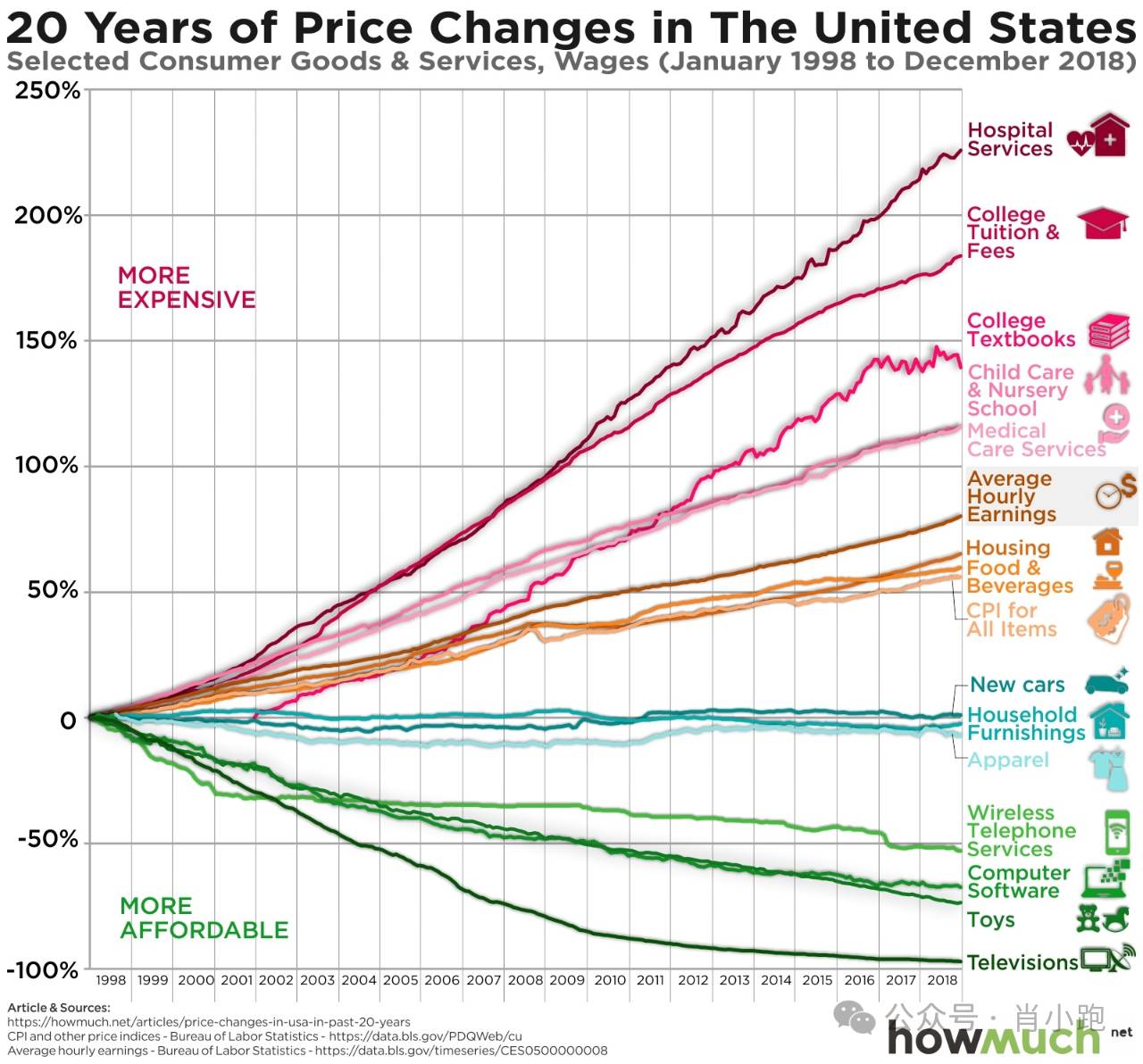
Food has become cheaper, but the costs of housing, healthcare, and childcare have skyrocketed. If you recalculate based on the 1963 standard of living—meaning the ability to normally "participate" in society (having a place to live, a car to drive, childcare, and access to medical treatment when sick)—the real poverty line today is not $30,000+, but $140,000 (approximately 1 million RMB), just to live decently in this society.

2. The harder you work, the poorer you become.

There's a huge bug in the design of the U.S. welfare system: When your annual salary is $40,000, you are officially poor, and the state gives you food stamps, covers your healthcare (Medicaid), and subsidizes childcare costs. Life is tight but there's a safety net.

But when you work hard and your salary increases to $60,000, $80,000, or even $100,000, disaster strikes: Your income is higher, but the welfare is gone. Now you need to pay for expensive health insurance and rent in full.

The result is: A family with an annual income of $100,000 might have less disposable cash left each month than a family with an annual income of $40,000 (receiving welfare).

This is the origin of the "execution line" and the narrative of "the execution line specifically targeting the middle class" on Chinese social networks: Just like in a game where your health drops to a certain threshold, you get instantly killed by a skill, taken out in one hit; the middle class, stuck in the middle,刚好踩在刚好 steps on the point where welfare withdraws, tax burdens increase, and all kinds of rigid expenses (health insurance, rent, childcare, student loans) fully press down. They lose subsidies while bearing high costs. Once they encounter unemployment, illness, or rent increases, they are locked in by the execution line.

3. The assets you own are actually quite inflated.

Because:

Your house is not an asset; it's prepaid rent: Did you get richer if your house increased from $200,000 to $800,000? No. Because if you sell it, you still have to spend $800,000 to buy a similar house to live in. You haven't gained additional purchasing power; your cost of living has just increased.

The inheritance you're waiting for is not a wealth transfer: The Baby Boomers' inheritance won't be passed down to you; it will go to nursing homes and the healthcare system. Nursing care (dementia care, nursing homes) in the U.S. now costs $6,000 to over $10,000 per month. An $800,000 house owned by parents will most likely turn into medical bills, collected by medical institutions and insurance companies.

Your class has become a caste: In the past, you could跨越阶级 through hard work. Now it depends on "admission tickets"—Ivy League degrees, recommendation letters from core circles. The inflation rate of these "assets" is even higher than that of houses. So an annual salary of $150,000 allows you to live, but it can't buy the ticket for your children to enter the upper class.

02

What exactly caused the great inflation of the U.S. poverty line (or, in our context—the great shift of the "execution line")?

Mike Green believes it's three turning points in U.S. history:

Turning Point 1: The deterioration and monopolization of unions in the 1960s, leading to decreased efficiency and increased costs.

Turning Point 2: The great antitrust shift in the 1970s, where large companies疯狂兼并, controlled the market, and suppressed wages.

Turning Point 3 (which everyone can probably guess): The China Shock. But the article's view is not that China forcibly took away jobs, but that U.S. capitalists engaged in capital arbitrage—moving almost all factories to China to profit from the differential.

But Teacher Green didn't just kill and not bury; he finally proposed a very hardcore solution called the "Rule of 65." The core idea is very familiar to us Chinese: "打倒土豪分田地" (Beat the local tyrants and distribute the land): (1) Increase taxes on enterprises (but exempt investments from taxes); (2) Prevent large companies from deducting interest on borrowed money from taxes,坚决打击坚决打击坚决打击坚决打击坚决打击坚决打击 financial空转 (idling of capital, financial speculation); (3) Reduce the burden on the workhorses:大幅降低大幅降低大幅降低大幅降低大幅降低 the payroll tax (FICA) for ordinary people, putting more cash in their hands. Where does the missing money come from? Make the rich pay more, remove the cap on social security taxes for the wealthy.

Chinese experience is absolutely practical.

03

Teacher Mike Green's views were enthusiastically刷屏 among the U.S. middle-class masses. But they aroused collective resistance from the elite class and various economists.

There are indeed many data flaws in his articles. For example, using data from affluent areas (Essex County, top 6% in U.S. housing prices) as the national average; assuming all children go to expensive daycare centers (over $30,000 per year), when in fact most American families still take care of their own children; some concepts are also somewhat confused, such as equating "average expenditure" with "minimum survival needs."

Later, Green went on many podcasts to explain himself: This $140,000 does not refer to the traditional poverty of "not having enough to eat," but rather the "threshold for a decent life" where an ordinary family can live without relying on government subsidies and still save some money.

Although Teacher Green's math seems to be indeed miscalculated, the critics didn't win either, because regardless of what the poverty line actually is, people's "feeling of poverty" is very real. And the "feeling of being executed" is becoming more and more real—whether for Americans or Chinese.

Why? I think the real reason is still "Baumol's Disease."

"Baumol's Cost Disease" was proposed by economist William Baumol in 1965, attempting to describe an economic phenomenon:

Some industries (like manufacturing) rely on machines and technology, becoming more and more efficient, with unit costs getting lower and lower; but some industries (like education, healthcare) mainly rely on people, and efficiency is difficult to significantly improve—one lesson still takes an hour, one doctor seeing one patient also takes time, impossible to speed up multiples like a factory.

So here's the problem: Wages across society will rise along with those efficient industries. To prevent teachers and doctors from jumping to higher-paying industries, schools and hospitals also have to raise wages. But their efficiency hasn't improved much, yet wages have risen, resulting in higher and higher costs, and prices also rising accordingly.

That is to say: Industries that can be sped up by machines have raised overall wages. Industries that cannot提速 have to raise salaries to retain people, but efficiency hasn't changed, so they become more expensive. This is "Baumol's Cost Disease."

This is why on the chart at the beginning of the article: The lines representing industrial products like TVs, mobile phones, and toys go downward, getting cheaper and cheaper; while the lines representing education, healthcare, and childcare costs soar.

The logic behind this is actually very realistic:

In areas that can be replaced by machines and automation, efficiency will only get higher. For example, mobile phones, although the price doesn't seem to have dropped much, their performance is worlds apart from a few years ago, with computing power and storage multiplying several times, which is essentially a kind of "invisible price reduction" brought by technology. Not to mention Chinese manufacturing, photovoltaics, EVs, and lithium batteries, where automation is getting higher and higher, driving costs down to rock-bottom prices.

But the problem lies in those places where "machines cannot replace people." When I was little, the nanny aunt who took care of me could look after four kids by herself. Even today, she can still only look after four at most, and because today's parents have higher demands, she might even be able to look after fewer children. This means that the productivity of the service industry hasn't changed for decades, and has even regressed.

However, the service industry (specifically in the U.S.) must raise wages for nannies and nurses to prevent them from running off to deliver food or work in factories; they have to keep up with the overall income level of society. The coffee beans in a coffee shop aren't expensive, but the exorbitant price you pay is mostly for the staff's labor, rent, and utilities. Efficiency hasn't increased, but wages have to rise, so the cost can only be passed on to consumers. (Note: This specifically refers to the U.S.)

Therefore, the American middle-class families being "executed" are not poor to the point of not having enough to eat. They have cars, iPhones, and various video memberships, but when facing "service-based expenditures" like buying a house, seeing a doctor, or raising children, their wallets are instantly emptied. So, it's not that the American people have truly become poorer; it's that their money becomes less and less sufficient in the face of those "inefficient but expensive" services.

Writing here, I know everyone has been wanting to ask: Does China have an execution line? Does China's execution line target the middle class? Has China's poverty line also become higher?

The answer is most likely no.

Therefore, our "execution line" might not appear. I discussed this with Dean Liu in the "Qianglie Tan" podcast episode: "When China Becomes Industrial Cthulhu, What's Left of Trade? Higher Productivity, Why Lower Wages?"

The situation in China, we Chinese should know: Chinese society is more sensitive to service prices. For things that are not "production tools," people are generally unwilling to pay, especially for services. In the expenditure structure of labor force reproduction, certain service expenditures have long been suppressed very low in China, even to the extent that "this part of the wage doesn't need to be paid." When services are undervalued and the welfare stage is different, the wage system naturally presents a structure completely different from the West.

This creates a奇妙的现象奇妙的现象奇妙的现象奇妙的现象奇妙的现象奇妙的现象奇妙的现象奇妙的现象奇妙的现象奇妙的现象奇妙的现象奇妙的现象奇妙的现象奇妙的现象奇妙的现象奇妙的现象奇妙的现象奇妙的现象奇妙的现象奇妙的现象奇妙的现象奇妙的现象奇妙的现象奇妙的现象奇妙的现象奇妙的现象奇妙的现象奇妙的现象奇妙的现象奇妙的现象奇妙的现象奇妙的现象奇妙的现象奇妙的现象奇妙的现象奇妙的现象奇妙的现象奇妙的现象奇妙的现象奇妙的现象奇妙的现象奇妙的现象奇妙的现象奇妙的现象奇妙的现象奇妙的现象奇妙的现象奇妙的现象奇妙的现象奇妙的现象奇妙的现象奇妙的现象奇妙的现象奇妙的现象奇妙的现象奇妙的现象奇妙的现象奇妙的现象奇妙的现象奇妙的现象奇妙的现象奇妙的现象奇妙的现象奇妙的现象奇妙的现象奇妙的现象奇妙的现象奇妙的现象奇妙的现象奇妙的现象奇妙的现象奇妙的现象奇妙的现象奇妙的现象奇妙的现象奇妙的现象奇妙的现象奇妙的现象奇妙的现象奇妙的现象奇妙的现象奇妙的现象奇妙的现象奇妙的现象奇妙的现象奇妙的现象奇妙的现象奇妙的现象奇妙的现象奇妙的现象奇妙的现象奇妙的现象奇妙的现象奇妙的现象奇妙的现象奇妙的现象奇妙的现象: No matter what, one can still "live." Because the cost of living can be pressed extremely low.

Therefore, China might not have an "execution line," but that doesn't mean there isn't an invisible threshold. For example, how low can the dignity of service providers be pressed? How high can the intensity be increased?

So it's still that saying: Everything comes at a cost.


Twitter:https://twitter.com/BitpushNewsCN

Bitpush TG Discussion Group:https://t.me/BitPushCommunity

Bitpush TG Subscription: https://t.me/bitpush

Original link:https://www.bitpush.news/articles/7598124

Crypto di tendenza

Domande pertinenti

QWhat is the concept of the 'poverty line' in the US according to Mike Green, and why does he argue it is outdated?

AMike Green argues that the official US poverty line of $31,200 for a family of four is outdated because it was calculated in 1963 based on the assumption that one-third of a family's budget was spent on food. He contends that the modern 'real' poverty line is $140,000, as the cost of housing, healthcare, and childcare has skyrocketed, while food has become cheaper. This amount is needed for a family to participate 'normally' in society with dignity.

QWhat is the 'killing threshold' narrative that emerged from Mike Green's theory, and how does it affect the middle class?

AThe 'killing threshold' narrative, which originated from Mike Green's 'poverty line' theory, describes a situation where middle-class families face a financial crisis when their income reaches a certain level. As their income increases (e.g., to $60,000-$100,000), they lose government welfare benefits like food stamps and Medicaid, while simultaneously facing high costs for healthcare, rent, and childcare. This creates a scenario where their disposable income may be less than that of lower-income families receiving benefits, making them vulnerable to being 'killed off' financially by unexpected expenses like job loss or illness.

QWhat is 'Baumol's Cost Disease' and how does it explain the rising cost of services like healthcare and education?

ABaumol's Cost Disease, proposed by economist William Baumol in 1965, explains that in sectors where productivity is difficult to increase (like healthcare, education, and childcare), costs rise because wages must keep pace with more productive sectors. While manufacturing and technology become more efficient and cheaper, service industries reliant on human labor cannot significantly improve efficiency. To retain workers, these sectors must raise wages, leading to higher prices for consumers, even though the service itself hasn't become more productive.

QHow does Mike Green's proposed 'Rule of 65' solution aim to address the economic issues facing the middle class?

AMike Green's 'Rule of 65' proposes a solution inspired by Chinese policies: (1) Increase taxes on corporations (but exempt investments), (2) Prevent large companies from deducting interest on debt to curb financial speculation, and (3) Reduce the tax burden (FICA tax) on ordinary workers to increase their disposable income. The revenue shortfall would be compensated by removing the cap on Social Security taxes for the wealthy, effectively making them contribute more.

QAccording to the article, why might China not have a 'killing threshold' for its middle class, and what is the potential trade-off?

AThe article suggests China may not have a 'killing threshold' because Chinese society is highly sensitive to service prices and is often unwilling to pay for 'non-productive' services. Certain costs in the reproduction of labor, particularly for services, are kept persistently low, allowing the cost of living to be compressed to an extremely low level. The trade-off, however, is that this creates an invisible threshold related to how low the dignity and compensation of service workers can be pushed and how high their workload intensity can become.

Letture associate

After Three Consecutive Quarters of Decline, Can the Crypto Market Find a Window for Stabilization in Q3?

The cryptocurrency market has just concluded its worst-performing quarter since 2022, with total capitalization dropping 12.6% to $2.1 trillion. All core metrics indicate capital is leaving the sector, not just rotating within it. Bitcoin fell 14.2% and Ethereum dropped 25.4% in Q2, breaking their previous correlation with US tech stocks. A key driver is the reversal in US spot Bitcoin ETF flows, which saw a net outflow of approximately $4.67 billion in Q2, including a record monthly outflow near $4.5 billion in June. While recent data suggests long-term holders are accumulating again, sustained ETF outflows mean continued selling pressure. Market focus is now singularly on the Federal Reserve. The upcoming July FOMC meeting is seen as the most critical event for Q3. A dovish signal could support Bitcoin reclaiming a $68,000-$84,000 range, while a hawkish stance might establish a new trading band around $50,000-$56,000. Additionally, regulatory uncertainty persists, with the progress of the crucial *CLARITY Act* stalling in the Senate, reducing its perceived 2026 passage probability to 40-45%. Despite the broad downturn, a few sectors showed growth. Prediction markets saw nominal volume surge 48.7% year-over-year to $113.8 billion, and tokenized collectibles transaction volume rose 143% quarterly to $1.4 billion. The Real-World Asset (RWA) tokenization sector also continued steady growth, now representing ~$28.1 billion in on-chain value. The market's foundation for an extreme crash appears limited, with Bitcoin price hovering near its 200-week moving average. However, the trading paradigm has shifted from narrative-driven speculation to decisions based on price action, policy developments, and interest rate expectations, making a broad sentiment-driven rally unlikely in the near term.

marsbit27 min fa

After Three Consecutive Quarters of Decline, Can the Crypto Market Find a Window for Stabilization in Q3?

marsbit27 min fa

BIT Trading Moment: BTC Still Suppressed by Weekly 200 EMA, Rejection May Restart Decline; Storage and Semiconductors that Surged Last Night Begin Falling in Evening Trading

**Crypto & Stock Market Wrap: Bitcoin Tests Resistance, Stocks Retreat After AI Surge** Bitcoin consolidates around $66,000, facing key resistance near $68,000—an area seen as a major psychological and technical hurdle where previous rallies have failed. Analysts note the cryptocurrency is caught between its 200-week moving average (~$63,333) and 200-week EMA (~$68,328). A clear break above $68k is needed to signal a stronger bullish trend, while a rejection could lead to a retest of $63k support. Market sentiment remains cautious, with low futures open interest pointing to a low-liquidity rebound rather than a full bull market. Bitcoin spot ETFs saw another $203 million inflow. US stock futures pointed lower after a strong Tuesday session led by a massive rebound in semiconductors and memory stocks. The rally was fueled by renewed optimism about AI-driven hardware demand, with Micron, SanDisk, and SK Hynix surging. However, those gains reversed in pre-market trading. Super Micro Computer (SMCI) soared over 20% after hours on strong guidance and a record backlog. Other standouts included Rocket Lab and nuclear energy plays Oklo and X-Energy. Rising oil prices (Brent above $91) and climbing Treasury yields (10-year near 4.64%), however, are reigniting inflation concerns and acting as a headwind for equities. In Asia, markets were mixed. South Korea's KOSPI pared early gains to close slightly higher as semiconductor stocks like SK Hynix gave back initial surges. Japan's Nikkei edged lower as the yen hit a fresh 38-year low against the dollar, raising fears of potential market intervention. Key events to watch include the Samsung Galaxy launch, AMD's AI event, and a slew of major tech earnings from Alphabet, Tesla, and IBM after the close on Wednesday, followed by the ECB meeting and Intel's earnings on Thursday.

marsbit35 min fa

BIT Trading Moment: BTC Still Suppressed by Weekly 200 EMA, Rejection May Restart Decline; Storage and Semiconductors that Surged Last Night Begin Falling in Evening Trading

marsbit35 min fa

Former CFTC Chairman, Circle President Tarbert: Preaching Long-Termism While Cashing Out $30 Million Himself

Former CFTC Chairman and Circle President Heath Tarbert has consistently advocated for a long-term vision in public, urging patience from investors as Circle’s stock price has fallen significantly from its peak. However, it has been revealed that since Circle’s IPO, Tarbert has continuously sold his CRCL shares through pre-arranged trading plans, cashing out approximately $30 million, without making any public market purchases. This contrast between his public messaging and personal actions has drawn criticism. Tarbert joined Circle in July 2023 as Chief Legal Officer, leveraging his regulatory experience to help guide the company through its IPO and expansion. Despite promoting stablecoins as long-term infrastructure, he established a 10b5-1 trading plan just before Circle went public, leading to substantial stock sales over the following year. In March 2026, he initiated another plan to sell more shares. His career trajectory highlights a pattern of moving between high-level regulatory roles and influential positions in the financial sector. After resigning as CFTC Chairman in early 2021, he joined Citadel Securities as Chief Legal Officer just 27 days later, during a period of intense regulatory scrutiny for the firm. He later joined Circle, aiding its efforts to navigate regulatory challenges for its public listing. While Tarbert's expertise in policy and compliance is valuable to companies like Circle, his actions—advocating long-term confidence while personally divesting—raise questions about the alignment between his public statements and his private financial decisions, leaving investors who followed his advice to bear the market risks.

marsbit58 min fa

Former CFTC Chairman, Circle President Tarbert: Preaching Long-Termism While Cashing Out $30 Million Himself

marsbit58 min fa

Gate Research Institute: The 'Wall Street-ization' Wave of Crypto Financial Products – Competition or Integration?

The article titled "Gate Research Institute: Are Crypto Financial Products Sparking a 'Wall Street' Wave—Competition or Convergence?" explores the evolving relationship between the crypto ecosystem and traditional finance (TradFi). The piece begins by reflecting on Bitcoin's original 2009 vision of decentralization, disintermediation, and moving away from banks. It then contrasts this with the 2024 landscape, where key crypto assets like Bitcoin are increasingly held through Wall Street products like ETFs issued by giants like BlackRock. The article questions whether this signifies that TradFi is systematically taking over the rights to issue, price, custody, and distribute crypto financial assets. The core argument is that this is not a zero-sum takeover but rather a bidirectional convergence where each side addresses the other's weaknesses. Crypto offers 24/7 global markets, programmable settlement, and open access but lacks compliant channels, institutional-grade custody, deep fiat liquidity, and mainstream distribution. TradFi possesses these but is constrained by legacy systems, limited operating hours, and slow settlement. Two primary convergence paths are highlighted: * **Path A (CEX to TradFi):** Exemplified by Gate, which has progressed from offering tokenized stocks and CFDs to providing direct, real stock trading (US, Hong Kong, South Korea) within its platform, using USDT. * **Path B (TradFi to Crypto):** Exemplified by Robinhood, which has integrated crypto trading, acquired exchanges like Bitstamp, and is moving traditional assets like stocks onto the blockchain via tokenization and its own Layer 2. Both paths are ultimately competing to become the next-generation, unified financial account—a "super account" where users can seamlessly trade cryptocurrencies, stocks, ETFs, RWA (Real World Assets), and tokenized treasury products in one interface. The growth of RWA and tokenized treasuries (e.g., BlackRock's BUIDL) is presented as the asset-layer fusion, providing stable, yield-bearing assets on-chain and acting as a bridge between the two worlds. In conclusion, the "Wall Street-ization" of crypto is framed as a mutual transformation. Decentralized ideals persist in the protocol layer, while at the application layer, a more efficient, global, and accessible unified capital market is emerging from this convergence. The future competition lies not between crypto exchanges and stockbrokers, but between platforms vying to offer the most comprehensive asset coverage, liquidity, and user experience within a single account.

marsbit1 h fa

Gate Research Institute: The 'Wall Street-ization' Wave of Crypto Financial Products – Competition or Integration?

marsbit1 h fa

Trading

Spot

Articoli Popolari

Come comprare US

Benvenuto in HTX.com! Abbiamo reso l'acquisto di Talus Network (US) semplice e conveniente. Segui la nostra guida passo passo per intraprendere il tuo viaggio nel mondo delle criptovalute.Step 1: Crea il tuo Account HTXUsa la tua email o numero di telefono per registrarti il tuo account gratuito su HTX. Vivi un'esperienza facile e sblocca tutte le funzionalità,Crea il mio accountStep 2: Vai in Acquista crypto e seleziona il tuo metodo di pagamentoCarta di credito/debito: utilizza la tua Visa o Mastercard per acquistare immediatamente Talus NetworkUS.Bilancio: Usa i fondi dal bilancio del tuo account HTX per fare trading senza problemi.Terze parti: abbiamo aggiunto metodi di pagamento molto utilizzati come Google Pay e Apple Pay per maggiore comodità.P2P: Fai trading direttamente con altri utenti HTX.Over-the-Counter (OTC): Offriamo servizi su misura e tassi di cambio competitivi per i trader.Step 3: Conserva Talus Network (US)Dopo aver acquistato Talus Network (US), conserva nel tuo account HTX. In alternativa, puoi inviare tramite trasferimento blockchain o scambiare per altre criptovalute.Step 4: Scambia Talus Network (US)Scambia facilmente Talus Network (US) nel mercato spot di HTX. Accedi al tuo account, seleziona la tua coppia di trading, esegui le tue operazioni e monitora in tempo reale. Offriamo un'esperienza user-friendly sia per chi ha appena iniziato che per i trader più esperti.

431 Totale visualizzazioniPubblicato il 2025.12.11Aggiornato il 2026.06.02

Come comprare US

Discussioni

Benvenuto nella Community HTX. Qui puoi rimanere informato sugli ultimi sviluppi della piattaforma e accedere ad approfondimenti esperti sul mercato. Le opinioni degli utenti sul prezzo di US US sono presentate come di seguito.

活动图片