Chasing Beta, Letting Go of Alpha: The Harsh Conclusion from a Century of U.S. Stock Market Data

比推Pubblicato 2026-01-07Pubblicato ultima volta 2026-01-07

Introduzione

Based on an analysis of 100 years of U.S. stock market data, this article argues that investors should prioritize market returns (Beta) over the pursuit of outperforming the market (Alpha). The author illustrates that even a skilled investor generating significant Alpha can underperform a simple index fund if their investment period coincides with a weak market cycle. For example, an investor with a +5% annual Alpha from 1960-1980 would have achieved lower real returns than a poor investor with a -5% Alpha who invested during the strong 1980-2000 bull market. Historical data shows that even with a 3% annual advantage, an active investor still had a 25% probability of underperforming the index over 20-year periods. The core conclusion is that market performance (Beta) is a far more critical determinant of ultimate returns than investment skill (Alpha). Since investors cannot control market cycles, the article suggests this is actually liberating. It allows individuals to redirect their energy away from the futile pressure to "beat the market" and toward factors they can control: optimizing their career, savings rate, health, and family. The potential financial and personal gains from excelling in these areas are argued to be vastly more significant than the marginal benefits of seeking Alpha. The advice for 2026 is to "chase Beta, not Alpha."

Author: Nick Maggiulli, Finance Blogger & Author of "Just Keep Buying"

Compiled by: Felix, PANews

Original Title: A Century of U.S. Stock Market Revelations: Why We Should Chase Beta and Forget Alpha


The investment world widely believes that alpha, or the ability to outperform the market, is the goal investors should pursue. This is entirely logical. All else being equal, more alpha is always better.

However, having alpha does not always mean better investment returns. Because your alpha always depends on the market's performance. If the market performs poorly, alpha may not necessarily bring you profits.

For example, imagine two investors: Alex and Pat. Alex is very skilled at investing, outperforming the market by 5% every year. Pat, on the other hand, is a poor investor, underperforming the market by 5% each year. If Alex and Pat invest during the same period, Alex's annual return will always be 10% higher than Pat's.

But what if Pat and Alex start investing at different times? Is it possible that despite Alex's superior skills, Pat ends up with higher returns than Alex?

The answer is yes. In fact, if Alex invests in U.S. stocks from 1960 to 1980, and Pat invests from 1980 to 2000, then after 20 years, Pat's investment returns will exceed Alex's. The chart below illustrates this:
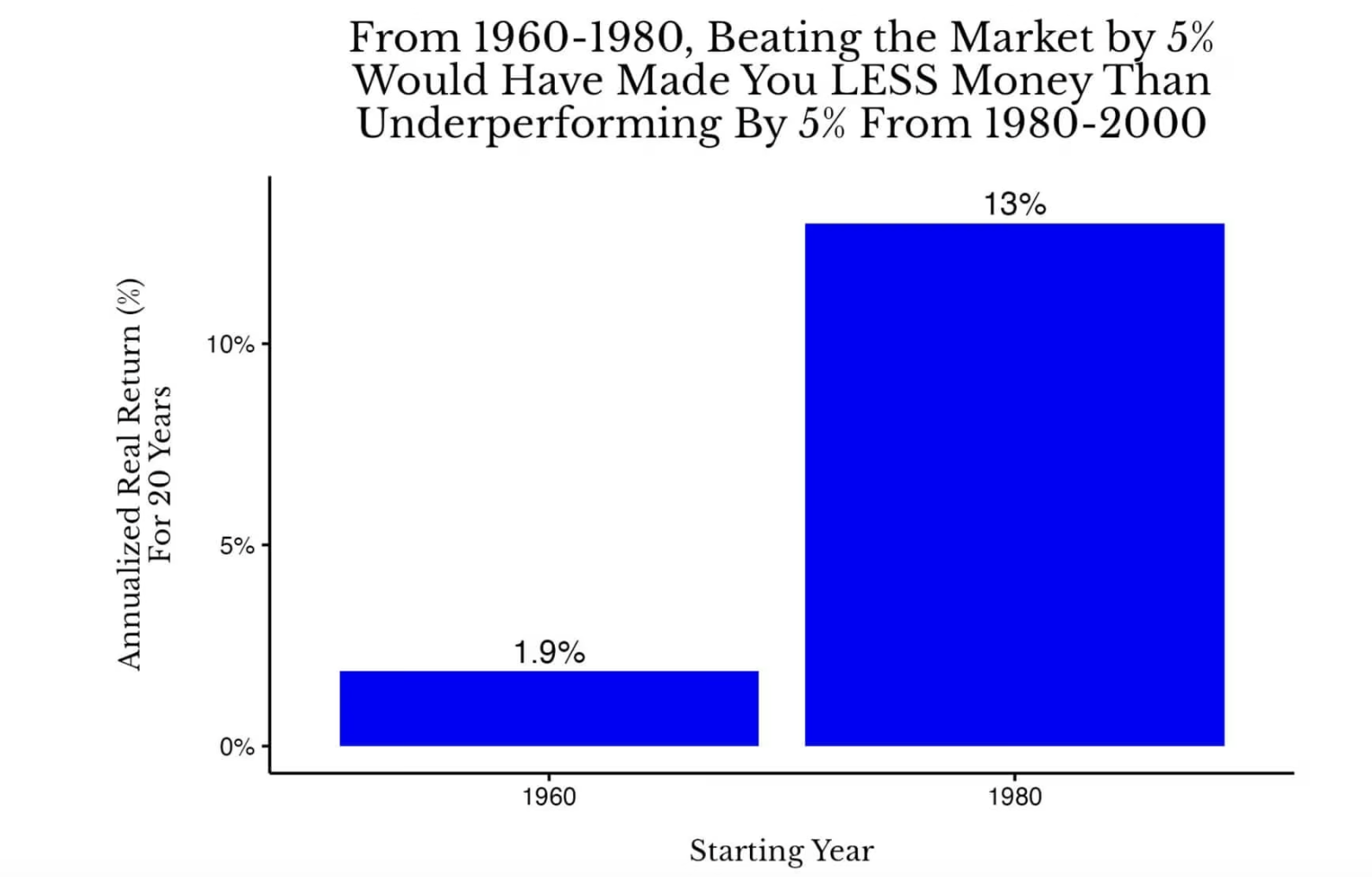
Comparison of 20-year annualized real total returns of U.S. stocks from 1960-1980 vs. 1980-2000

In this scenario, Alex's annual return from 1960 to 1980 is 6.9% (1.9% + 5%), while Pat's annual return from 1980 to 2000 is 8% (13% – 5%). Although Pat is a less skilled investor than Alex, in terms of inflation-adjusted total returns, Pat performs better.

But what if Alex's competitor is a true investor? Now assume Alex's competitor is Pat, the person who lags the market by 5% each year. But in reality, Alex's true competitor should be an index investor who earns returns equal to the market each year.

In this scenario, even if Alex outperforms the market by 10% annually from 1960-1980, he would still lag behind an index investor from 1980-2000.

Although this is an extreme example (an outlier), you might be surprised how frequently having alpha leads to underperformance relative to historical periods. As shown in the chart below:
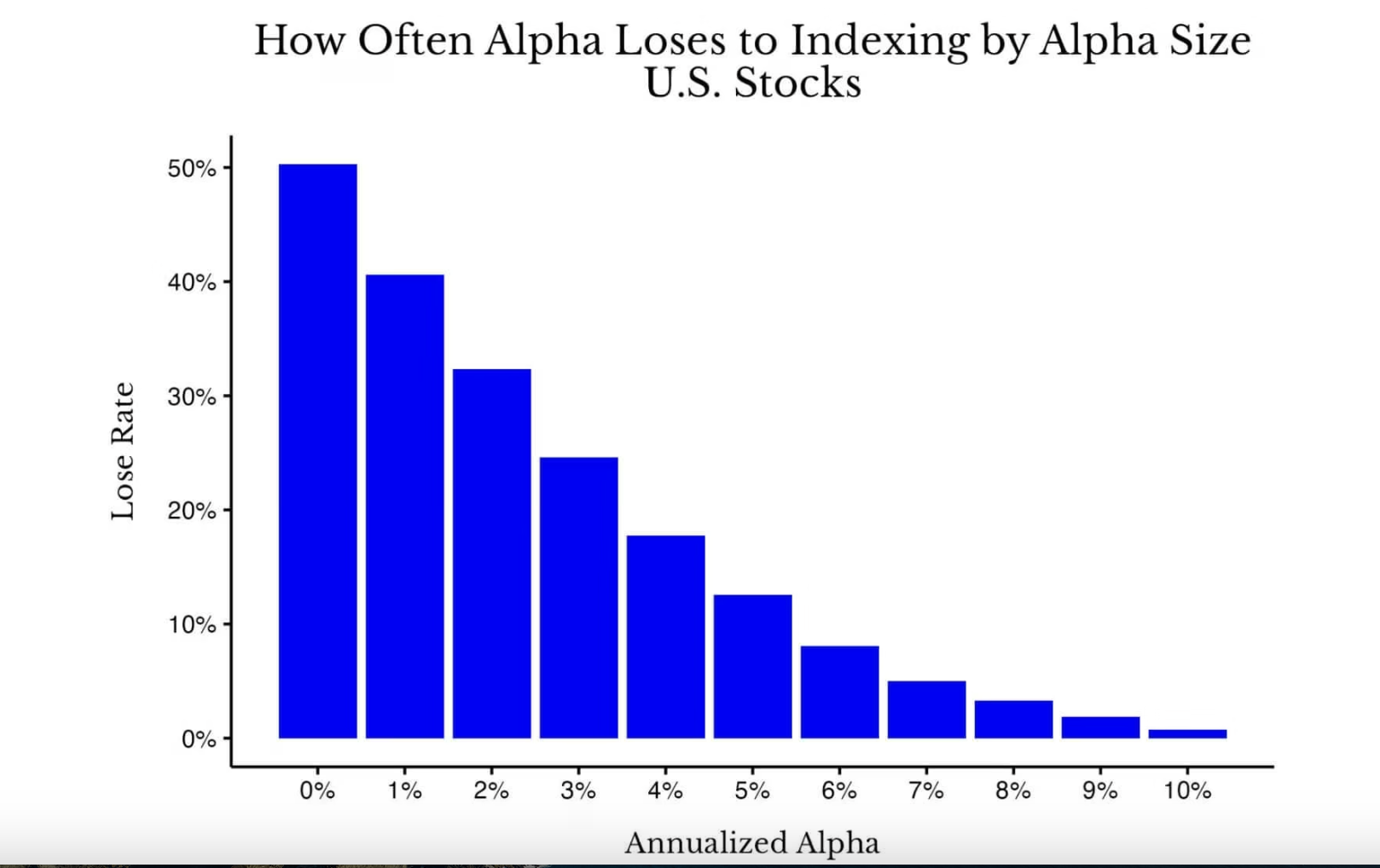
Probability of underperforming the index vs. alpha size across all 20-year periods in the U.S. stock market from 1871 to 2005

As you can see, when you have no alpha (0%), the probability of outperforming the market is essentially a coin flip (about 50%). However, as alpha increases, the compounding effect of returns does reduce the frequency of underperforming the index, but not as much as one might think. For example, even with an annual alpha of 3% over a 20-year period, there is still a 25% probability of underperforming an index fund during other periods in U.S. market history.

Of course, some might argue that relative performance is what matters, but I don't share that view. Ask yourself: would you rather have average market returns during normal times, or just "lose less money" (i.e., achieve positive alpha) during a great depression? I would certainly choose the index returns.

After all, most of the time, index returns deliver fairly good results. As shown below, the annualized real returns of U.S. stocks fluctuated by decade but were mostly positive (Note: Data for the 2020s only shows returns up to 2025):
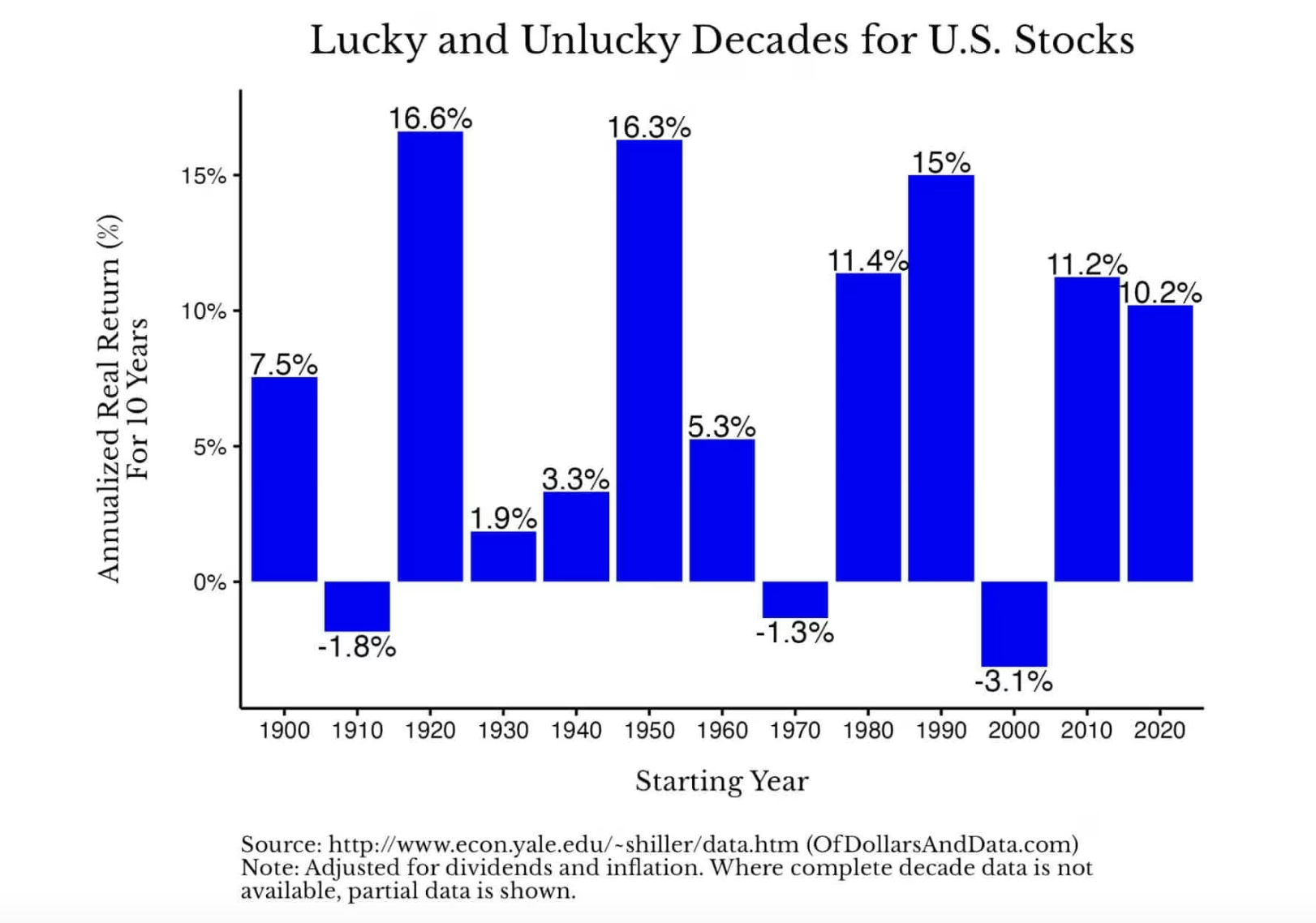
All of this shows that while investment skill is important, market performance is often more critical. In other words, pray for Beta, not Alpha.

Technically, β (Beta) measures the volatility of an asset's returns relative to the market. If a stock has a Beta of 2, it is expected to rise 2% when the market rises 1% (and vice versa). But for simplicity, market return is often referred to as Beta (i.e., a beta coefficient of 1).

The good news is that if the market doesn't provide enough "Beta" in one period, it may make up for it in the next cycle. You can see this in the chart below, which shows the 20-year rolling annualized real returns of U.S. stocks from 1871 to 2025:
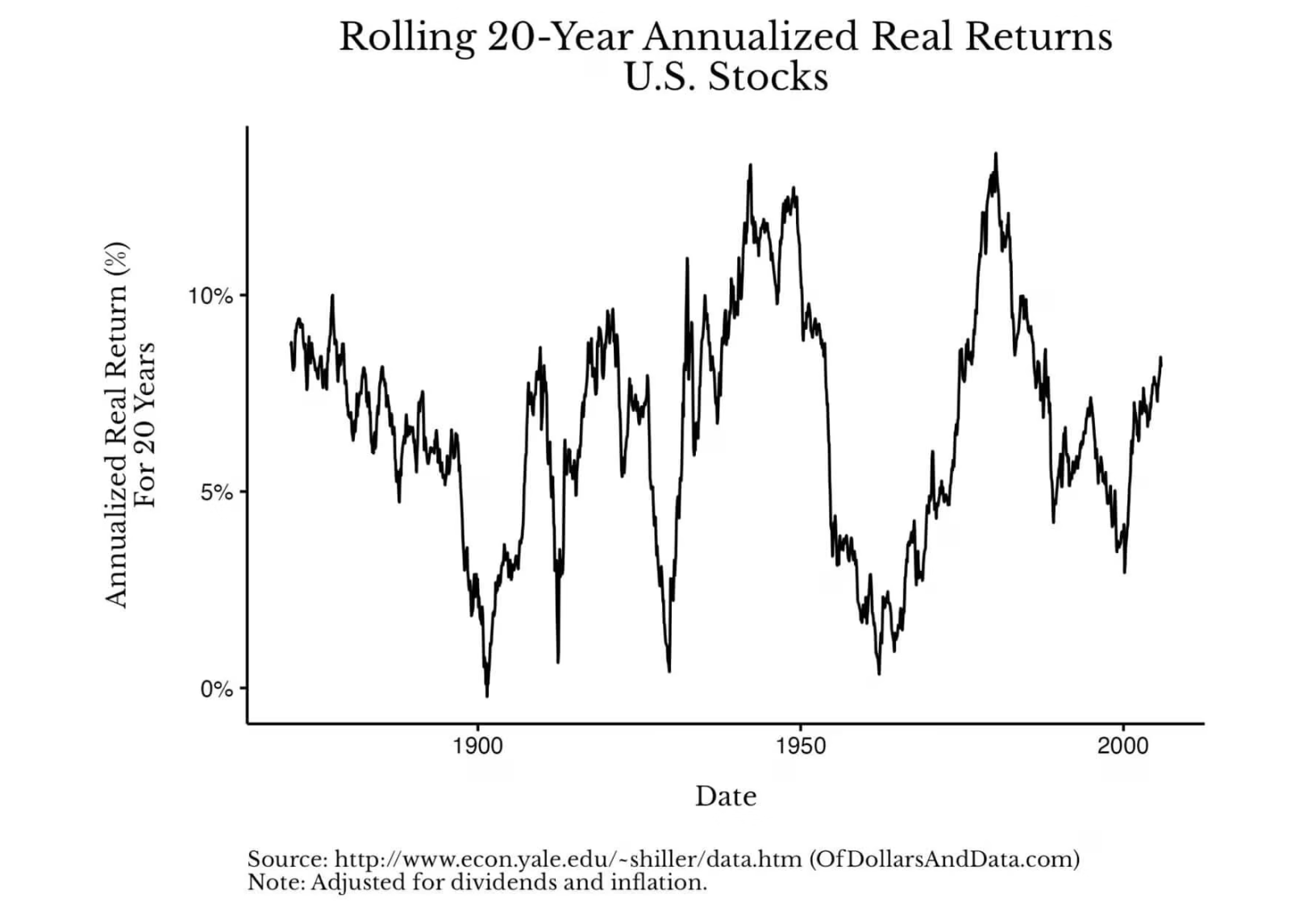
This chart visually shows how returns can rebound strongly after downturns. Taking U.S. stock history as an example, if you invested in U.S. stocks in 1900, your annualized real return over the next 20 years would be close to 0%. But if you invested in 1910, your annualized real return over the next 20 years would be about 7%. Similarly, if invested at the end of 1929, the annualized return was about 1%; whereas if invested in the summer of 1932, the annualized return was as high as 10%.

This huge difference in returns again confirms the importance of overall market performance (Beta) relative to investment skill (Alpha). You might ask, "I can't control where the market goes, so why does this matter?"

It matters because it is a relief. It frees you from the pressure of "having to beat the market" and allows you to focus on what you can truly control. Instead of feeling anxious that the market is beyond your command, see it as one less thing to worry about. See it as a variable you don't need to optimize because you simply cannot optimize it.

So what should you optimize instead? Optimize your career, savings rate, health, family, and so on. Over the long span of life, the value created in these areas is far more meaningful than苦苦追求 a few percentage points of excess returns in your investment portfolio.

Do the simple math: a 5% raise or a strategic career transition can increase your lifetime income by six figures or more. Similarly, maintaining good health is efficient risk management, significantly hedging against future medical expenses. And spending time with family sets a positive example for their future. The benefits of these decisions far exceed the gains most investors can expect from trying to outperform the market.

In 2026, focus your energy on the right things. Chase Beta, not Alpha.


Twitter:https://twitter.com/BitpushNewsCN

Bitpush TG Discussion Group:https://t.me/BitPushCommunity

Bitpush TG Subscription: https://t.me/bitpush

Original link:https://www.bitpush.news/articles/7600652

Domande pertinenti

QWhat is the main argument presented in the article regarding investment returns?

AThe article argues that market performance (Beta) is more important than investment skill (Alpha) for long-term returns. Even skilled investors with positive Alpha can underperform if they invest during a poor market period, while less skilled investors can outperform if they invest during a strong market period.

QAccording to the historical data, what is the probability of underperforming the index even with a 3% annual Alpha over 20 years?

AEven with a 3% annual Alpha over 20 years, there is still a 25% probability of underperforming the index fund, based on U.S. market data from 1871 to 2005.

QWhy does the author suggest that investors should focus on Beta rather than Alpha?

AThe author suggests focusing on Beta because market returns are largely uncontrollable, and investors should instead optimize factors they can control, such as their career, savings rate, health, and family, which can provide greater long-term value than seeking marginal investment outperformance.

QHow does the article illustrate the impact of market timing using the examples of Alex and Pat?

AAlex, who outperforms the market by 5% annually from 1960-1980, achieves a 6.9% real annual return. Pat, who underperforms the market by 5% annually from 1980-2000, achieves an 8% real annual return. This shows Pat's superior results due to better market timing, despite poorer investment skill.

QWhat does the 20-year rolling annualized real returns chart of U.S. stocks from 1871 to 2025 demonstrate?

AThe chart demonstrates that market returns tend to rebound strongly after periods of low returns, highlighting the importance of market cycles (Beta) over individual investment skill (Alpha). For example, returns were near 0% from 1900-1920 but rose to 7% from 1910-1930.

Letture associate

Raising Interest Rates Is Not a Tech Killer, EPS Is: A Strategy for Discarding the Weak and Retaining the Strong After the AI Theme's Sharp Decline

**Summary: Rising Interest Rates Are Not the Killer of Tech; EPS Is: The "Keep the Strong, Ditch the Weak" Strategy After the AI Theme Plunge** The author argues that the sharp sell-off in tech and AI-related stocks, triggered by a strong US jobs report that heightened Fed rate hike fears, represents a "pullback to pick up passengers" rather than a "car crash." The true end of a tech bull market is not determined by an extra 25 basis point hike, but by industry overcapacity and the disproval of earnings per share (EPS) expectations. Historical analysis shows that during past rate hike cycles, the Nasdaq-100 often outperformed, provided EPS growth remained strong. The current phase is seen as a shift from a "broad narrative-driven rally" to a "focused verification stage" for AI. The investment strategy should be to "keep the strong, ditch the weak." * **Retain exposure** to high-conviction AI infrastructure leaders with clear order visibility, stable margins, strong cash flow, and upward EPS revisions (e.g., AI servers, advanced packaging, optical modules, key cloud suppliers). * **Reduce exposure** to high-beta, narrative-driven stocks with unclear profit paths (e.g., some quantum computing, space, or speculative chip stocks), especially on rebounds. Valuation concerns should focus on whether earnings can catch up to high multiples, not on high P/E alone. Crowded positioning signals a concentration into quality assets, not necessarily a market top. The upcoming Q2 earnings season will be a key validation point. The core principle is to hold stocks with proven EPS, while using macro events (CPI data, central bank meetings) to manage timing and risk.

marsbit36 min fa

Raising Interest Rates Is Not a Tech Killer, EPS Is: A Strategy for Discarding the Weak and Retaining the Strong After the AI Theme's Sharp Decline

marsbit36 min fa

The Largest IPO in History Ignites Heated Debate: Is SpaceX Worth $1.77 Trillion?

SpaceX's potential IPO is priced at $135 per share, aiming to raise $75 billion and valuing the company at approximately $1.77 trillion, which would make it the largest IPO in history. This valuation has sparked intense debate among investors. Bullish analysts, including major underwriters Goldman Sachs and Morgan Stanley, argue the valuation is justified by SpaceX's long-term potential. They see it not just as a rocket company but as a future leader in space infrastructure, with key growth drivers being Starlink satellite internet, low-cost rocket launches, and future AI-related ventures. They project revenues reaching hundreds of billions to trillions of dollars by 2030-2040. ARK Invest's model suggests a 2030 enterprise value could reach $2.5 trillion. Bearish analysts from independent research firms like Morningstar, PitchBook, and New Constructs contend the IPO price is excessively high, already pricing in unrealistic future growth. Using DCF and sum-of-the-parts models, they estimate fair value between $780 billion and $1.7 trillion, significantly below the IPO target. They highlight risks such as the speculative nature of AI projections, over-dependence on Elon Musk, high growth expectations, and corporate governance concerns. Trefis set a target price of just $79 per share. While both sides acknowledge SpaceX's unique position in commercial space, the core disagreement centers on whether the $135 share price offers a reasonable margin of safety or is overly optimistic. Despite the valuation controversy, reported strong demand for the IPO indicates significant market interest.

marsbit2 h fa

The Largest IPO in History Ignites Heated Debate: Is SpaceX Worth $1.77 Trillion?

marsbit2 h fa

After the Passage of the GENIUS Act and the CLARITY Act, What Is the Correct Architecture for On-Chain Yield?

The article discusses the evolution of on-chain credit, distinguishing three markets: overcollateralized crypto lending, unsecured lending (largely unsuccessful), and asset-backed credit (ABC). ABC, backed by identifiable real-world collateral with legal recourse, is identified as the fastest-growing category and the only one credibly addressing adverse selection—the core problem in credit where the riskiest borrowers self-select. Current growth in on-chain Real World Assets (RWAs), particularly tokenized private credit funds (e.g., Maple Finance, Centrifuge), is substantial but often merely "wraps" existing fund structures, inheriting their risks rather than solving adverse selection at the protocol level. The regulatory landscape is a key driver, with the US GENIUS Act (prohibiting stablecoin issuers from paying yield) and the proposed CLARITY Act (closing loopholes on indirect yield) set to redefine permissible yield-bearing products. This makes vaults (like ERC-4626) the critical architecture—they become the primary compliant vehicle for delivering yield, functioning as issuance, disclosure, distribution, and recovery mechanisms. The author's thesis is that the correct post-GENIUS/CLARITY architecture involves building ABC solutions where credit assessment, structure, and recovery are encoded directly into the smart contract vault layer, moving beyond mere tokenized fund wrappers to solve adverse selection fundamentally and ensure regulatory compliance.

Foresight News3 h fa

After the Passage of the GENIUS Act and the CLARITY Act, What Is the Correct Architecture for On-Chain Yield?

Foresight News3 h fa

Trading

Spot
Futures
活动图片