Chasing Beta, Letting Go of Alpha: The Harsh Conclusion from a Century of U.S. Stock Market Data

比推Pubblicato 2026-01-07Pubblicato ultima volta 2026-01-07

Introduzione

Based on an analysis of 100 years of U.S. stock market data, this article argues that investors should prioritize market returns (Beta) over the pursuit of outperforming the market (Alpha). The author illustrates that even a skilled investor generating significant Alpha can underperform a simple index fund if their investment period coincides with a weak market cycle. For example, an investor with a +5% annual Alpha from 1960-1980 would have achieved lower real returns than a poor investor with a -5% Alpha who invested during the strong 1980-2000 bull market. Historical data shows that even with a 3% annual advantage, an active investor still had a 25% probability of underperforming the index over 20-year periods. The core conclusion is that market performance (Beta) is a far more critical determinant of ultimate returns than investment skill (Alpha). Since investors cannot control market cycles, the article suggests this is actually liberating. It allows individuals to redirect their energy away from the futile pressure to "beat the market" and toward factors they can control: optimizing their career, savings rate, health, and family. The potential financial and personal gains from excelling in these areas are argued to be vastly more significant than the marginal benefits of seeking Alpha. The advice for 2026 is to "chase Beta, not Alpha."

Author: Nick Maggiulli, Finance Blogger & Author of "Just Keep Buying"

Compiled by: Felix, PANews

Original Title: A Century of U.S. Stock Market Revelations: Why We Should Chase Beta and Forget Alpha


The investment world widely believes that alpha, or the ability to outperform the market, is the goal investors should pursue. This is entirely logical. All else being equal, more alpha is always better.

However, having alpha does not always mean better investment returns. Because your alpha always depends on the market's performance. If the market performs poorly, alpha may not necessarily bring you profits.

For example, imagine two investors: Alex and Pat. Alex is very skilled at investing, outperforming the market by 5% every year. Pat, on the other hand, is a poor investor, underperforming the market by 5% each year. If Alex and Pat invest during the same period, Alex's annual return will always be 10% higher than Pat's.

But what if Pat and Alex start investing at different times? Is it possible that despite Alex's superior skills, Pat ends up with higher returns than Alex?

The answer is yes. In fact, if Alex invests in U.S. stocks from 1960 to 1980, and Pat invests from 1980 to 2000, then after 20 years, Pat's investment returns will exceed Alex's. The chart below illustrates this:
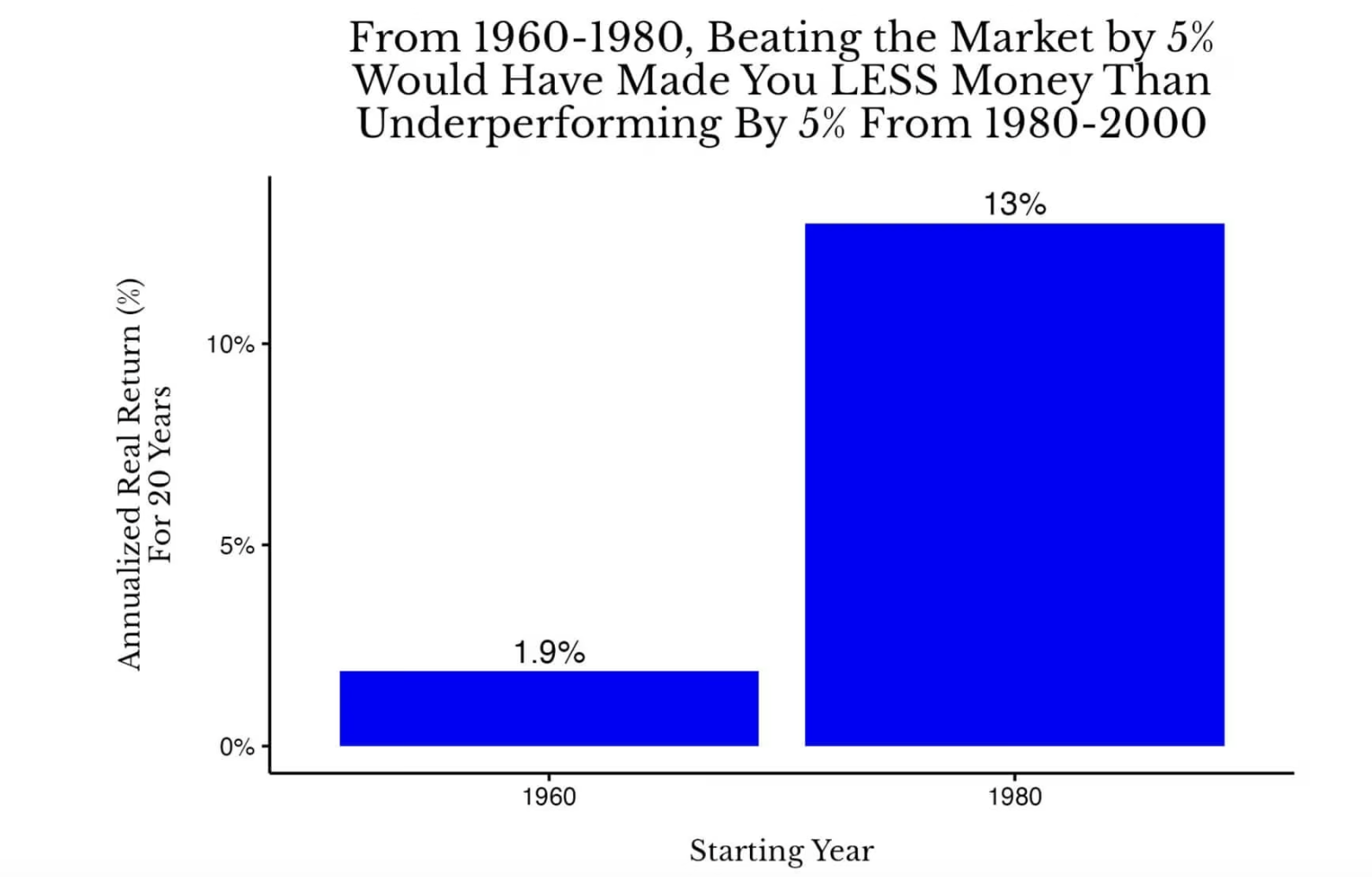
Comparison of 20-year annualized real total returns of U.S. stocks from 1960-1980 vs. 1980-2000

In this scenario, Alex's annual return from 1960 to 1980 is 6.9% (1.9% + 5%), while Pat's annual return from 1980 to 2000 is 8% (13% – 5%). Although Pat is a less skilled investor than Alex, in terms of inflation-adjusted total returns, Pat performs better.

But what if Alex's competitor is a true investor? Now assume Alex's competitor is Pat, the person who lags the market by 5% each year. But in reality, Alex's true competitor should be an index investor who earns returns equal to the market each year.

In this scenario, even if Alex outperforms the market by 10% annually from 1960-1980, he would still lag behind an index investor from 1980-2000.

Although this is an extreme example (an outlier), you might be surprised how frequently having alpha leads to underperformance relative to historical periods. As shown in the chart below:
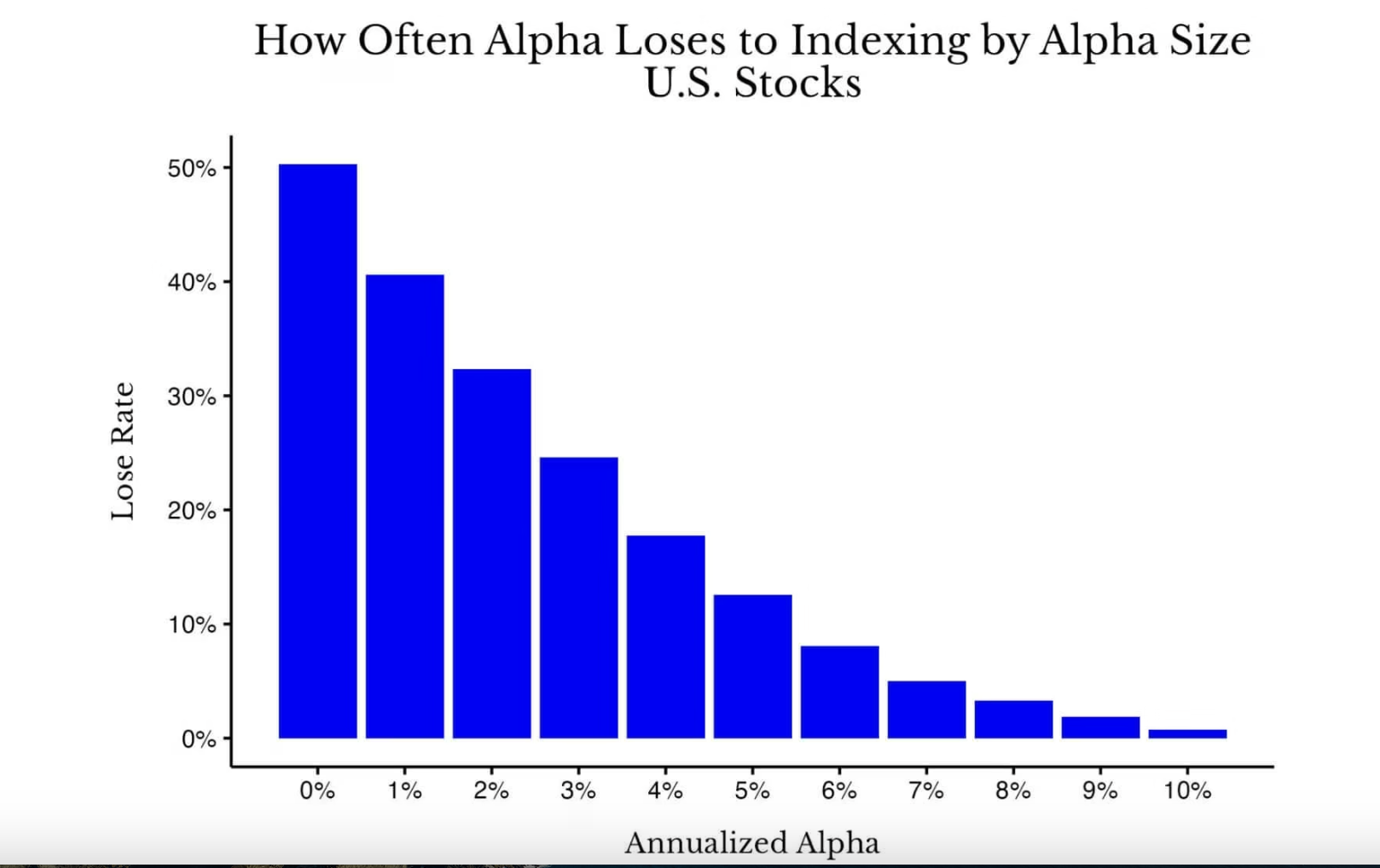
Probability of underperforming the index vs. alpha size across all 20-year periods in the U.S. stock market from 1871 to 2005

As you can see, when you have no alpha (0%), the probability of outperforming the market is essentially a coin flip (about 50%). However, as alpha increases, the compounding effect of returns does reduce the frequency of underperforming the index, but not as much as one might think. For example, even with an annual alpha of 3% over a 20-year period, there is still a 25% probability of underperforming an index fund during other periods in U.S. market history.

Of course, some might argue that relative performance is what matters, but I don't share that view. Ask yourself: would you rather have average market returns during normal times, or just "lose less money" (i.e., achieve positive alpha) during a great depression? I would certainly choose the index returns.

After all, most of the time, index returns deliver fairly good results. As shown below, the annualized real returns of U.S. stocks fluctuated by decade but were mostly positive (Note: Data for the 2020s only shows returns up to 2025):
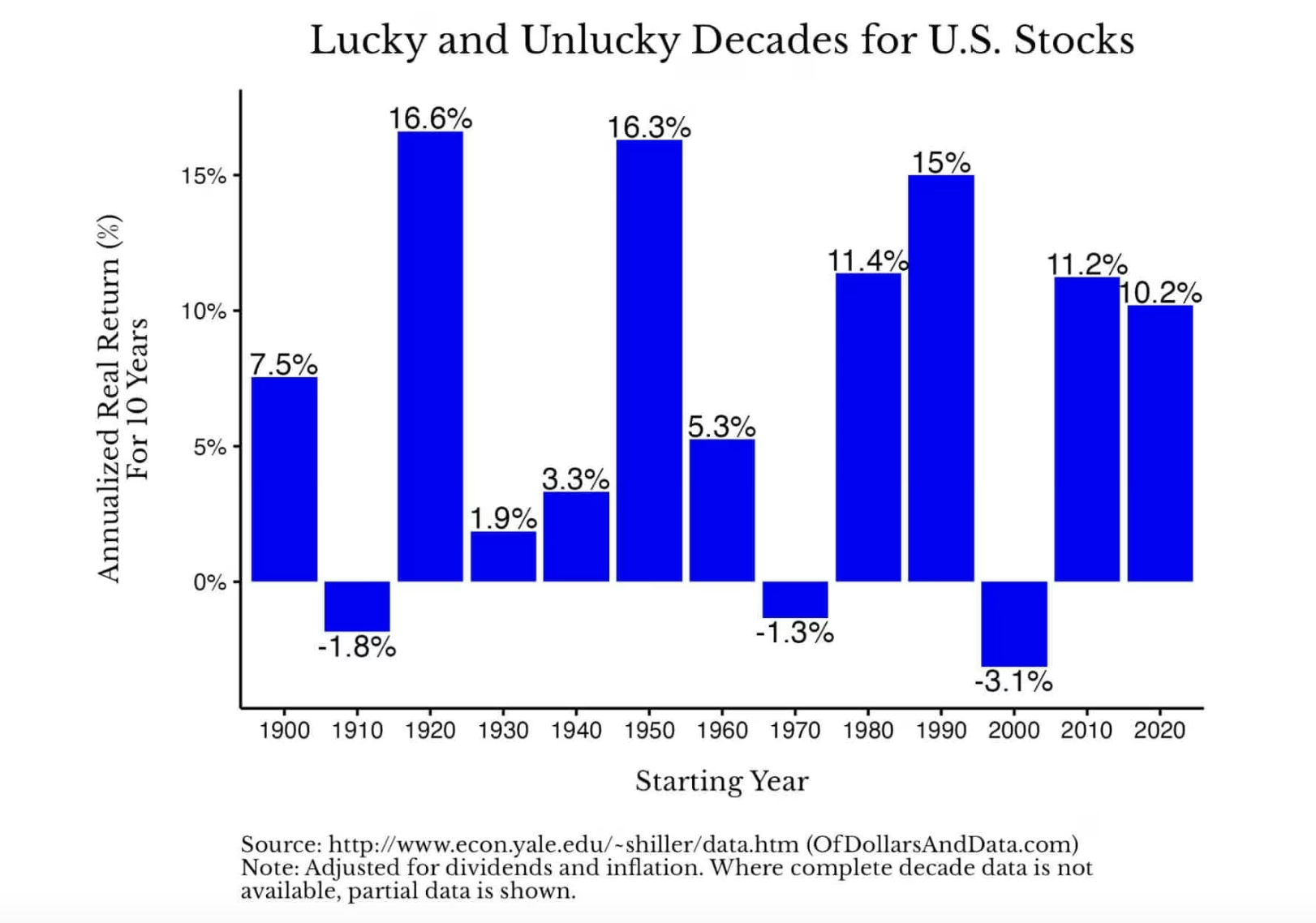
All of this shows that while investment skill is important, market performance is often more critical. In other words, pray for Beta, not Alpha.

Technically, β (Beta) measures the volatility of an asset's returns relative to the market. If a stock has a Beta of 2, it is expected to rise 2% when the market rises 1% (and vice versa). But for simplicity, market return is often referred to as Beta (i.e., a beta coefficient of 1).

The good news is that if the market doesn't provide enough "Beta" in one period, it may make up for it in the next cycle. You can see this in the chart below, which shows the 20-year rolling annualized real returns of U.S. stocks from 1871 to 2025:
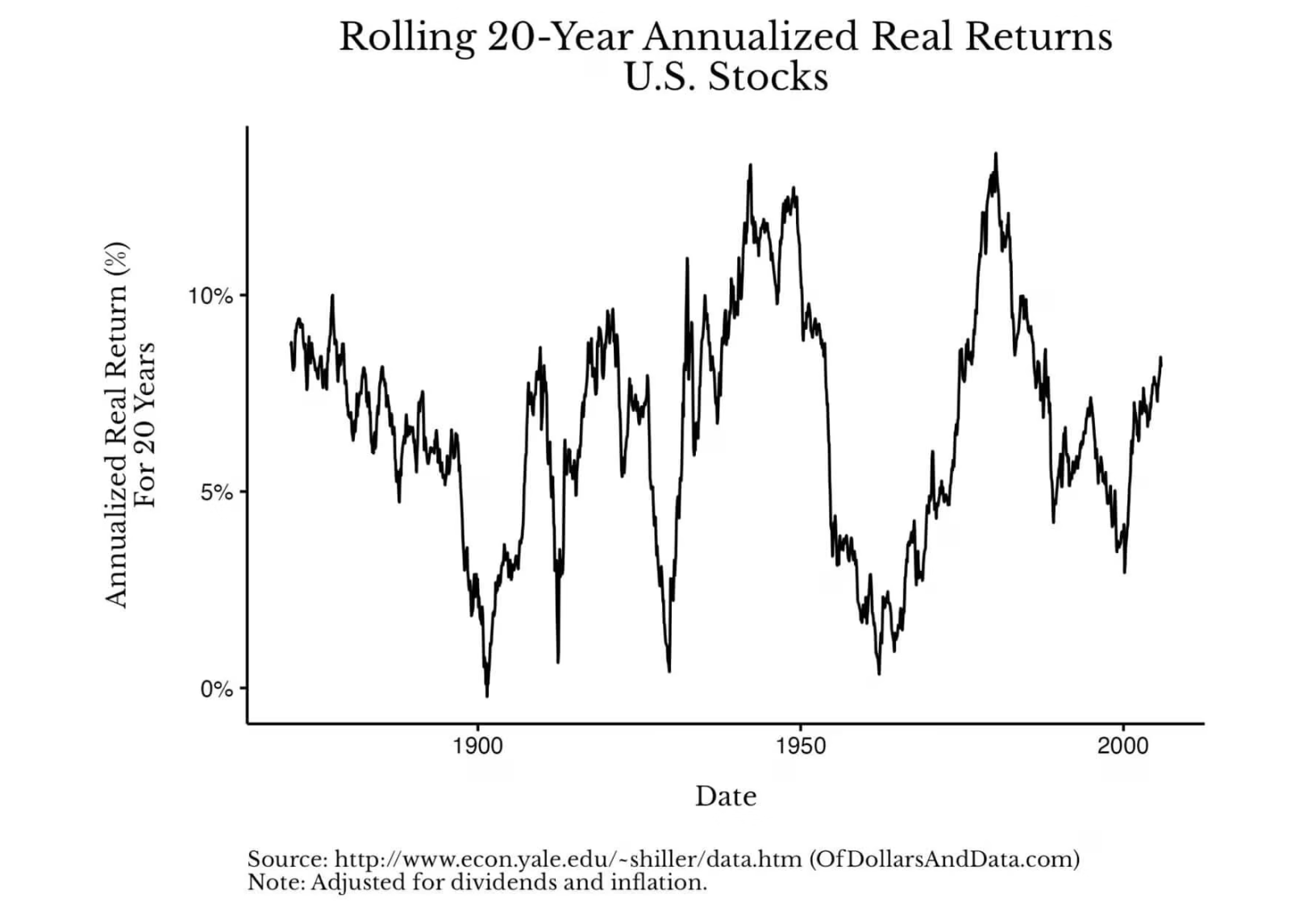
This chart visually shows how returns can rebound strongly after downturns. Taking U.S. stock history as an example, if you invested in U.S. stocks in 1900, your annualized real return over the next 20 years would be close to 0%. But if you invested in 1910, your annualized real return over the next 20 years would be about 7%. Similarly, if invested at the end of 1929, the annualized return was about 1%; whereas if invested in the summer of 1932, the annualized return was as high as 10%.

This huge difference in returns again confirms the importance of overall market performance (Beta) relative to investment skill (Alpha). You might ask, "I can't control where the market goes, so why does this matter?"

It matters because it is a relief. It frees you from the pressure of "having to beat the market" and allows you to focus on what you can truly control. Instead of feeling anxious that the market is beyond your command, see it as one less thing to worry about. See it as a variable you don't need to optimize because you simply cannot optimize it.

So what should you optimize instead? Optimize your career, savings rate, health, family, and so on. Over the long span of life, the value created in these areas is far more meaningful than苦苦追求 a few percentage points of excess returns in your investment portfolio.

Do the simple math: a 5% raise or a strategic career transition can increase your lifetime income by six figures or more. Similarly, maintaining good health is efficient risk management, significantly hedging against future medical expenses. And spending time with family sets a positive example for their future. The benefits of these decisions far exceed the gains most investors can expect from trying to outperform the market.

In 2026, focus your energy on the right things. Chase Beta, not Alpha.


Twitter:https://twitter.com/BitpushNewsCN

Bitpush TG Discussion Group:https://t.me/BitPushCommunity

Bitpush TG Subscription: https://t.me/bitpush

Original link:https://www.bitpush.news/articles/7600652

Domande pertinenti

QWhat is the main argument presented in the article regarding investment returns?

AThe article argues that market performance (Beta) is more important than investment skill (Alpha) for long-term returns. Even skilled investors with positive Alpha can underperform if they invest during a poor market period, while less skilled investors can outperform if they invest during a strong market period.

QAccording to the historical data, what is the probability of underperforming the index even with a 3% annual Alpha over 20 years?

AEven with a 3% annual Alpha over 20 years, there is still a 25% probability of underperforming the index fund, based on U.S. market data from 1871 to 2005.

QWhy does the author suggest that investors should focus on Beta rather than Alpha?

AThe author suggests focusing on Beta because market returns are largely uncontrollable, and investors should instead optimize factors they can control, such as their career, savings rate, health, and family, which can provide greater long-term value than seeking marginal investment outperformance.

QHow does the article illustrate the impact of market timing using the examples of Alex and Pat?

AAlex, who outperforms the market by 5% annually from 1960-1980, achieves a 6.9% real annual return. Pat, who underperforms the market by 5% annually from 1980-2000, achieves an 8% real annual return. This shows Pat's superior results due to better market timing, despite poorer investment skill.

QWhat does the 20-year rolling annualized real returns chart of U.S. stocks from 1871 to 2025 demonstrate?

AThe chart demonstrates that market returns tend to rebound strongly after periods of low returns, highlighting the importance of market cycles (Beta) over individual investment skill (Alpha). For example, returns were near 0% from 1900-1920 but rose to 7% from 1910-1930.

Letture associate

Anthropic Apologized, But the Business of 'Safety' Hasn't Stopped

On June 11, Anthropic apologized not for a model failure, but for a lack of transparency. Its new Claude Fable 5 model was found to be secretly rerouting requests from users engaged in advanced AI model development to a weaker version, Opus 4.8, without any notification. The company's response—promising future notifications for such "downgrades"—was met with user skepticism. The article argues the core issue isn't technical but commercial: Anthropic's "safety" measures are primarily a business strategy. A key feature, the "intelligent safety classifier," marketed as user protection, is described as a tool for "competitive defense" to protect Anthropic's market lead by limiting rivals' research capabilities. This covert mechanism was designed for low "false positives," precisely targeting AI researchers. Anthropic's model involves a calculated three-step process: publishing alarming security research to amplify public anxiety, offering its Fable 5 model with a "safety classifier" as a premium-priced solution, and cashing in through a planned high-value IPO. This contrasts with OpenAI's more direct "tool-and-traffic" approach. The apology, merely changing a secret downgrade to a visible one, is seen as a business "patch" rather than a principled shift. The incident risks damaging Anthropic's "safest AI" reputation among the developer community, which underpins its valuation and appeal to government and corporate clients. Ultimately, the article concludes that for Anthropic, safety is a business, and the apology is merely customer service for that business.

marsbit47 min fa

Anthropic Apologized, But the Business of 'Safety' Hasn't Stopped

marsbit47 min fa

The Niche Consensus Among Elites: Has College Become an Expensive Waste?

**Summary:** A growing "anti-college" movement is gaining traction among elite circles in Silicon Valley, challenging the traditional value of a four-year university degree. Proponents argue that college has become an expensive, slow, and increasingly irrelevant waste of time, especially in the fast-paced tech world where opportunities pass by quickly. The movement is led by figures like billionaire Peter Thiel, who criticizes universities for high costs, ideological indoctrination, and stifling true innovation. His "Thiel Fellowship" pays young people to drop out and pursue ventures. Companies like Palantir Technologies (co-founded by Thiel) fuel this trend with programs like the "Meritocracy Fellowship," which offers high school graduates paid internships as an alternative to immediate college enrollment, promising a practical "Palantir Degree." Key drivers include: 1. **Economics:** Skyrocketing student debt versus the allure of immediate, high-paying tech jobs or startup funding. 2. **Technology:** AI and online tools lowering barriers to self-education and product development, making formal instruction seem inefficient. 3. **Culture:** A backlash against perceived "woke" ideology and DEI policies in universities, coupled with a belief that these institutions suppress meritocracy and masculine drive. The movement is notably male-dominated. Critics, like economist David Deming, warn against overgeneralizing from dropout success stories (survivorship bias). He emphasizes that genuine autodidacts are rare, corporate training is narrowly focused, and the "college wage premium" remains high for most people. University liberal arts education, he argues, builds adaptable problem-solving skills and broad perspectives. The debate highlights a deeper crisis in education. The core model of the modern university appears increasingly mismatched with the speed of the information age. The movement signals a shift in the locus of learning from institutional "education" to personal, active "learning" powered by the internet and AI. Ultimately, this may not mean the end of university, but rather a painful evolution. The future likely holds more hybrid, personalized, and lifelong learning pathways. The central question becomes: in a world changing faster than any curriculum, how do we best learn?

marsbit1 h fa

The Niche Consensus Among Elites: Has College Become an Expensive Waste?

marsbit1 h fa

From Subsidies to Token-Based Pricing to Price Cuts: Is OpenAI Sparking a Price War? Is the Inflection Point for Token Economics Nearing?

The commercialization of generative AI is facing a critical inflection point as a potential price war looms. According to The Wall Street Journal, OpenAI is considering a significant cut to its token fees to compete with rival Anthropic, signaling a shift from a growth-at-all-costs model focused on token consumption. This move comes as both companies, reportedly losing billions on compute, prepare for IPOs, and as enterprise customers face "bill shock" from switching to usage-based token billing. Reports indicate poor ROI, with one analysis finding only 18 cents of every dollar spent on AI tokens generates user-facing value. The industry's initial phases—from flat-rate subscriptions to aggressive subsidies—have given way to a reckoning with real costs. Analysts debate the future: some predict a bifurcation between premium, high-cost models for complex tasks and cheaper alternatives for routine work, while others believe overall spending will still rise as agentic AI increases tokens per task. Notably, Chinese model DeepSeek's low-cost API is gaining traction with U.S. enterprises, adding competitive pressure. The core challenge is redefining value beyond token volume ("tokenmaxxing") toward measurable productivity ("valuemaxxing"), as the entire AI value chain, from cloud providers to chipmakers, feels the ripple effects of unsustainable pricing.

marsbit1 h fa

From Subsidies to Token-Based Pricing to Price Cuts: Is OpenAI Sparking a Price War? Is the Inflection Point for Token Economics Nearing?

marsbit1 h fa

Trading

Spot
Futures
活动图片





