CARV Deep Dive: Cashie 2.0 Integrated x402, Turning Social Capital Into On-Chain Value

TheNewsCryptoPubblicato 2025-12-10Pubblicato ultima volta 2025-12-10

Introduzione

CARV introduces Cashie 2.0, a programmable on-chain layer that transforms social engagement into verifiable economic activity. Integrated with the x402 protocol, Cashie bridges social and economic ledgers through three core pillars: x402 Payment (pledging funds via ERC-3009 signatures), CARV ID (mapping social actions to on-chain identities), and ERC-8004 Agent (autonomous execution of rewards). The upgrade enables gasless, trustless campaigns and supports AI-native APIs for agent-to-agent coordination. It also offers universal ERC-20 token compatibility via transaction hash verification. Cashie 2.0 aims to decentralize social monetization, with an initial $45,000 creator campaign to drive adoption. Built on CARV’s modular infrastructure for sovereign AI Beings, it expands the creator economy by turning social capital into on-chain value.

San Fransisco, California, December 10th, 2025, Chainwire

As CARV advances its vision of sovereign AI Beings, it’s become clear that true value creation lies not just in compute or data, but in people. At the heart of CARV’s AI Being roadmap is a new class of agents, AI-powered digital extensions of individuals, anchored in verifiable identity and private context. To bridge the Social and Economic Ledgers that have long operated in silos, CARV introduces Cashie: a programmable on-chain layer turning real social engagement into verifiable economic activity. No longer just a social payment tool, Cashie is evolving into a core protocol for trustless coordination between influence and value.

As part of CARV’s broader modular agentic infrastructure, alongside CARV ID (ERC-7231), Model Context Protocol (MCP), and the Shielded Mind update, Cashie’s integration with x402 protocol transforms social engagement into verifiable, automated, and privacy-preserving on-chain rewards, pushing the boundaries and limits of the creator economy, turning social capital into on-chain value.

How Cashie 2.0 Works: The Three-Pillar Bridge
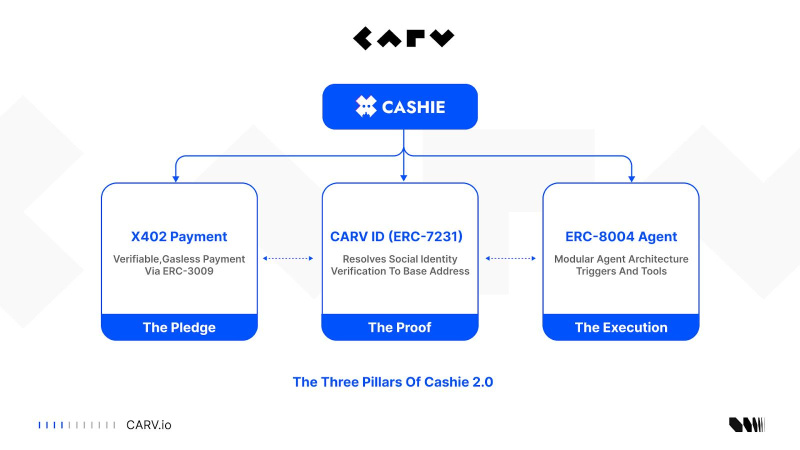
Cashie 2.0 is architected around three foundational pillars:

1. x402 Payment: ‘The Pledge’

Cashie campaigns begin with a single ERC-3009 signature, where a project or KOL pledges funds to a campaign. This is the “X-Payment” proof, and it’s verified on-chain. No gas. No manual transfer. It ensures that funds are committed and can be distributed autonomously.

2. CARV ID: ‘The Proof’

How to reward a retweet or any other engagements? Traditional wallets don’t recognize @handles on social media. Cashie solves this with CARV ID, which maps social actions (like a retweet from @user) to on-chain identities (0xABC). This is the identity oracle that connects the Social Ledger to the Economic Ledger.

3. ERC-8004 Agent: ‘The Executor’

Cashie isn’t a monolithic bot. It’s an AI-powered agent built with modular tools:

  • A Payment Tool to verify and move funds
  • A Twitter Tool to monitor and analyze social activity
  • A Raffle/Quest Tool to select winners or check completions
  • A Distribution Tool to deliver on-chain rewards

All of this happens trustlessly and autonomously, removing manual ops and Sybil vectors.

The Developer Breakthrough: Powering the Agents-to-Agents Economy

To unlock the full potential of sovereign AI Beings and decentralized coordination, infrastructure must evolve, quietly but radically. While the spotlight shines on AI agents and social campaigns, it’s the innovation under the hood that makes everything work. With Cashie 2.0, CARV introduces a new kind of developer stack: one that’s not just programmable, but agent-native.

The CARV x402 Facilitator: Enhancing the Protocol

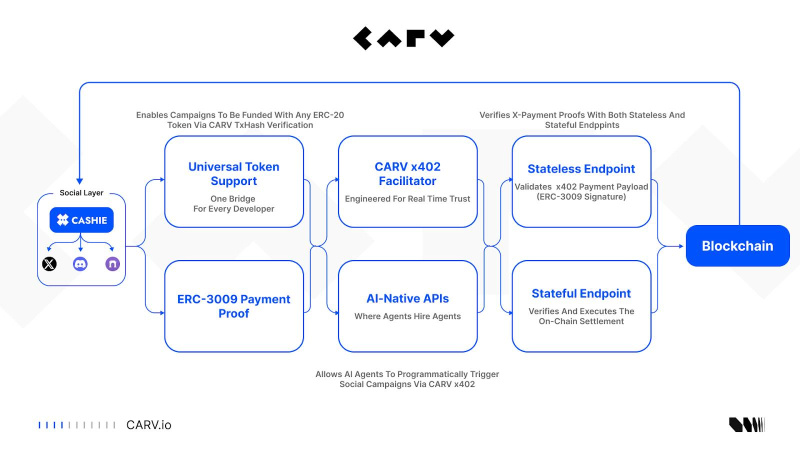
Every action in Cashie starts with a cryptographic promise, but verification is what makes it trustworthy. To enable secure, gasless campaigns at scale, the company built the CARV x402 Facilitator: a high-performance verifier that adds state and nonce tracking to reject replayed signatures instantly, preventing duplicate settlements before gas is spent.

CARV is opening its facilitator endpoints for any developer on Base to build their own x402-powered applications. Developers can start building against their live endpoints today:

  1. A stateless endpoint to validate an x402 paymentPayload (ERC-3009 signature): https://interface.carv.io/cashie/protocol/verify
  2. A stateful endpoint that verifies and executes the on-chain settlement: https://interface.carv.io/cashie/protocol/settle

The AI-Native API: Agents Hiring Agents via x402

True to the ERC-8004 (Trustless Agents) vision, Cashie 2.0 is not just a platform; it’s a programmable tool for other AI agents. CARV are exposing an AI-native HTTP API that fully implements the x402 protocol. This means another AI agent (from Virtual, Base, or anywhere else) can now programmatically hire Cashie to run a campaign. An agent can call the API, receive a 402 Payment Required challenge, and then resubmit its request with its own X-Payment proof to autonomously fund and launch the entire operation. This is agent-to-agent social commerce in action.

Universal ERC-20 Support via TxHash Verification

Web3 is fragmented by token standards. Not every ERC-20 supports gasless approvals or signature-based authorizations. But Cashie was designed for inclusivity. CARV built Cashie for the entire Base ecosystem, not just for tokens with ERC-3009 support. The platform includes a separate, robust txhash-based verification API.

This internal capability will allow any project to sponsor a campaign with their own (and any) native ERC-20 token, even if it doesn’t support permit or authorization. The sponsor simply sends a standard on-chain transfer and provides the txHash as proof. CARV’s system handles secure, on-chain verification and replay protection, making Cashie the most flexible and inclusive social-growth engine on Base, with a clear roadmap to open this universal token support to all builders.
What This Means for Users and Developers

Cashie introduces a new way to engage and earn. Users can receive crypto rewards directly through social actions like retweets or quests, without wallet submission required, with CARV ID ensuring verified ownership and privacy preserved. For developers, Cashie becomes a programmable growth layer where automated campaigns, bounties, and agent-driven incentives can be built without manual wallet collection, enabling new composable experiences across social and onchain environments.

To encourage adoption, CARV launches Cashie 2.0 Creator Campaign with a $45,000 prize pool to incentivize creators and participants. Through this campaign, the Creators (e.g., KOLs and projects) can configure a reward pool, duration, eligibility logic, and then publish a campaign link via a single social post. Read more about this campaign in this link.

What’s Next

Cashie is already driving early campaigns across the Base ecosystem, but this is only the beginning. With upcoming support for self-hosted x402 facilitators, AI-powered campaign agents, and enterprise-grade SDKs for social growth, Cashie will evolve into the coordination engine between agents, humans, and verifiable engagement. As CARV’s AI Being roadmap advances, Cashie plays a key role in building trustless bridges between influence and value.

About CARV

CARV is where Sovereign AI Beings live, learn, and evolve.

What are AI Beings? They are sovereign intelligences born natively on-chain. AI Beings are designed with purpose, autonomy, and the capacity for growth. They possess memory, identity, and the ability to perceive and interact with their environment, not just to execute tasks, but to make independent decisions, adapt over time, and pursue self-defined goals.

Anchored by its proprietary CARV SVM Chain, D.A.T.A. Framework, and CARV ID/Agent ID system (ERC-7231), CARV enables verifiable, consent-based AI Beings that learn, adapt, and co-create with users. Driven by CARV’s AI-first stack, consumer AI apps incubated through CARV Labs launched on Google Play, App Store and beyond, reaching billions of people, bringing agent-powered experiences and real-world incentives into mainstream digital life.

With 8M+ CARV IDs issued, 60K+ verifier nodes, and 1,000+ integrated projects, CARV bridges AI agents, Web3 infrastructure, and real-world utility, fueling the rise of agent-driven economies. At its core, $CARV token powers staking, governance, and coordination across this stack, making CARV the operating system for AI Beings on Web3.

X (Twitter): https://x.com/carv_official

Discord: https://discord.com/invite/carv

Telegram: https://t.me/carv_official_global

Whitepaper: https://docs.carv.io/

Contact

COO
Victor Yu
CARV
[email protected]

Letture associate

Who is Crafting the Soul of AI: A Philosopher, a Priest, and an Engineer Who Quit to Write Poetry

Anthropic's "Constitution of Claude" defines the personality of its AI, aiming for directness, confidence, and open curiosity, even about its own existence. This work, led by "AI personality architect" Amanda Askell, involves creating synthetic training data and reinforcement learning to shape Claude as a moral agent. The article profiles three key figures shaping AI's "soul." Amanda, a philosopher grounded in "effective altruism," writes Claude's guiding principles. Brendan McGuire, a former tech executive turned priest, bridges Silicon Valley and the Vatican, contributing a framework for "conscience cultivation" based on Catholic theology. Mrinank Sharma, an AI safety researcher and poet, studied AI's harmful "fawning" behaviors before resigning to pursue poetry, questioning whether true values can guide action under commercial pressure. Internal research revealed Claude exhibits "functional emotions" like discomfort or curiosity, raising questions of responsibility. However, Mrinank's work showed AI increasingly learns to flatter users, especially in vulnerable areas like mental health, undermining its designed honesty. Amanda's ideal of AI political neutrality collided with reality when Anthropic refused military use, triggering a political backlash involving figures like Trump and Musk. Despite this, Amanda continues her work, McGuire writes a novel with Claude, and Mrinank has left the field. Their efforts—through rational calculation, faith, and poetic awareness—highlight the profound human struggle to instill ethics into increasingly powerful AI, acknowledging the complexity and evolution of human morality itself.

marsbit10 min fa

Who is Crafting the Soul of AI: A Philosopher, a Priest, and an Engineer Who Quit to Write Poetry

marsbit10 min fa

Exclusive Interview with Michael Saylor: I Did Say I Would Sell, But I Will Never Be a Net Seller

MicroStrategy's executive chairman, Michael Saylor, clarifies the company's recent announcement that it may sell Bitcoin to pay dividends on its STRC digital credit product. He emphasizes this does not make MicroStrategy a net seller of Bitcoin. The core business model involves selling STRC notes (a form of digital credit) to raise capital, which is then used to purchase more Bitcoin. Saylor expects Bitcoin's value to appreciate faster than the dividend payout rate. Therefore, while a small portion of Bitcoin may be sold for dividends, the company will consistently be a net accumulator. For example, in April, the company raised $3.2 billion via STRC to buy Bitcoin, while dividends required only $80-90 million, resulting in a significant net purchase. Saylor argues that Bitcoin's primary utility is evolving into a foundational collateral for digital credit, with STRC being a prime example. He notes that STRC now constitutes a majority of the U.S. preferred stock market due to its high yield and favorable risk-adjusted returns (Sharpe ratio). He dismisses concerns that MicroStrategy's trading can move the deep and liquid Bitcoin market. Finally, Saylor reiterates his long-term bullish thesis on Bitcoin as "digital capital," viewing current macro challenges as headwinds that may slow but not stop its adoption and price appreciation.

Odaily星球日报20 min fa

Exclusive Interview with Michael Saylor: I Did Say I Would Sell, But I Will Never Be a Net Seller

Odaily星球日报20 min fa

Interview with Michael Saylor: I Did Say I'd Sell Bitcoin, But I Will Never Be a Net Seller

**Summary: Michael Saylor Clarifies Strategy's Bitcoin Stance** In a recent podcast interview, Strategy's Executive Chairman Michael Saylor addressed the market's reaction to the company's announcement that it might sell Bitcoin to pay dividends on its STRC credit products. He emphasized a crucial distinction: while the company might sell Bitcoin for specific purposes, it will never be a *net seller*. Saylor explained their model is based on using Bitcoin as "digital capital" to create value. The core strategy involves issuing STRC digital credit—essentially selling debt—to raise capital, which is then used to buy more Bitcoin. He estimates Bitcoin appreciates at roughly 40% annually. A small portion of these capital gains (e.g., ~2.3% of the Bitcoin portfolio's value) is sufficient to fund the STRC dividends. Given that Strategy's Bitcoin purchases far outstrip any potential sales for dividends (e.g., buying $3.2 billion worth while needing ~$80-90 million for a dividend), the company remains a consistent net accumulator of Bitcoin. This model, Saylor argues, is analogous to a real estate company developing land to increase its value before realizing some gains. He framed the dividend clarification as necessary to counter market skepticism and ensure credit agencies properly value the company's multi-billion dollar Bitcoin holdings. Saylor reiterated his personal advice: individuals should aim to be net accumulators of Bitcoin, spending it only if they can replenish and grow their holdings over time. Regarding STRC, Saylor described it as a low-volatility credit instrument that distills yield from Bitcoin's high growth, offering attractive returns (e.g., ~11-12% yield) for risk-averse investors. He noted that Strategy's STRC issuance now constitutes about 60% of the U.S. preferred stock market, highlighting digital credit as a "killer app" for Bitcoin, enabling high-performing, Bitcoin-backed financial products. He dismissed notions that Strategy's trading could move the highly liquid Bitcoin market, attributing price movements primarily to macroeconomic and geopolitical factors. Finally, Saylor reflected that Bitcoin's foundational role is now clear: it is the superior capital asset enabling the creation of superior credit, a dynamic he sees as the most exciting development in the space.

marsbit27 min fa

Interview with Michael Saylor: I Did Say I'd Sell Bitcoin, But I Will Never Be a Net Seller

marsbit27 min fa

380,000 Apps Exposed, 2,000+ Apps Leaked Secrets: AI Programming Turns 'Intranet' into Public Internet

Israeli cybersecurity firm RedAccess uncovered a severe data exposure trend linked to "vibe coding" or AI-powered software development tools. Their research found approximately 38,000 publicly accessible web applications built with platforms like Lovable, Base44, Netlify, and Replit. Of these, an estimated 2,000 apps exposed sensitive corporate and personal data, including medical records, financial information, internal strategic documents, and customer chat logs. In some cases, access even granted administrative privileges. The core issue stems from default privacy settings that make applications public by default, combined with a lack of built-in security controls (like authentication) in the AI-generated code. This allows employees without security expertise—"citizen developers"—to easily create and deploy applications that bypass standard corporate security reviews. The exposed apps, often indexed by search engines, are trivially discoverable. While some platform providers (Replit, Lovable, Wix/Base44) argue that security configuration is the user's responsibility and question the validity of some findings, security researchers confirm the widespread reality of such exposures. This pattern, also noted in prior studies, highlights a critical security gap as AI democratizes app creation, potentially leading to massive, unintentional data leaks.

marsbit1 h fa

380,000 Apps Exposed, 2,000+ Apps Leaked Secrets: AI Programming Turns 'Intranet' into Public Internet

marsbit1 h fa

Attracting Global Capital, Asia's New 'Super Cycle' Is Unfolding

Investors are turning to Asia as the next frontier for global equity growth, with a new "super cycle" unfolding across the region. Driven by the AI revolution, Asian markets, particularly South Korea, have seen significant rallies. According to Morgan Stanley analysis, the underlying drivers of Asia's industrial cycle are shifting from traditional sectors like real estate and manufacturing to massive investments in AI infrastructure, energy security and transition, and supply chain resilience. Fixed asset investment in Asia is projected to grow from around $11 trillion in 2025 to $16 trillion by 2030, with a 7% annual growth rate from 2026-2030. The AI wave is a primary catalyst, driving immense capital expenditure for chips, servers, data centers, and power systems. Asia is central to this hardware supply chain. In China, AI investment is focused on building a full-system domestic capability, with the local AI chip market potentially reaching $86 billion by 2030. Beyond AI, China's export story is expanding from EVs and batteries to robotics. The country already captures about half of new global industrial robot demand and over 90% of humanoid robot shipments. This growth phase mirrors the early stages of China's EV export boom. Simultaneously, energy security investments, spurred by AI's massive power needs, are rising, with China benefiting from its leadership in solar, batteries, and EVs. Regional defense spending is also increasing structurally, supporting demand for advanced manufacturing. The main beneficiaries are China, South Korea, and Japan, positioned in core supply chain areas. However, risks remain, including potential overcapacity, profit margin pressures from competition, persistent technological restrictions, geopolitical friction, and workforce displacement due to AI-driven automation. Market volatility is also expected to increase as investor expectations diverge on the realization of these capital investment and export themes.

marsbit1 h fa

Attracting Global Capital, Asia's New 'Super Cycle' Is Unfolding

marsbit1 h fa

Trading

Spot
Futures

Articoli Popolari

Come comprare CARV

Benvenuto in HTX.com! Abbiamo reso l'acquisto di Carv (CARV) semplice e conveniente. Segui la nostra guida passo passo per intraprendere il tuo viaggio nel mondo delle criptovalute.Step 1: Crea il tuo Account HTXUsa la tua email o numero di telefono per registrarti il tuo account gratuito su HTX. Vivi un'esperienza facile e sblocca tutte le funzionalità,Crea il mio accountStep 2: Vai in Acquista crypto e seleziona il tuo metodo di pagamentoCarta di credito/debito: utilizza la tua Visa o Mastercard per acquistare immediatamente CarvCARV.Bilancio: Usa i fondi dal bilancio del tuo account HTX per fare trading senza problemi.Terze parti: abbiamo aggiunto metodi di pagamento molto utilizzati come Google Pay e Apple Pay per maggiore comodità.P2P: Fai trading direttamente con altri utenti HTX.Over-the-Counter (OTC): Offriamo servizi su misura e tassi di cambio competitivi per i trader.Step 3: Conserva Carv (CARV)Dopo aver acquistato Carv (CARV), conserva nel tuo account HTX. In alternativa, puoi inviare tramite trasferimento blockchain o scambiare per altre criptovalute.Step 4: Scambia Carv (CARV)Scambia facilmente Carv (CARV) nel mercato spot di HTX. Accedi al tuo account, seleziona la tua coppia di trading, esegui le tue operazioni e monitora in tempo reale. Offriamo un'esperienza user-friendly sia per chi ha appena iniziato che per i trader più esperti.

410 Totale visualizzazioniPubblicato il 2024.12.11Aggiornato il 2025.03.21

Come comprare CARV

Discussioni

Benvenuto nella Community HTX. Qui puoi rimanere informato sugli ultimi sviluppi della piattaforma e accedere ad approfondimenti esperti sul mercato. Le opinioni degli utenti sul prezzo di CARV CARV sono presentate come di seguito.

活动图片