Cardano Millionaire Wallets Reach Record 25B ADA Holdings

bitcoinistPubblicato 2026-05-15Pubblicato ultima volta 2026-05-15

Introduzione

Cardano's millionaire-tier wallets, holding at least 1 million ADA (approx. $262,400), have accumulated to a new all-time high of 25.09 billion ADA, according to on-chain data from Santiment. This represents about 67.47% of the total supply. Notably, this accumulation has persisted through the recent bearish market, during which ADA's market cap has fallen 71% over nine months, suggesting large investors are buying at discounted prices. In related news, Bitcoin sharks and whales have also added over 50,000 BTC in the past month. While large holders accumulate, smaller retail entities have shown net selling. At the time of reporting, ADA is trading around $0.264, down 1.9% in 24 hours.

On-chain data shows the Cardano sharks and whales have quietly accumulated amid the market decline as their holdings have hit a new record.

Cardano Sharks & Whales Have Pushed Supply To A New All-Time High

In a new post on X, on-chain analytics firm Santiment has talked about the latest trend in the supply of millionaire Cardano wallets. A “millionaire wallet” in the context of ADA refers to an address with 1 million tokens, worth roughly $262,400 at the current exchange rate. The cohorts that are part of this range are popularly known as the sharks and whales.

Since investors with larger holdings have a greater potential influence on the market, holders that fall in this class are considered key for the network. As such, the behavior of the sharks and whales can be worth keeping an eye on.

Now, here is the chart shared by Santiment that shows the trend in the combined amount of supply held by the millionaire Cardano wallets over the last few years:
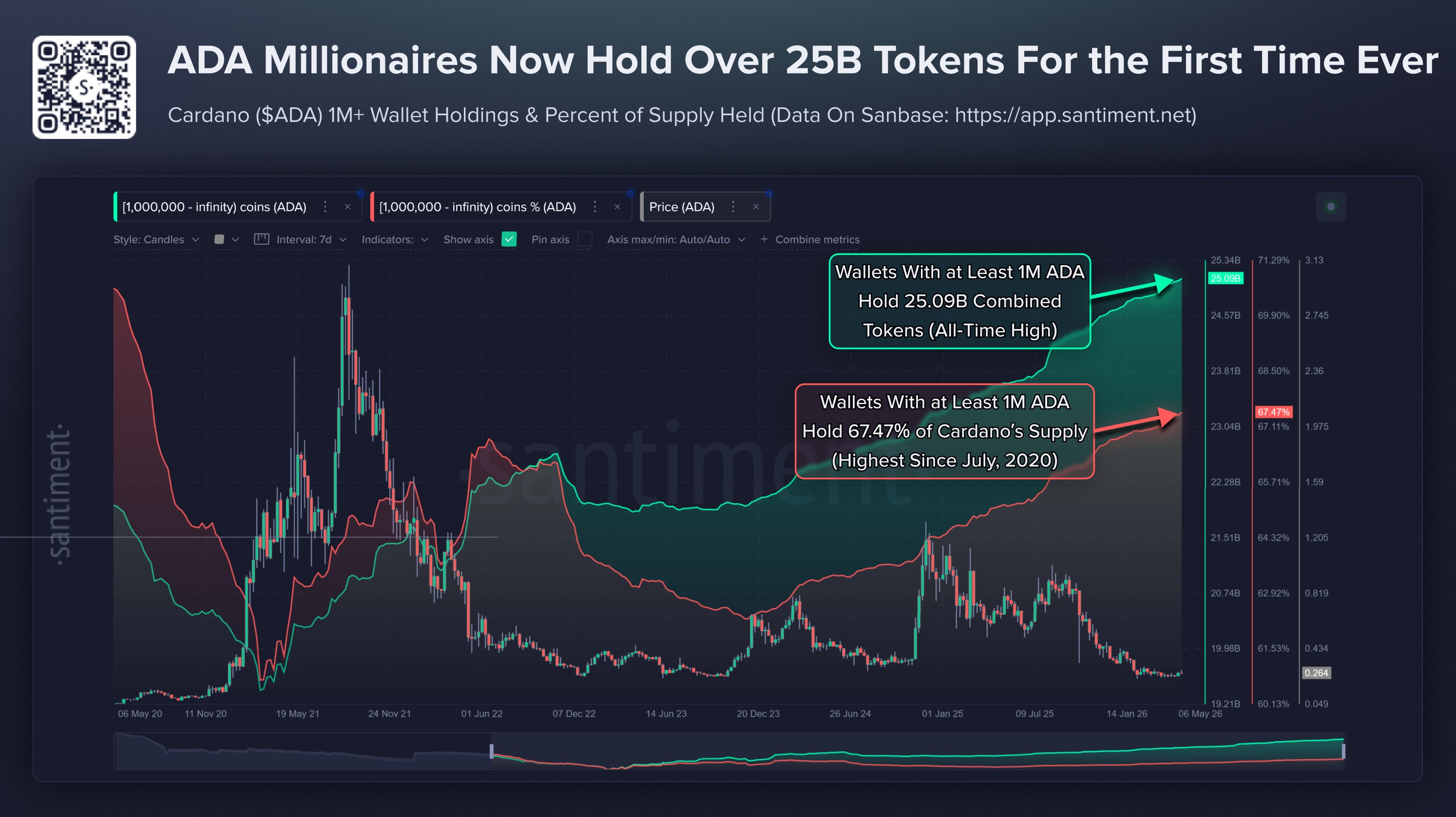
The value of the metric seems to have been climbing in recent years | Source: Santiment on X

As displayed in the above graph, the Cardano sharks and whales have seen their supply follow a pretty consistent uptrend since December 2023. During 2024 and 2025, the wider cryptocurrency sector followed a bullish trend, so it’s not surprising to see that large holders were accumulating.

Interestingly, however, the uptrend in the supply of the millionaire ADA wallets has maintained even through the bearish market shift that has followed since the last quarter of 2025. The analytics firm noted:

Although the asset has lost -71% of its market cap over the past 9 months, the “millionaire” tier of sharks and whales appear to be content with adding more while prices are at a discount.

Following the latest continuation of the metric’s upward trajectory, its value has reached the 25.09 billion ADA mark, which is a new all-time high (ATH). Though while this is a record in terms of the pure number of tokens, it’s not quite an ATH in terms of the supply share. Cardano has seen its supply go up over the years, so sharks and whales today control about 67.47% of the cryptocurrency’s supply, which is below the highs from 2020.

In related news, the Bitcoin sharks and whales have also participated in accumulation recently, as Santiment has highlighted in another X post. For BTC, these investors correspond to the 10 to 10,000 coins range.

As the chart below shows, these large investors have added 50,241 BTC to their holdings over the past month, representing an increase of 0.37%.
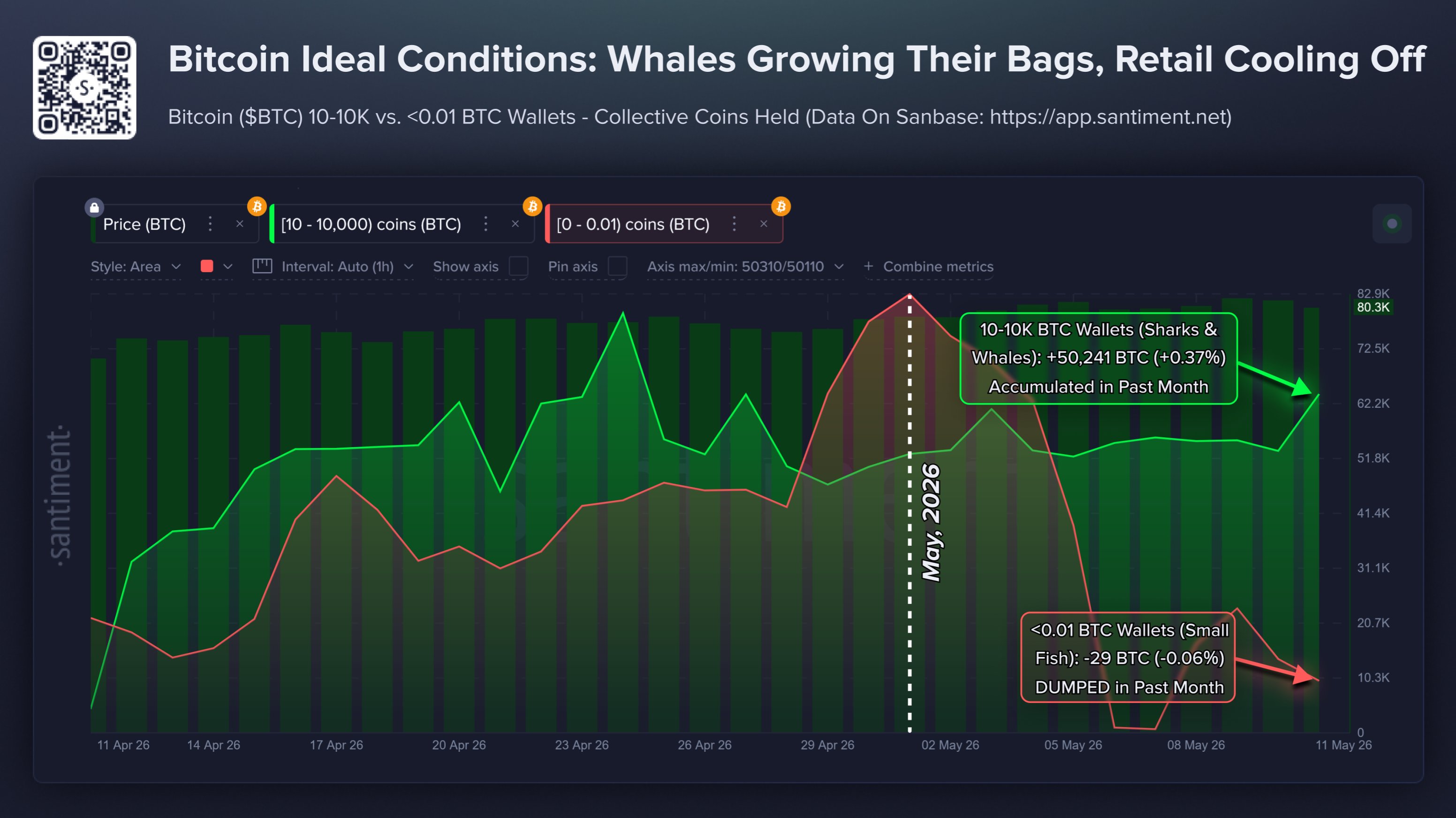
How the supply of the BTC sharks and whales has changed recently | Source: Santiment on X

While the large holders have been accumulating, the small entities carrying less than 0.01 BTC have collectively sold 29 BTC in this window instead. “Ideal conditions for any coin consist of large stakeholders continuing to add more to their bags, as retail shows FUD,” explained the analytics firm.

ADA Price

At the time of writing, Cardano is trading around $0.264, down 1.9% over the last 24 hours.

The trend in the price of the coin over the last five days | Source: ADAUSDT on TradingView


Domande pertinenti

QAccording to the article, what is a 'millionaire wallet' in the context of Cardano (ADA)?

AA 'millionaire wallet' in the context of Cardano refers to an address holding 1 million ADA tokens, which is worth roughly $262,400 at the current exchange rate. Investors in this cohort are known as sharks and whales.

QWhat new record has the supply held by Cardano shark and whale wallets reached?

AThe combined supply held by Cardano millionaire wallets (sharks and whales) has reached a new all-time high of 25.09 billion ADA.

QDespite the market decline, what behavior have the Cardano sharks and whales shown?

ADespite the market decline where ADA has lost -71% of its market cap over the past 9 months, Cardano sharks and whales have continued to accumulate more tokens, adding to their holdings while prices are at a discount.

QHow do the sharks and whales' holdings in terms of supply share compare to highs from 2020?

AWhile the sharks and whales hold a record 25.09 billion ADA in pure token numbers, their supply share is about 67.47% of Cardano's total supply, which is below the highs from 2020.

QWhat contrasting behavior is noted between large BTC holders and small BTC entities over the past month?

AOver the past month, large Bitcoin holders (sharks and whales with 10 to 10,000 BTC) accumulated 50,241 BTC, while small entities holding less than 0.01 BTC collectively sold 29 BTC.

Letture associate

GitHub, Transfixed by AI

On the night of February 9th, GitHub suffered a major outage caused by a simple configuration change—reducing a cache refresh interval from 12 to 2 hours—that triggered a cascade of failures. This was not an isolated event, but part of a broader pattern. In early 2026, GitHub experienced at least 8 major incidents, failing to meet its promised 99.9% availability. These outages stemmed from structural issues: explosive growth in load, tight service coupling, and insufficient protection against abnormal traffic. This unprecedented load is driven by AI Agents. In 2025, GitHub handled ~1 billion commits. By 2026, weekly commits reached 275 million, projecting to ~14 billion for the year—a 14x increase. AI tools like Claude Code now contribute 4.5% of all public repository commits, with weekly submissions surging 25x in just three months. AI-generated pull requests jumped from 4 million to 17 million per month in half a year. Unlike human developers, AI Agents work continuously, generating commits at a scale that overwhelms infrastructure designed for human rhythms. The surge also shattered GitHub's business model. Copilot's flat-rate pricing, based on assisting human developers, became unsustainable as Agentic AI sessions consumed resources worth hundreds of dollars for a few dollars in fees. In response, GitHub imposed usage limits and, by June 1st, shifted to a pay-per-use "AI Credits" system. Facing this new reality, GitHub realized a 10x scaling plan was insufficient. It announced a need to *redesign* its architecture for 30x current scale—decoupling services, adding fault isolation, and improving change management to prevent cascading failures. Other platforms like Stripe and AWS are facing similar challenges with AI Agents. Fundamentally, GitHub is transitioning from a human collaboration platform to an "exhaust pipe" for automated AI workflows. Its detailed post-mortem reports aim to maintain trust during this turbulent rebuild. The February outage was not just a technical glitch, but a signal of the software industry's entry into a new, AI-driven era.

marsbit7 min fa

GitHub, Transfixed by AI

marsbit7 min fa

Both Suffer Massive Losses Exceeding $90 Billion, Which Is in Greater Peril: Strategy or Bitmine?

Facing massive paper losses exceeding $90 billion each amidst a sharp market downturn, "Digital Asset Treasury" (DAT) giants Strategy and Bitmine find themselves in a precarious position, but with different underlying risks. Strategy, heavily invested in Bitcoin (BTC), faces significant financial strain. Its strategy relies heavily on debt, including convertible notes and preferred stock (STRC) requiring substantial dividend payments. With its cash reserves dwindling and BTC offering no staking yield for cash flow, Strategy's high leverage makes it vulnerable. A continued price decline could force asset sales to meet obligations, potentially creating a negative feedback loop. Its market value has already fallen sharply. In contrast, Bitmine, an Ethereum (ETH) holder, appears on firmer financial ground. It primarily funds its purchases through equity offerings (like ATM programs), avoiding debt pressure. It also generates income by staking a large portion of its ETH holdings. While not immune to market drops and shareholder dilution concerns, Bitmine maintains more flexibility, recently announcing a new preferred share offering to raise further capital. The core divergence lies in their financing: Bitmine uses equity (investor money), while Strategy uses debt (borrowed money). Consequently, Bitmine currently faces less immediate liquidity pressure than Strategy, which must navigate the dual challenge of servicing debt/dividends and a declining core asset (BTC) price.

marsbit14 min fa

Both Suffer Massive Losses Exceeding $90 Billion, Which Is in Greater Peril: Strategy or Bitmine?

marsbit14 min fa

Where the AI Bubble Really Is: Which Layer of Players Are Naked

AI Bubble: Where It Really Is and Who's Swimming Naked This analysis dissects the AI industry not as a single entity but as a five-layer pyramid, arguing that bubbles are concentrated in specific tiers, not uniformly distributed. **Key Distinction from the 2000 Dot-com Bubble:** Unlike 2000, where companies had stock prices before revenue, today's leading AI players have massive, contract-backed revenue driving their valuations. Core infrastructure demand is real, with every GPU running at full capacity for paying customers. **The Five-Layer Pyramid & Bubble Assessment:** * **L0 (Fab/Manufacturing) & Top L4 (Leading AI Apps): NO BUBBLE.** Companies like TSMC, NVIDIA, major cloud providers (Microsoft, Google, Meta, Amazon), and top AI labs have real revenues and orders. Supply is tightly constrained by TSMC's disciplined capacity control and physical limits like power/land for data centers, preventing a supply glut. * **L1 (Memory): BATTLEGROUND.** Sky-high HBM margins could signal a new structural cycle or a classic "boom before bust." The oligopoly of three major players may enforce supply discipline, making this a high-stakes bet. * **L2 (Interconnect/Optical Modules): BUBBLE TERRITORY.** Companies like Lumentum and AAOI have seen stock surges (4-10x) far outpacing revenue growth. This hardware segment has lower physical barriers to expansion than fabs, allowing speculation. It mirrors the 2000 bubble's epicenter—optics. * **L3 (Infrastructure/"GPU Landlords"): VULNERABLE.** GPU leasing companies profit from the current compute shortage but own no long-term moat. Their business model relies on a temporary bottleneck that will ease as big tech expands and new tech (e.g., potential space-based data centers) emerges. * **L4 Long Tail (VC-backed Startups): STRONG BUBBLE SIGNALS.** VC funding concentration in AI is twice that of the 1999 peak. Many startups with little revenue use the valuation logic of successful giants to justify their own, creating high risk of a "valuation crunch" when funding dries up. **Critical Risks to Monitor:** 1. **GPU Depreciation & Accounting:** Companies extending the assumed useful life of GPUs artificially boost profits. The true economic life depends on future generational leaps from NVIDIA. 2. **"GPU Credit" & Off-Balance-Sheet Leverage:** Emerging structures where shell companies borrow to buy GPUs and lease them out (with chipmakers sometimes investing) move debt off major balance sheets. This echoes the "vendor financing" of 2000 and the securitization risks of 2008, though currently small-scale. 3. **TSMC Abandoning Caution:** If the primary supply bottleneck (TSMC's conservative capacity planning) breaks, runaway supply could trigger a bust. 4. **Algorithmic Efficiency Breakthrough:** A major leap in software efficiency could drastically reduce the need for raw compute hardware, undermining the investment thesis. **Conclusion:** The AI boom is expensive and has frothy areas, but its core is underpinned by real demand and physical supply constraints. The bubble risk is layered: most present in optical components, GPU leasing, and the long-tail startup ecosystem, while the foundational chip manufacturing and leading application layers remain relatively solid—for now.

marsbit26 min fa

Where the AI Bubble Really Is: Which Layer of Players Are Naked

marsbit26 min fa

Trading

Spot
Futures

Articoli Popolari

Come comprare ADA

Benvenuto in HTX.com! Abbiamo reso l'acquisto di Cardano (ADA) semplice e conveniente. Segui la nostra guida passo passo per intraprendere il tuo viaggio nel mondo delle criptovalute.Step 1: Crea il tuo Account HTXUsa la tua email o numero di telefono per registrarti il tuo account gratuito su HTX. Vivi un'esperienza facile e sblocca tutte le funzionalità,Crea il mio accountStep 2: Vai in Acquista crypto e seleziona il tuo metodo di pagamentoCarta di credito/debito: utilizza la tua Visa o Mastercard per acquistare immediatamente CardanoADA.Bilancio: Usa i fondi dal bilancio del tuo account HTX per fare trading senza problemi.Terze parti: abbiamo aggiunto metodi di pagamento molto utilizzati come Google Pay e Apple Pay per maggiore comodità.P2P: Fai trading direttamente con altri utenti HTX.Over-the-Counter (OTC): Offriamo servizi su misura e tassi di cambio competitivi per i trader.Step 3: Conserva Cardano (ADA)Dopo aver acquistato Cardano (ADA), conserva nel tuo account HTX. In alternativa, puoi inviare tramite trasferimento blockchain o scambiare per altre criptovalute.Step 4: Scambia Cardano (ADA)Scambia facilmente Cardano (ADA) nel mercato spot di HTX. Accedi al tuo account, seleziona la tua coppia di trading, esegui le tue operazioni e monitora in tempo reale. Offriamo un'esperienza user-friendly sia per chi ha appena iniziato che per i trader più esperti.

1.3k Totale visualizzazioniPubblicato il 2024.12.10Aggiornato il 2026.06.02

Come comprare ADA

Discussioni

Benvenuto nella Community HTX. Qui puoi rimanere informato sugli ultimi sviluppi della piattaforma e accedere ad approfondimenti esperti sul mercato. Le opinioni degli utenti sul prezzo di ADA ADA sono presentate come di seguito.

活动图片












