Cardano Leadership Structure Comes Under Scrutiny, Clouding Its Future – See Why

bitcoinistPubblicato 2026-04-20Pubblicato ultima volta 2026-04-20

Introduzione

Cardano is recognized as one of the most decentralized blockchains, yet recent criticism highlights its lack of clear leadership. Analyst Cardano Yoda argues that despite the introduction of on-chain governance—which involves DReps (governance decision-makers) and Pentad (leadership and execution)—the network remains centralized in practice. While DReps control treasury spending, they lack coordination and strategic direction, relying instead on founding entities like IOG, the Cardano Foundation, and EMURGO. This creates fragmented leadership and accountability issues. Yoda suggests that DReps should evolve into a more coordinated body, possibly through a board or DAOs, to define strategy and improve governance effectiveness. Enhanced cooperation between DReps, founding entities, and Intersect is essential for Cardano’s future leadership clarity and operational unity.

In the dynamic blockchain sector, the Cardano network is being flagged as the most decentralized blockchain by several crypto analysts, with security being a major part of this assertion. However, the highly decentralized network has been called out for its lack of clear leadership.

Unclear Cardano Leadership Raises Concerns In The Ecosystem

Recently, a fresh debate has been raised around the Cardano network, particularly involving its leadership state. A crypto pundit and ADA enthusiast, Cardano Yoda, argues that the leading network is lacking clear leadership. Once again, the focus is on how Cardano strikes a compromise between decentralization and the requirement for unified leadership.

The pundit stated that in the past, the network was centered around the IOGs, the Cardano Foundation, and EMURGO, and its founder, Charles Hoskinson, was considered the leader. However, after the introduction of on-chain governance, the model evolved, breaking into two parts. These include DReps (governance decision-making) and Pentad (leadership and execution), which go hand-in-hand to produce a unified platform.

While DReps decide on Treasury spending, they also grant legitimacy to the strategy that Pentad offers because DReps are not coordinated. Since they cannot define the strategy and prioritize, on-chain governance is still dependent on the founding entities, indicating that the network remains strongly centralized in leadership and execution. These entities can offer their experience, knowledge, and expertise, but DReps will set the path from the ground up.
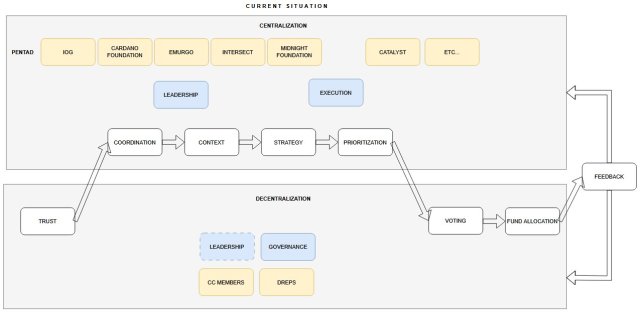
Source: Chart from Cardano Yoda on X

A strong player is intersect as it plays the role of coordinator, particularly preparing the budget framework process. Meanwhile, intersect is required to balance the role of facilitator and leader because it may not want to be a leader. However, being a leader means taking on responsibilities.

According to Yoda, on-chain governance is not the same as leadership, and Cardano does not have one. The issue is that it is difficult, if not impossible, to decentralize leadership and execution. A leader bears responsibility, which is diluted somewhere between Pentad and DReps, causing a fragmented network.

Despite this, Yoda still believes that leadership should not be dismissed because of decentralization. In the meantime, there may be a struggle for leadership, as new leaders may be born, or it might remain the same.

An Ideal Direction For Leadership

After carefully analyzing the Cardano network, Yoda claims that the logical direction for leadership is toward DReps because they have a stronger position and must be coordinated. With the emergence of a DReps board, they are expected to take responsibility for treasury spending, defining strategy, and prioritizing.

By using DAOs, DReps can be involved in the process of an effective execution. This is because they are responsible for supporting builders, ecosystem growth, innovation, marketing, and open-source activities, among others.

To have clear leadership, a more robust layer of cooperation between DReps, founding entities, and Intersect is required. However, this can only be built by a clearly defined coordination layer between DReps and sub-DAOs. Meanwhile, to create a dialogue between DReps and founding entities, the governance system must evolve.

Currently, communication is carried out through on-chain proposals, and may result in a rejected proposal regarding Summit and TOKEN2049 due to the diverse views of DReps and founding entities. Although it may not be easy, the goal remains finding a consensus on the future functioning because governance needs to be more effective.

ADA trading at $0.24 on the 1D chart | Source: ADAUSDT on Tradingview.com

Crypto di tendenza

Domande pertinenti

QWhat is the main concern raised about the Cardano network in the article?

AThe main concern is that despite being highly decentralized, the Cardano network lacks clear leadership, creating a fragmented system and raising questions about its future direction.

QAccording to the article, what are the two key parts of Cardano's governance model after the introduction of on-chain governance?

AThe two key parts are DReps (governance decision-making) and Pentad (leadership and execution).

QWhy does the article suggest that on-chain governance does not equate to leadership for Cardano?

ABecause leadership involves taking responsibility, which is currently diluted between Pentad and the uncoordinated DReps, making it difficult to decentralize leadership and execution effectively.

QWhat role does the entity 'Intersect' play in the Cardano ecosystem, as described in the article?

AIntersect acts as a coordinator, primarily in preparing the budget framework process, and is required to balance the roles of facilitator and leader.

QWhat does the article propose as the ideal direction for leadership to address Cardano's current issues?

AThe ideal direction is for leadership to move towards the DReps, who should be coordinated through a board to take responsibility for treasury spending, strategy, and prioritization, potentially using DAOs for effective execution.

Letture associate

In Jinjiang, Fujian, a Storage Super Unicorn Lies Quiet

In Fujian's Jinjiang, a city known for sportswear, lies a quiet semiconductor giant: Fujian Jinhua Integrated Circuit Co. (JHICC). Once a promising domestic DRAM manufacturer alongside Yangtze Memory and ChangXin Memory Technologies (CXMT), its journey was derailed in 2018 when the U.S. placed it on an Entity List and filed criminal charges for alleged trade secret theft. This halted production for years. A turning point came in February 2024 when a U.S. federal court found JHICC not guilty. However, it had lost crucial time. While CXMT soared to become a top-valued A-share company in 2024, JHICC, with an estimated valuation of 80 billion RMB, was just restarting. Its current output is primarily customized DDR4 chips, not the advanced DDR5/HBM demanded for AI, but it still benefits from the broader memory chip upcycle. JHICC's story is tied to Chen Zhengkun, a veteran engineer who left Micron to lead the venture. Founded in 2016 with state-backed funding, JHICC partnered with Taiwan's UMC to develop DRAM technology. Rapid progress was cut short by the U.S. actions, which Micron initiated, partly due to its heavy reliance on the Chinese market. Post-sanctions, Chen's team worked to rebuild the production line with reduced reliance on U.S. technology. According to its records, JHICC achieved small-scale production and revenue growth under immense pressure. It now focuses on the stable "niche" DRAM market (e.g., TVs, routers) with a monthly capacity of ~40,000 wafers, aiming for 60,000 by 2026. It holds over 1,000 patents but remains on the Entity List. For Jinjiang, investing in JHICC was a bold industrial leap. The local government provided unwavering financial and logistical support during the crisis, helping the company survive. JHICC has become the anchor for a growing local semiconductor cluster. Though its scale lags behind domestic peers, JHICC's persistence symbolizes a hard-won foothold in a global market long dominated by Samsung, SK Hynix, and Micron. Having missed one boom, it seeks a place in the new AI-driven memory supercycle.

marsbit25 min fa

In Jinjiang, Fujian, a Storage Super Unicorn Lies Quiet

marsbit25 min fa

Must-Watch Events Next Week|CLARITY Act Could Face Senate Vote; SpaceX, Circle to Report Earnings (8.3-8.9)

**Summary: Key Events and Developments to Watch (August 3-9)** The upcoming week is marked by significant financial disclosures, key legislative deadlines, and notable product updates. **Major Financial Events:** Several companies are scheduled to release their Q2 2026 earnings. American Bitcoin (ABTC) will report on August 3, followed by SpaceX and Hut 8 Mining Corp. on August 4, and Circle on August 5. Notably, a significant portion of SpaceX shares (up to 12% of total shares) will be unlocked on August 6 following their earnings release. **Key Legislative Deadline:** The U.S. Senate faces an August 7 deadline to secure 60 votes for the CLARITY Act, a bipartisan bill aiming to establish a federal regulatory framework for cryptocurrencies. The Senate may hold a full vote on the bill during the week. **Economic Data:** The U.S. July Non-Farm Payrolls report will be released on August 7, providing crucial labor market data. **Technology & Product Updates:** * **Shutdowns:** DeFi portfolio tracker Zapper and wallet app Ctrl Wallet will cease operations on August 3. * **Upgrades:** LayerZero will deprecate its v1 relayers on August 3. XRP Ledger's new version 3.3.0, featuring five new functions, is expected next week. * **AI:** Elon Musk announced that the advanced Grok 4.6 AI model is set for release around August 7. * **Bitcoin:** The BIP-110 forced signaling for a potential Bitcoin network change is scheduled to begin around August 8. **Other Notable Events:** Chinese robotics firm Unitree Tech has set its preliminary price inquiry for its IPO for August 5. South Korean exchange Upbit will delist AQT and AERGO tokens on August 3.

marsbit2 h fa

Must-Watch Events Next Week|CLARITY Act Could Face Senate Vote; SpaceX, Circle to Report Earnings (8.3-8.9)

marsbit2 h fa

Trading

Spot

Articoli Popolari

Come comprare ADA

Benvenuto in HTX.com! Abbiamo reso l'acquisto di Cardano (ADA) semplice e conveniente. Segui la nostra guida passo passo per intraprendere il tuo viaggio nel mondo delle criptovalute.Step 1: Crea il tuo Account HTXUsa la tua email o numero di telefono per registrarti il tuo account gratuito su HTX. Vivi un'esperienza facile e sblocca tutte le funzionalità,Crea il mio accountStep 2: Vai in Acquista crypto e seleziona il tuo metodo di pagamentoCarta di credito/debito: utilizza la tua Visa o Mastercard per acquistare immediatamente CardanoADA.Bilancio: Usa i fondi dal bilancio del tuo account HTX per fare trading senza problemi.Terze parti: abbiamo aggiunto metodi di pagamento molto utilizzati come Google Pay e Apple Pay per maggiore comodità.P2P: Fai trading direttamente con altri utenti HTX.Over-the-Counter (OTC): Offriamo servizi su misura e tassi di cambio competitivi per i trader.Step 3: Conserva Cardano (ADA)Dopo aver acquistato Cardano (ADA), conserva nel tuo account HTX. In alternativa, puoi inviare tramite trasferimento blockchain o scambiare per altre criptovalute.Step 4: Scambia Cardano (ADA)Scambia facilmente Cardano (ADA) nel mercato spot di HTX. Accedi al tuo account, seleziona la tua coppia di trading, esegui le tue operazioni e monitora in tempo reale. Offriamo un'esperienza user-friendly sia per chi ha appena iniziato che per i trader più esperti.

1.4k Totale visualizzazioniPubblicato il 2024.12.10Aggiornato il 2026.06.02

Come comprare ADA

Discussioni

Benvenuto nella Community HTX. Qui puoi rimanere informato sugli ultimi sviluppi della piattaforma e accedere ad approfondimenti esperti sul mercato. Le opinioni degli utenti sul prezzo di ADA ADA sono presentate come di seguito.

活动图片













