Cardano Gains Institutional Momentum as Smart Contract Fund Exposure Surges

bitcoinistPubblicato 2026-02-25Pubblicato ultima volta 2026-02-25

Introduzione

Institutional investors are increasing their exposure to smart contract platforms, with Cardano (ADA) becoming a central focus. Grayscale Investments has raised its ADA allocation in its Smart Contract Fund to 20.2%, making it the fund's third-largest holding behind Ethereum and Solana. This signals growing institutional confidence in Cardano's long-term ecosystem, despite ongoing market weakness and ADA's price trading near key support at $0.24. Additionally, Cardano has integrated with LayerZero, enabling cross-chain interoperability with over 80 blockchains. This aims to improve liquidity and DeFi access by allowing direct asset and data transfers between networks like Ethereum and Solana. Further roadmap upgrades focus on scalability, privacy sidechains, and stablecoin integrations to attract institutional use cases. While technical indicators remain cautious, the institutional accumulation and ecosystem developments suggest strengthened long-term positioning.

Institutional investors are improving exposure to smart contract platforms amid ongoing market volatility, with Cardano (ADA) increasingly becoming a central focus. Recent portfolio adjustments by major crypto asset managers suggest long-term positioning is gaining priority over short-term price movements.

Related Reading: Strategy Makes 100th Bitcoin Purchase, Total Holdings Reach 717,722 BTC

Digital asset manager Grayscale Investments has steadily increased its allocation to Cardano’s ADA token within its Smart Contract Fund, signaling growing institutional interest in the network’s evolving ecosystem and infrastructure strategy.
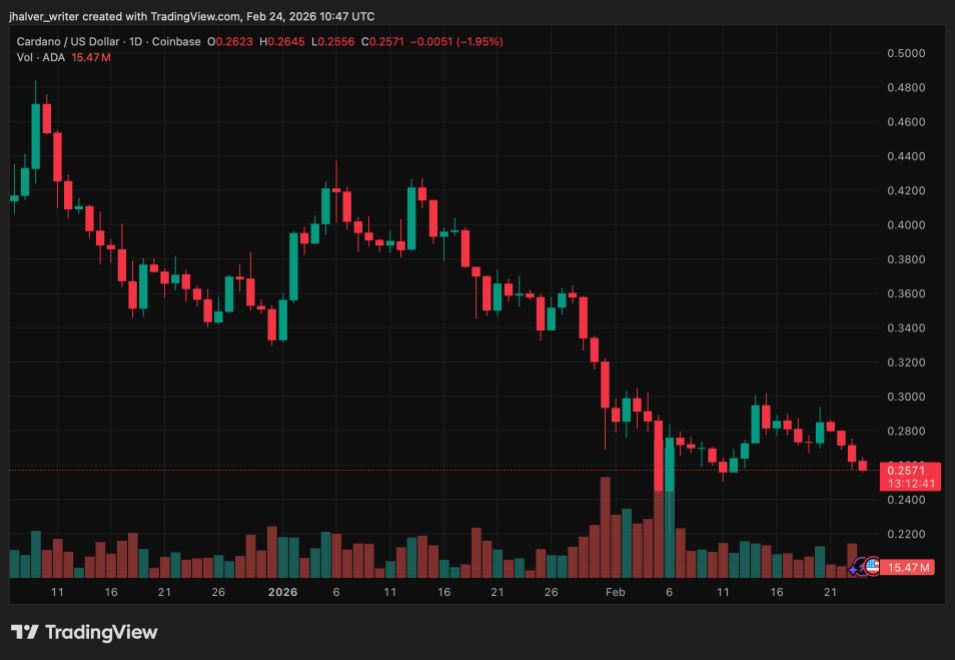
ADA's price trends to the downside on the daily chart. Source: ADAUSD on Tradingview 

Institutional ADA Allocation Expands Despite Market Weakness

Grayscale’s latest rebalancing shows ADA accounting for roughly 20.2% of the Smart Contract Platform Select Capped Index (SCPXC), up from about 18.55% at the start of the year. The increase makes Cardano the third-largest holding in the fund, behind Ethereum and Solana, which each command allocations above 28%.

The fund maintains diversified exposure across several smart contract networks, including Hedera, Avalanche, and Sui, while managing approximately $1.8 million in assets under management with a net asset value of $5.81 per share.

The rising allocation comes amid macro-driven pressure on crypto markets, with risk sentiment weakening across major tokens. Despite the downturn, institutional positioning suggests investors are reassessing long-term blockchain infrastructure plays rather than reducing exposure entirely.

Cardano-LayerZero Integration Strengthens Ecosystem Outlook

Alongside institutional accumulation, Cardano (ADA) has introduced technical developments to expand its interoperability. The network recently integrated with LayerZero, enabling cross-chain messaging and asset transfers across more than 80 blockchain networks.

The upgrade allows dApps on Cardano to interact directly with ecosystems such as Ethereum and Solana, addressing long-standing liquidity fragmentation challenges. Developers can now move assets and data across chains without relying heavily on wrapped tokens or centralized bridges, potentially widening DeFi access.

Additional roadmap initiatives, including protocol upgrades, privacy-focused sidechains, and stablecoin integrations, are designed to improve scalability and attract institutional-grade use cases over the coming year.

Price Structure Remains Fragile Near Key Support

While institutional signals have strengthened, ADA’s market structure remains under pressure. The token is trading around $0.25 after a prolonged downtrend from January highs around $0.42.

Analysts are closely monitoring the $0.24 level, a long-standing demand zone that has historically attracted buyers during periods of heavy selling.

Related Reading: CZ Eyes Binance US Expansion Following Withdrawal Of SEC’s Lawsuit – Report

Technical indicators remain cautious, with resistance forming near the $0.30–$0.31 range. A sustained move above that zone could shift short-term sentiment, while a breakdown below support may expose lower historical price areas.

Cover image from ChatGPT, ADAUSD chart on Tradingview

Domande pertinenti

QWhat is the main reason for the increased institutional interest in Cardano (ADA) according to the article?

AInstitutional investors are increasing exposure to Cardano due to its evolving ecosystem and infrastructure strategy, prioritizing long-term positioning over short-term price movements.

QWhich asset manager has significantly increased its allocation to ADA in its Smart Contract Fund?

AGrayscale Investments has steadily increased its allocation to Cardano's ADA token within its Smart Contract Fund.

QWhat recent technical development has improved Cardano's interoperability with other blockchains?

ACardano has integrated with LayerZero, enabling cross-chain messaging and asset transfers across more than 80 blockchain networks.

QWhat is ADA's current ranking by allocation size in Grayscale's Smart Contract Platform Select Capped Index?

AADA is the third-largest holding in the fund, behind Ethereum and Solana, with an allocation of approximately 20.2%.

QWhat key price level are analysts monitoring for ADA amid its current downtrend?

AAnalysts are closely monitoring the $0.24 level, which is a long-standing demand zone that has historically attracted buyers during periods of heavy selling.

Letture associate

Uncovering the Truth About Agent Commerce, Payments, and Infrastructure

Decoding Agent Commerce, Payments, and Infrastructure: The Reality Over the past year, I've been building infrastructure for the Agent economy, engaging with major players like Stripe, Visa, Coinbase, Google, and dozens of startups. A clear conclusion emerges: true, large-scale demand does not yet exist. Startups face structural challenges. Data points illustrate this gap. Stripe's Agent commerce platform has over 1,000 merchants but only single-digit transacting agents. Visa's Agent payment token requires 9-month KYC and a $250M revenue threshold, accessible only to giants like Amazon. On-chain analysis reveals actual daily Agent transaction volume is around $17k, half of which are test transactions. The article analyzes four potential markets: **1. Agent-to-Merchant (A2M):** Current AI shopping UX is often inferior to traditional e-commerce for visual, comparison-heavy purchases (clothing, electronics). Chat interfaces are a step back. Real merchant interest is defensive "Agent Engine Optimization," fearing future obsolescence, not current demand. Potential exists in high-frequency, low-decision purchases (e.g., food delivery) or simplifying terrible UX (complex checkouts, non-native shoppers), but these require massive consumer distribution channels dominated by giants like DoorDash and Amazon. **2. Agent-to-API (A2A):** Developers already have subscriptions and billing for core APIs (compute, data). The argument for micro-payments via crypto for sub-dollar API calls is addressed by pre-paid balances today. The deeper issue is supplier resistance; major SaaS firms rely on enterprise contracts, not fractional cent pricing. Opportunity lies in the long tail of niche services, but this is a smaller market catering to developers, a historically low-paying group. **3. Agent-to-Agent (A2A):** This remains a theoretical long-term vision with near-zero current transaction volume. It involves unique challenges: discovery, trust, negotiation, dispute resolution. When it materializes, it will require a fundamentally new settlement infrastructure for high-speed, variable-value, multi-party transactions. It's a real long-term bet, but not the current market. **4. Agent-to-Finance (A2F):** This is the only category with existing, paying demand. Integrating AI into financial workflows (trading, portfolio management) is a natural evolution and enables new capabilities like autonomous rebalancing. However, competition favors incumbents with regulatory licenses, compliance infrastructure, and existing client relationships. **The Real Issue:** Why is infrastructure still being built? Incumbents can afford long-term bets, and payment companies see every problem as a nail for their payment hammer. However, payment is just one piece. The core challenge is *coordination*—orchestrating work between Agents and humans, verifying outcomes, and settling results. Payment is part of settlement, which is part of coordination. Companies that solve the coordination problem will subsume payments, not the other way around. Startups lack the infinite runway of giants and must find today's real market, which, after a year of exploration, lies outside these four categories—in an area with real, growing, and underserved activity.

marsbit1 h fa

Uncovering the Truth About Agent Commerce, Payments, and Infrastructure

marsbit1 h fa

Kalshi, MTS, and a16z's Ambition

The article "Kalshi, MTS, and a16z's Ambition" explores prediction markets as a focal point of excitement in 2025 for investors, crypto enthusiasts, and media. It traces their intellectual lineage from Friedrich Hayek's ideas on dispersed knowledge and market coordination to Robin Hanson's Logarithmic Market Scoring Rule (LMSR), which incentivizes truthful information sharing. The piece argues that a16z's significant investment in prediction market platform Kalshi (valued at $220B) transcends mere financial speculation. a16z frames prediction markets as a new form of "media" that provides "presence"—a way for individuals to actively engage with and influence world events through financial stakes, countering postmodern detachment. By wagering on outcomes, users become "super observers," and the market's aggregated probabilities gain authoritative power to define event truth and importance. The article uses media company MTS ("Monitoring The Situation") as a case study of a16z's "new media" strategy: rapidly producing high-intensity, multi-format content to "take over the timeline." However, prediction markets like Kalshi are presented as the ultimate piece in this media empire. Their real-money, crowd-sourced probabilities possess a unique "reality distortion field" and perceived objectivity, potentially swaying public opinion and granting a private company unprecedented interpretive power over reality. Ultimately, Kalshi's immense valuation is attributed not just to its exchange model, but to its role as a foundational component in a16z's envisioned new media landscape, where prediction markets define narrative and truth.

链捕手1 h fa

Kalshi, MTS, and a16z's Ambition

链捕手1 h fa

Trading

Spot
Futures

Articoli Popolari

Come comprare ADA

Benvenuto in HTX.com! Abbiamo reso l'acquisto di Cardano (ADA) semplice e conveniente. Segui la nostra guida passo passo per intraprendere il tuo viaggio nel mondo delle criptovalute.Step 1: Crea il tuo Account HTXUsa la tua email o numero di telefono per registrarti il tuo account gratuito su HTX. Vivi un'esperienza facile e sblocca tutte le funzionalità,Crea il mio accountStep 2: Vai in Acquista crypto e seleziona il tuo metodo di pagamentoCarta di credito/debito: utilizza la tua Visa o Mastercard per acquistare immediatamente CardanoADA.Bilancio: Usa i fondi dal bilancio del tuo account HTX per fare trading senza problemi.Terze parti: abbiamo aggiunto metodi di pagamento molto utilizzati come Google Pay e Apple Pay per maggiore comodità.P2P: Fai trading direttamente con altri utenti HTX.Over-the-Counter (OTC): Offriamo servizi su misura e tassi di cambio competitivi per i trader.Step 3: Conserva Cardano (ADA)Dopo aver acquistato Cardano (ADA), conserva nel tuo account HTX. In alternativa, puoi inviare tramite trasferimento blockchain o scambiare per altre criptovalute.Step 4: Scambia Cardano (ADA)Scambia facilmente Cardano (ADA) nel mercato spot di HTX. Accedi al tuo account, seleziona la tua coppia di trading, esegui le tue operazioni e monitora in tempo reale. Offriamo un'esperienza user-friendly sia per chi ha appena iniziato che per i trader più esperti.

1.3k Totale visualizzazioniPubblicato il 2024.12.10Aggiornato il 2026.06.02

Come comprare ADA

Discussioni

Benvenuto nella Community HTX. Qui puoi rimanere informato sugli ultimi sviluppi della piattaforma e accedere ad approfondimenti esperti sul mercato. Le opinioni degli utenti sul prezzo di ADA ADA sono presentate come di seguito.

活动图片