Cardano Founder Says This Midnight Deal Could Bring Billions In TVL

bitcoinistPubblicato 2026-03-26Pubblicato ultima volta 2026-03-26

Introduzione

Cardano founder Charles Hoskinson announced a major partnership between the privacy-focused blockchain Midnight and UK-based Monument Bank, which plans to tokenize up to £250 million in retail deposits. This initial phase could expand into billions in Total Value Locked (TVL) as Monument aims to later offer tokenized investment products and Lombard-style lending. The deal is positioned as a breakthrough for regulated finance on public blockchains, using Midnight’s privacy features to balance transparency with banking confidentiality while operating within existing regulatory frameworks.

Cardano founder Charles Hoskinson says Midnight’s new partnership with Monument Bank could become one of the biggest commercial wins yet for the privacy-focused network, after the UK lender unveiled plans to put retail customer deposits on a public blockchain. In a post on X, the Cardano founder wrote:

“This is one of the largest deals we’ve ever done and could bring hundreds of millions to billions of TVL to the Midnight ecosystem. I’m extremely proud of Fahmi Syed and his team at the Midnight Foundation for the hard work they put into the negotiations with Monument. Midnight is the home of Web 2.5 ventures.”

Why The Cardano So Enthusiastic

Monument, a UK digital bank serving the mass-affluent segment, said it plans to become the first UK bank to tokenize retail customer deposits on a public blockchain, with Midnight providing the underlying network and privacy-preserving architecture.

The first phase is concrete. Monument said it is targeting up to £250 million in tokenized deposits, with each token representing a one-to-one claim on funds held at the bank. Those deposits are intended to remain interest-bearing, redeemable in pounds sterling and protected within the existing regulatory framework, including the Financial Services Compensation Scheme. Monument says it currently serves more than 100,000 clients and has over £7 billion in savings deposits, giving the project a real balance-sheet base rather than a purely experimental starting point.

That setup is central to Midnight’s pitch. The tokenized deposits are not being framed as a new synthetic asset or an offshore wrapper, but as a blockchain mirror of traditional bank deposits. According to the release, transaction data on Midnight will be shielded and visible only to Monument and its customers, an architecture aimed at preserving the confidentiality banks need while still using public-chain rails.

Midnight Foundation President Fahmi Syed used the deal to make a broader point about institutional blockchain adoption. Financial firms, he said, have struggled with the tension between openness and banking-grade confidentiality. Midnight, in his words, is designed to “represent assets on public networks” while protecting “sensitive financial information,” and Monument’s rollout is meant to show that regulated products can move on-chain without stepping outside existing compliance and consumer-protection frameworks.

The longer-term roadmap explains why Hoskinson is talking in terms of billions rather than the initial £250 million. Phase two would expand beyond tokenized deposits into tokenized investment products delivered through the Monument app, including access to private equity, commodity funds and structured products. Phase three would introduce Lombard-style lending, allowing clients to borrow against investments without selling them. Monument also said its technology affiliate aims to extend tokenized-deposit functionality to other institutions through its Banking-as-a-Service platform.

In that sense, Hoskinson’s TVL projection reads less like a claim about day-one inflows and more like a statement about the size of the pipeline if the rollout expands as planned. The hard figure disclosed so far is £250 million in the first phase. But if Monument can move from deposit tokenization into investment products, lending and third-party enablement, Midnight would be competing for balance-sheet-linked activity that is structurally different from mercenary DeFi liquidity.

For Midnight, the partnership is also a live test of its core thesis: that privacy-enhancing infrastructure can make public blockchains usable for regulated finance. If Monument executes beyond the pilot, the deal would give the Cardano-linked network something many crypto projects still lack, a banking use case tied to real deposits, real customers and a product roadmap built to stay inside the guardrails of traditional finance.

At press time, Cardano traded at $0.26.
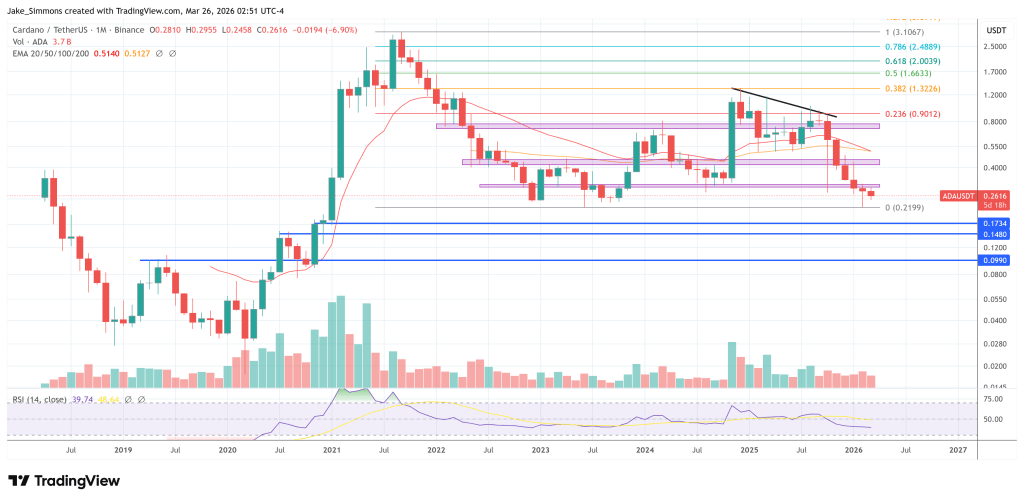
Cardano hovers below key resistance, 1-month chart | Source: ADAUSDT on TradingView.com

Crypto di tendenza

Domande pertinenti

QWhat is the significance of the partnership between Midnight and Monument Bank according to Cardano founder Charles Hoskinson?

ACharles Hoskinson believes this partnership could become one of the largest deals for Midnight, potentially bringing hundreds of millions to billions in Total Value Locked (TVL) to its ecosystem.

QWhat specific service does Monument Bank plan to implement using Midnight's network?

AMonument Bank plans to become the first UK bank to tokenize retail customer deposits on a public blockchain, using Midnight's network and privacy-preserving architecture.

QWhat is the initial target amount for tokenized deposits in the first phase of the project?

AThe initial target for the first phase is up to £250 million in tokenized deposits.

QHow does Midnight's technology address the conflict between openness and confidentiality for financial institutions?

AMidnight is designed to represent assets on public networks while protecting sensitive financial information through its privacy-enhancing infrastructure, allowing transaction data to be shielded and visible only to the bank and its customers.

QWhat are the future phases of the project beyond tokenizing deposits?

APhase two will expand into tokenized investment products like private equity and commodity funds, while phase three will introduce Lombard-style lending, allowing clients to borrow against their investments without selling them.

Letture associate

Global Stock Market's Storm Center: South Korea's Stock Market De-leveraging Is Largely Complete

Storm's Eye: South Korean Market De-leveraging Nears Completion The recent sharp correction in South Korean equities, with the KOSPI index dropping 32% from its June high, has been a key trigger for global tech stock volatility. The core driver was not a fundamental shift but a forced de-leveraging process within the market's unique structure, which is now largely complete. Two main leverage channels amplified the sell-off: 1. **Leveraged ETFs:** Their size, proportionally four times larger than in the U.S., peaked near $50 billion. Their mandatory daily rebalancing mechanism created a vicious cycle of "price drop → forced selling → further drop." Approximately 75% of this excess has been unwound, shrinking to $26 billion, with regulatory curbs now blocking new inflows. 2. **Hedge Fund Leverage:** Using swaps to magnify exposure, hedge funds saw their net long positioning fall by over 50% from peak levels. The most intense phase of this institutional de-leveraging is over. In contrast, **retail margin debt** poses minimal systemic risk. At 0.5% of market cap, it is far lower than in the U.S. or China, lacks automatic triggers, and is concentrated in smaller stocks. The conclusion: the high-leverage structures most prone to "chain-reaction selling" have been substantially cleared. The market is transitioning from a liquidity-driven crash to one priced more on fundamentals. The article argues that the AI trend—centered on Korean memory chips—remains intact. This episode represents a painful but necessary clearing of crowded trades, not the end of the AI revolution. For investors, the key question is conviction in the long-term AI direction; if the trend is real, current volatility is a cost of entry, not a terminal risk.

链捕手1 h fa

Global Stock Market's Storm Center: South Korea's Stock Market De-leveraging Is Largely Complete

链捕手1 h fa

The Eternal Fragments of Money: Third-Party Payment Has No First Principle

"The Enduring Fragments of Money: Third-Party Payments Lack a First Principle" Stripe is reportedly attempting to acquire PayPal, marking a significant shift reminiscent of PayPal's merger with the original X.com 30 years ago. The article analyzes Stripe's strategic challenges and the broader payments industry landscape. Despite its initial success with a developer-friendly API model, Stripe missed its optimal IPO window during the pandemic and has since seen its valuation decline. Its attempts to expand through acquisitions and new ventures, particularly in stablecoins (like its OUSD project) and Agent-focused payments (ACP/MPP protocols), have faced headwinds. The author argues that the payment industry remains highly fragmented and is ultimately an adjunct to the traditional banking system. This structure limits the potential for any single player, including Stripe, to achieve complete dominance. While stablecoins and the future rise of autonomous Agent economies present potential growth avenues, they are not yet mainstream and still require integration with the existing financial system. For now, Agent-based transactions are largely used for speculative "volume boosting" rather than substantive business applications. Stripe's current move to acquire PayPal is seen as an attempt to bolster its weak consumer-facing (C-side) business after its stablecoin-focused strategies faltered. Meanwhile, PayPal is described as structurally outdated, unable to revive itself through new products like Venmo or PYUSD. The future of payments may lie not in payments themselves but in value-added services like more efficient settlement networks. The author suggests that companies like Stripe and Circle, which are building their own blockchains (Tempo, Arc) and stablecoins, are positioning themselves to eventually profit from high-efficiency settlement systems. These new networks could potentially bypass some traditional banking layers. In conclusion, the article posits that third-party payment is a perpetually fragmented battlefield where scale alone cannot ensure victory. Players must find new models, focusing on efficiency to compete with the entrenched banking system. Stripe's acquisition of PayPal represents a bet on this uncertain future.

链捕手1 h fa

The Eternal Fragments of Money: Third-Party Payment Has No First Principle

链捕手1 h fa

Trading

Spot

Articoli Popolari

Come comprare ADA

Benvenuto in HTX.com! Abbiamo reso l'acquisto di Cardano (ADA) semplice e conveniente. Segui la nostra guida passo passo per intraprendere il tuo viaggio nel mondo delle criptovalute.Step 1: Crea il tuo Account HTXUsa la tua email o numero di telefono per registrarti il tuo account gratuito su HTX. Vivi un'esperienza facile e sblocca tutte le funzionalità,Crea il mio accountStep 2: Vai in Acquista crypto e seleziona il tuo metodo di pagamentoCarta di credito/debito: utilizza la tua Visa o Mastercard per acquistare immediatamente CardanoADA.Bilancio: Usa i fondi dal bilancio del tuo account HTX per fare trading senza problemi.Terze parti: abbiamo aggiunto metodi di pagamento molto utilizzati come Google Pay e Apple Pay per maggiore comodità.P2P: Fai trading direttamente con altri utenti HTX.Over-the-Counter (OTC): Offriamo servizi su misura e tassi di cambio competitivi per i trader.Step 3: Conserva Cardano (ADA)Dopo aver acquistato Cardano (ADA), conserva nel tuo account HTX. In alternativa, puoi inviare tramite trasferimento blockchain o scambiare per altre criptovalute.Step 4: Scambia Cardano (ADA)Scambia facilmente Cardano (ADA) nel mercato spot di HTX. Accedi al tuo account, seleziona la tua coppia di trading, esegui le tue operazioni e monitora in tempo reale. Offriamo un'esperienza user-friendly sia per chi ha appena iniziato che per i trader più esperti.

1.4k Totale visualizzazioniPubblicato il 2024.12.10Aggiornato il 2026.06.02

Come comprare ADA

Discussioni

Benvenuto nella Community HTX. Qui puoi rimanere informato sugli ultimi sviluppi della piattaforma e accedere ad approfondimenti esperti sul mercato. Le opinioni degli utenti sul prezzo di ADA ADA sono presentate come di seguito.

活动图片