Cardano Founder Says Pentad Faces $40 Million Shortfall After ADA Price Crash

bitcoinistPubblicato 2026-03-09Pubblicato ultima volta 2026-03-09

Charles Hoskinson says Cardano’s Pentad initiative is dealing with a roughly $40 million funding gap after ADA fell from around $0.83 at the time of the original proposal to roughly $0.25. In a March 6 video update, the Cardano founder said the plan was initially working with the equivalent of about $58 million in value from 70 million ADA, but that figure has since dropped to about $18 million.

That repricing, he argued, has fundamentally changed the economics of the program. “The reality is that there’s a $40 million shortfall between when we wanted to do it and where we’re at today,” Hoskinson said. “Every single member of the Pentad has to accept that shortfall, meaning out of pocket for commitments and obligations. They have to make it up.”

Hoskinson Defends The Cardano Pentad

Pentad was designed as a coordinated effort between five core Cardano ecosystem entities to secure commercially important integrations for the network more efficiently and at scale. Hoskinson said the original logic was that Cardano and Midnight could negotiate together and get better aggregate terms, but the collapse in ADA’s dollar value means even the Cardano-side integrations now cost more than the treasury-backed funding effectively covers. Midnight, he said, is also paying for its own integrations out of pocket, with liabilities exceeding $10 million.

A central point of the update was a reimbursement dispute tied to Fireblocks. Hoskinson said one party had negotiated separately with Fireblocks outside the Pentad process, reached its own fee arrangement, and then later sought reimbursement. That, he argued, is not comparable to the more expansive and expensive integration the Midnight Foundation had been negotiating and was never part of the original governance-approved structure.

“Everyone in the Pentad is at a loss. We did not make a profit,” he said. “The vast majority of the integrations will require out-of-pocket expenses from the Cardano Foundation, the Midnight Foundation, Input Output, Emergo, and Intersect and long-term liabilities because many of these things required multi-year contracts.” By contrast, he added, external actors who were not signers to those liabilities cannot reasonably expect to be made whole simply because earlier public comments were made under different assumptions.

Hoskinson nevertheless cast Pentad V1 as an operational success. He said Cardano went from signing a deal with Circle to having USDCX live on the network in 84 days, calling it the number one stablecoin on Cardano already. He also pointed to integrations with LayerZero, Pyth, Dune Analytics and custodians, arguing the effort has moved Cardano from being “an island” to being connected to the broader crypto market.

Related Reading: Cardano Founder Sounds Alarm Over New US Crypto Bill

That shift matters because, in Hoskinson’s view, Cardano’s next challenge is no longer core infrastructure. It is utility, user experience and DeFi traction. He said the ecosystem still needs strategic capital deployment to help applications survive and compete, and floated Pentad V2 as a possible treasury-backed “weighted index” of Cardano DApps and DeFi projects rather than a grant program.

“We don’t have an infrastructure problem,” he said later in the video. “We have DApps and DeFi and we have an experience problem. We were an island. We’re no longer an island. We built those bridges. That’s what you paid for with Pentad.”

The broader message was political as much as financial. Hoskinson framed the reimbursement fight as a test of whether Cardano’s on-chain governance can function under stress without collapsing into public infighting. If the ecosystem can align behind difficult capital-allocation decisions despite lower token prices, he argued, Pentad could become less a funding controversy than an early demonstration of whether Cardano’s governance model can actually execute.

At press time, ADA traded at $0.2548.
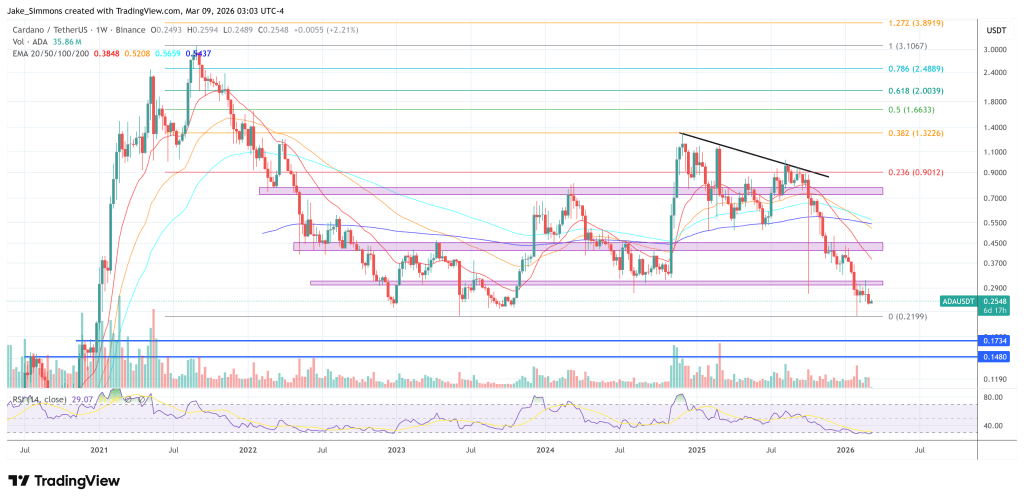
ADA hovers below key resistance, 1-week chart | Source: ADAUSDT on TradingView.com

Domande pertinenti

QWhat is the main financial issue facing Cardano's Pentad initiative according to Charles Hoskinson?

AThe main financial issue is a roughly $40 million funding shortfall due to the sharp decline in ADA's price, which has reduced the value of the treasury from an initial $58 million to about $18 million.

QWhat was the original purpose of the Pentad initiative?

APentad was designed as a coordinated effort between five core Cardano ecosystem entities to secure commercially important integrations for the network more efficiently and at scale.

QHow did Hoskinson defend the operational success of Pentad V1 despite the financial shortfall?

AHe cited the rapid 84-day integration of USDCX, making it the number one stablecoin on Cardano, and pointed to successful integrations with LayerZero, Pyth, Dune Analytics, and custodians, which connected Cardano to the broader crypto market.

QWhat did Hoskinson identify as Cardano's next major challenge after improving its infrastructure?

AHe stated that the next challenge is no longer core infrastructure, but rather utility, user experience, and DeFi traction for the ecosystem.

QWhat broader, non-financial test did Hoskinson say the reimbursement dispute represents for the Cardano ecosystem?

AHe framed it as a test of whether Cardano's on-chain governance can function under stress without public infighting and if it can execute difficult capital-allocation decisions despite lower token prices.

Letture associate

Bitcoin's 'Rally Ends,' Officially Entering the Later Stage of a Bear Market?

Bitcoin prices declined 13% this week, reversing the recent rebound and signaling a likely transition into the later stages of a bear market. Key on-chain metrics deteriorated, with the short-term holder cost basis falling below the Realized Price—a pattern last seen in early 2022, characteristic of bear market maturity. The rally to ~$82k proved to be a bear market bounce, as evidenced by the 90-day realized profit/loss ratio failing to sustain above the bullish threshold of 2. Daily realized losses surged to $1.35B, including significant selling from long-term holders who accumulated near cycle tops, indicating ongoing supply redistribution. Price was rejected almost precisely at the aggregate US spot ETF cost basis of ~$83k, turning that level into resistance and leaving the average ETF investor underwater again. Spot market selling pressure intensified, with the 7-day volume delta turning significantly negative to its weakest level since February. While a major long liquidation event cleared over $400M in leverage, spot demand has not yet stepped in to absorb the resulting supply. Options markets continue pricing in higher future volatility (elevated volatility risk premium) and maintain a skew toward put options, reflecting persistent demand for downside protection, though not yet panic. Overall, market structure remains fragile. Sustained recovery likely requires a reclaim of the ETF cost basis, a shift back to positive spot demand, and a slowdown in realized loss-taking. Until then, the market risks further downside or extended consolidation within the broader bear trend.

Foresight News1 h fa

Bitcoin's 'Rally Ends,' Officially Entering the Later Stage of a Bear Market?

Foresight News1 h fa

How Risky is the "Death Spiral" of MSTR and STRC?

Summary: This article explores the perceived "death spiral" risk between MicroStrategy (MSTR), its Bitcoin holdings, and its perpetual preferred stock (STRC), drawing comparisons to the LUNA-UST collapse. While both systems feature price anchors, high yields for holders, and potential feedback loops, their core mechanisms differ fundamentally. The MSTR-STRC structure relies on continuous financing to sustain its high dividend payouts, primarily through stock ATM offerings. A negative feedback cycle could occur: falling MSTR stock price makes raising equity capital harder, increasing pressure to sell Bitcoin, which undermines STRC confidence and further depresses MSTR. However, unlike LUNA-UST's automated, direct linkage, the MSTR-STRC loop is weaker and has brakes: STRC dividends can be deferred or rates lowered, and STRC holders have a $100/share liquidation preference in bankruptcy, providing a price floor. The company's sustainability hinges on its ability to continue financing. Its current ~$900 million USD reserves cover only about 6.3 months of its ~$1.71 billion annual interest/dividend burden. The next six months are critical, aligning with both the potential bottom in Bitcoin's four-year cycle and the depletion timeline of its reserves. While a LUNA-style catastrophic collapse is deemed highly unlikely due to structural differences, the key question is whether MicroStrategy can navigate this period through healthy deleveraging to restart its capital engine.

Foresight News1 h fa

How Risky is the "Death Spiral" of MSTR and STRC?

Foresight News1 h fa

Trading

Spot
Futures

Articoli Popolari

Come comprare ADA

Benvenuto in HTX.com! Abbiamo reso l'acquisto di Cardano (ADA) semplice e conveniente. Segui la nostra guida passo passo per intraprendere il tuo viaggio nel mondo delle criptovalute.Step 1: Crea il tuo Account HTXUsa la tua email o numero di telefono per registrarti il tuo account gratuito su HTX. Vivi un'esperienza facile e sblocca tutte le funzionalità,Crea il mio accountStep 2: Vai in Acquista crypto e seleziona il tuo metodo di pagamentoCarta di credito/debito: utilizza la tua Visa o Mastercard per acquistare immediatamente CardanoADA.Bilancio: Usa i fondi dal bilancio del tuo account HTX per fare trading senza problemi.Terze parti: abbiamo aggiunto metodi di pagamento molto utilizzati come Google Pay e Apple Pay per maggiore comodità.P2P: Fai trading direttamente con altri utenti HTX.Over-the-Counter (OTC): Offriamo servizi su misura e tassi di cambio competitivi per i trader.Step 3: Conserva Cardano (ADA)Dopo aver acquistato Cardano (ADA), conserva nel tuo account HTX. In alternativa, puoi inviare tramite trasferimento blockchain o scambiare per altre criptovalute.Step 4: Scambia Cardano (ADA)Scambia facilmente Cardano (ADA) nel mercato spot di HTX. Accedi al tuo account, seleziona la tua coppia di trading, esegui le tue operazioni e monitora in tempo reale. Offriamo un'esperienza user-friendly sia per chi ha appena iniziato che per i trader più esperti.

1.3k Totale visualizzazioniPubblicato il 2024.12.10Aggiornato il 2026.06.02

Come comprare ADA

Discussioni

Benvenuto nella Community HTX. Qui puoi rimanere informato sugli ultimi sviluppi della piattaforma e accedere ad approfondimenti esperti sul mercato. Le opinioni degli utenti sul prezzo di ADA ADA sono presentate come di seguito.

活动图片